


Hi, dear passengers and avgeeks!
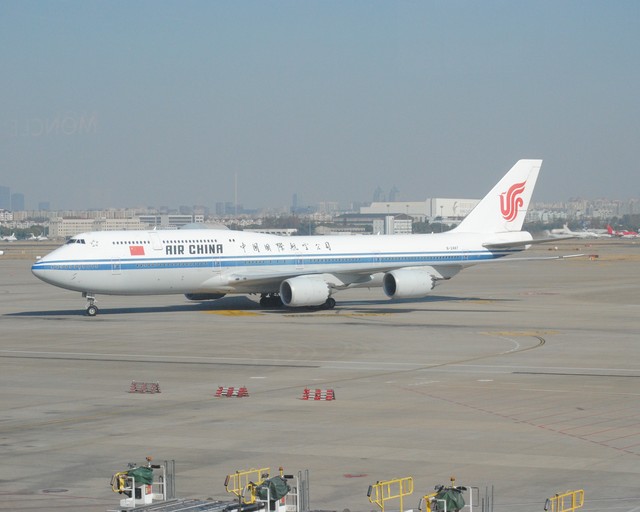
This set of 2 FRs presents remastered versions of FRs of Air China B748 domestic flights between Beijing Capital (PEK) and Shanghai Hongqiao (SHA) taken in November 2025. As I have grown in the quality of my FR, I decided that these FRs of rare Chinese B748s need an update with better-selected photosets and with the new data, actual for mid-2026. So, let's start again…
The Chinese Flag Carrier And Its Structure
Air China was formed from CAAC in 1988 (inheriting its IATA code CA) as the sole mainland Chinese airline. Since then mailand Chinese aviation has grown into the amazing diversity: the CN3 (CA, MU, CZ) plus a large variety of smaller Chinese carriers, and even the latter ones are usually quite impressive in terms of fleet size.
Nowadays CA is the official Chinese flag carrier and (with its 510-strong fleet) is the world's 10th-largest airline in terms of fleet size. For comparison, CZ is the 4th (being also the largest airline in Asia) and MU is the 6th by this metrics. Also worth noting that CA and MU are the 2 only Chinese airlines, serving all the 6 inhabited continents. As one can guess, South America is the most challenging continent for Chinese carriers due to its geography, and they found the solution in 1-stop direct flights: CA flies PEK-MAD-GRU and MU flies PVG-AKL-EZE.
Currently (mid-2026) CA has the next fleet structure (only passenger-configured aircrafts excluding the VIP ones):
B748 - 5 frames in passenger layout (3.5-class with F).
B744 - 2 frames (3-class with F).
B77W - 28 frames (20 are 3-class with F and 3-3-3 Y, 8 are 2-class).
B789 - 14 frames (2.5-class).
A359 - 28 frames (3-class).
A333 - 28 frames (2- and 2.5-class with very different cabins depending on the production year).
A332 - 15 frames (2-class with very different cabins depending on the production year).
A21N - 47 frames (2-class; the first 10 frames have the old door config, the rest are ACF ones).
A321 - 61 frames (2-class; only 8 are fitted with sharklets).
A20N - 53 frames (2-class).
A320 - 38 frames (2-class; 16 frames are fitted with sharklets).
A19N - 8 frames (2-class).
A319 - 17 frames (2-class; 3 frames are fitted with sharklets).
B7M8 - 31 frames (2-class).
B738 - 95 frames (2-class; 2 frames don't have winglets).
B737 - 14 frames (2-class; 4 frames don't have winglets).
C919 - 11 frames (2-class).
C909 - 35 frames (1-class).
As one can see, the current CA's fleet is a kind of avgeek paradise: B748s, B744s, B77Ws with 3-3-3 economy, pre-ACF A21Ns, A19Ns, B737s, C919s and C909s! Even CA's A333/A332 fleet is not that generic as one may think on the first glance (more on this further).
The Flagship Of Chinese Aviation. How To Fly Chinese Jumbos in Mid-2026
Since the pandemic demise (2022) of CZ A380s, CA's B748s (5 frames) are the largest passenger aircrafts in China and thus are the flagships of Chinese aviation. CA's B744s (2 frames) are the second-largest ones. Then we have a large pool of B77Ws: CA ones (28 frames), MU ones (20 frames) and CZ ones (15 ones). Quite impressive even for the country of the size and economical power of China!
CA has 5 passenger-configured B748s in 3.5-class F12_C54_Y+66_Y233 layout with very nonstandard location of F (more on this further), namely: 2014-built B-2485, B-2486, B-2487 and 2015-built B-2482 and B-2480. This makes CA's B748 fleet the world's second-youngest (after the KE B748 fleet, consisting of 4 2016-2017 last-built B748s) and second-largest (after LH B748 fleet, consisting of whopping 18 frames). Though, usually only 3 of 5 CA B748s are active at a time, which makes them the world's smallest active passenger B748 fleet.
The main purpose of CA B748 fleet is to serve 3 important international routes:
PEK-JFK-PEK (CA981/982): operates 5 times/week, departing PEK on Mondays, Wednesdays, Thursdays, Saturdays and Sundays.
PEK-IAD-PEK (CA817/818): operates 2 times/week, departing PEK on Tuesdays and Fridays.
PEK-FRA-PEK (CA965/CA966): operated by B748 3 times/week, departing PEK on Tuesdays, Fridays and Sundays; on Mondays and Saturdays (from PEK) these frequencies are operated by B77Ws (3-class).
For more than 1.5 years - from late June 2024 until late January 2026 - B748s were withdrawn from FRA flights (which were then operated exclusively by 3-class B77Ws) and their international operations were limited by JFK and IAD. This hiatus ended 27 January 2026 with the introduction of B748s on CA931/932 frequencies 3 times/week. Later B748s were switched to CA965/966 frequencies (also 3 times/week). Due to the 2026 Iran war that started in late February and subsequent Middle East crisis affecting ME3 carriers, CA decided to keep B748s on FRA flights indefinitely (the initial plan was to keep them on this route until the end of NS-2026 schedule) as the demand rose immediately and significantly. As one may guess, CA charges exorbitant prices for these flights, gaining profits from the current situation.
Worth noting that CA's IAD-PEK and JFK-PEK flights are currently the world's longest B747 flights both by distance and by flight time, with IAD-PEK being slighly longer than JFK-PEK (though, sometimes the latter may surpass the former by flight time depending on winds). The world's third-longest B747 flight is LH's HND-FRA (via so-called polar route), also operated by B748s. Formerly the world's longest B747 flight was KE's ATL-ICN on B748, but since late 2025 the 4 remaining KE B748s were switched exclusively to serve shorter LAX flights.
One can quite easily figure out that the current schedule of CA flights to JFK, IAD and FRA requires 3 B748s as a bare minimum, which coincides with the fact that usually exactly 3 frames are active at a time. Though, this schedule also leaves some room for domestic utilization of these B748s, and sometimes they can be deployed on some PEK-SHA-PEK rotations (thus making them the world's shortest B747 flights!), which pair well with the international schedule with enough turnaround time (in the recent past until the return of CA B748s to FRA flights, some rotations to CAN were also served by B748s, and more predictably than SHA rotations).
Though, one has to be aware that even if a certain PEK-SHA-PEK frequency has favorable conditions to be regarded with B748, it doesn't guarantee that B748 will actually be deployed. Air China is notoriously known for its nickname "Air Change", and even if a B748 is announced on PEK-SHA-PEK rotation, it can be swapped at the last moment to any other CA widebody, from B744 and B77W down to A332, or the flight can be simply cancelled (though, a cancellation gives a lot of flexibility to the passenger, allowing to rearrange the plans). One of the main reasons is that CA tries to save life of its B748s for long-haul flights and tends to underutilize them domestically.
Speaking of the old Jumbos, CA has 2 B744s: 1995-built B-2447 and 2000-built B-2472 in 3-class F10_C42_Y292 layout (also with very nonstandard location of F). The unique thing is that these venerable Jumbos are PW-powered ones and there're no another PW-powered passenger B744s left in the world in scheduled passenger service (Atlas Air in US also has 1 PW-powered passenger-configured B744s, but it serves only charter flights), so flying them is even more a treat than flying a B748! In 2011-2020 B-2472 served as the Chinese "Air Force One" until 2 VIP-configured B748s took over this role. These venerable Jumbos are put into passenger service very rarely and unpredictably and almost always serve only domestic flights - mostly to SHA, but in the past CAN and SZX were also happening. In May 2026 these B744s served ICN a couple of times.
My Game On CA Domestic B748 Flights And CA Beijing Office.
I visited China (Urumqi, Beijing and Shanghai) as a side trip from Kazakhstan in November 2025, making all the way from Kazakh-Chinese border to Beijing and back on the cheapest slow trains in sitting carriages (yes, it's crazy, but I managed to endure!).
Back then CA was putting B748s on certain PEK-SHA-PEK frequencies quite regularly (but surely with an element of unpredictability) and these flights were usually priced very reasonably. I booked RT ticket PEK-SHA-PEK (CA1557 on 22 November 2025 and CA1558 on 26 November 2026) 3 weeks in advance for just 1280 RMB (156 EUR) - the cheapest possible price to fly B748s twice! Moreover, this price was holding until up to few days before the departure date! Though, the reality brought some corrections to this plan.
In the evening of 20 November I checked CA app and discovered that CA1557 flight disappeared from the schedule on my planned date - 22 November! And yes - then I received an email, saying that this flight was cancelled. The CA system was proposing me an adjacent flight, operated by an A333, but this definitely was not a way to go. Since I had failed to create an account in CA website or app, I had to go to the CA office in Beijing to sort the things out.
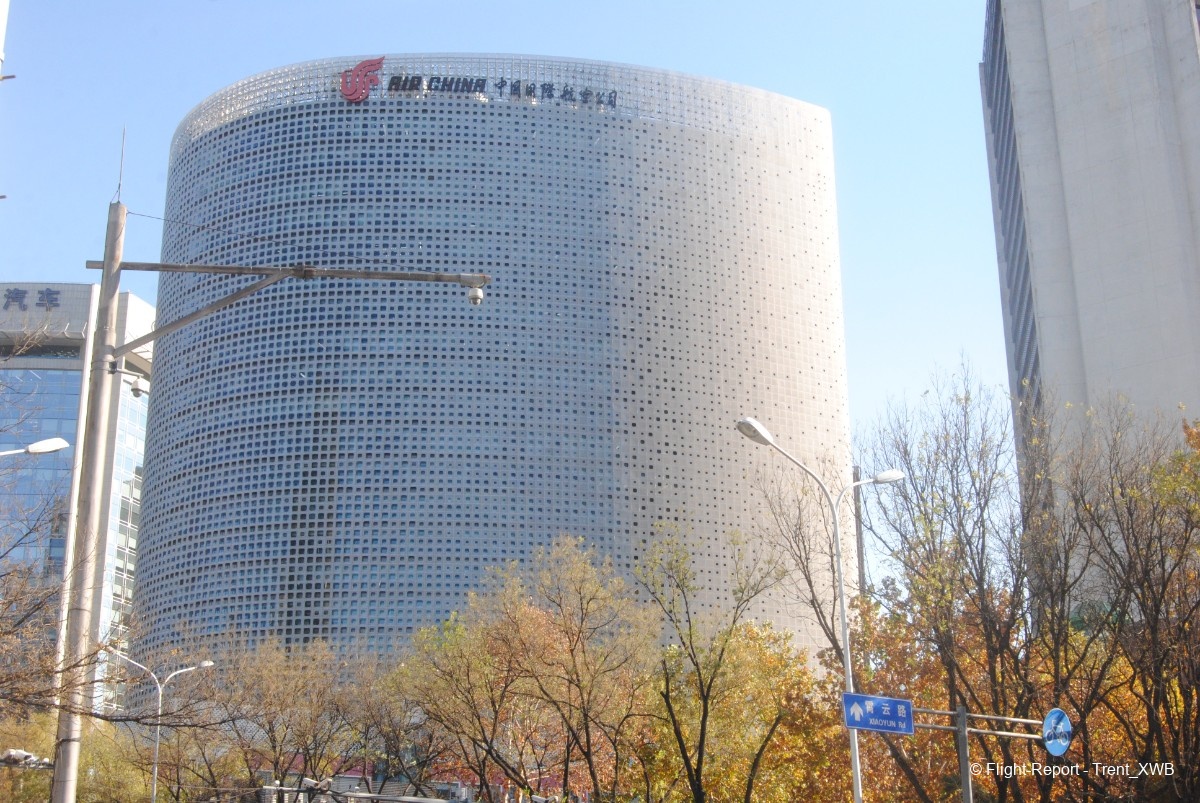
The office is located in Air China Century building near Liangmaqiao subway station.
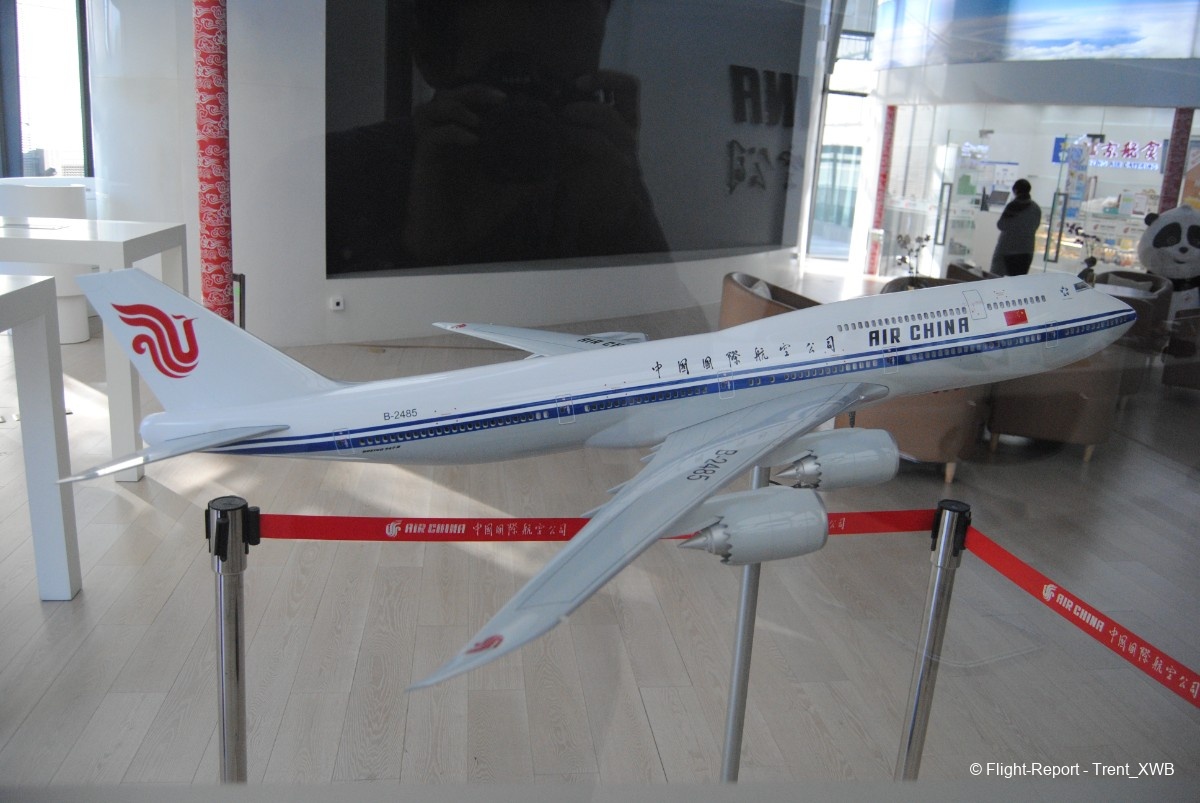
The CA ticketing office is located on the ground floor. The most remarkable thing there is a large model of the first CA B748 - B-2485 - with glass panels of the fuselage, showing the mock-ups of the cabins. Coincidentally, B-2485 was the aircraft I got on my new flight.
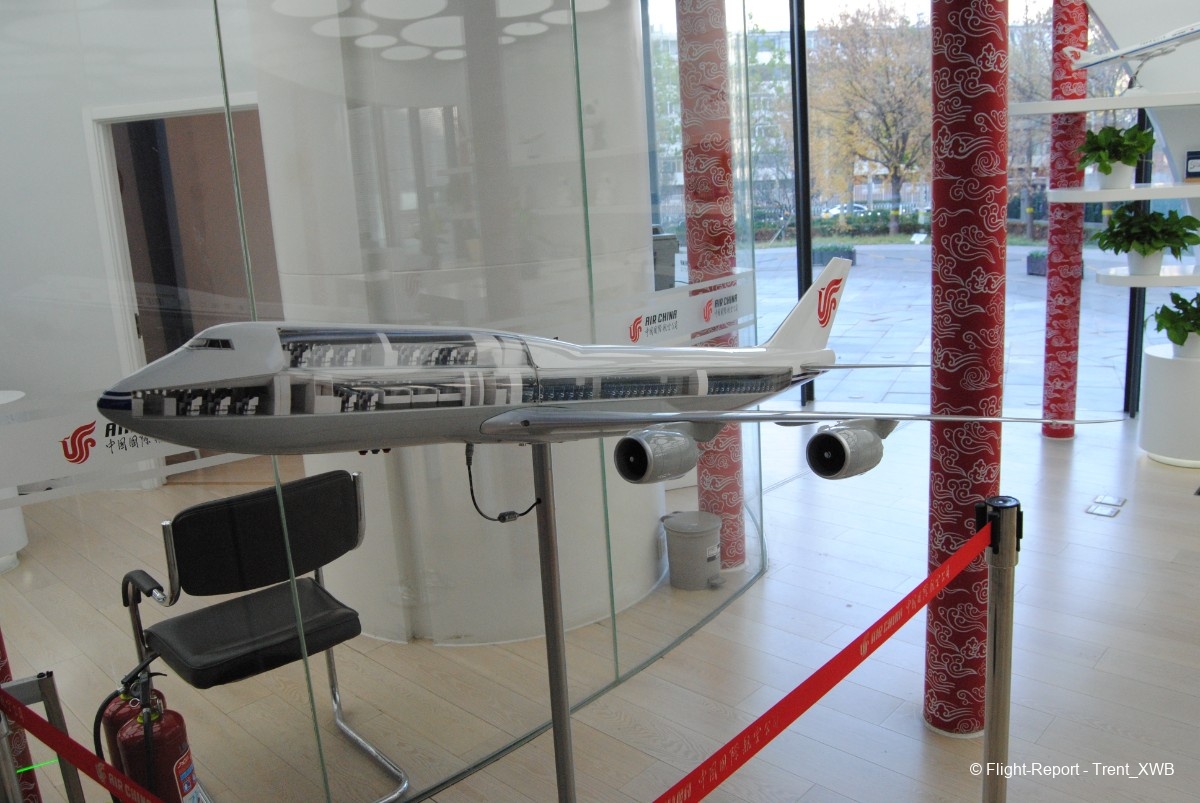
The staff of the office was extremely helpful. They told me that a cancellation of one of the flights in RT ticket gives a possibility to change both flights on any date and on any frequency for the ticketed route! After quite long consultation with my intuition I settled on CA1557 on 23 November and CA1558 on 26 November (deciding not to change the return flight). And this decision played out well. As the online check-in was already open for my new CA1557 flight, I was unable to choose a seat (CA website/app allows to choose a seat free of charge at any moment between the ticket purchase and the opening of online check-in, which is very generous by today's standards), but the girl very kindly checked me in via her app, allowing me to select a good seat among the available ones. Having the things sorted, I just enjoyed the remaining additional time in Beijing.
Beijing Capital Airport (PEK). T3C (Landside).
The Chinese capital has 2 major international airports: Capital (PEK) - the older one, located north-east from the city, and Daxing (PKX) - the newer one (with the terminal designed by famous Zaha Hadid), located to the south from the city, further than PEK. Both airports are connected with the city's vast subway network by the corresponding airport express train lines. Whereas the maximum fare for a ride within the city subway network doesn't exceed 10 RMB, the airport train ride fare is much steeper 25 RMB. There are also some bus routes, connecting the airports with the city, but they cost almost the same, and the train provides superior convenience.
As of 2025, PEK is the world's 15th-busies airport by passenger traffic (between CDG and SIN). PEK consists of 3 runways - 18L/36R (3801 m.), 18R/36L (3445 m.) and 01/19 (3810 m.) - and of (formally) 2 terminals: T2 and T3, the latter is the home for almost all CA flights out of Beijing (CA also gradually opens some destinations out of PKX) and the former is the home for the rest airlines, serving PEK.
T3, which was designed by Foster and partners architect bureau and finished in 2008, actually consists of 3 large piers (making it one of the largest airport terminals in the world) :
T3C houses airport train station, international, domestic and Hong Kong / Macao / Taiwan arrivals, check-in hall and domestic pier for mid-size widebody and narrowbody flights.
T3D houses domestic pier for widebody flights (usually operated by CA's largest widebodies like B748, B744, B77W).
T3E houses international flights and flights to Hong Kong, Macao and Taiwan (in the next FR I'll say a bit about the CA fleet operating flights to Taiwan).
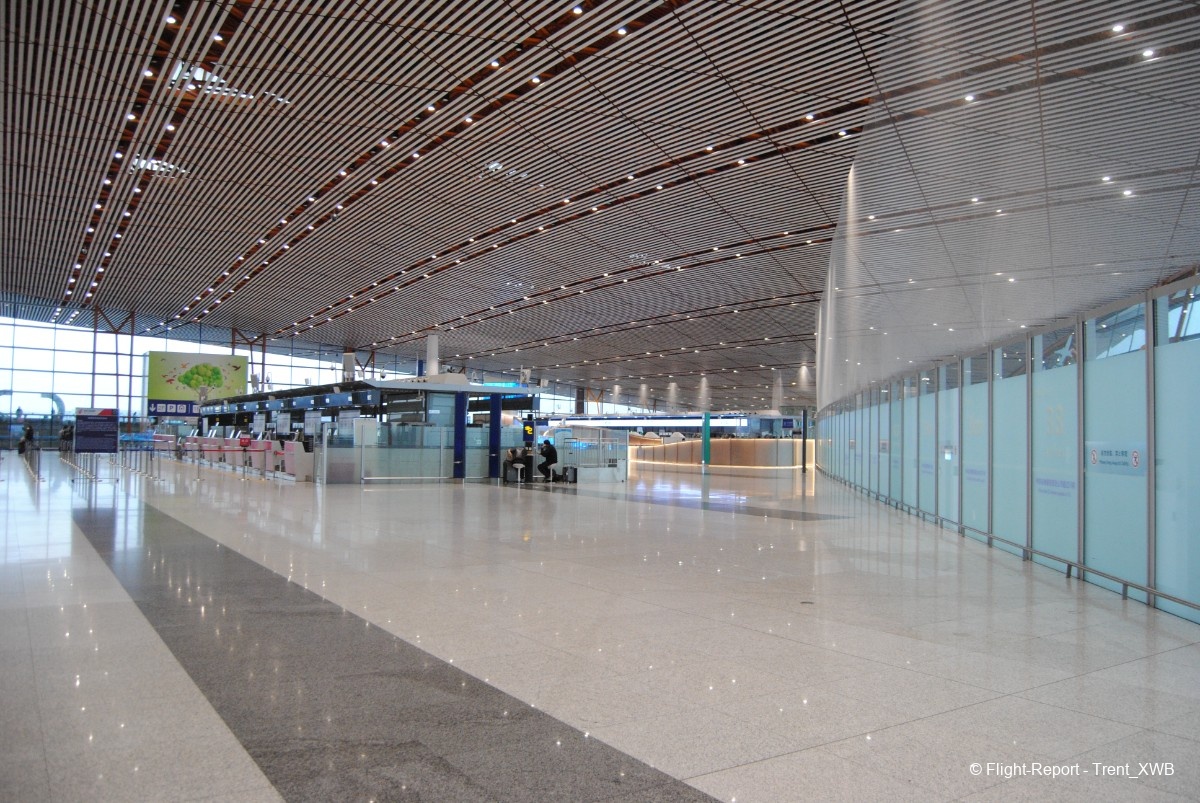
Upon entering T3C check-in hall from the T3's train station, one finds oneself under a wave-like roof with a lot of space and natural light (when the daylight comes). In the centre of the hall one can see an installation with a reminder of the age of PRC and a large FID, showing, how busy PEK is. The CA domestic counters (CA domestic service for the trunk routes to SHA, CAN, etc is calles "Express Line") are always busy.
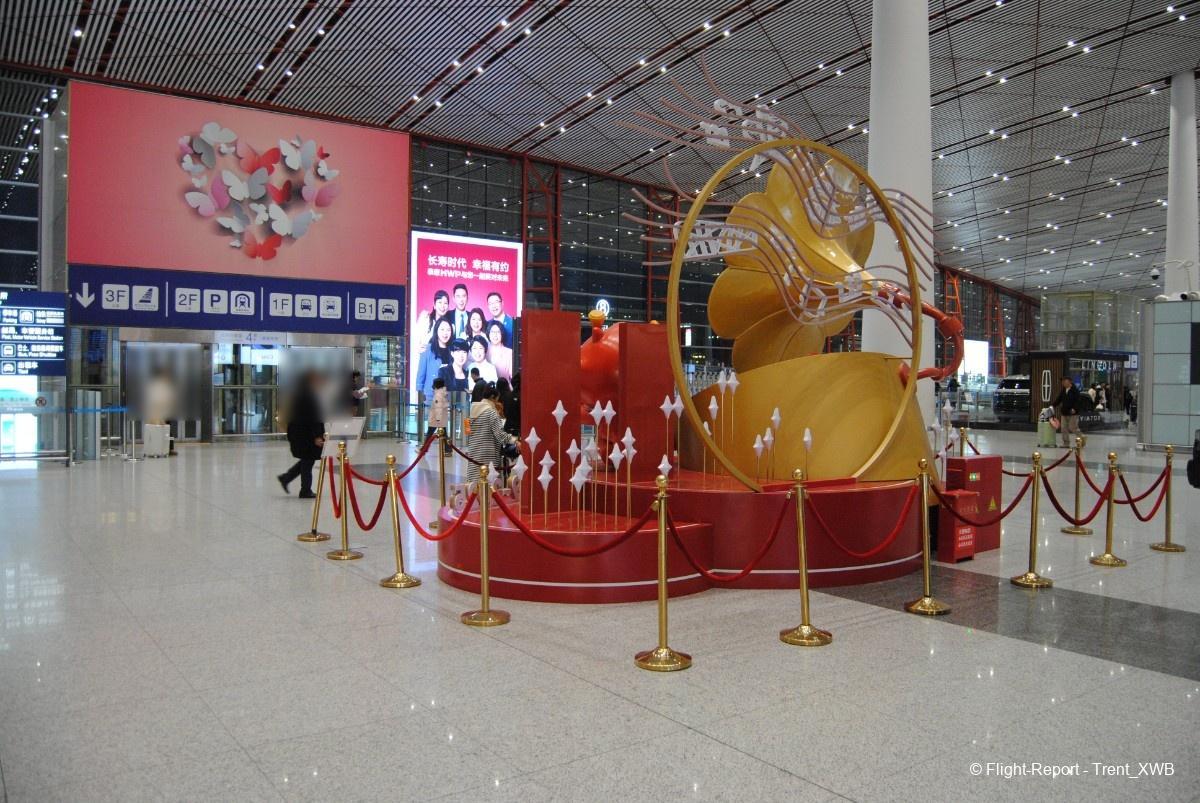
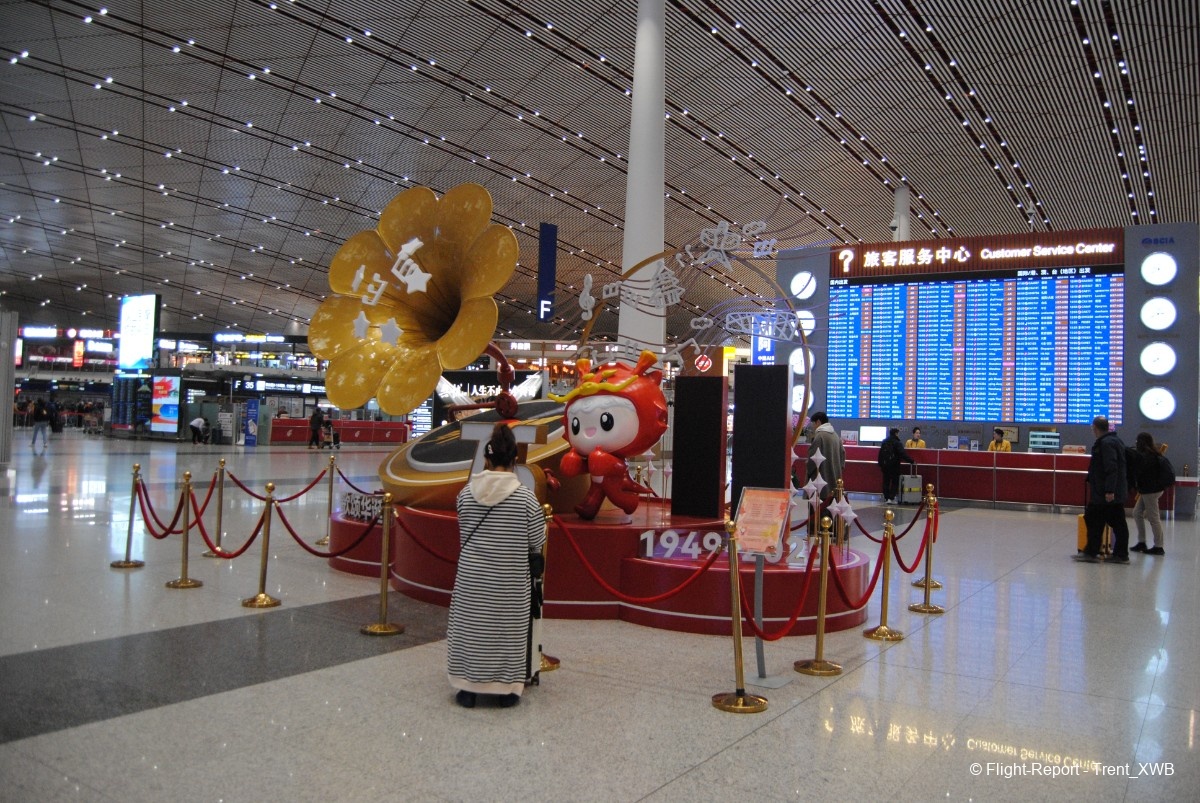
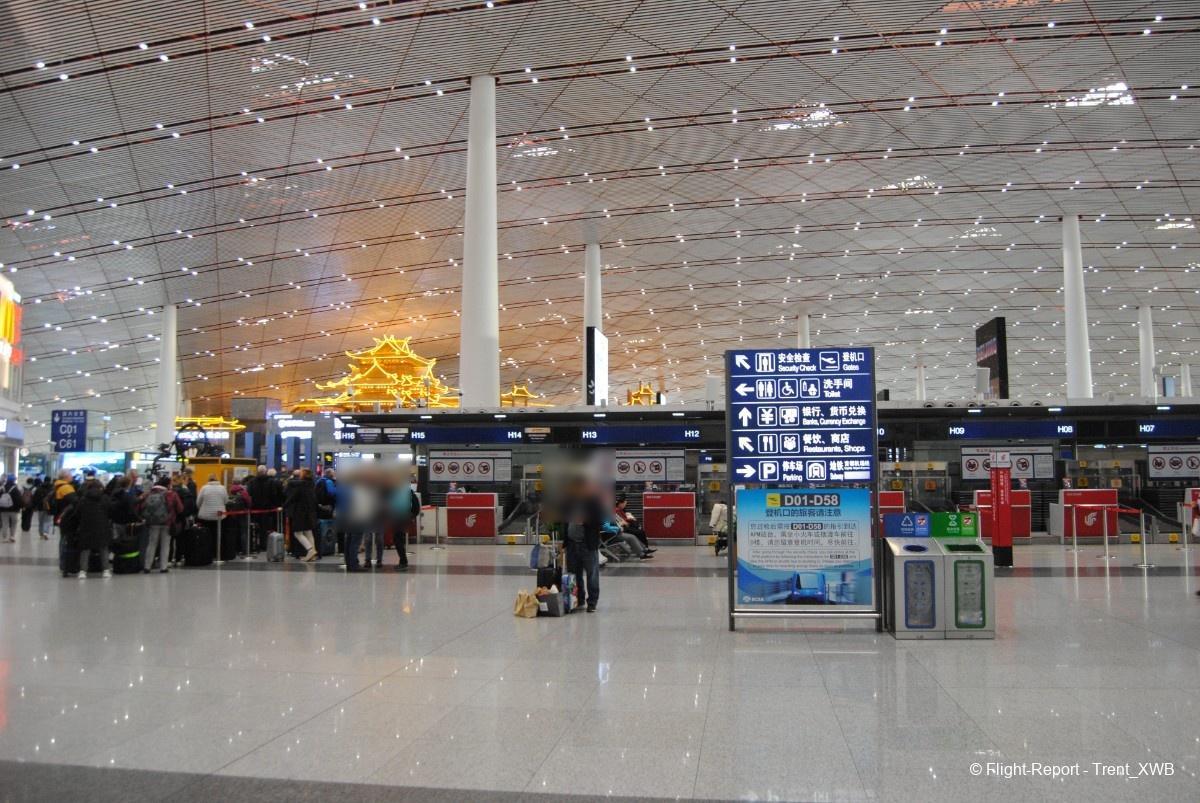
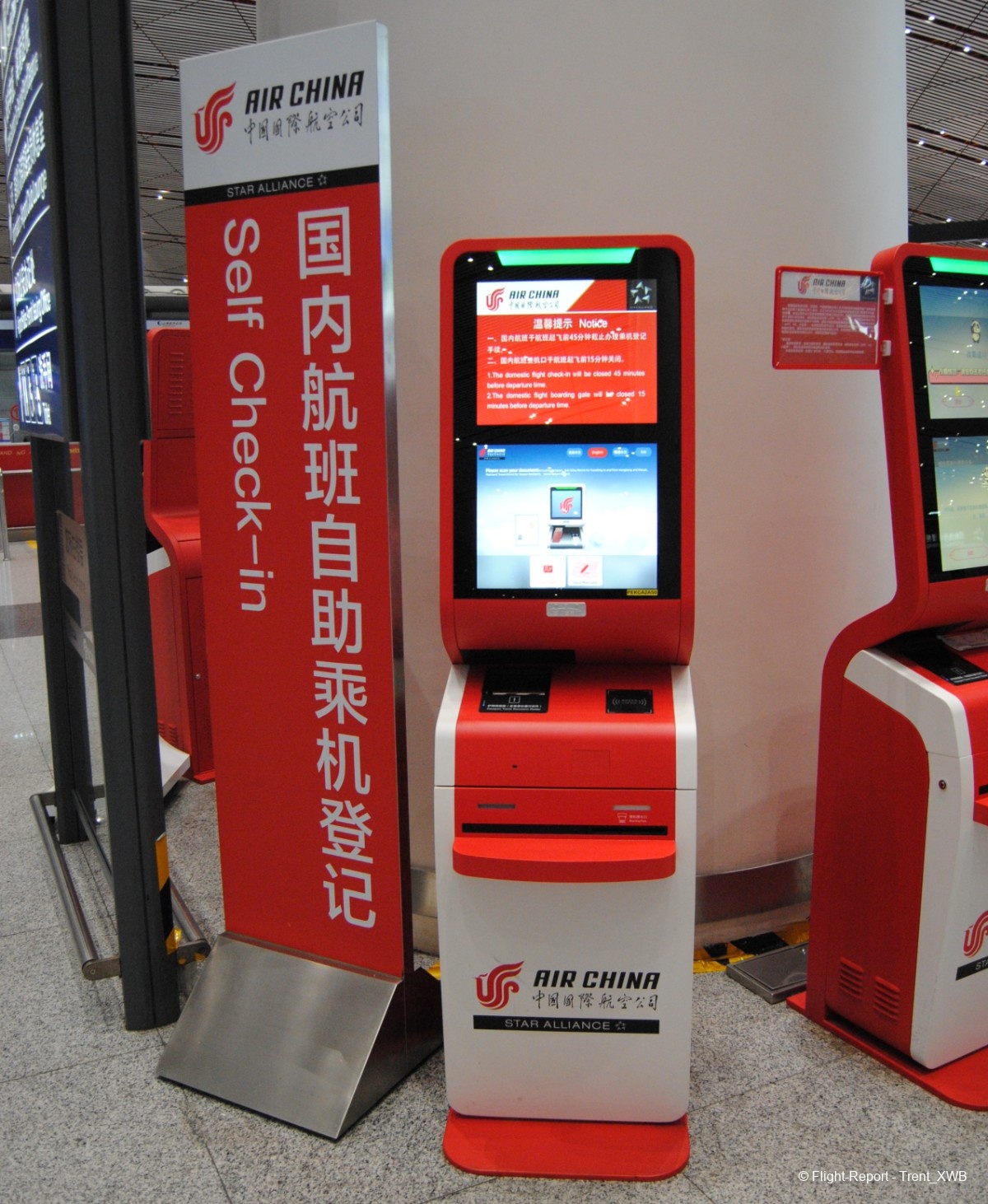
CA self-check-in machines.
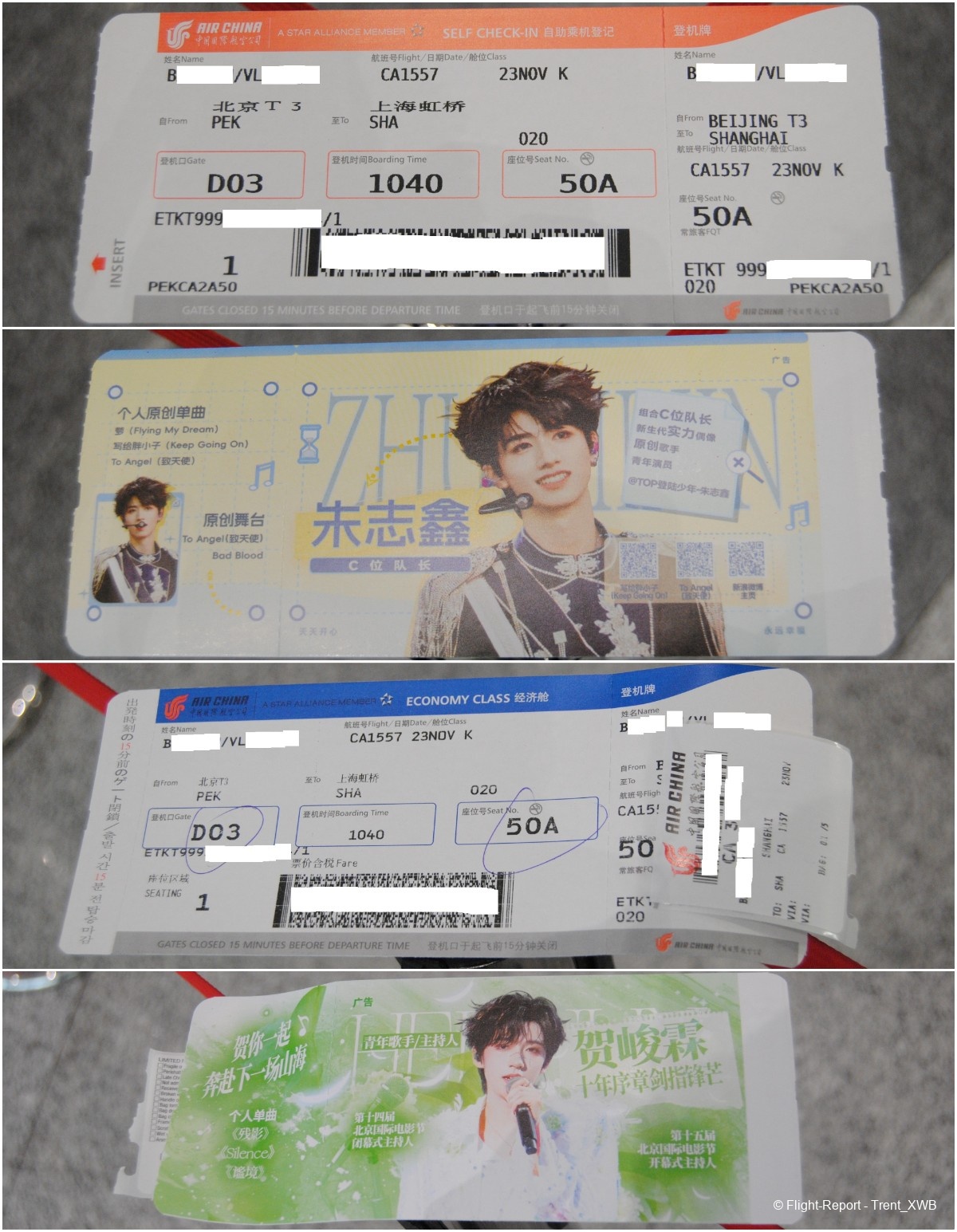
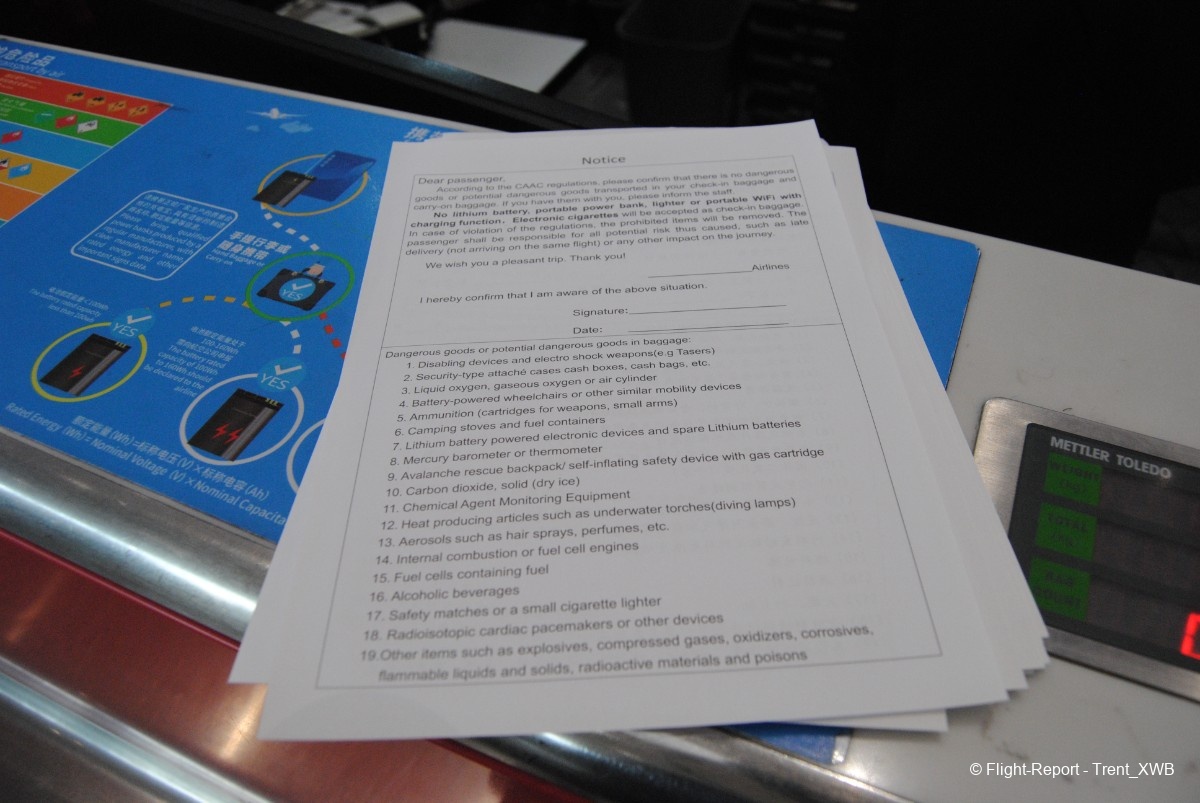
As I was already checked in, I printed my BP (note how beautiful is the blank!), but then decided to check my backpack (taking the deviced out to the little light backpack) to lower the pressure on my back. I came to a CA Express Line counter, got another BP on another (also beautiful) blank and discovered that one has to sign a declaration about the luggage. For me it was OK as I had nothing extraordinary with me, but I recommend to read its text carefully to avoid unpleasant surprises.
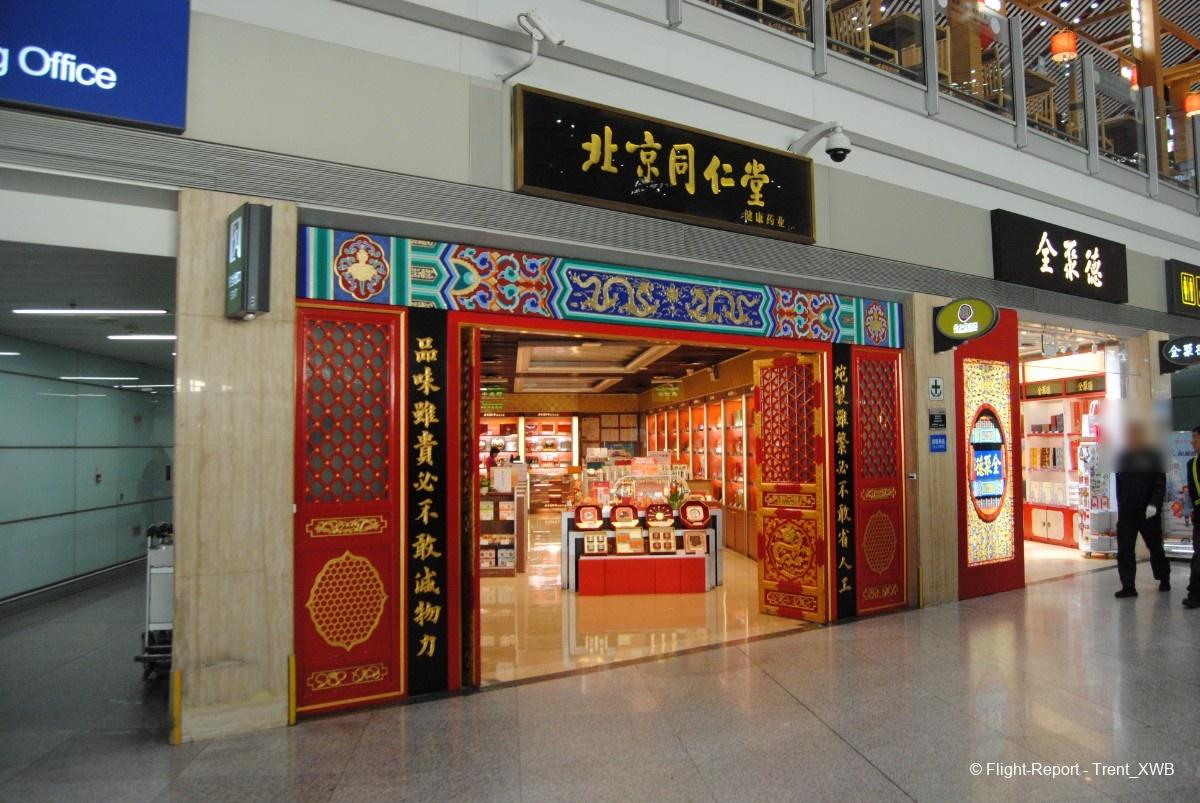
The shopping area of T3C's check-in hall is very interesting. A couple of examples: a vending machine with toys…
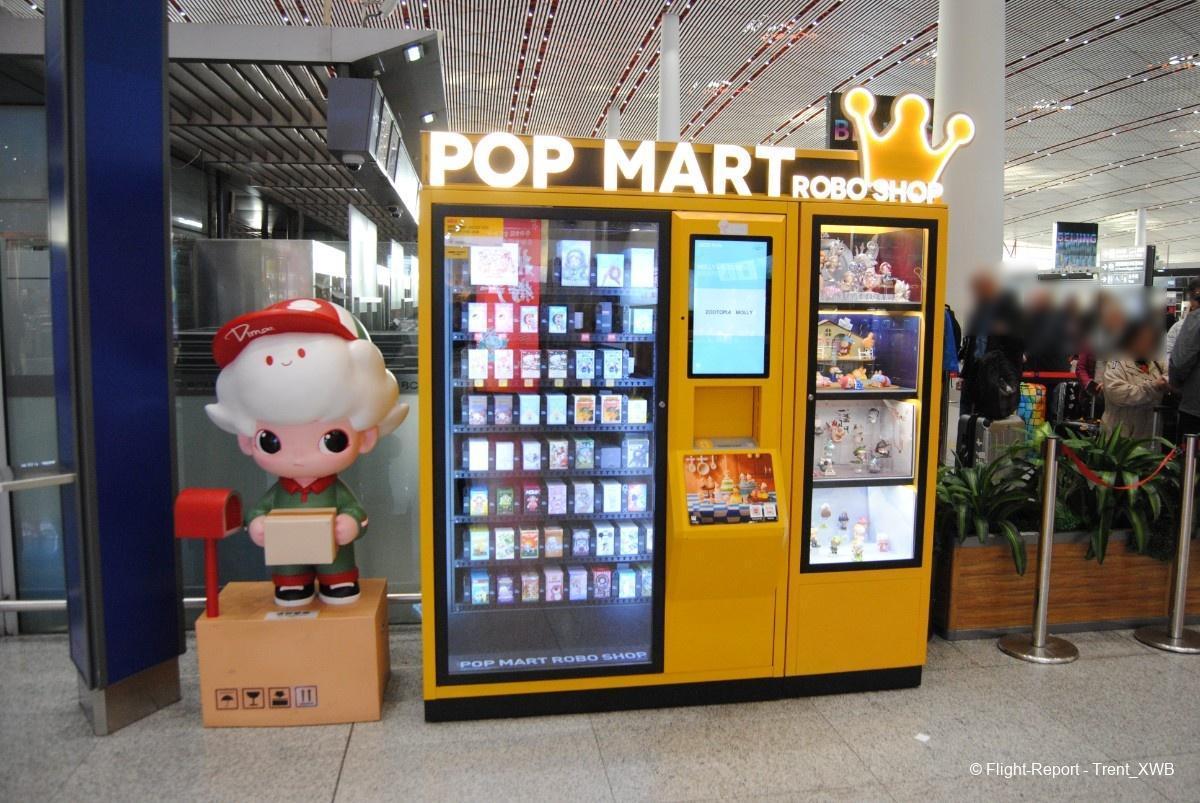
… and a golden jewelry shop.
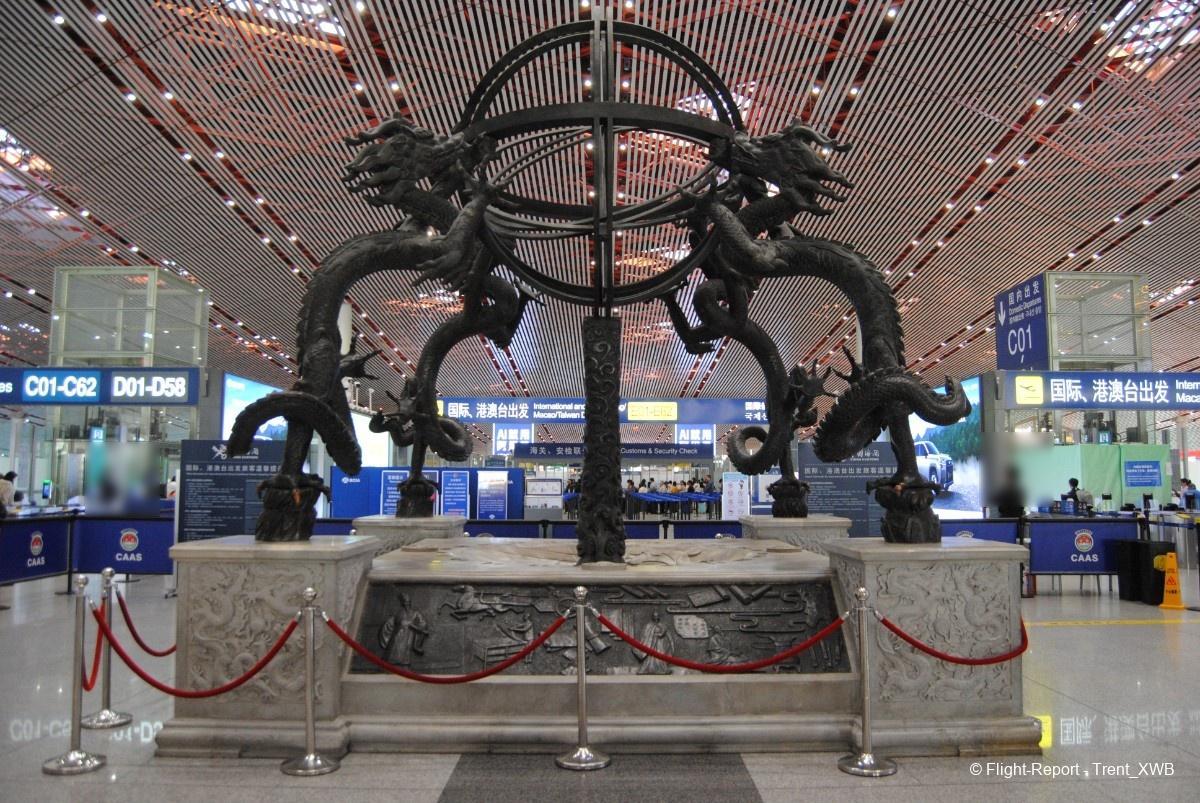
A sculpture with dragons near the entrance to the security.
PEK T3C (Airside)
As one can see from this map, T3C has kind of Y-shape (gates C01-C37), where the lower part of "Y" is forked (gates C09-C18 and C19-C30), encompassing the railway of the shuttle train to T3D and T3E. Taking into account that T3C's area is really large and that my flight was departing from T3D, I decided to explore only a part of T3C to save time.
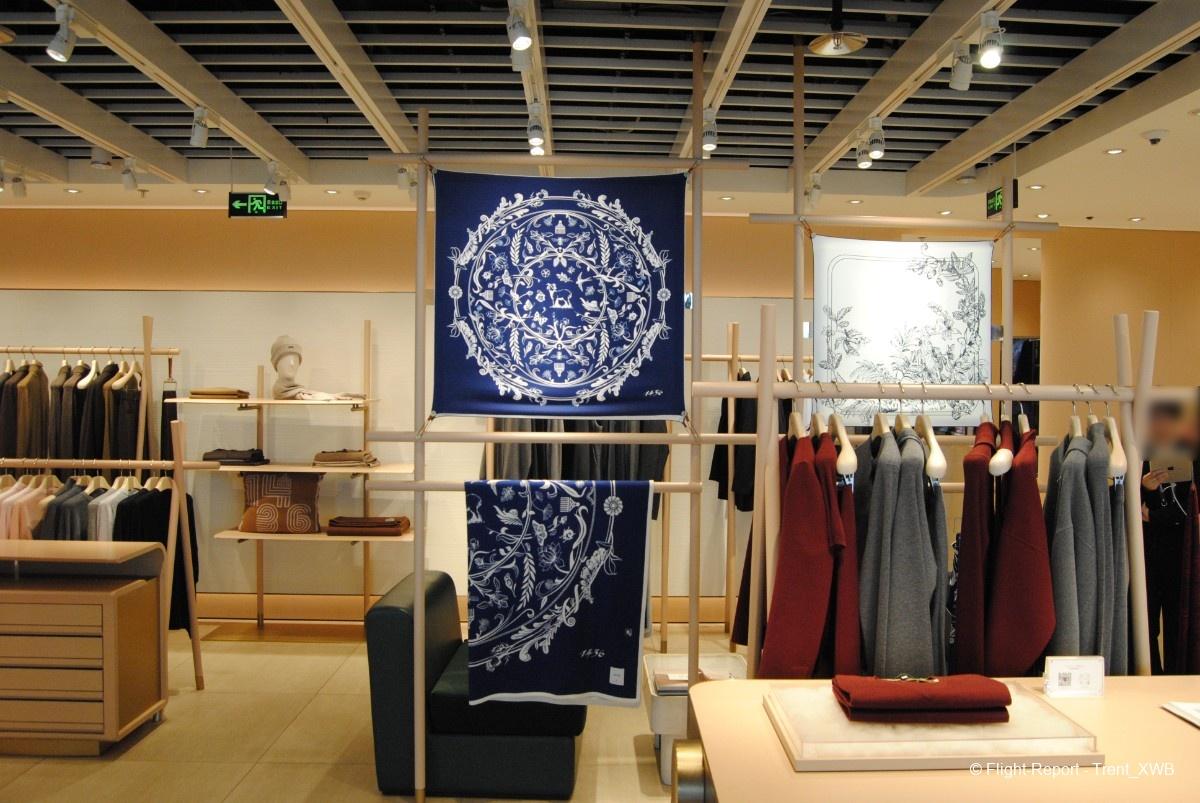
A beautiful clothing shop after the security.
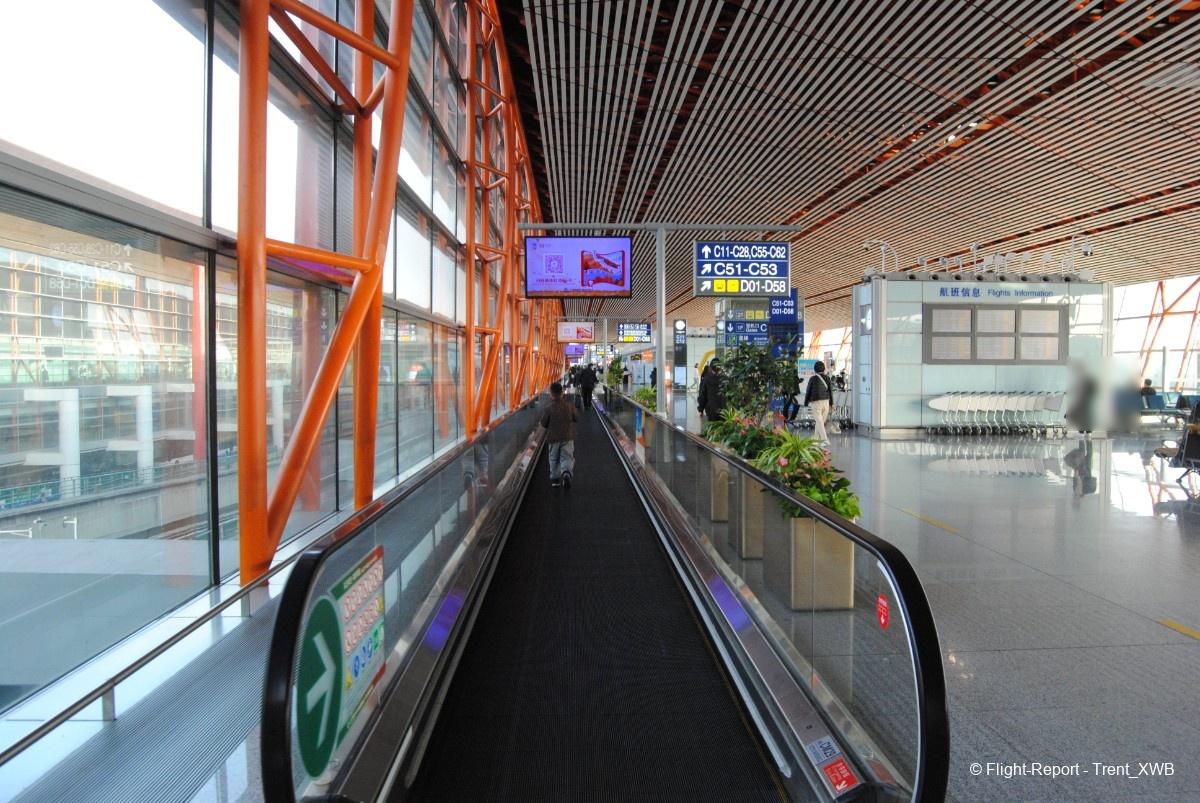
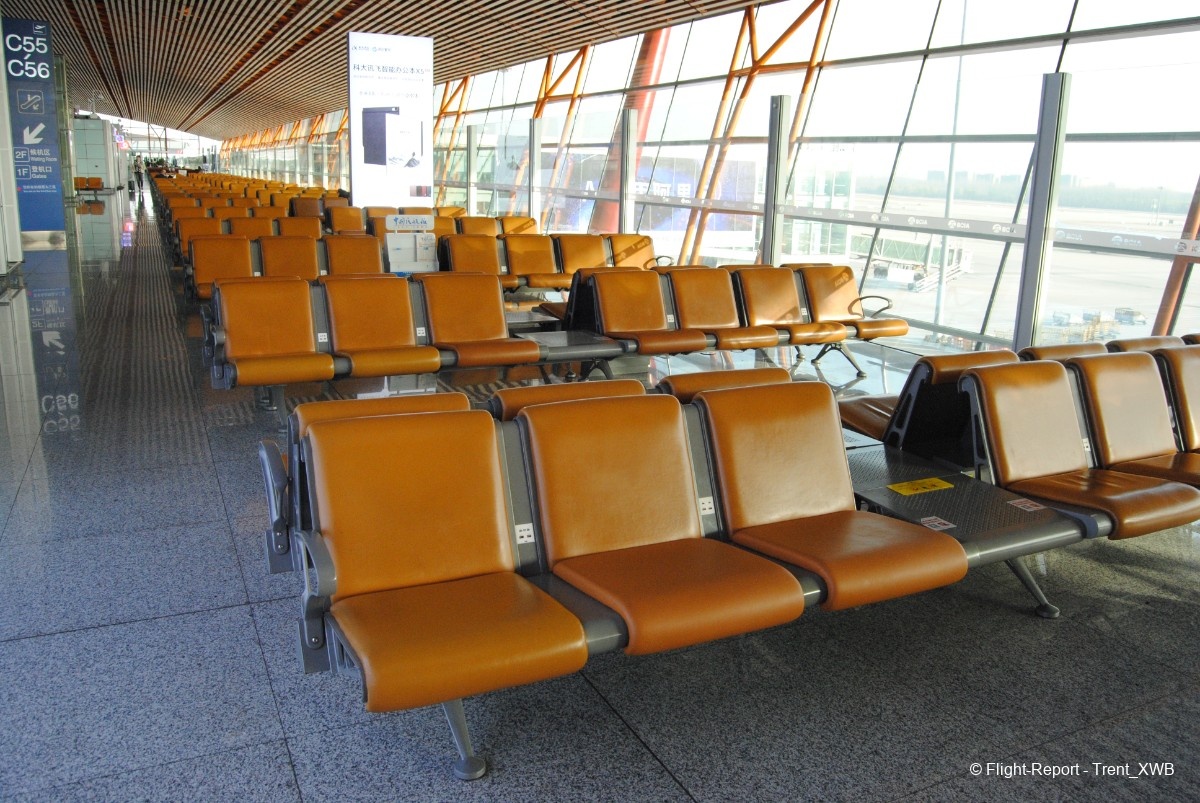
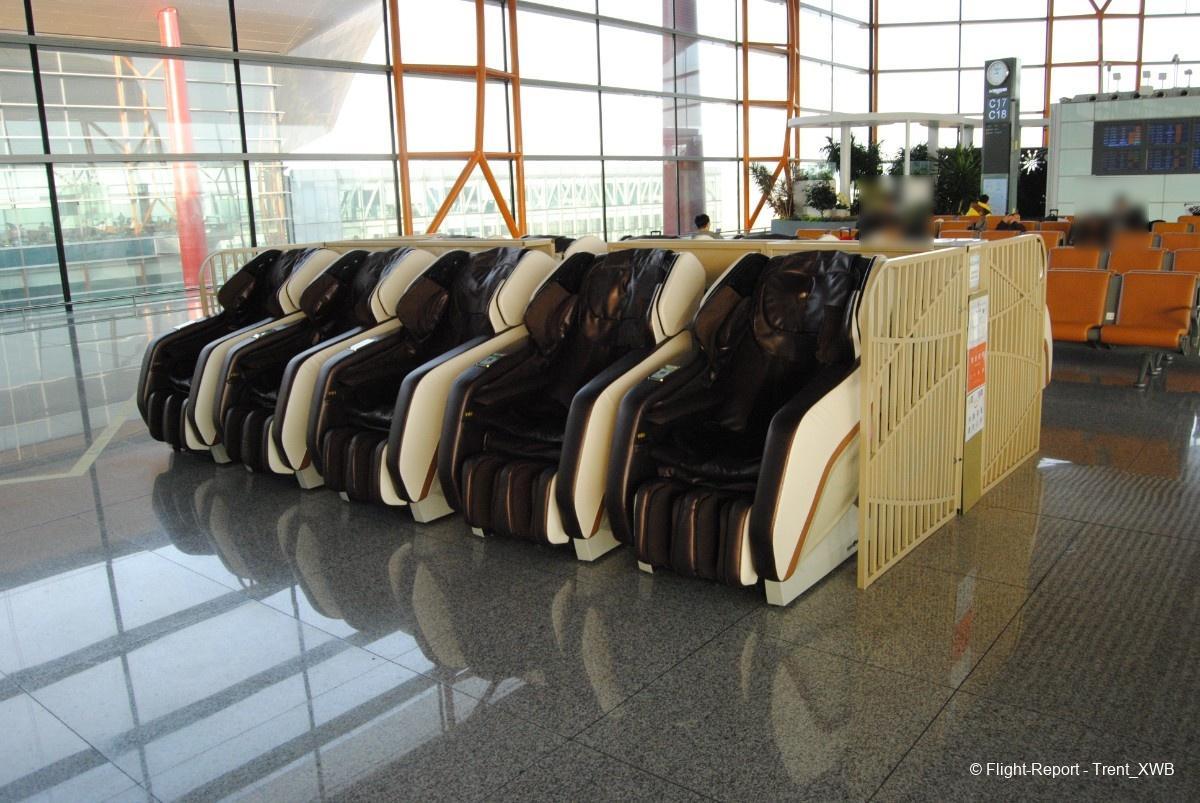
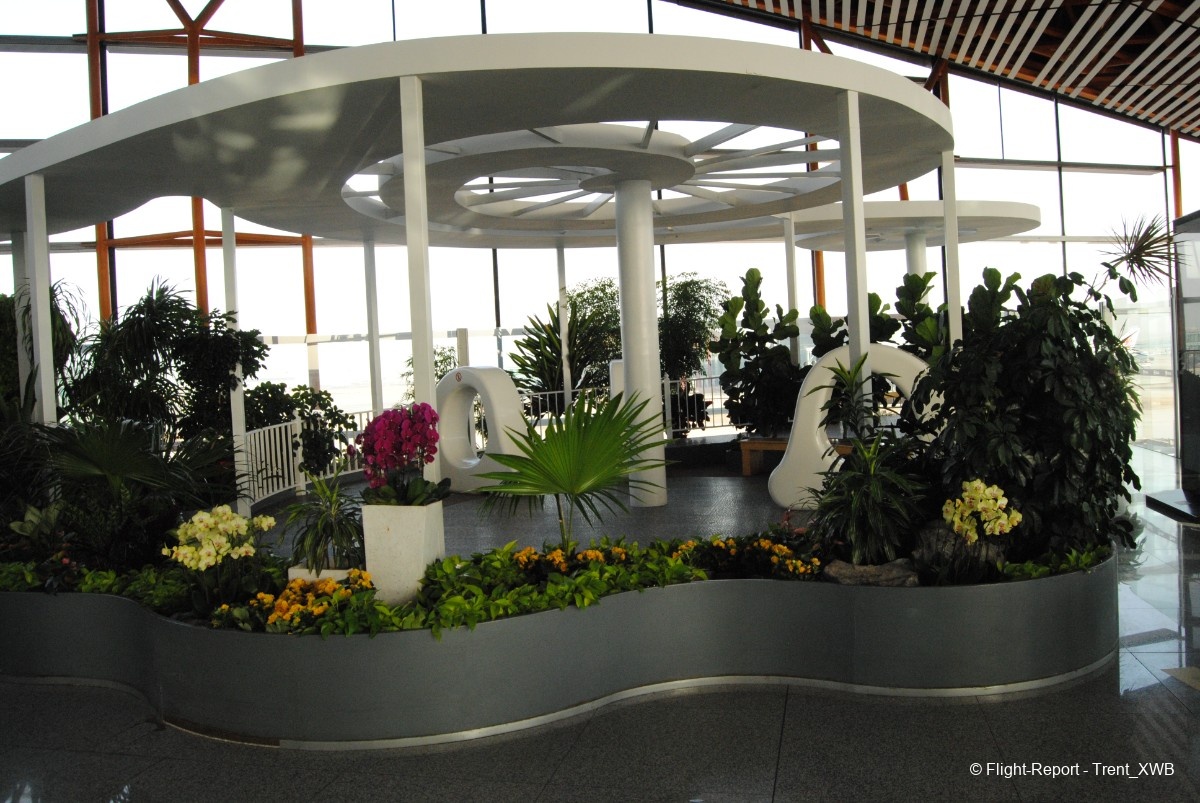
This is how the "fork" part of T3C looks like. These piers (C09-C18 and C19-C30) are rather narrow (photo 1) and have a connection in their middle parts (gates with C50+ numbers are the underlying bus-type ones). In the most part of the fork the planespotting possibilities are limited due to the lack of direct access to the windows (photo 2). Only the far ends (photos 3, 4), where kind of "relax areas" are arranged, have unrestricted access to the windows. On the plus side this part of T3C has high ceilings and a lot of natural light.
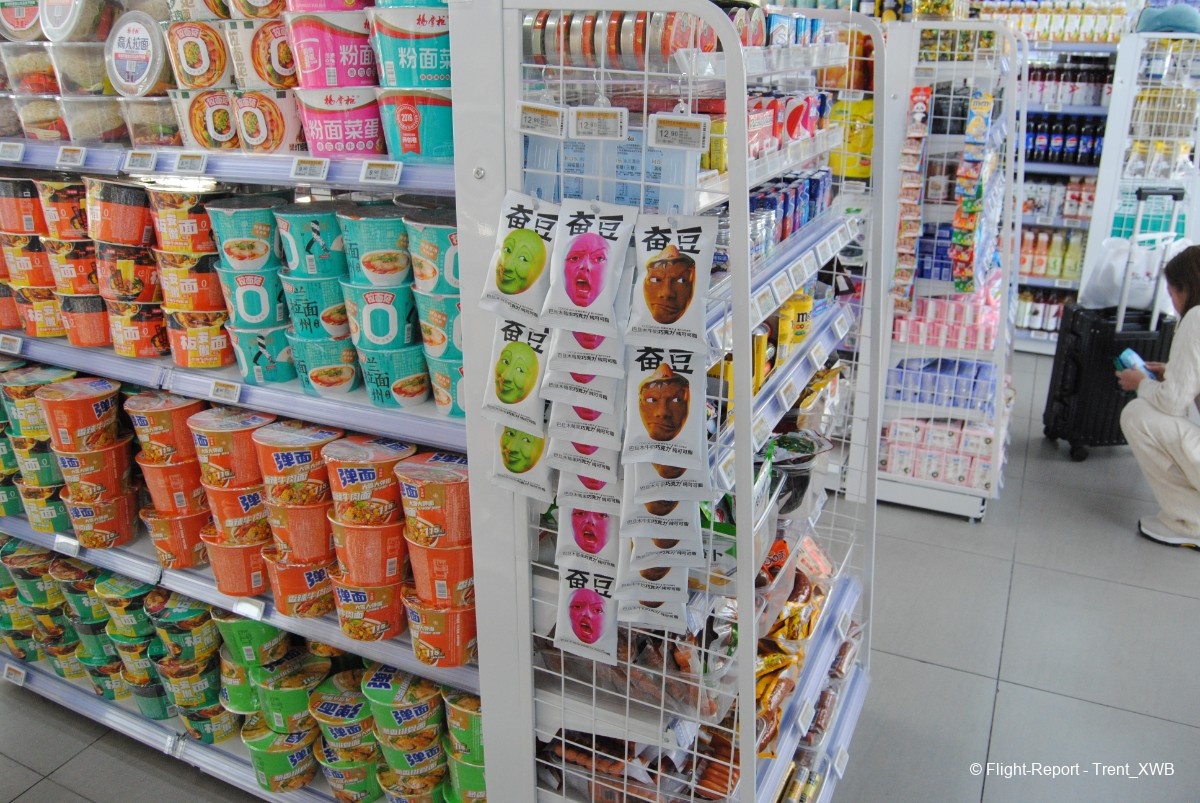
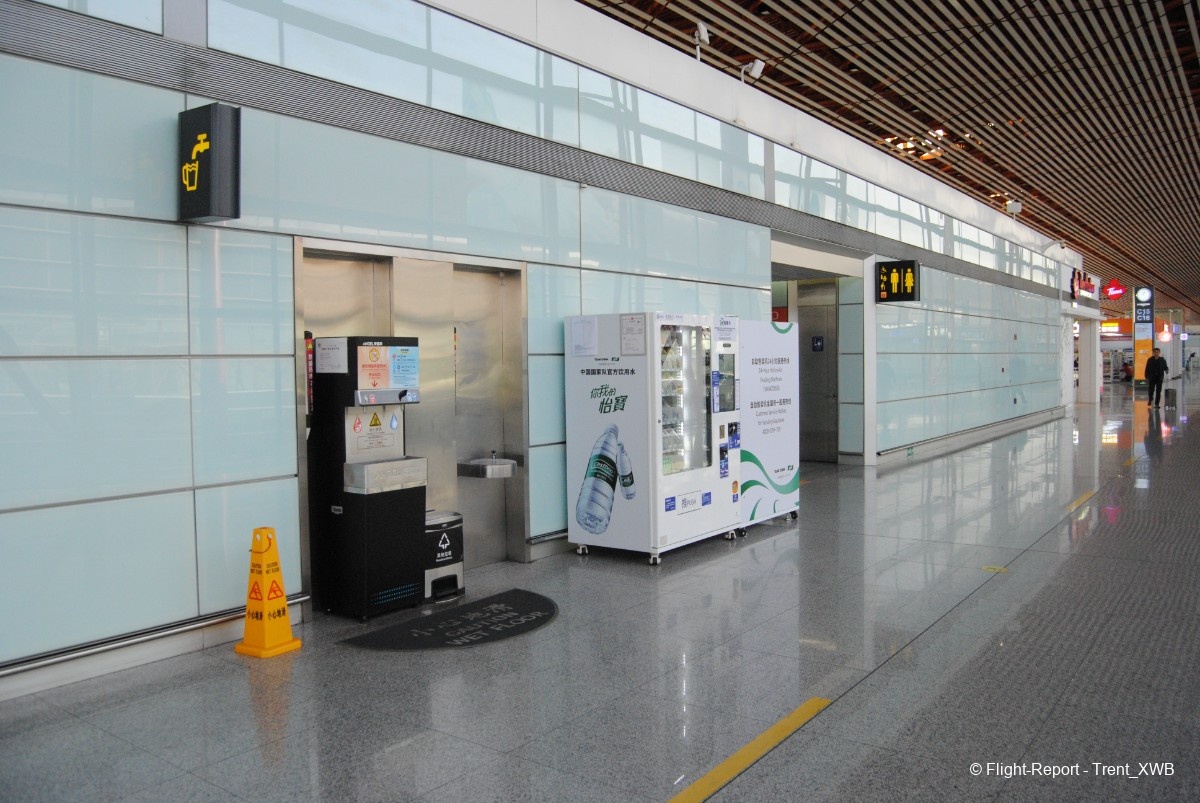
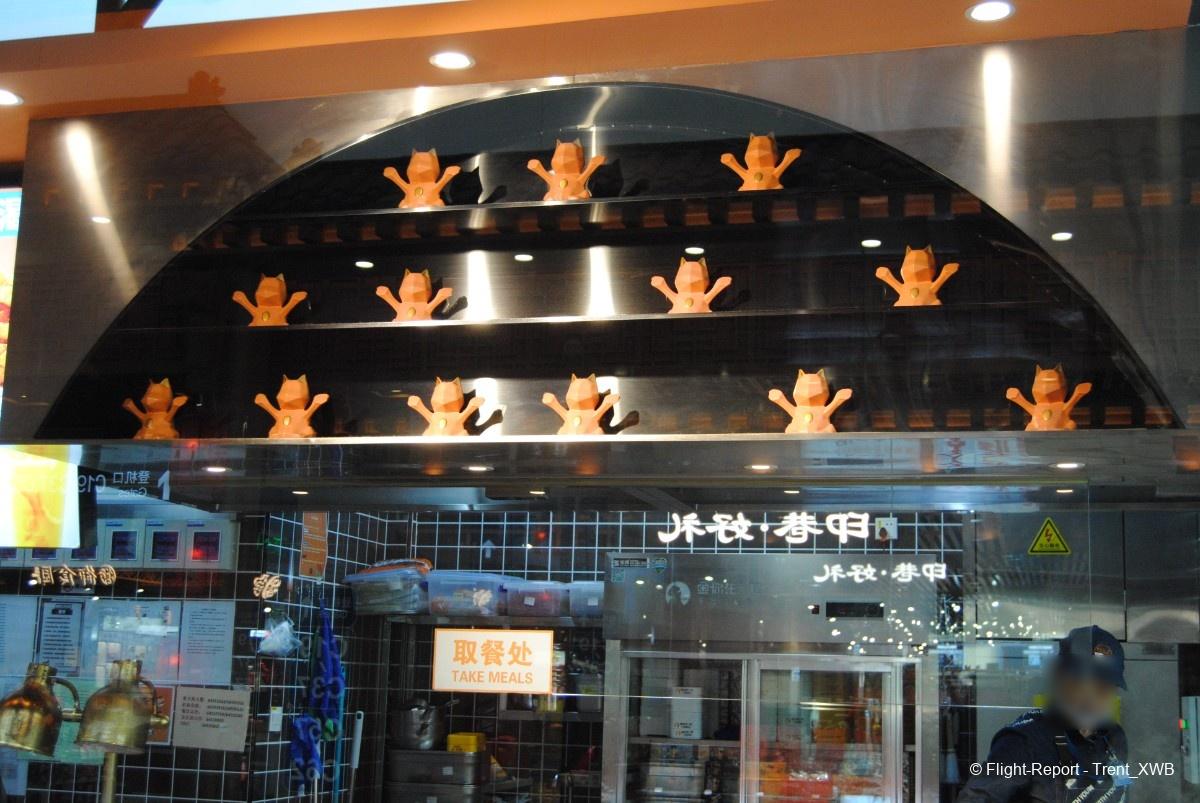
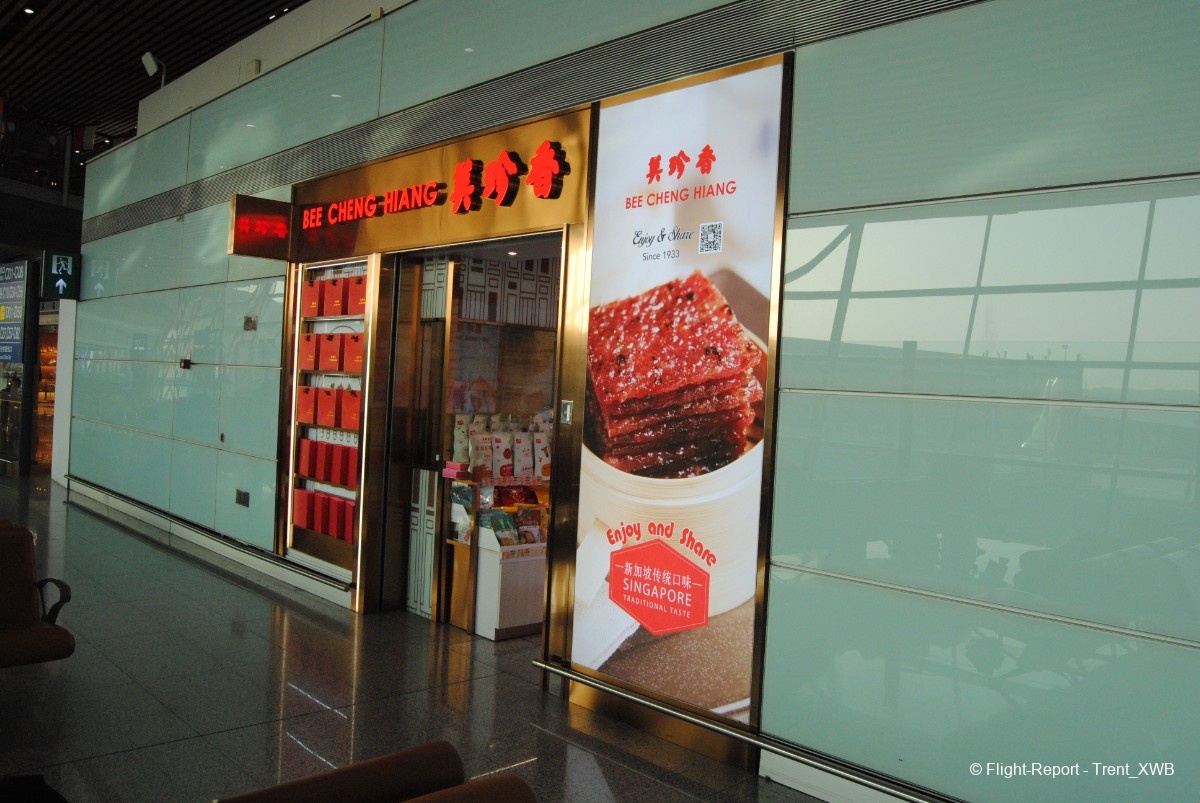
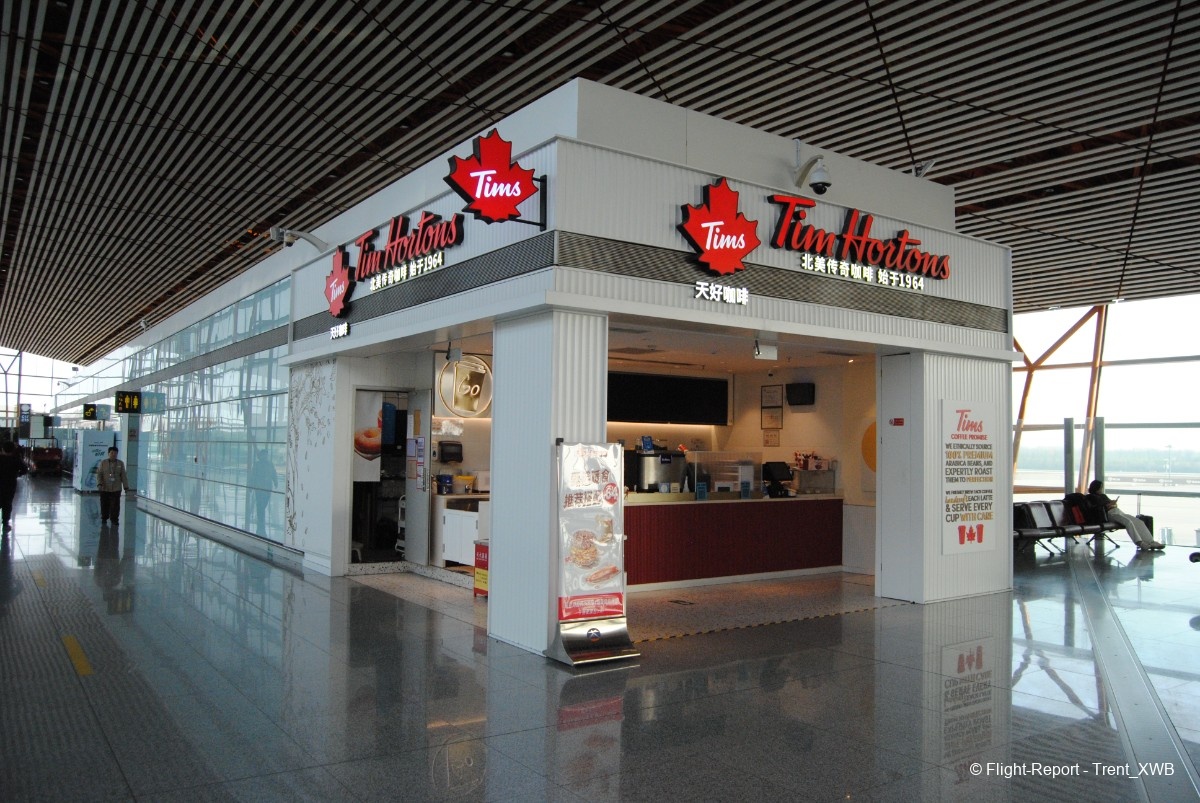
Considering food facilities, T3C has a lot to offer: from noodles from conbini, which you can immediately boil using the free of charge water dispenser (one can find these dispensers in any Chinese airport or major railway station), to more elite stores and eateries. Even Tim Hortons (Canadian cafe franchise) can be found here!
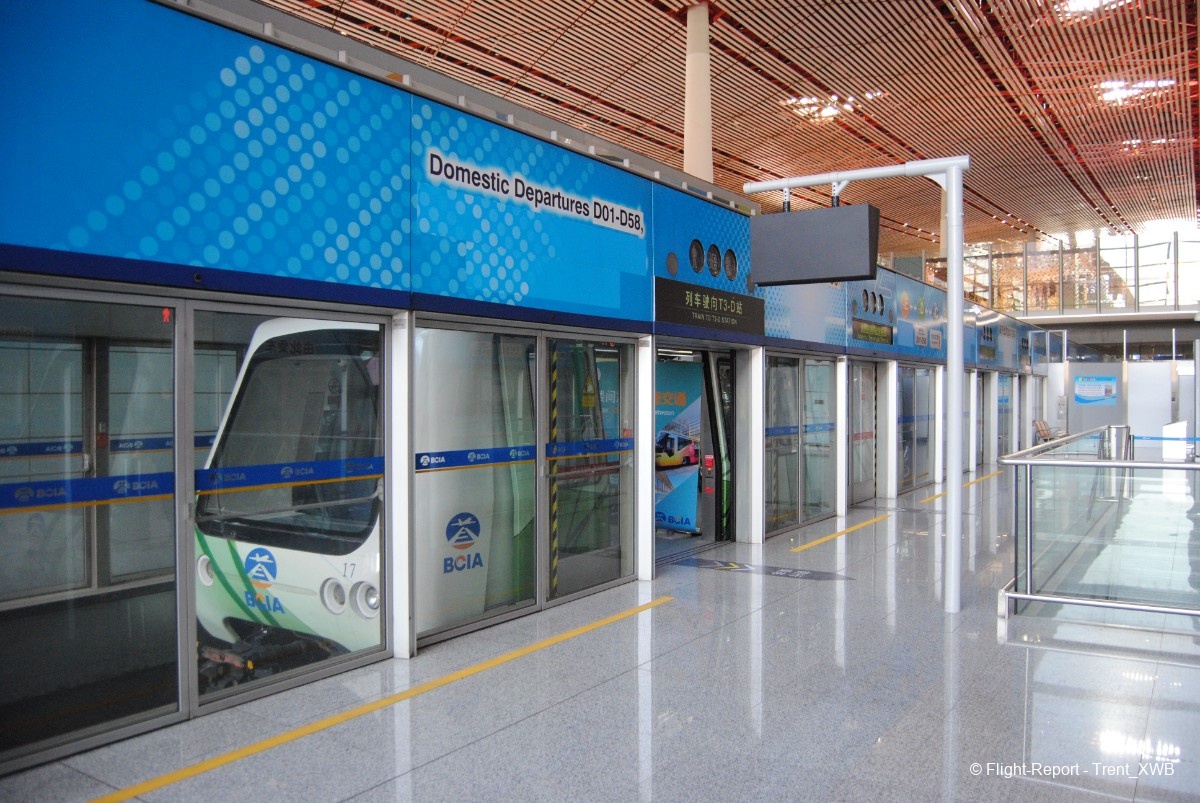
To move from T3C to T3D or T3E, one has to take the shuttle train, whose station is located one level down where the "fork" joins "V" (near gates C09 and C30).
Planespotting from T3C
As I said earlier, the best points for planespotting are located in the far ends of the "fork". Though, if one have a telelens, one can make satisfactory shots even from the areas without direct window access. The most part of the traffic seen from here consists of various CA planes.
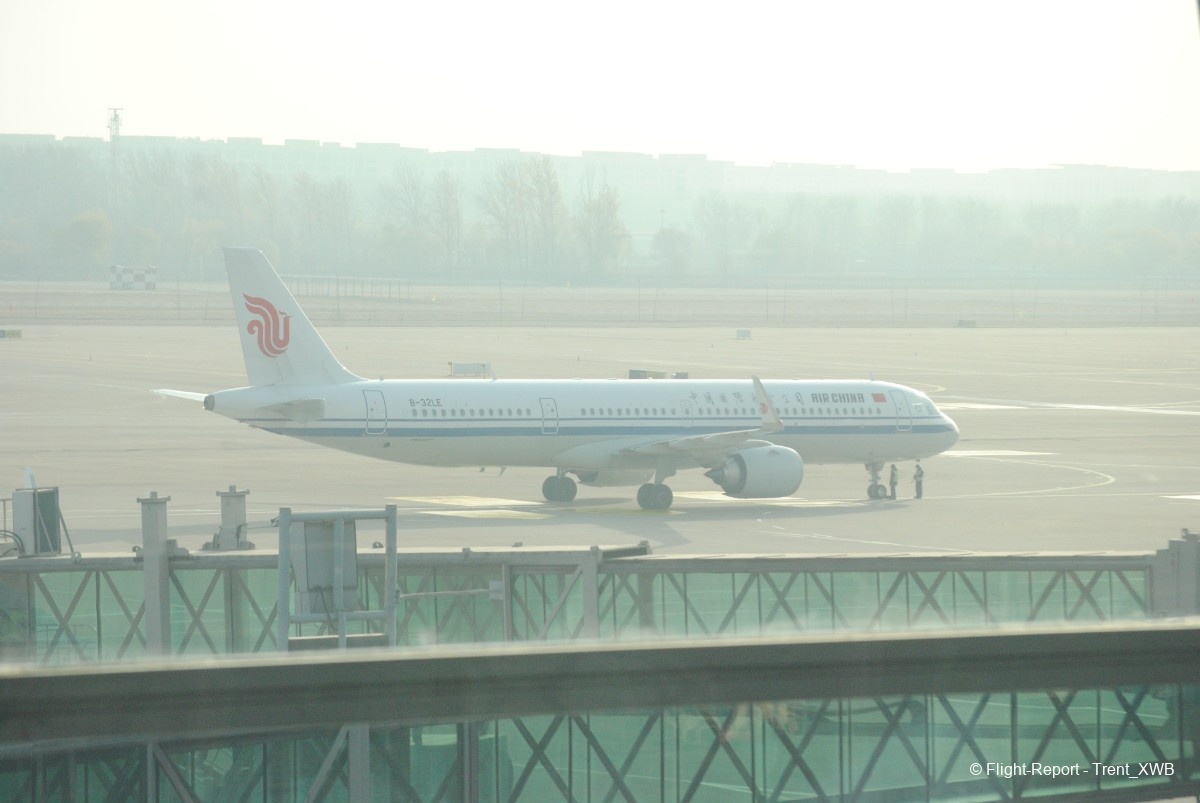
CA A21N (B-32LE) with ACF (the most common) door config - one of newest CA's A21Ns for that moment (delivered in August 2025). These A21Ns have 2-class C12_Y186 layout with Collins MiQ seats (similar to the popular premium economy model for widebodies) in business and Collins Pinnacle seats in economy. Both C and Y seat models are very comfortable.
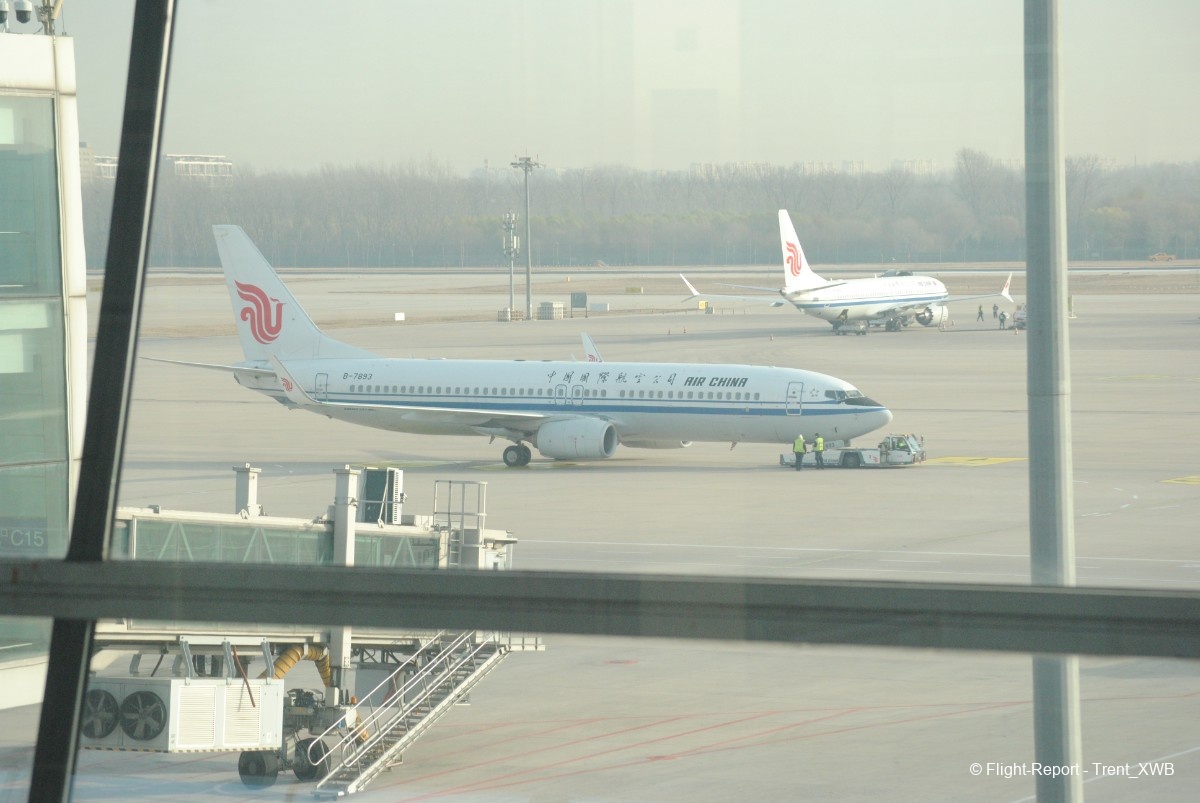
One of CA's latest B738s (B-7893) and a CA B7M8. The former has 2-class C8_Y168 layout (there are 3 different layouts for CA B738s depending on the production year); the latter has similar C8_Y168 layout as well as all the other CA B7M8s.
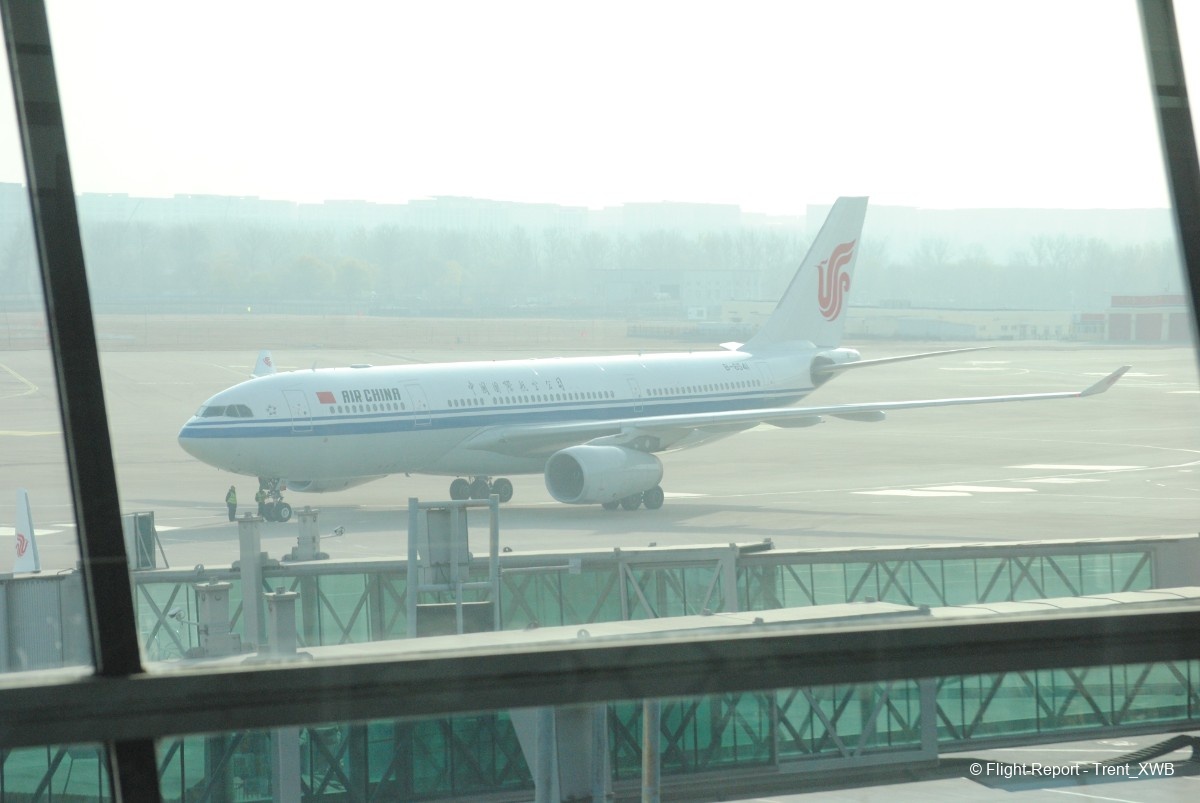
2012-built CA A332 (B-6541) with C18_Y247 layout with Zodiac Aura Lite seats in business and Weber 5751 (early production years) seats in economy (similar to the ones in 3-class CA B77Ws). CA has 8 2012-2013-built A332s with this layout, and beside some domestic flights, these planes operate some long-haul flights with relatively small demand. These 8 A332s are definitely the most comfortable CA A330s in economy. One has to be aware that CA also have 3 2006-2007-built A332 with C12_Y271 layout (with Recaro CL6510 recliner seats in business and Sicma Airgonomic seats in economy) and 4 2008-built A332 with C30_Y207 layout (with Zodiac Aura Lite seats in business and Sicma Airgonomic seats in economy). In terms of comfort all these 7 older A332 are inferior in economy, as Sicma Airgonomic seats are quite poorly designed, and the 3 oldest A332 are also inferior in business (worth noting that these 3 frames are allowed for Taiwan flights as they don't have PRC flag on the fuselage; one can also remember an example of KLM Asia livery which was set up for a number of KL B777s to allow flights from the Netherlands to Taiwan without disputing with mainland China). All the CA A332s are RR-powered.
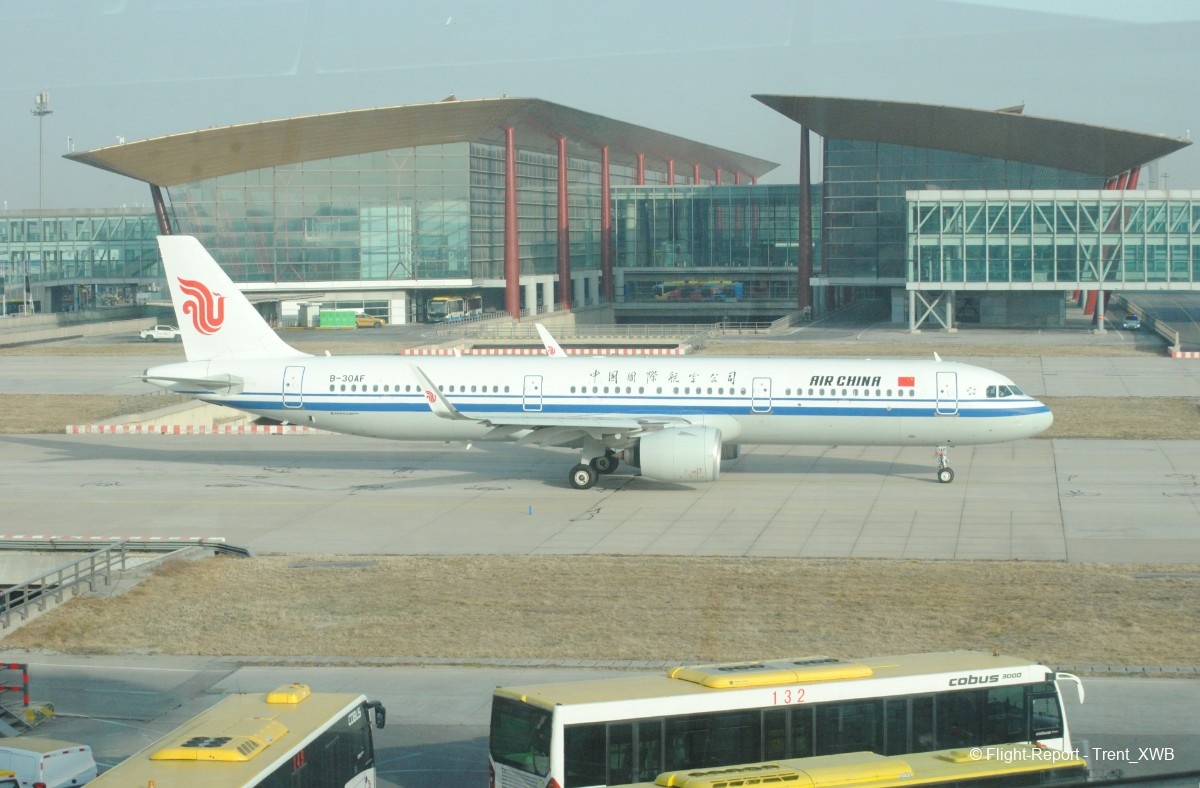
CA A21N (B-30AF) with the old (pre-ACF) door config with C12_Y182 layout, taxiing past T3D. CA has 10 of these 2018-2020-built pre-ACF A21Ns. These A21Ns feature the same comfortable Collins MiQ recliners in business and Collins Pinnacle seats in economy as their newer ACF siblings. Worth noting that the operators of the last-built (2021) pre-ACF A21Ns are ANA in Japan and Sichuan Airlines in China. The production of pre-ACF A21Ns ended simultaneously with the A321SL production in December 2021 and since then all the produced A21Ns are only ACF ones.
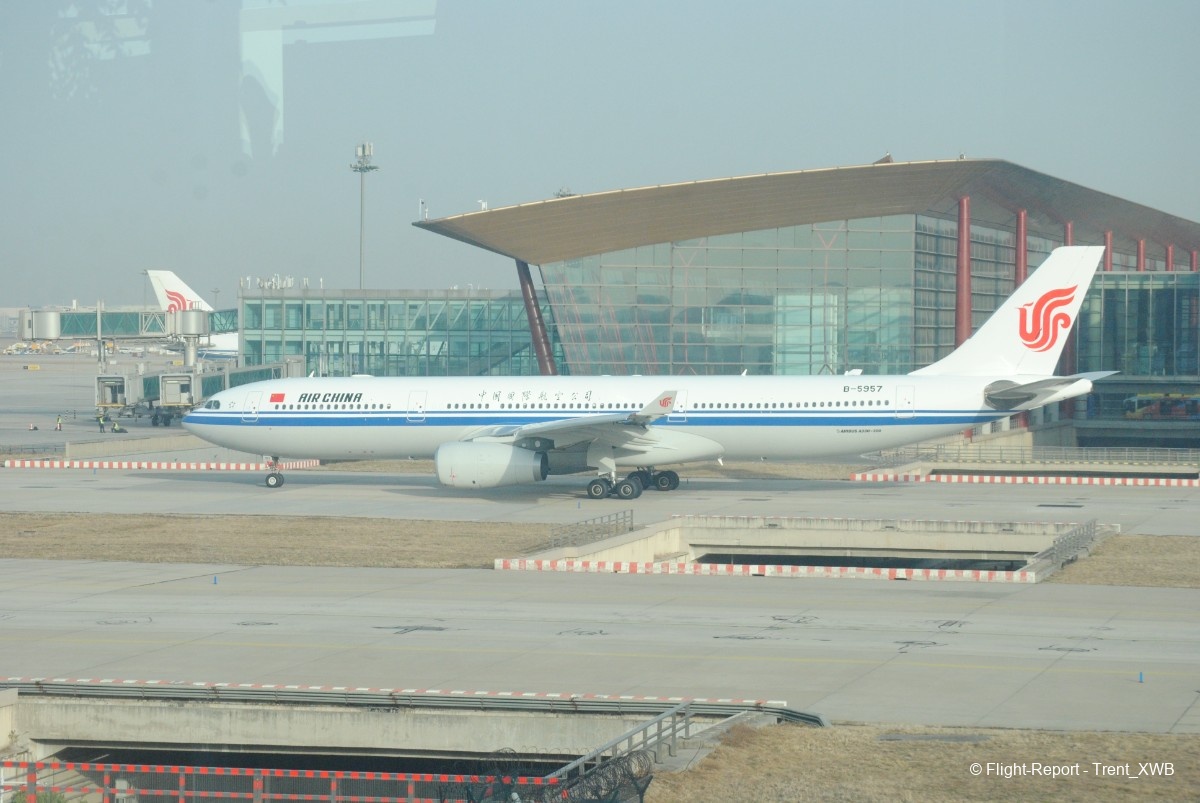
CA A333 (B-5957) in 2.5-class C30_Y+16_Y255 layout, taxiing past T3D. CA has 22 2012-2017-built A333s with this layout, featuring Zodiac Aura Lite seats in business and B/E Aerospace Star Plus seats (more on them a bit further as they're similar to the ones in B748s) in "economy plus" and economy. These A333s are considered as "international" ones and usually operate CA international flights requring A333 capacity. But one has to be aware that CA also have 6 2010-2011-built A333s (B-65XX regs) with 2.5-class C36_Y+20_Y255 layout with Recaro CL6510 recliners in business and Sicma Airgonomic seats in "economy plus" and economy, delivering inferior comfort in all the classes. Moreso, the 3 oldest (2010-built) of these A333s don't even have headrests and IFE in regular economy (they are present only in "economy plus" rows) and Sicma Airgonomic seats without headrest are very short, especially for taller people. These 6 oldest CA A333s are allowed for Taiwan flights, as they don't have PRC flag on the fuselages, but sometimes CA can put them on quite lenghty international flights like 6-hours PEK-SIN, otherwise served by "international" younger A333s! Worth also noting that there are some Taiwan-allowed newer "international" C30_Y+16_Y255 A333s. As of mid-2026 these are, namely: B-5912 (Star Alliance livery), B-5913, B-5946, B-8383, B-8577. All the CA A333s are RR-powered.
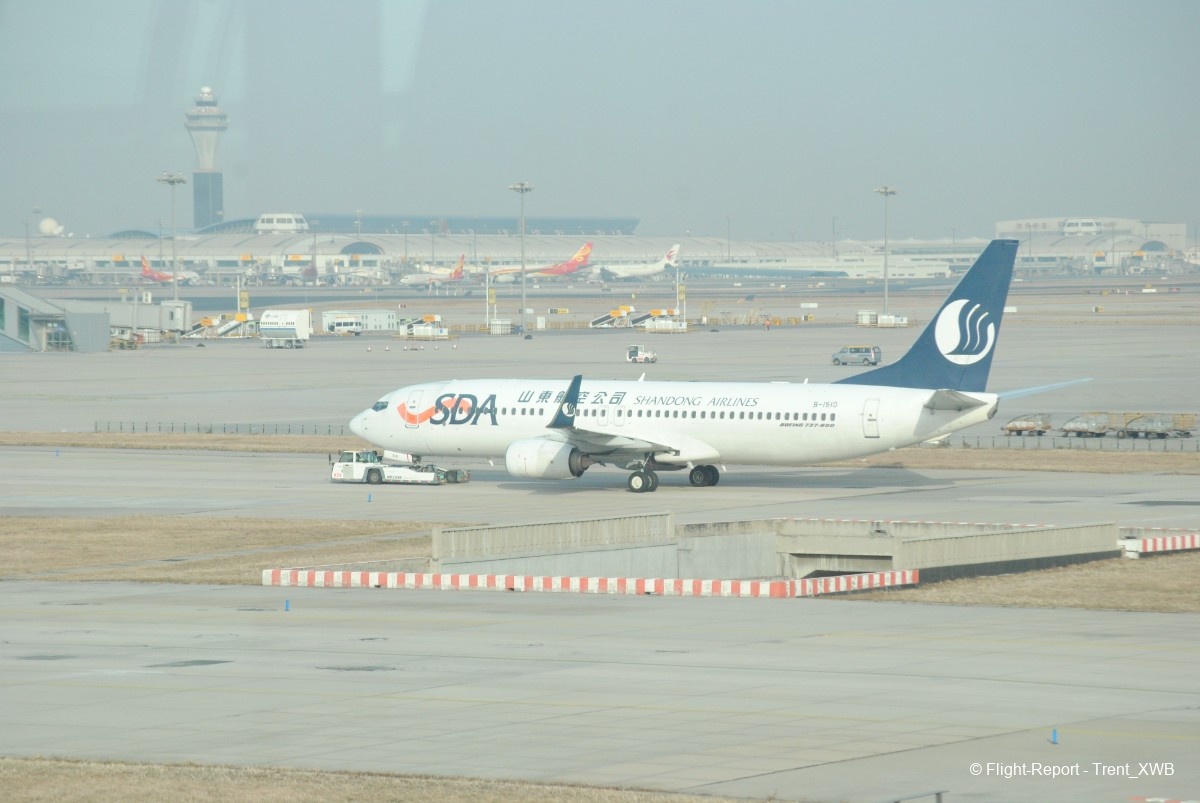
B738 (B-1510) of SDA (Shandong Airlines) in SC's standard livery. SC is one the Chinese "smaller" carriers, operating only narrowbody fleet, but its size is impressive: 15 B7M8s plus 122 B738s! On the background is T2 with its ATC tower and HU and MU aircrafts. T2 PEK is mostly HU's reign.
PEK T3D
After a short shuttle train ride one finds oneself in T3D - the domestic satellite of T3 (the train goes further to T3E). T3D, albeit being spacious, is rather compact compared to the vast size of T3C and T3D.
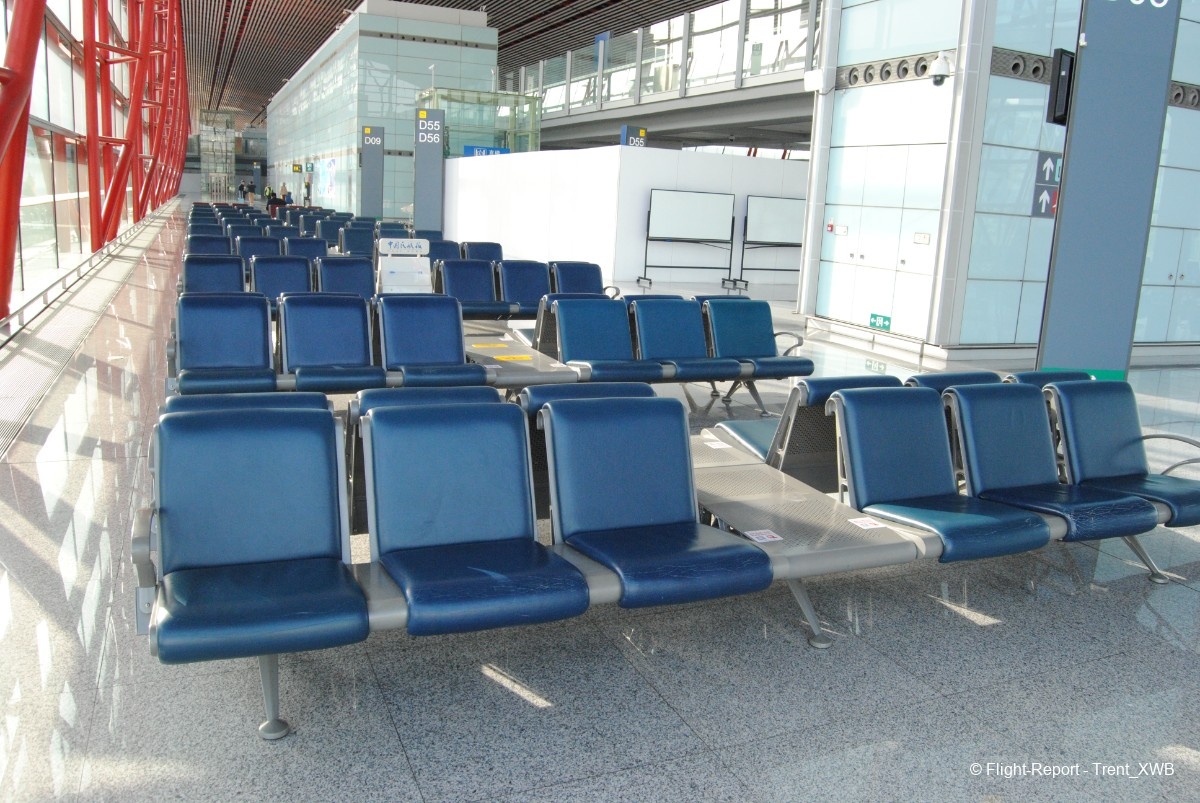
Whereas T3C feels quite quite, T3D feels almost deserted, so it's hard to feel here that PEK is a busy hub in reality. One may notice that T3D has direct access to the windows, thus giving excellent planespotting possibilities.
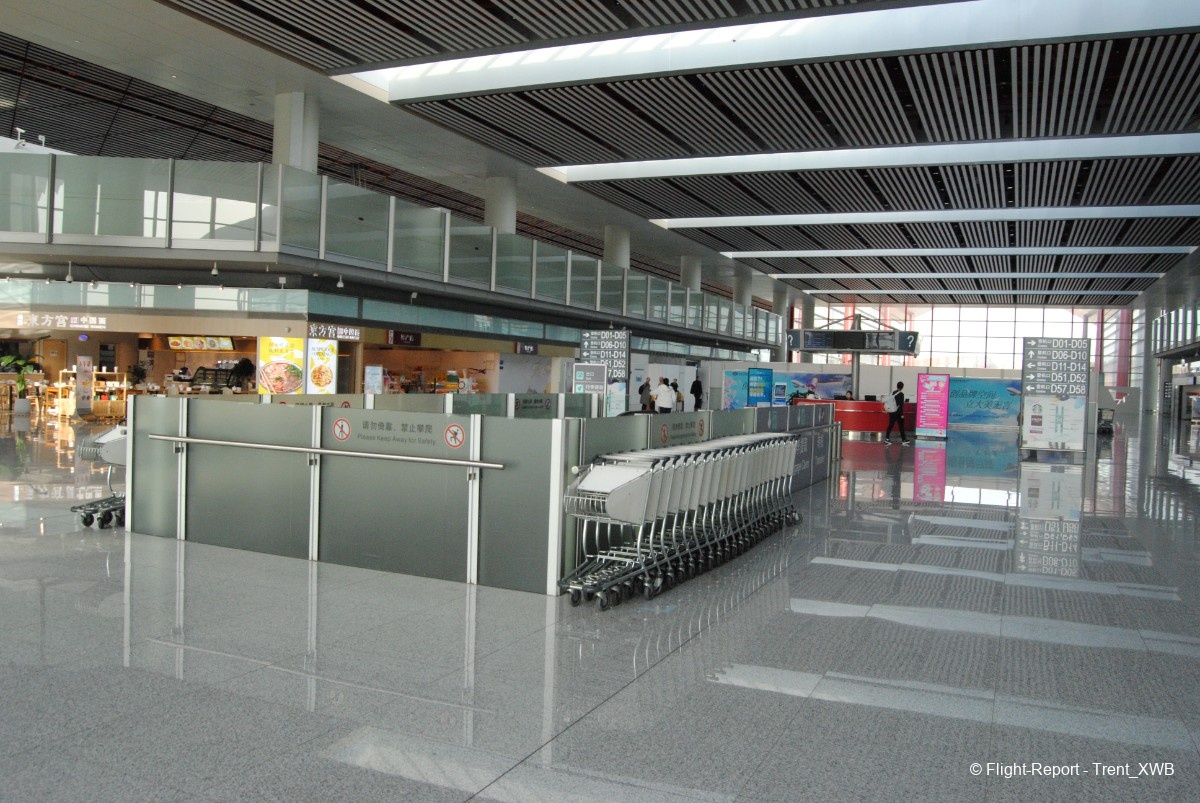
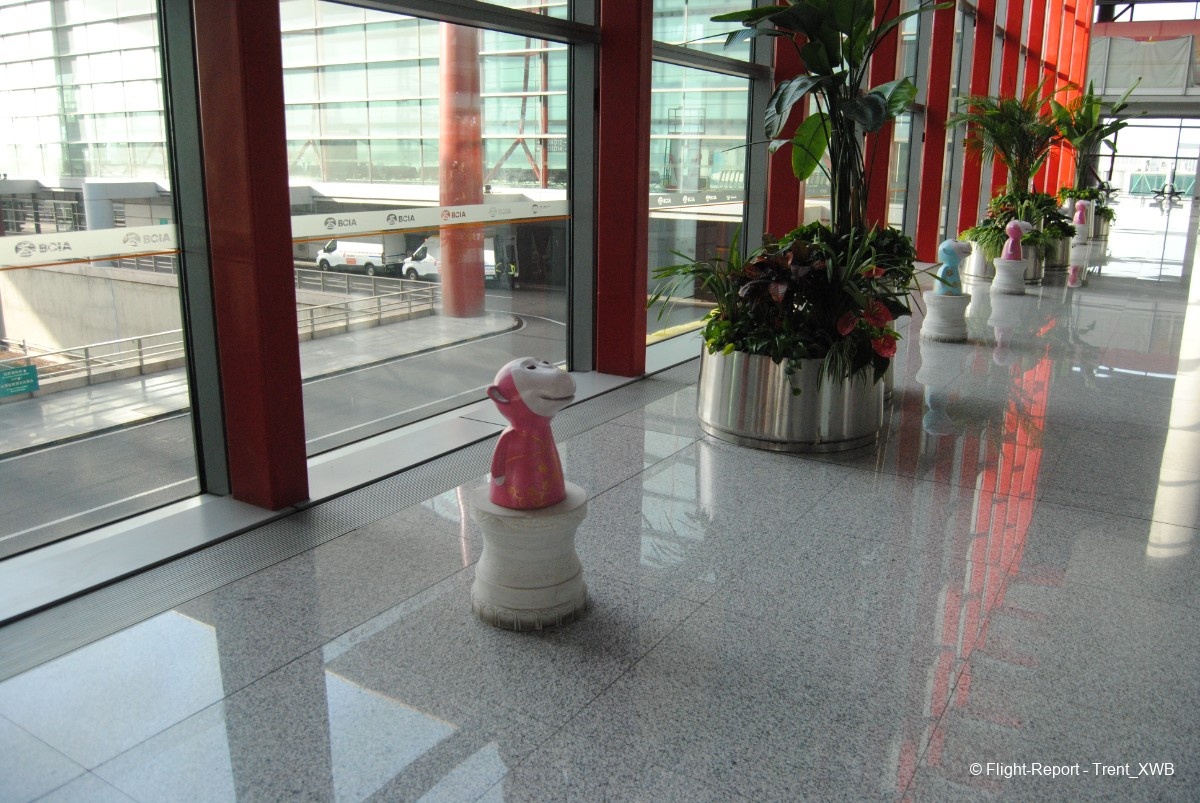
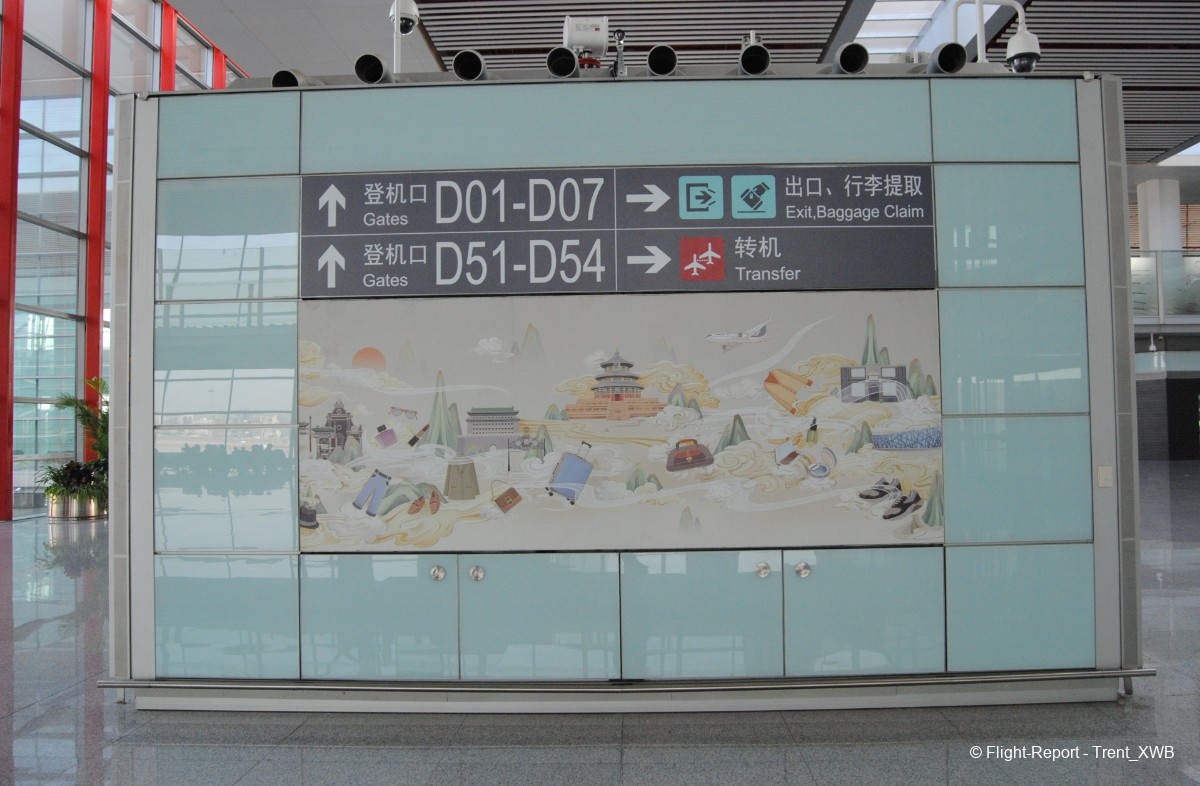
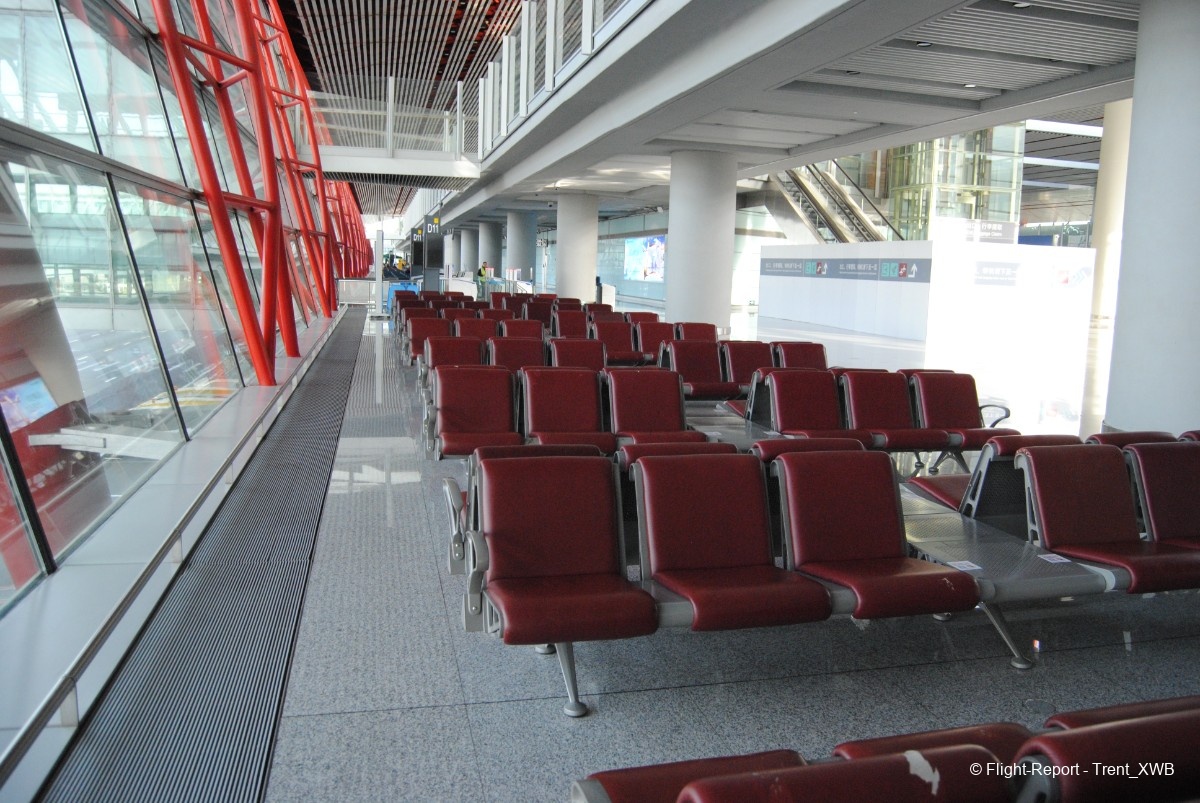
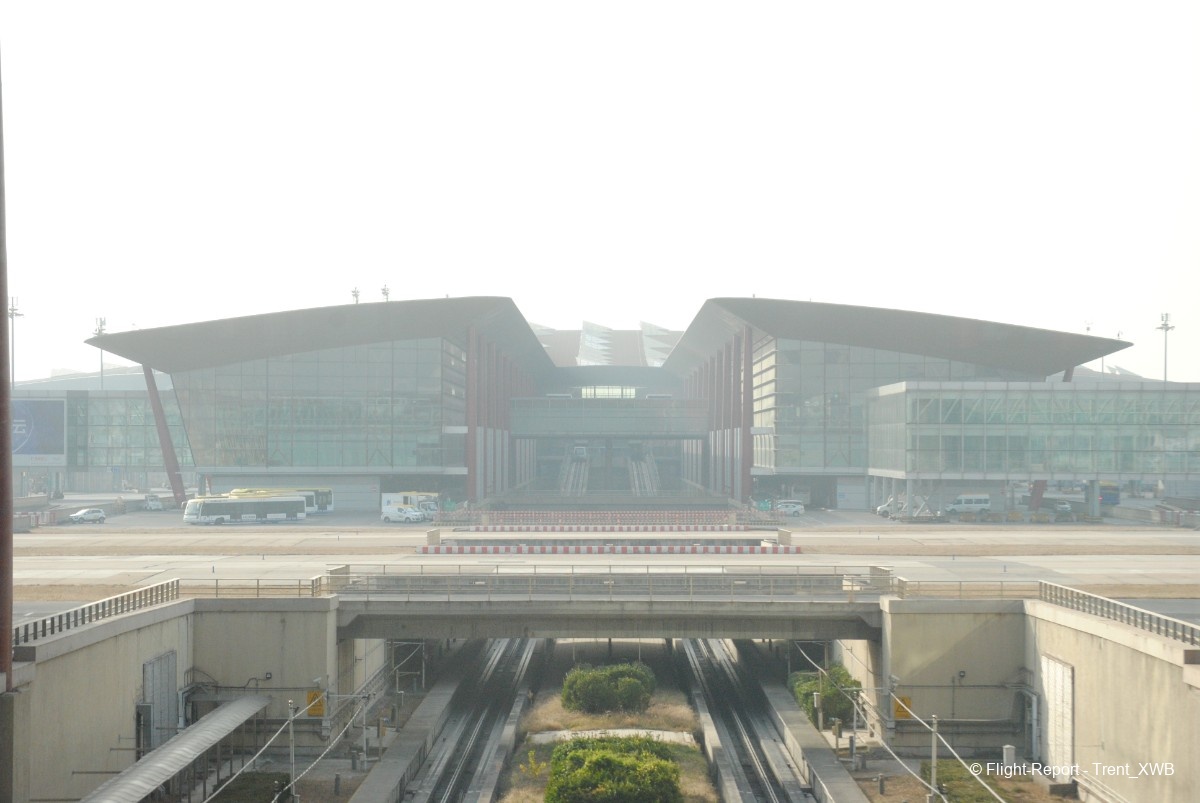
A view of T3C and the shuttle train line from the southern end of T3D.
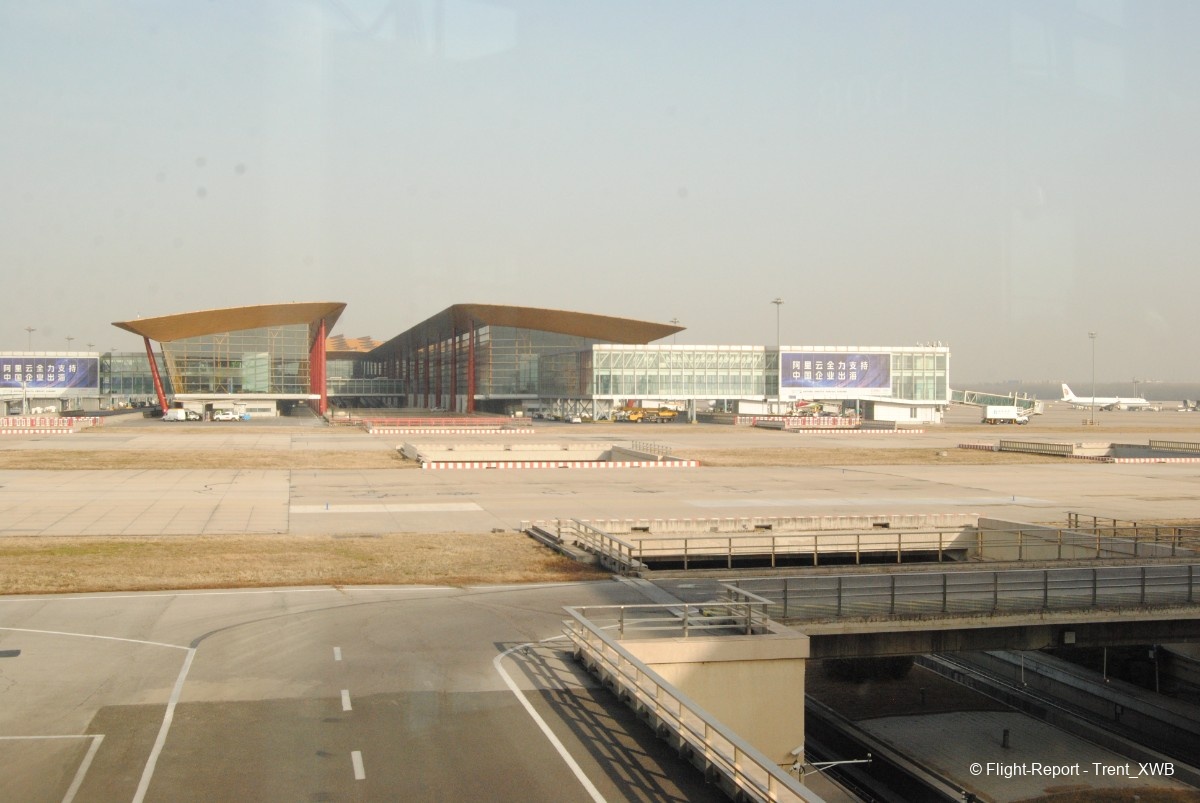
A view of T3E from the northern end of T3D.
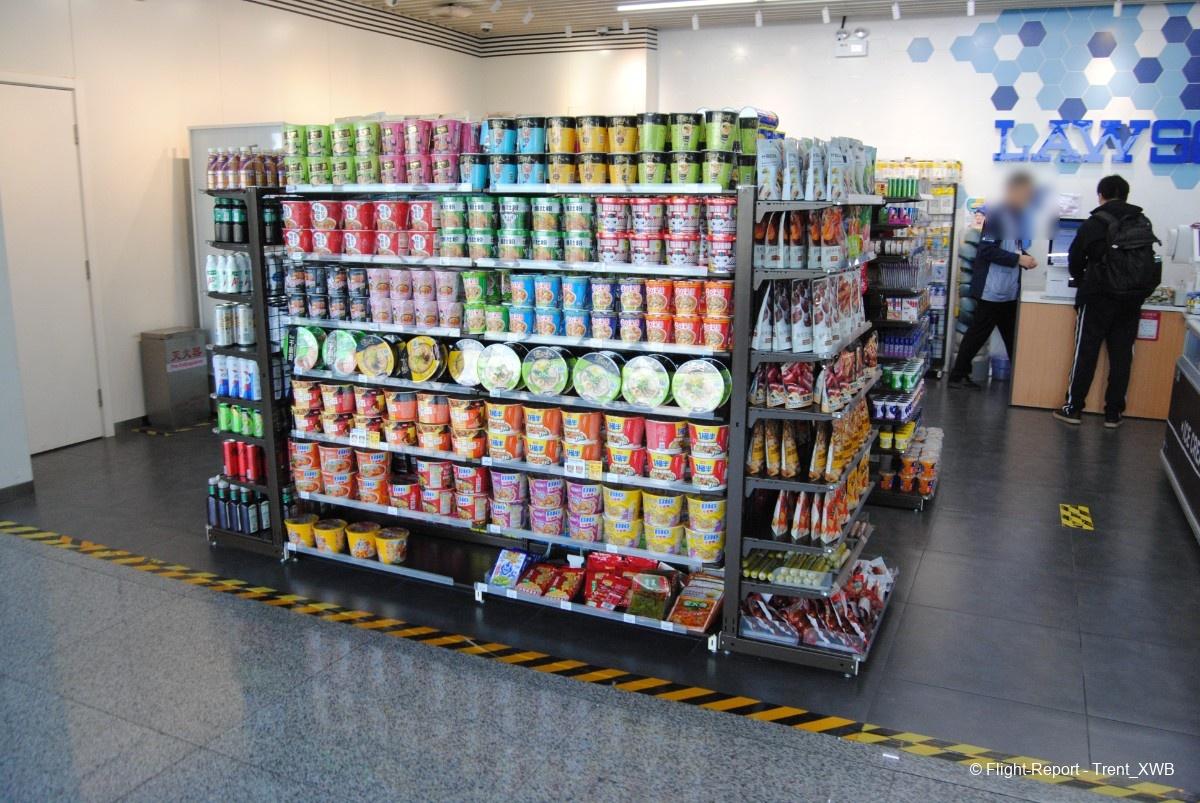
Despite T3D feels kind of "deserted", it has some shops, including omnipresent Lawson with its democratic prices (and one can immediately boil the noodles using omnipresent hot water dispensers).
Planespotting From T3D
Let's continue planespotting using excellent windows of T3D with direct access.
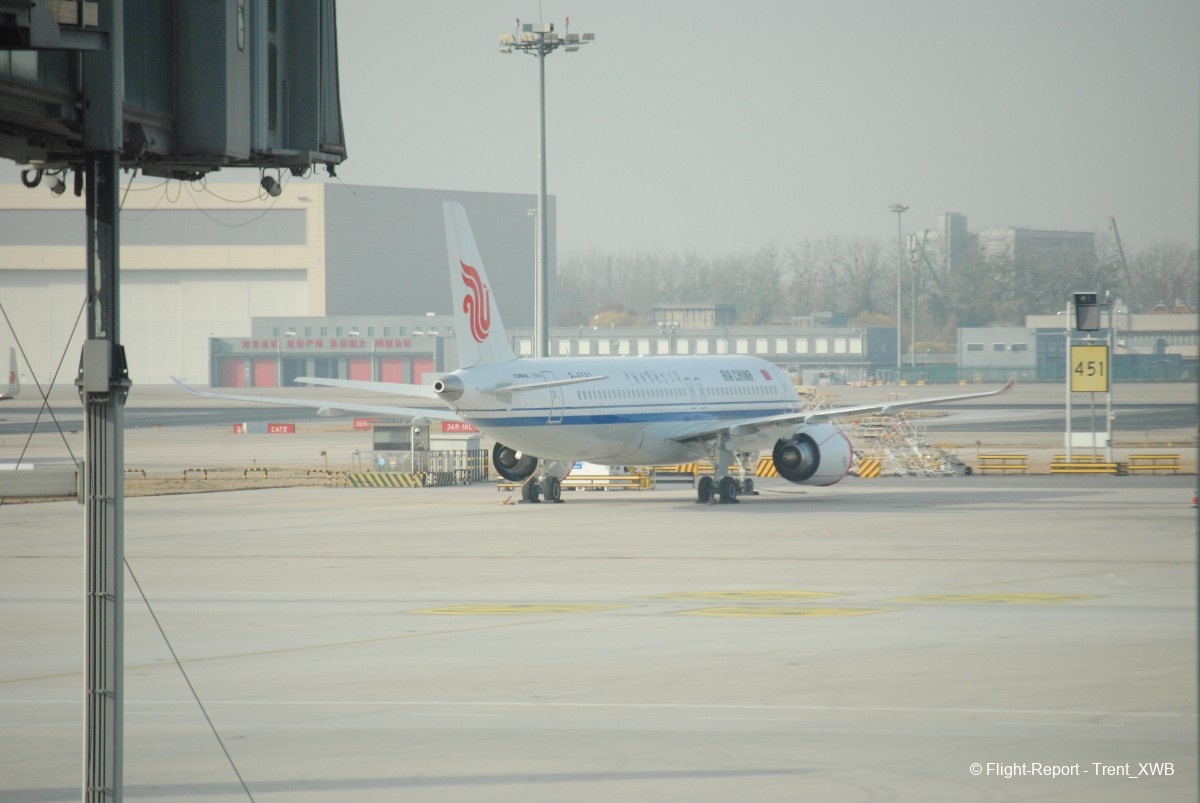
CA C919 (B-6580). Currently CA has 11 2024-2026-built C919 with C8_Y150 layout. It's an aircraft I also dream to fly on, but that time I didn't have enough energy to check all the Chinese avgeek boxes and concentrated only on B748s. Anyway, I have a reason to visit China again (and again).
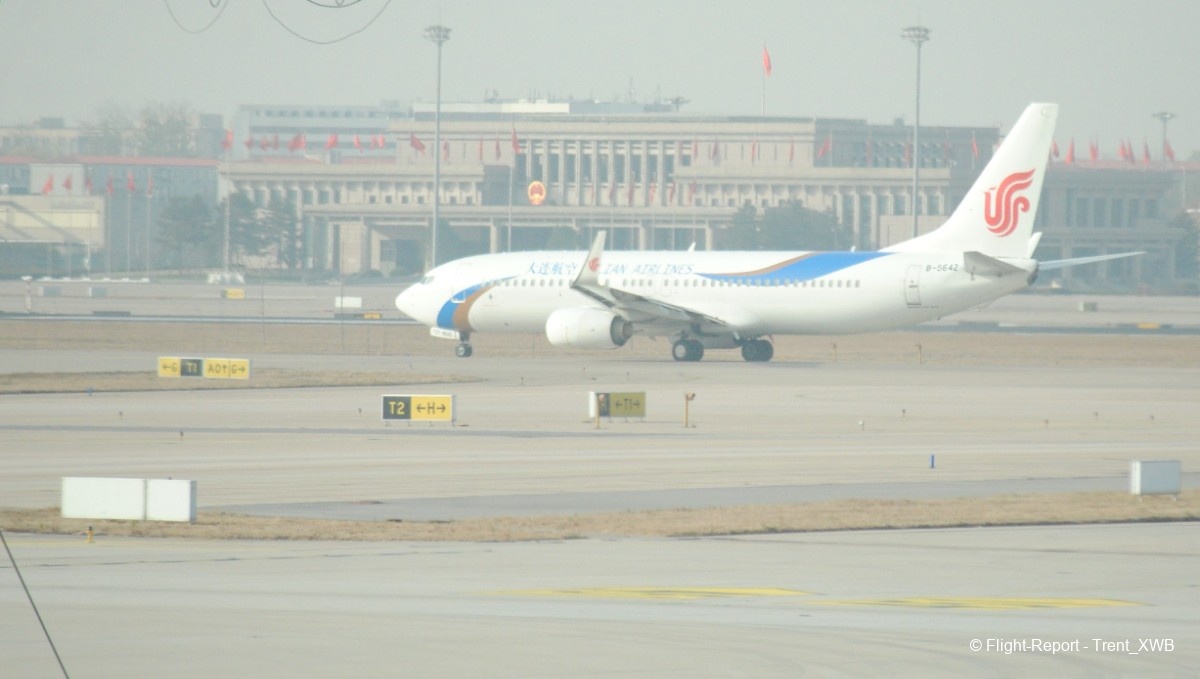
B738 (B-5642) of Dalian Airlines - a subsidiary of CA, which doesn't even have an independent IATA code. Dalian Airlines consists of just 12 CA B738s, featuring 3 different 2-class layouts. On the backdrop one can see an administrative building with numerous PRC flags.
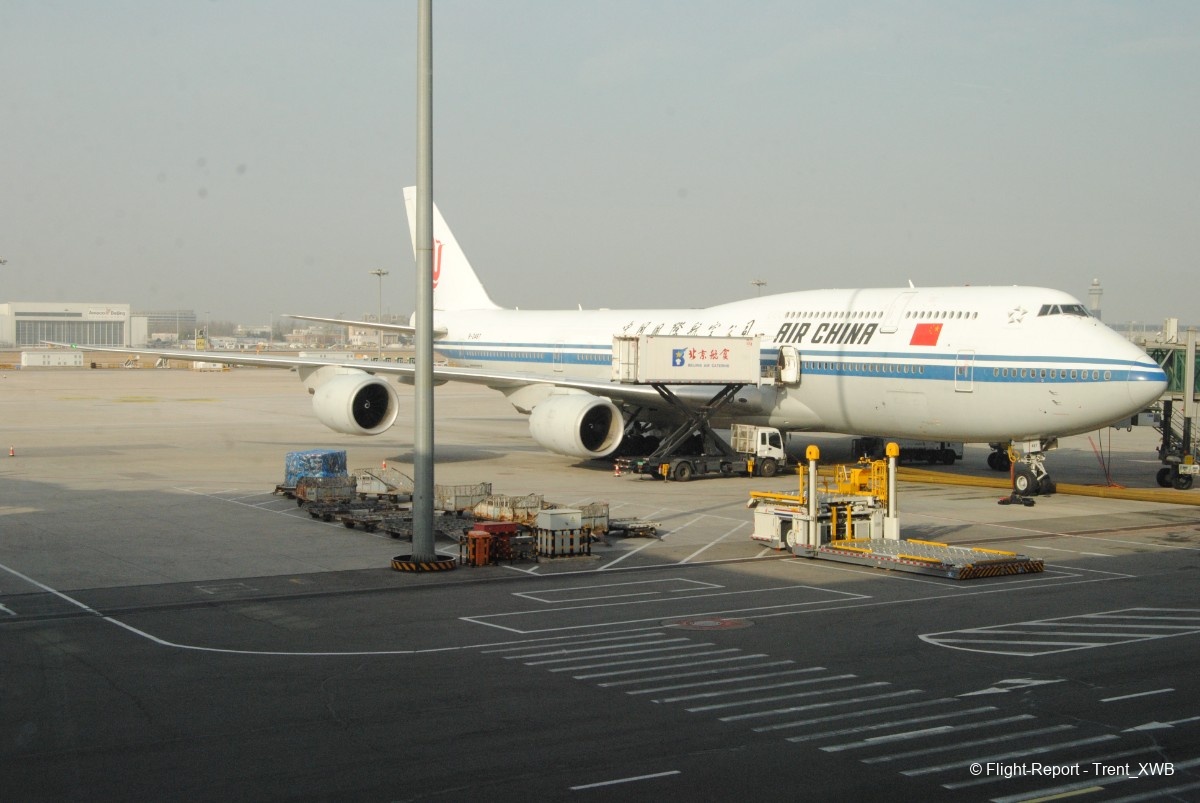
Finally I got to see a Chinese Jumbo! CA B748 (B-2487), being prepared to CA1315 flight to CAN (with 10:55 departure). Back then CA1315/1316 rotations (and some other PEK-CAN-PEK rotations as well) were seeing B748 quite regularly and more stable than PEK-SHA-PEK rotations. But this went into history when CA returned B748s to FRA flights. Coincidentally, it was B-2487 who operated my return CA1558 SHA-PEK flight as you'll see in the next FR.
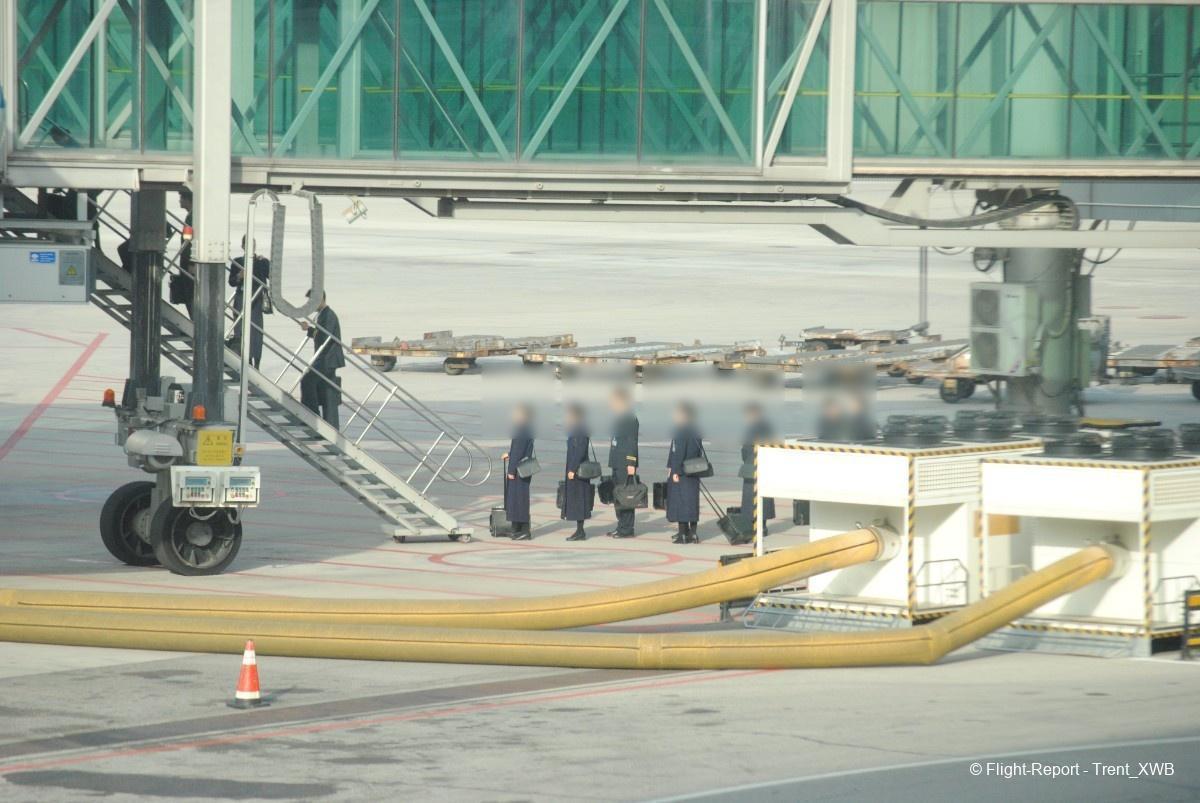
The crew board B-2487 using dedicated stair, not via the jetbridge. It seems to be a norm for CA.
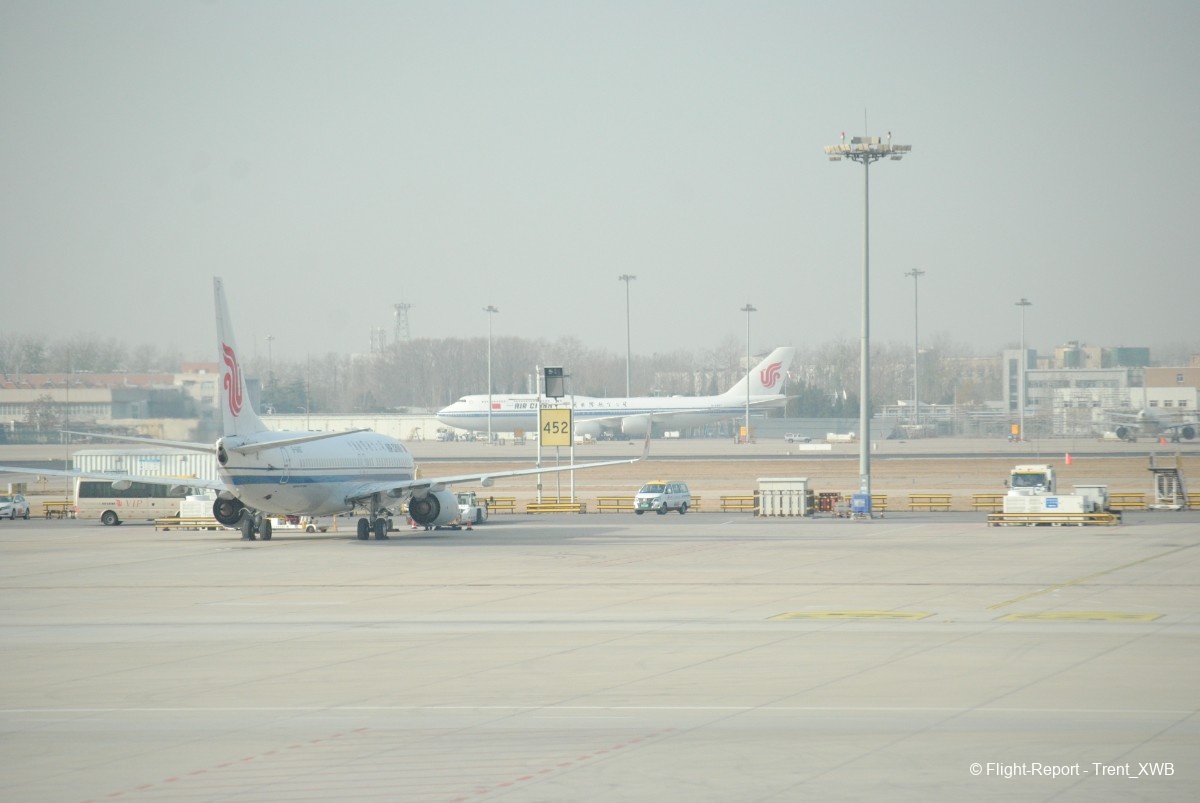
One of CA B738 and a CA B748 in the distance. Back then 3 B748s - B-2485, B-2486 and B-2487 - were in scheduled passenger service with B-2482 and B-2480 being stored, so this one was rather one of 2 VIP ones - most probably B-2481 (though, the last digit of the tail number looked rather like "7" in the telelens, which made me puzzled, as the true B-2487 was standing near T3D being prepared for CA1315 flight!).
The Aircraft
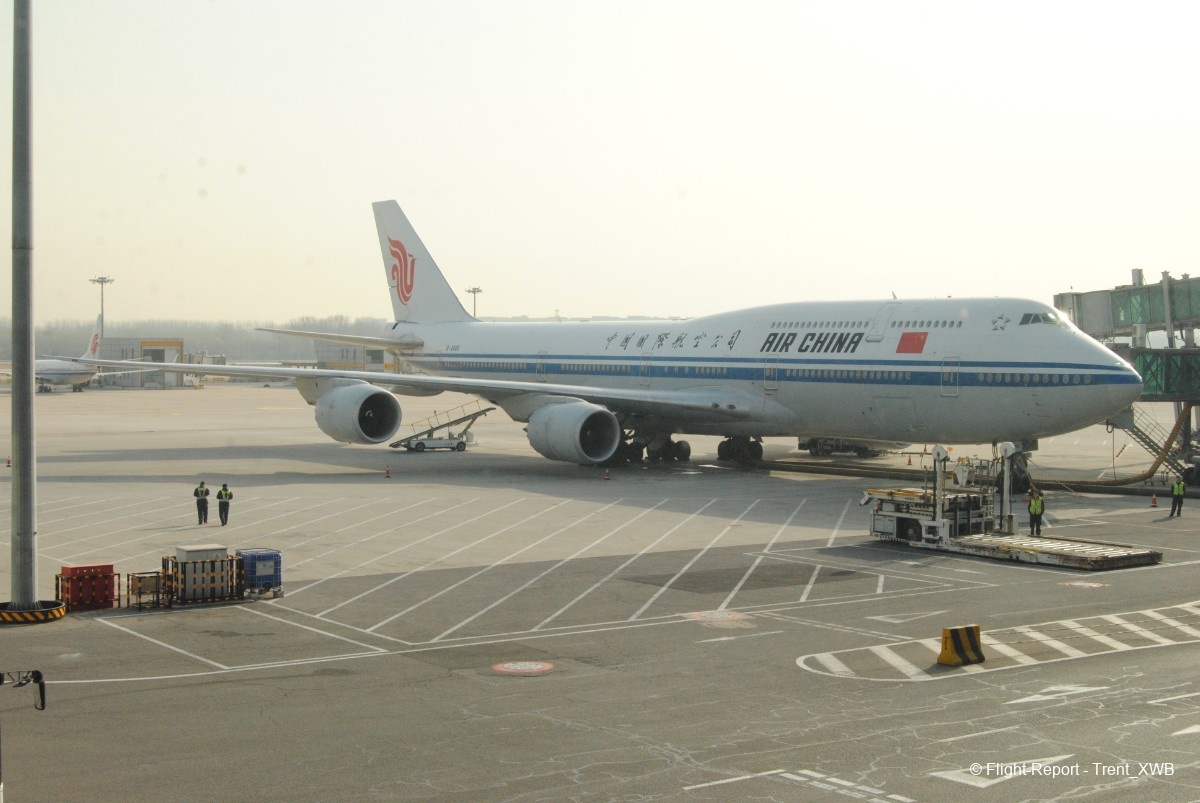
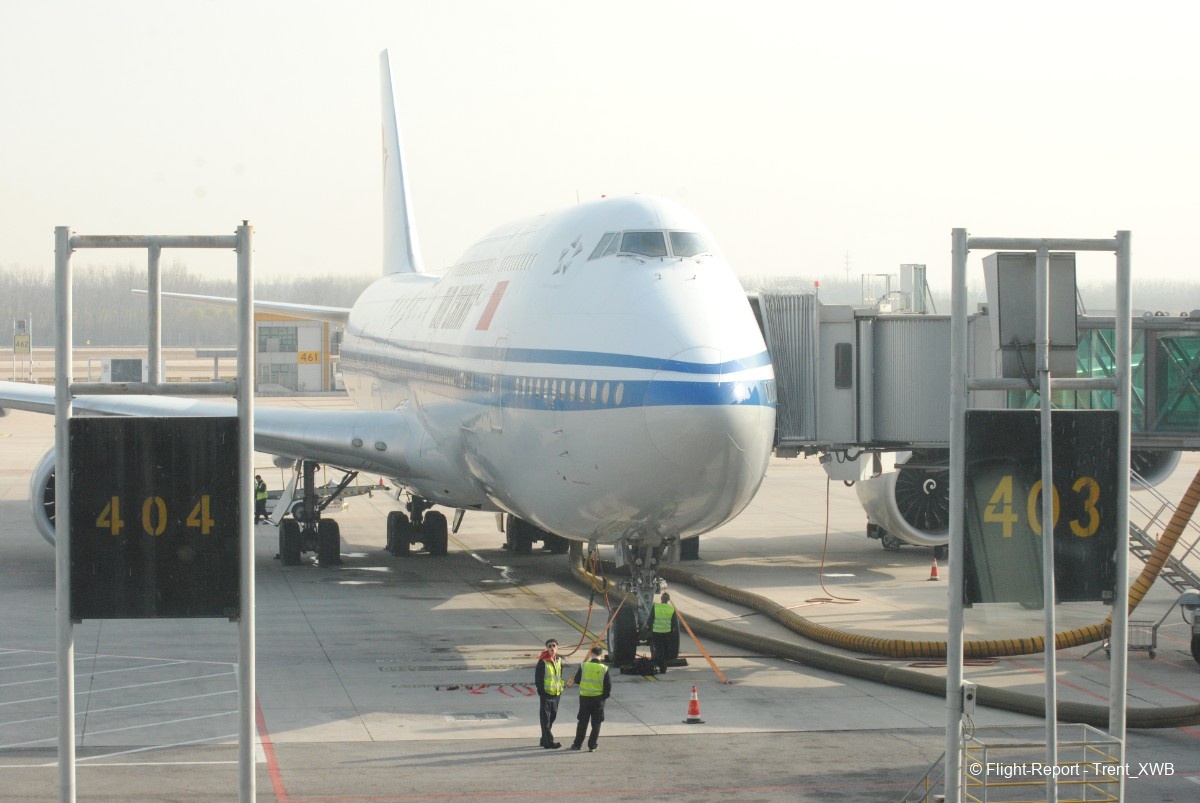
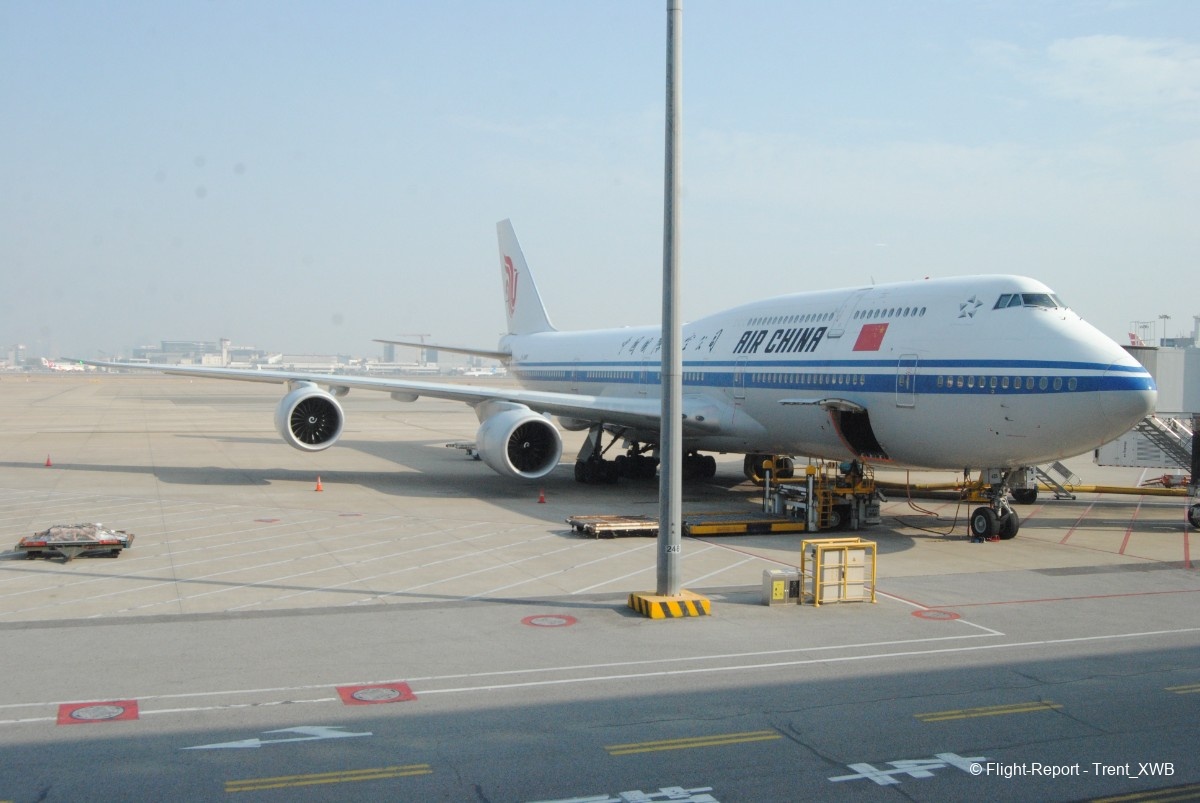
And here's the Jumbo of today - 2014-built B-2485, the very first B748 in CA fleet, having arrived from IAD early in the morning. My bet on today's CA1557 played out! Unlike B-2487 on the opposite side of T3D, my gate was allowing only counter-light photos of B-2485. But even in the counter-light the Jumbo looks magnificent! On the backdrop one may notice remote stands with jetbridges (which are useful in adverse weather), reminding ones in Iceland (KEF).
Boarding
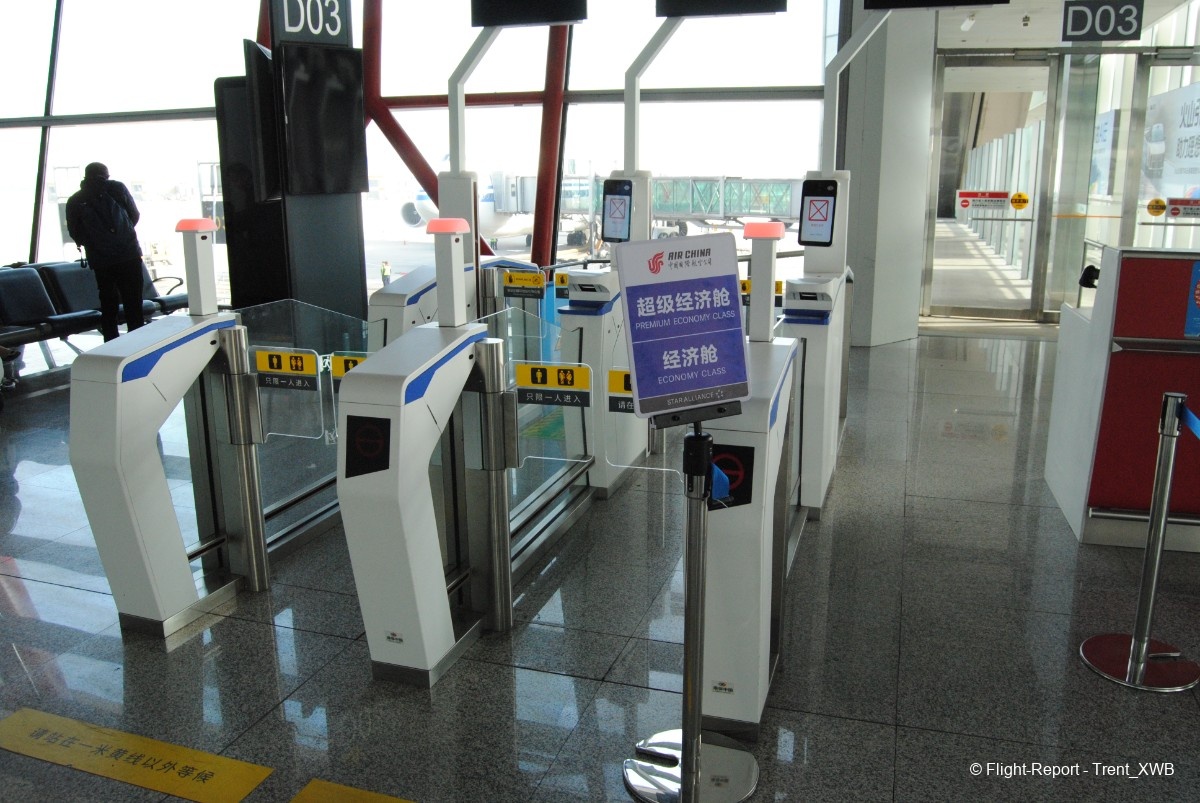
My CA1557 flight PEK-SHA was boarding from gate D03. One may notice that these gates have FaceID system, but it was not used this time. There were no boarding groups, just one common line. I was boarding one of the first.
The 2L door of the Jumbo. Boarding was via 2 jetbridges (1L and 2L doors), I was directed to 2L door.
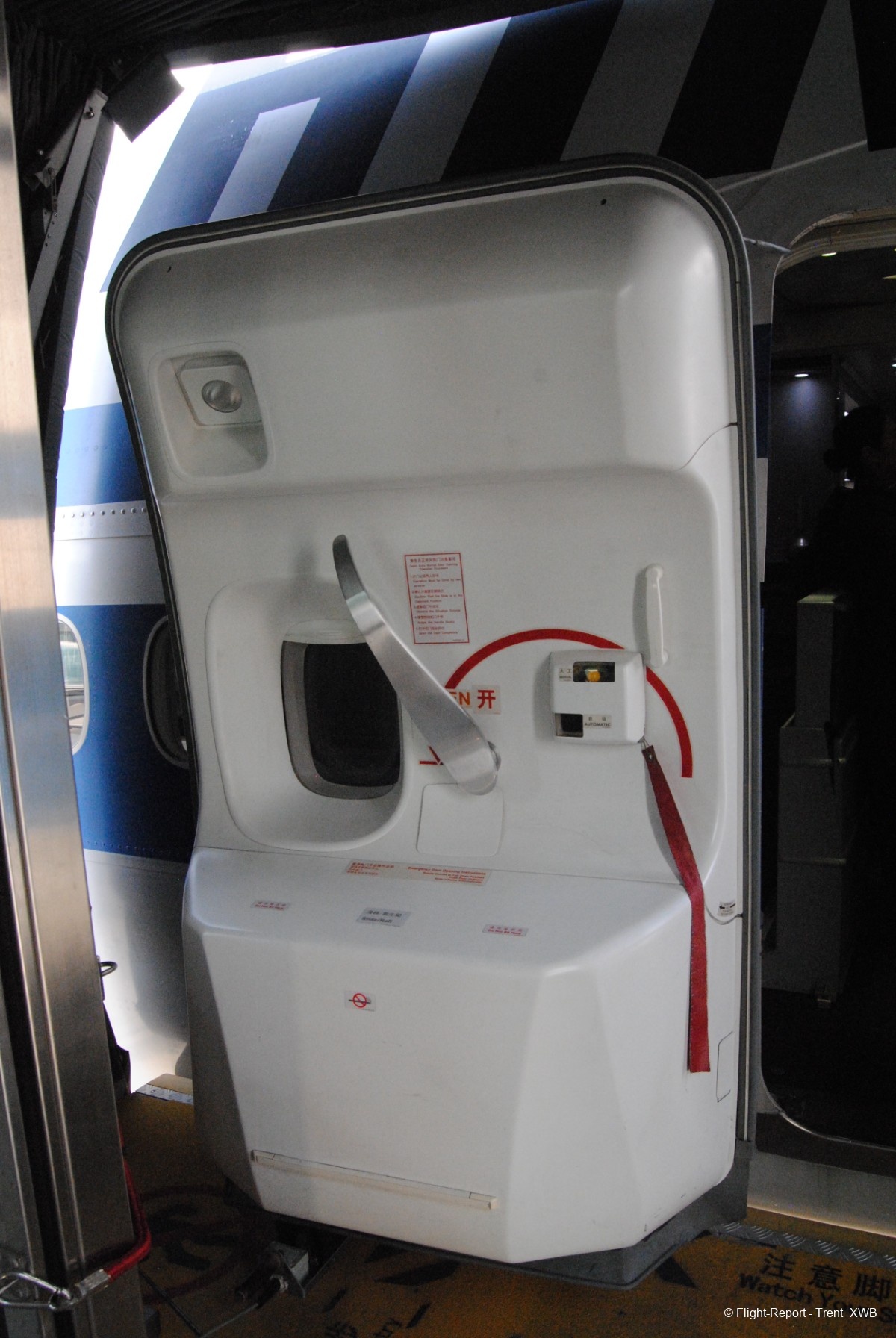
Instead of turning right upon entering 2L door, I decided to have a look on the main deck's premium cabins firstly.
The Nose Business Class Cabin
A general view of the nose business cabin, consisting of 12 Collins Parallel Diamond seats in 2-2 layout (rows 11-13), with overhead bins closed and moodlighting turned on (I'll show this cabin in more details further). One can ask: well, but where is the first class, which is usually located in the nose in Jumbos? A bit of patience, I'll show it a bit further.
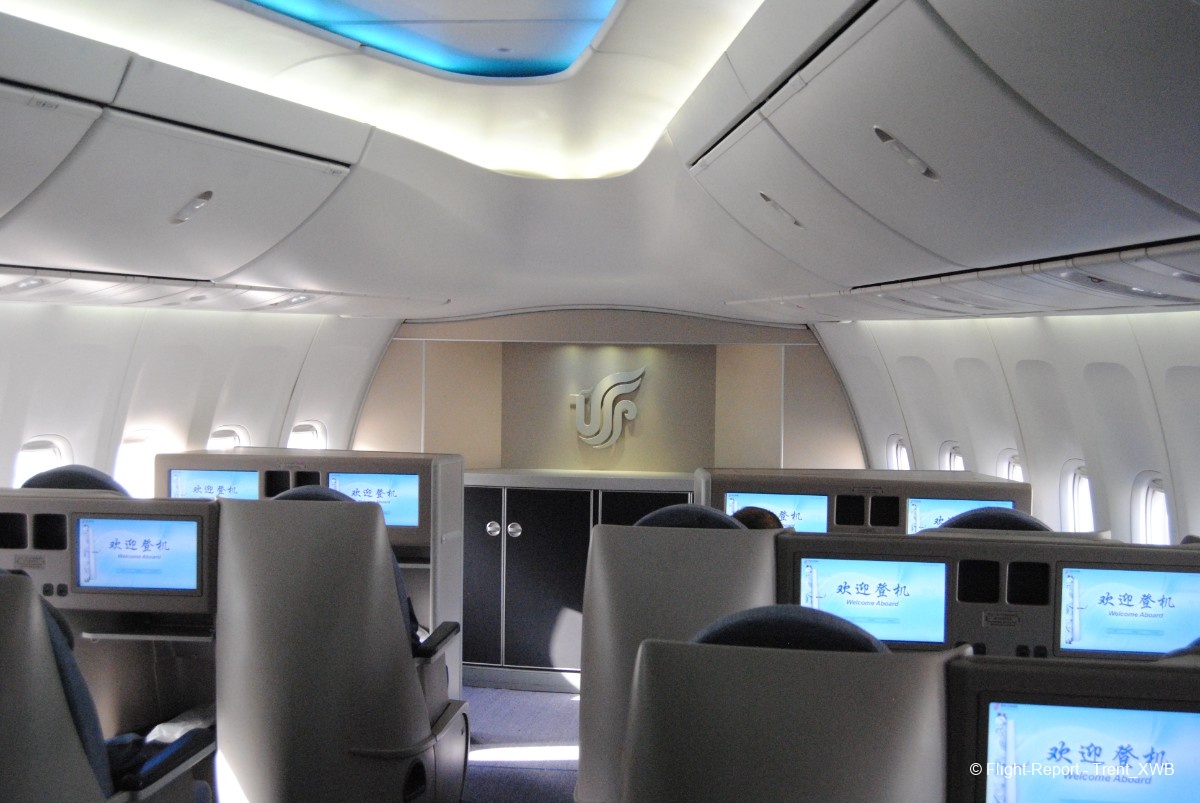
The Second Main Deck Business Class Cabin
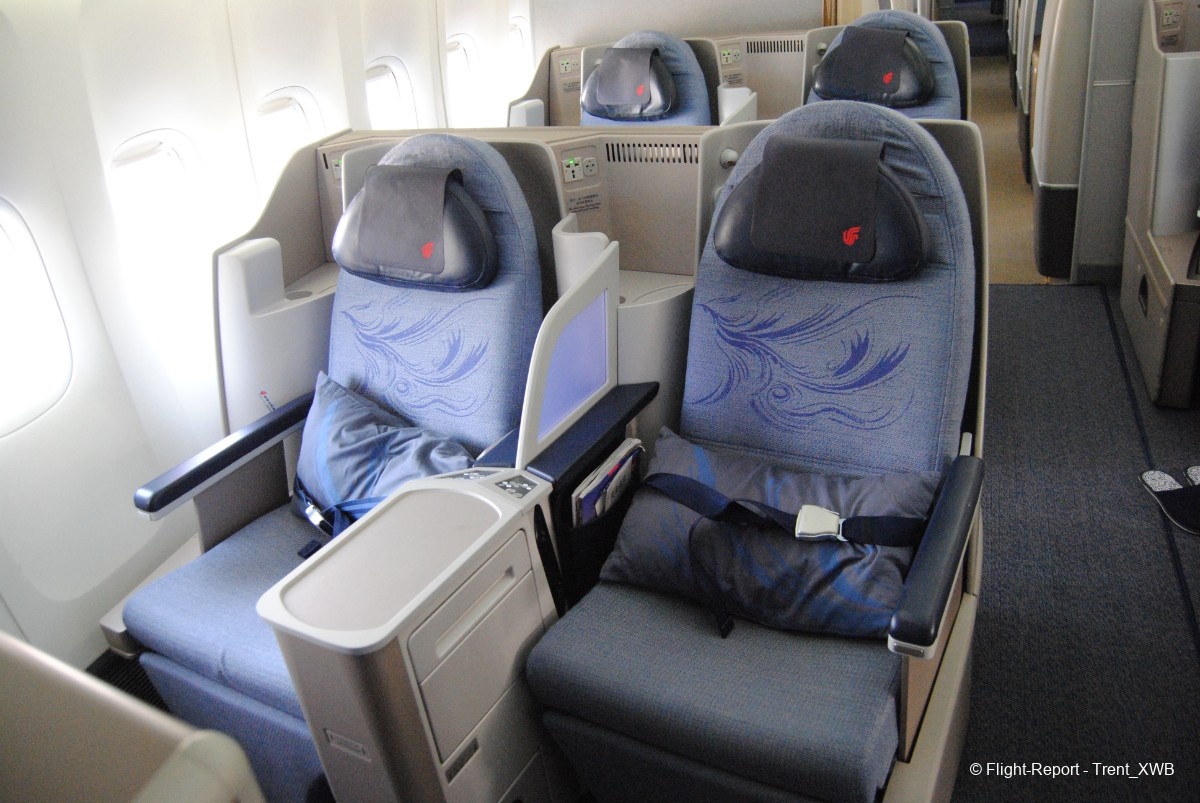
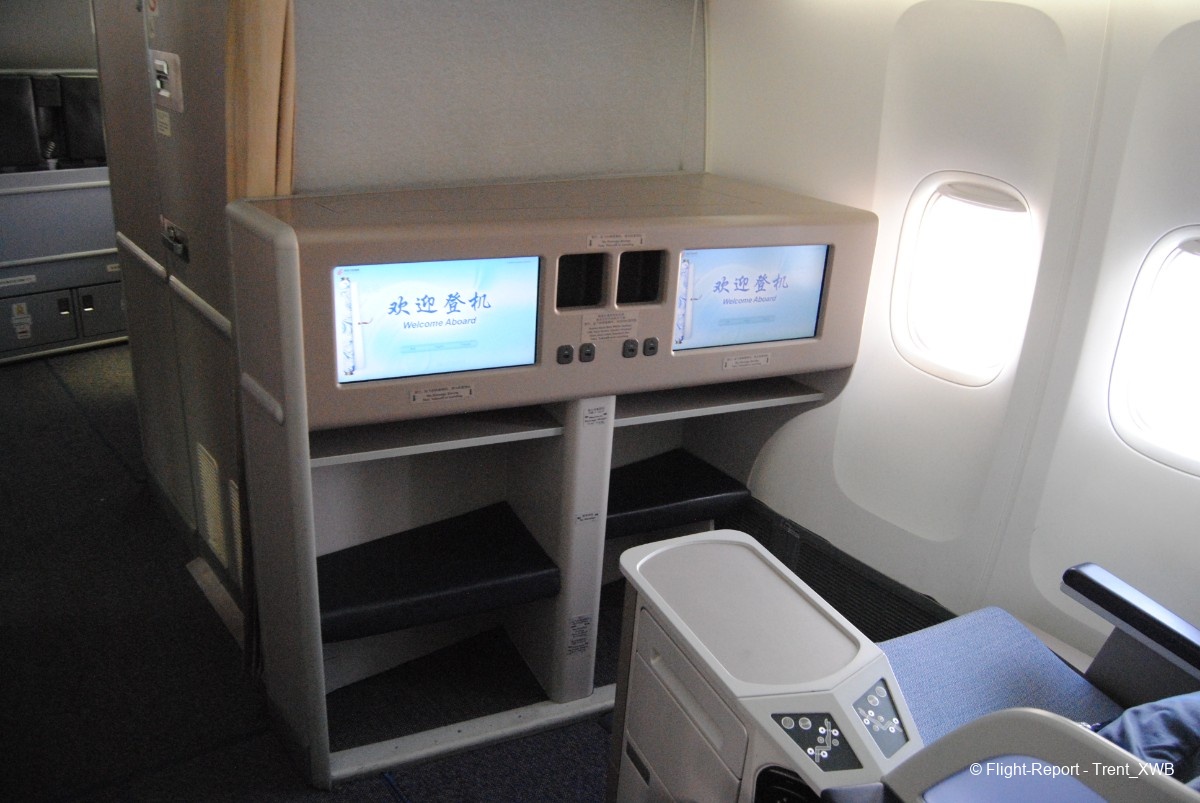
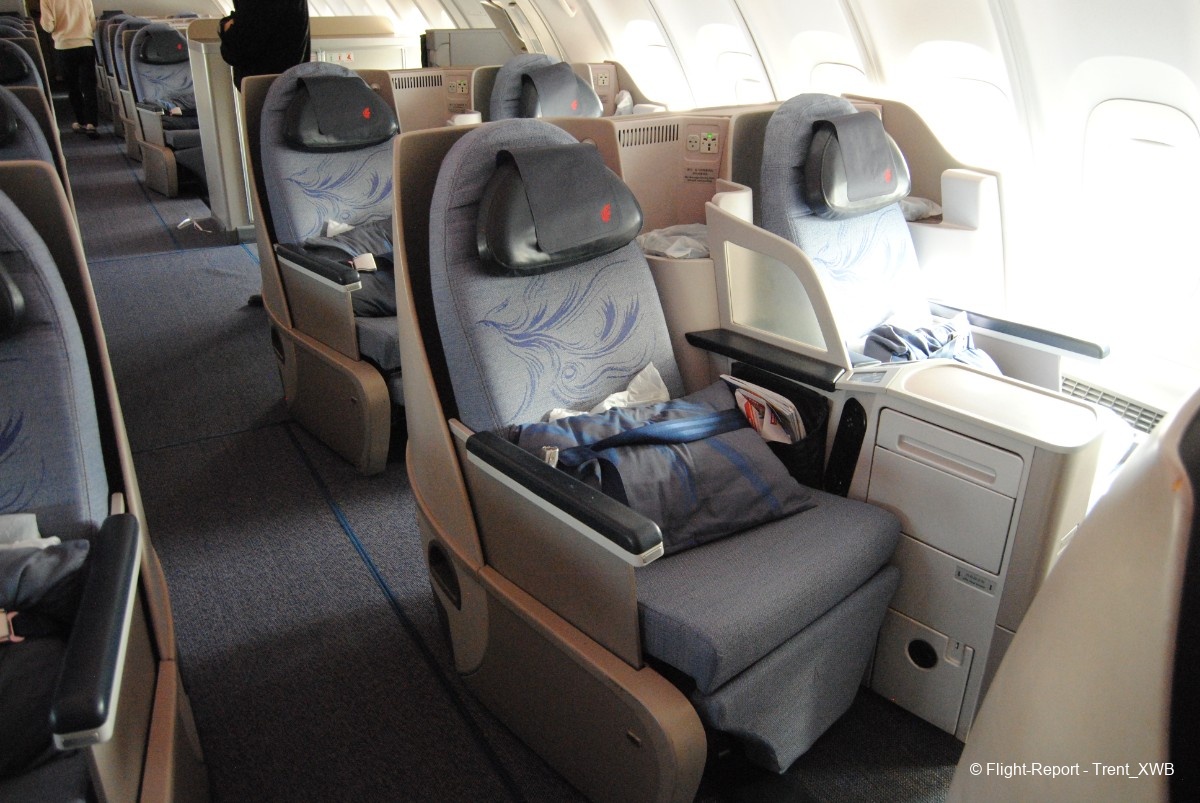
Then, right after 1L/R doors, follows the second main deck business cabins, also consisting of 12 Collins Parallel Diamond seats, but here in 2-2-2 layout (rows 14-15). In this layout the central blocks of these seats are identical to the right-oriented ones and look odd due to their asymmetry. These seats are massive, but very obsolete by today's standards, having zero privacy and no direct aisle access for window seats. Moreover, the regular rows have quite restricted footwell space (as I'll show further). But it seems that CA really loved these seats, as they are also installed in business class of CA B77Ws (both 3-class and 2-class ones) and CA B789s. At the same time, CA chose different business seat models for its A333s and A332s (even though Parallel Diamond can be installed into the narrower cabins of A330s). Only when CA started to receive A359s, it chose modern reverse herringbone seats for its newest widebodies. Among the other operators of Collins Parallel Diamond seats are, for example, ET (early B789s and A359s), KL (A333s and A332s, which are being phased out), SU (most B77Ws except the 3 last ones), DL (transcon B752s) and UA (all B752s). Worth noting that ET and KL have symmetrical central blocks of Parallel Diamond seats in their respective A359s and A333s/A332s, so it seems a bit strange, why the others Parallel Diamond operators, including CA, didn't choose this option, which is much more pleasant aestetically than the asymmetrical one.
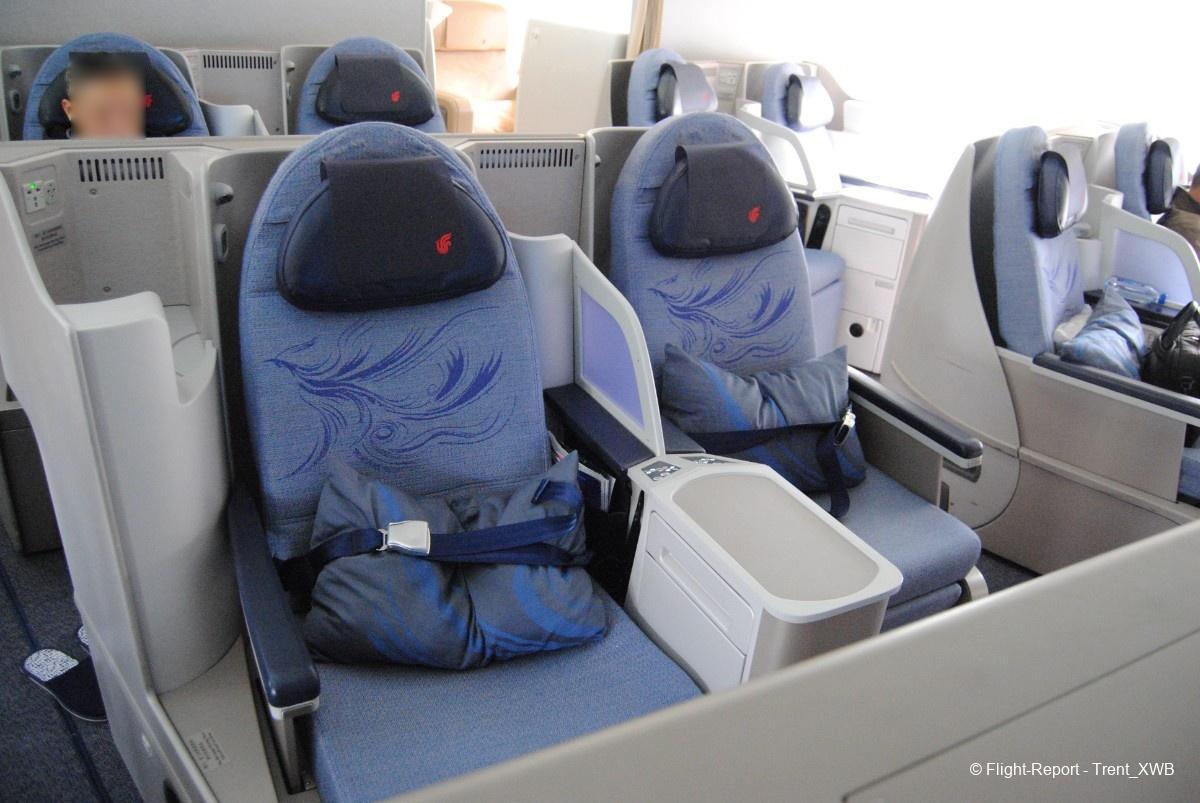
In this cabin only the bulkhead row (14) provides unrestricted footspace (which can be compared with the one of Zodiac Aura Lite / Safran Aura Enhanced seats having, let's remind, huge unrestricted footspace in any row). One can guess that one should have a certain tier in CA's "Phoenix Miles" loyalty program or one of the higher Star Alliance tiers to be able to choose theses bulkhead seats in business without a fee.
The First Class Cabin
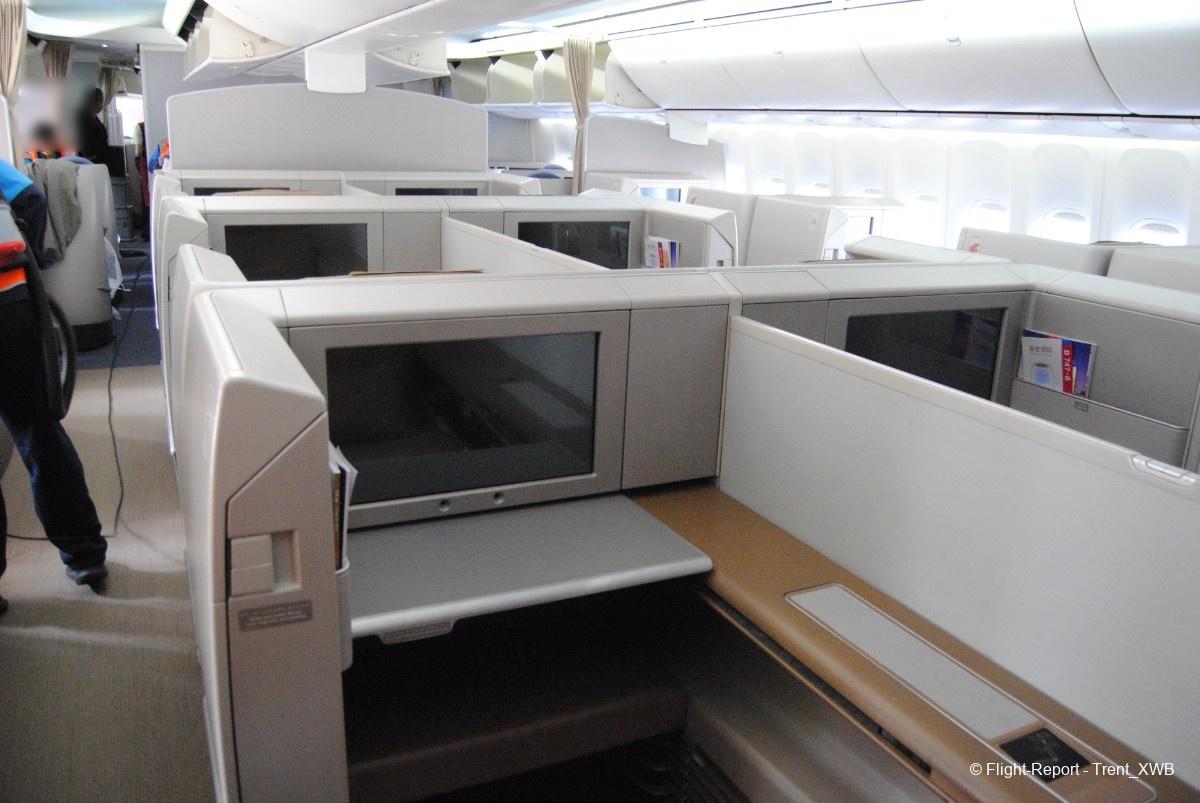
Stepping back from the second main deck business cabin, here we are in the large first class cabin, consisting of 12 Zodiac Aerospace Venus suites in 1-2-1 layout (rows 1-3), located before 2L/R doors. Yes - it's the largest first class cabin of any of the 3 existing passenger B748 operators. For comparison, LH has 8 so-called "open suites" (which are actually not suites at all) in the nose of their B748s (after the planned "allegrization" of these B748s - somewhere in early 2030s - the number of Allegris first class suites will be just 6) and KE has 6 rather modern Cosmo Suites 2.0 also in the nose of their B748s. There are 2 reasons why CA chose such nonstandard location of its first class: firstly, these suites are tailored for the widest part of B747 and B777 cabins, as CA's 3-class B77Ws (which debuted in 2012 - 2 years earlier than CA B748s) also have these suites (but 8 instead of 12); secondly, first class suites are always heavy and the location of such a large first class cabin between 1L/R and 2L/R doors provides better weight balance compared to the location in the nose - no need to use counterweights (hello, LH B748s and LX A333s!). By the way, CA's 2 remaining old venerable B744s have the similar location of their F cabin. The difference is that B744's F seats are old-school ones (not suites), their number is 10, not 12, and the distance between 1L/R and 2L/R doors in B744 doesn't allow to squeeze some C rows between the F cabin and 1L/R doors.
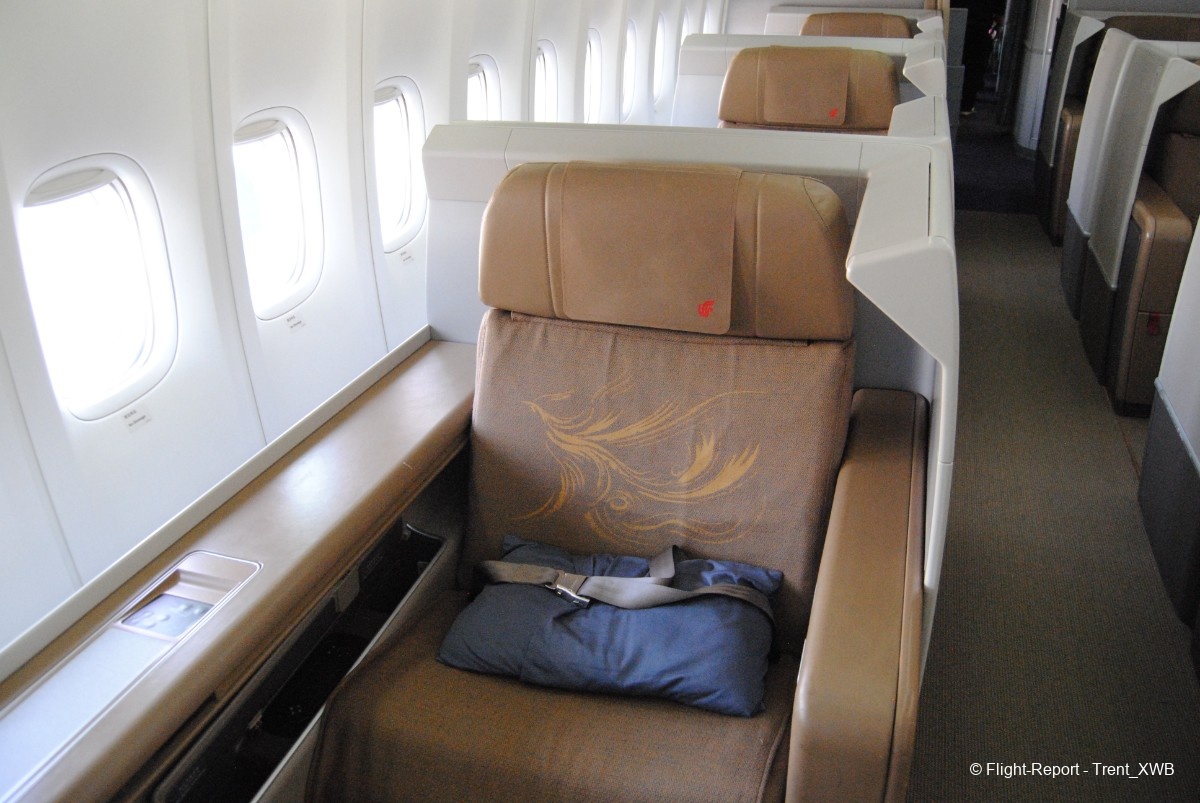
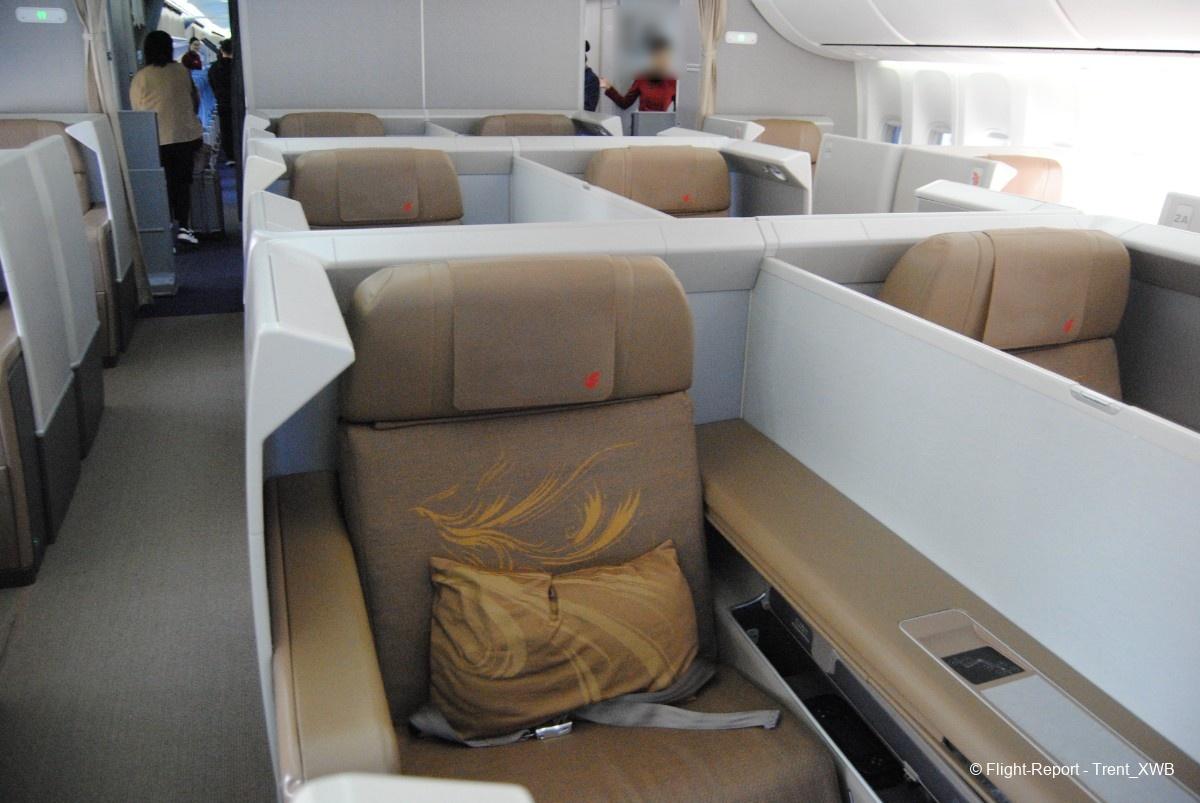
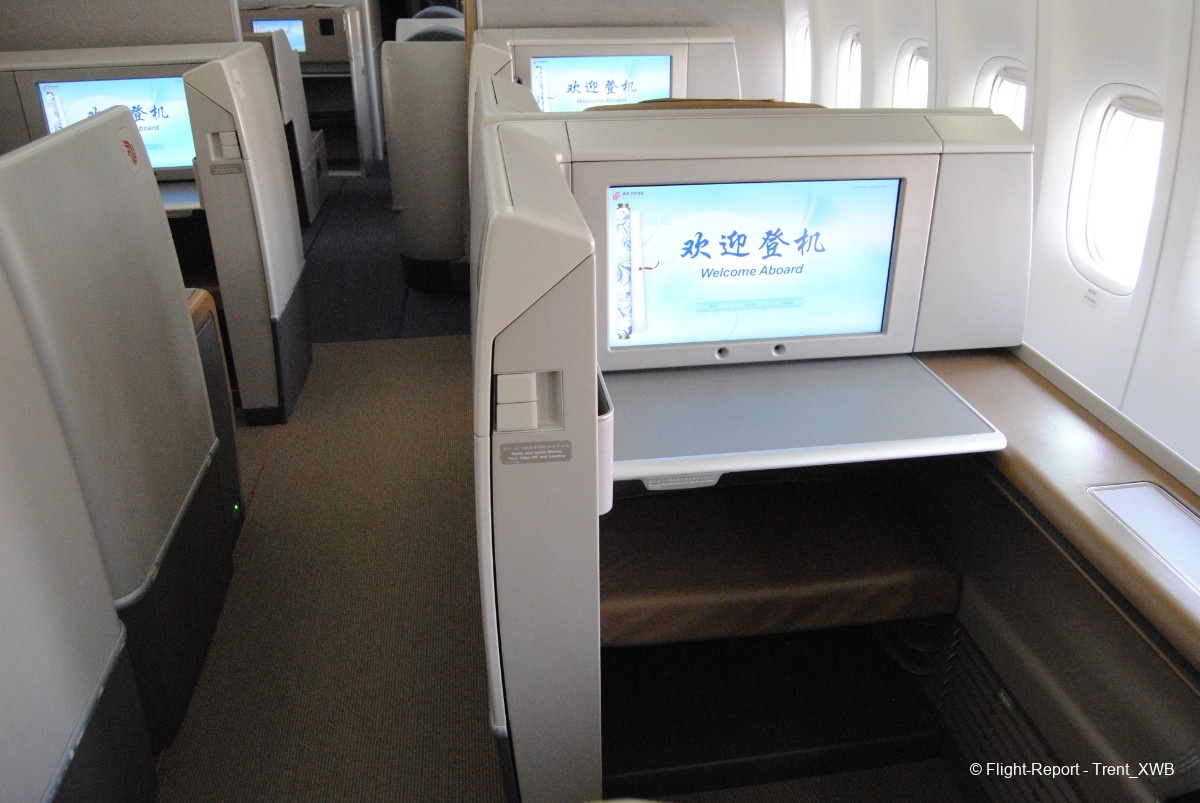
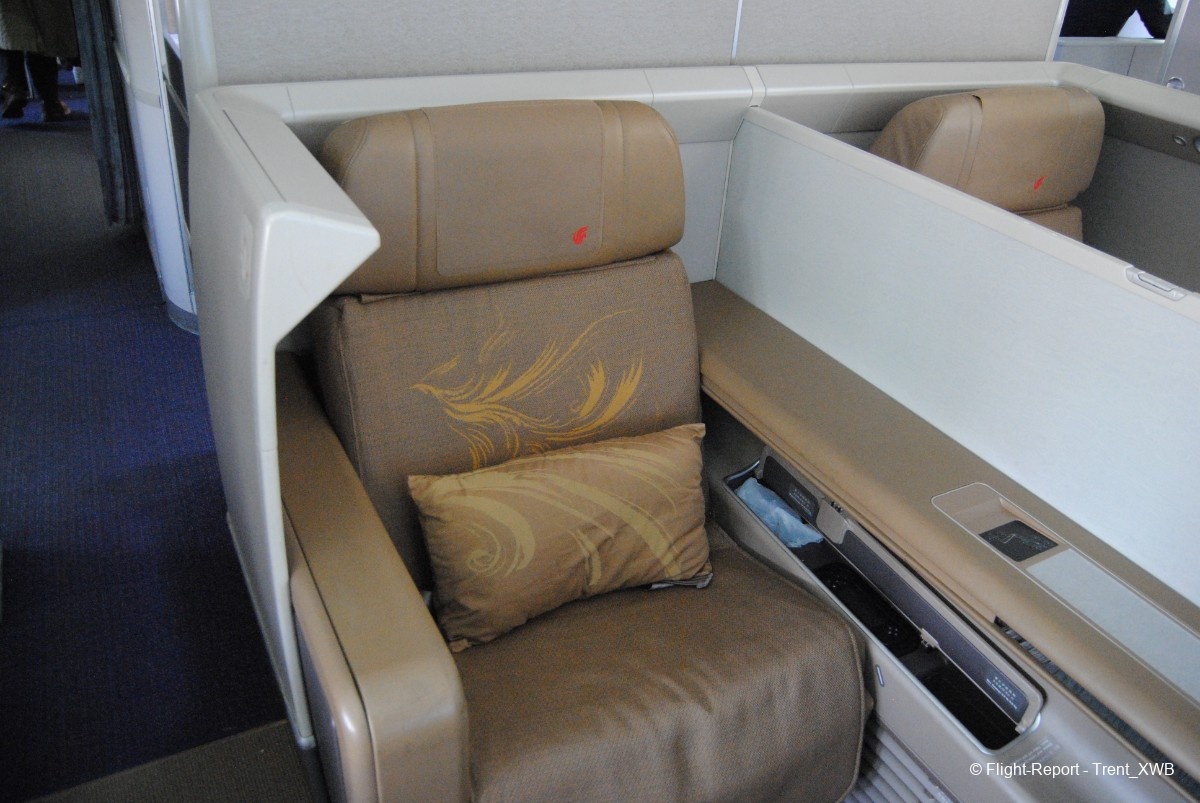
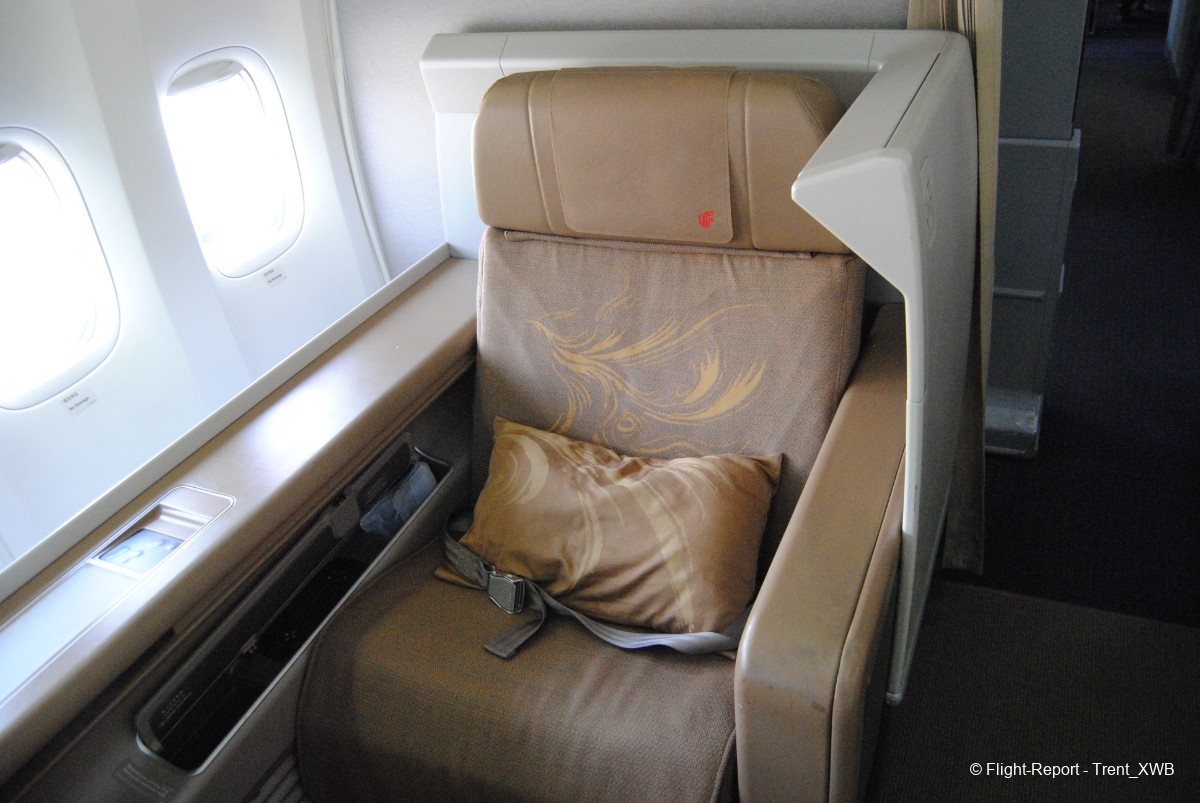
These suites are very spacious, encompassing 4 windows each. But as one can see, they already look quite obsolete for the today's standards: they don't have doors and their walls are quite low, and these factors combined make the passengers partially exposed. They are definitely better than LH "zero privacy suites" in the old F in B748s, but lag far behind the first class Cosmo Suites 2.0 in KE B748s. To be honest, for today's standards CA's hard product in F looks rather like "business plus". The corresponding soft product, as one can find from the FR of CA PEK-YVR flight in the F of 3-class B77W by Sewey135, is also rather of "business plus" level. Having also flown a MU B77W and having had a look on MU's first class cabin, I can say that CA's hard product in F also lags behind the MU's one. Anyway, it was exciting to spend a couple of minutes alone in the empty F cabin of the Jumbo!
One may have already noticed a beautiful pattern on the first and business class seat upholstery (golden in F and blue in C). Well, it's time to speak about the concept on which CA B748 interiors are based. According to this article, the design of B748s interiors was developed by collaboration of Chinese artist Han Meilin and JPA Design. Han Meilin was the author of CA's logo in 1988, when the airline was formed from CAAC:
"Given that the phoenix symbolizes beauty and auspiciousness, happiness and harmony, as well as flight, the phoenix was always a strong contender for the logo. However, Han was particularly inspired by the head of a Han dynasty (206BC-220AD) bronze stick unearthed in Jinning’s Shizhai Mountain in Yunnan, on which a number of parallel lines had been turned into a phoenix pattern. Han made the parallel lines into not only a phoenix pattern, but the letters ‘VIP’. Chinese red was selected as the logo color, as in Chinese culture it implies auspiciousness, completion, peace and happiness. The logo is applied to the tailfin of the Air China fleet, with the fuselage including a Chinese flag and the airline’s name in English and in Chinese calligraphy, written by former national leader Deng Xiaoping."
It took 3 years - from 2011 to 2014 - to develop and implement the design of B748 interiors.
"Han created artwork specifically for the Air China interiors, including a phoenix in flight and a divine cloud, creating soft, dream-like images in a calligraphy style. The patterns depict three traditional Chinese cultural elements – beautiful clouds, pottery pieces and the auspicious phoenix – which represent heaven, earth and flight respectively, conveying the message that heaven, the land and man are in perfect harmony in a peaceful and happy world."
Though, the implementation of Han's artwork into the interiors by JPA (which already had developed the partial interior scheme for CA 3-class B77Ws, debuted in 2012) wasn't easy.
“Han painted a few hundred artworks, but only a few were shortlisted for us to experiment with. We selected those that we thought had a good balance for that international feel, and those that worked well with the colors we had in mind. Some of the calligraphy-style phoenix designs cannot be replicated well on a fabric, because on a fabric the pattern has to be repeated. Some of the designs have a lot of empty space, which also didn’t work out well. The weaving process, by its nature, may not be able to capture the dynamism of the phoenix.”
However, after many modifications the artwork was finalized, with styles and scales appropriate for cabin materials. The textiles feature the artworks in different scales between the seat fabrics and soft goods, and in different colors throughout the aircraft, from first, to business, premium economy and economy.
“The idea is that you don’t see the same design everywhere, but you can see that they are all from the same family. There’s a theme that runs through the whole aircraft and we emphasize different aspects of the design for different finishes”.
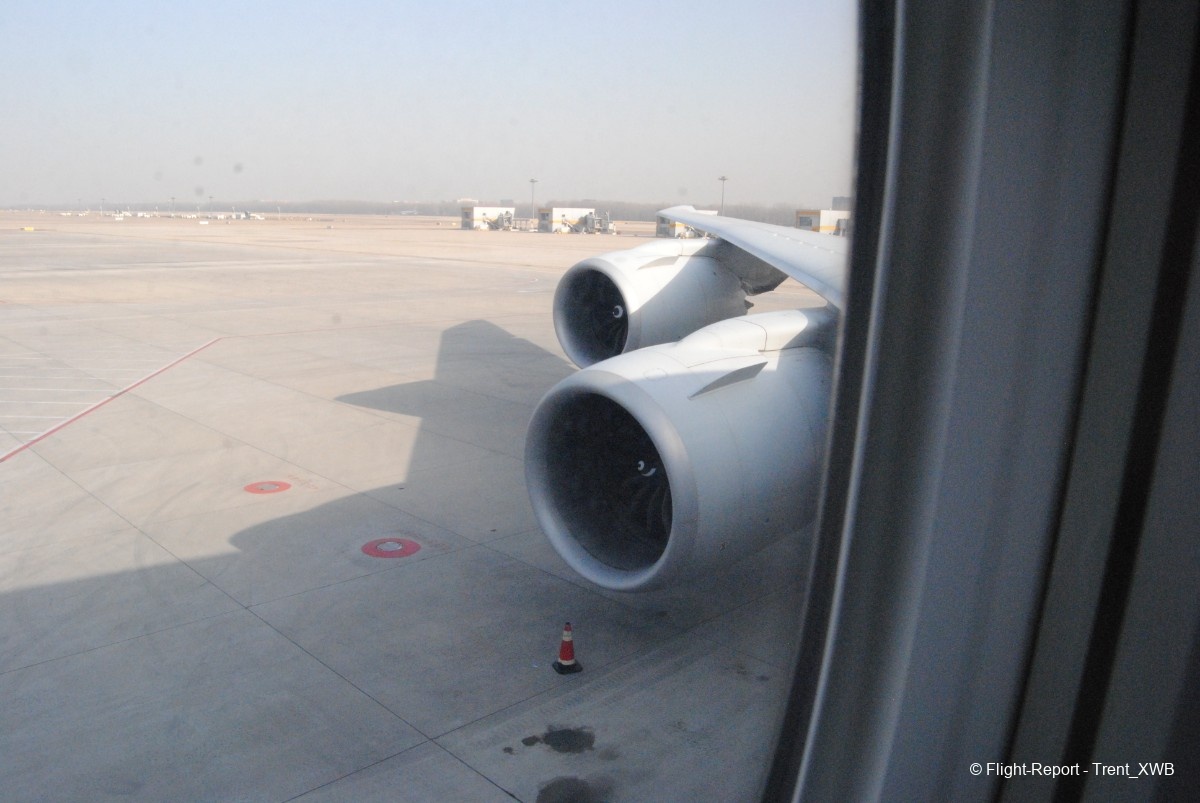
Before leaving the first class cabin I made a glance into windows of 3L suite to capture this magnificent wing / engines view. One can add the third reason for this location of the F cabin: the best views from the windows.
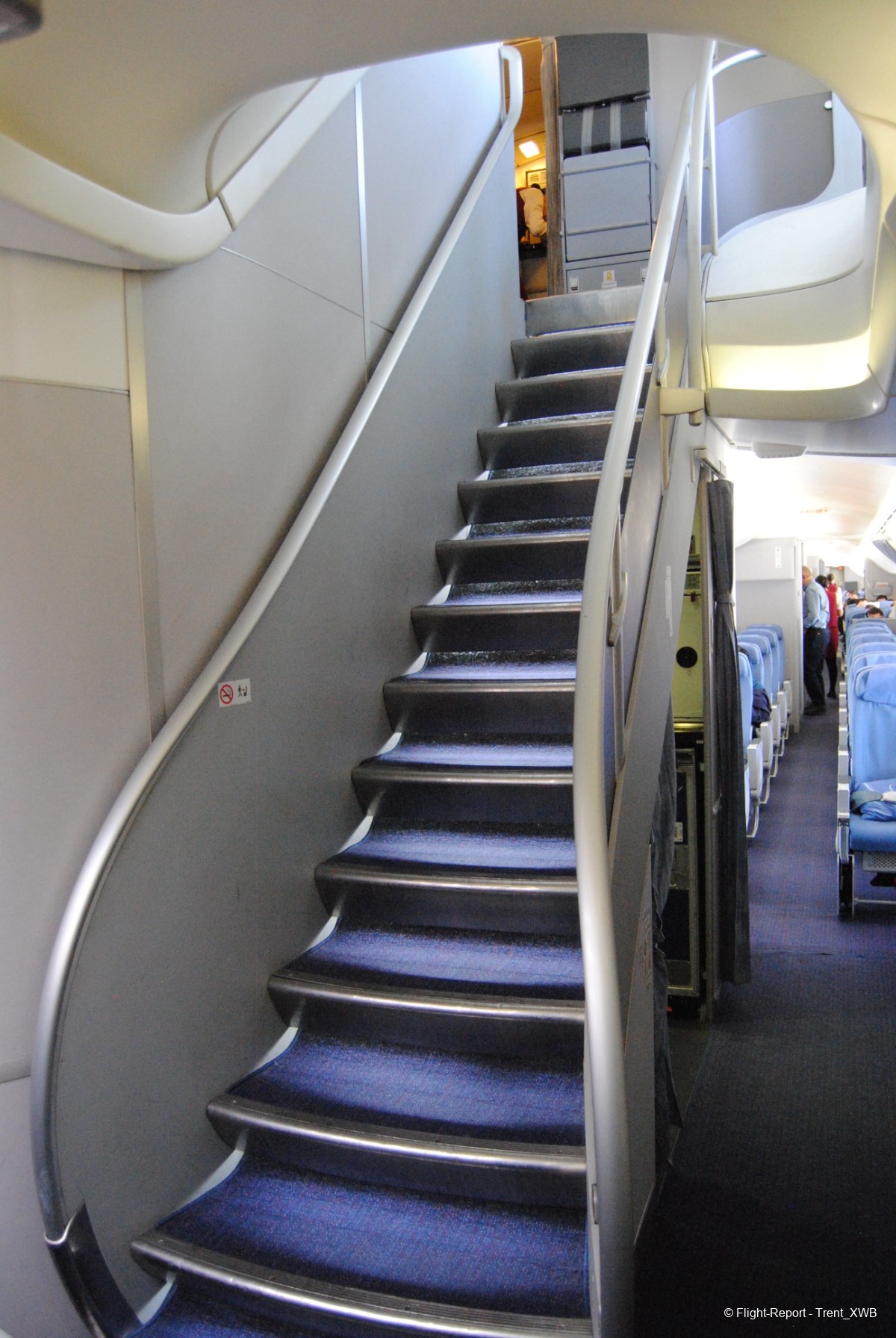
The Stair
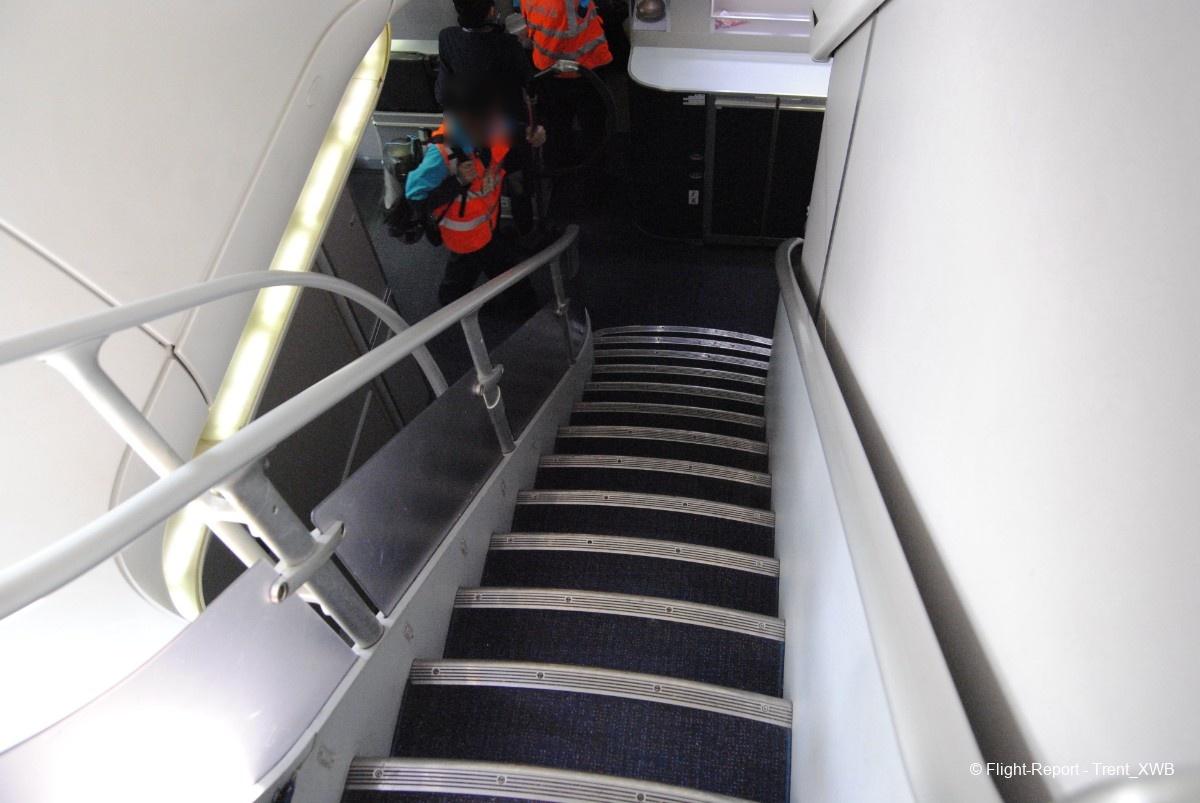
Passing the 2L/R doors, it's impossible not to look at the stair, which is one of the iconic elements of the Jumbo. A glance towards upstairs with some high hopes (which came into fruition as you'll see further).
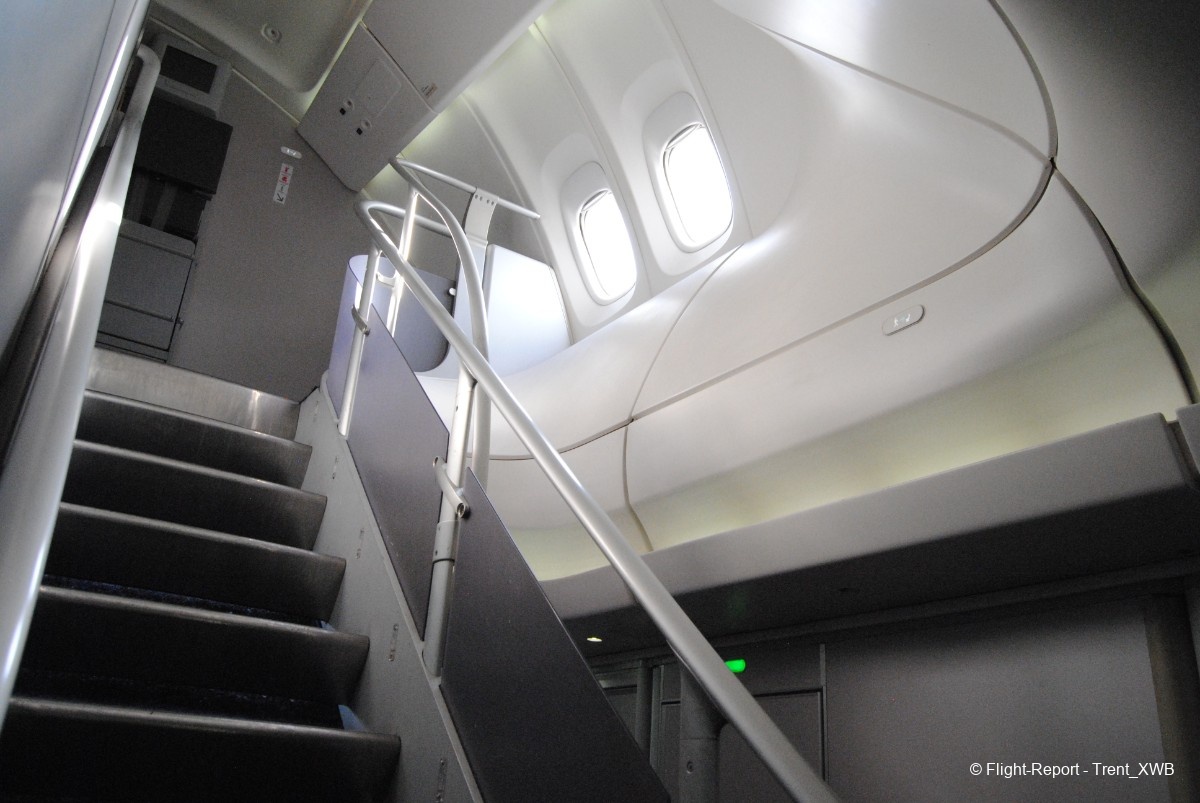
The general view of the stair. This photo was made later inflight, but I put it here for the logical continuity.
The Economy Plus Cabin
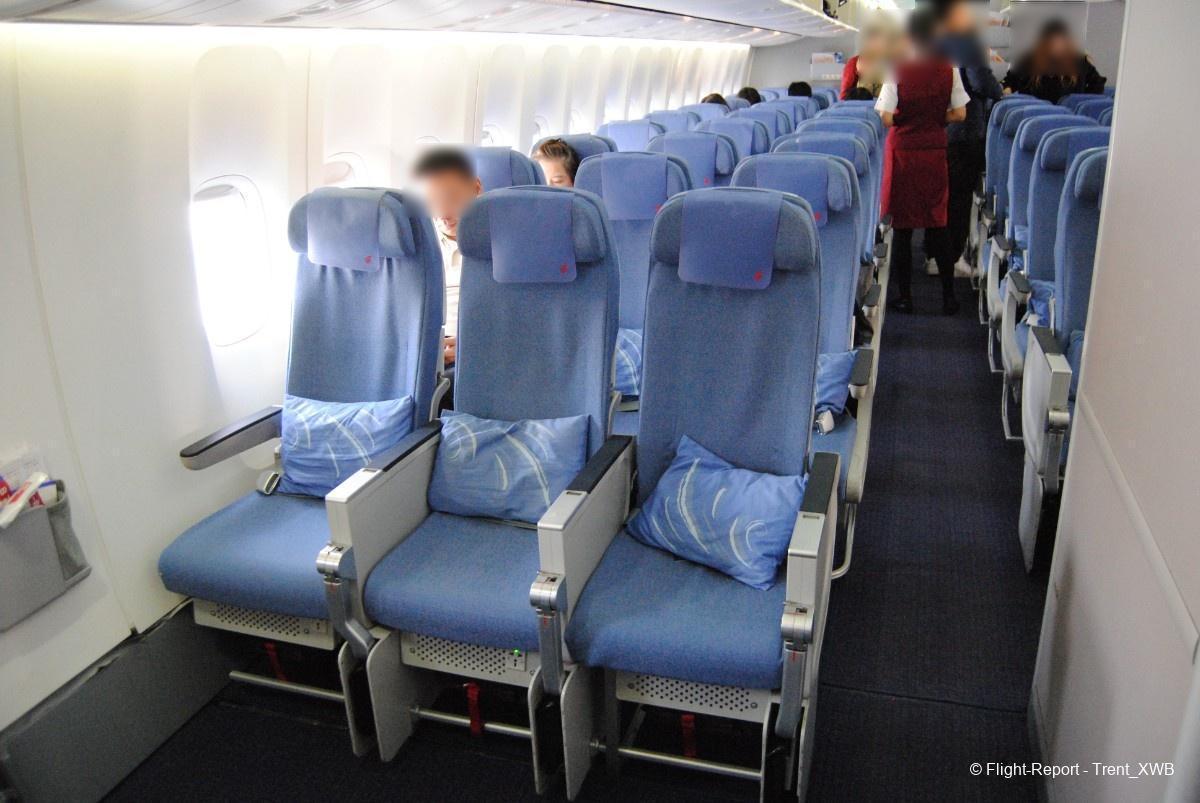
Between 2L/R and 3L/R one can find the "economy plus" cabin (rows 31-37), consisting of bulkhead seat blocks (with fixed armrests) of B/E Aerospace Star Plus seats in 3-4-3 layout (similar to the regular economy layout), totalling 66 seats with very generous row pitch. CA markets this cabin as "premium economy" (as well as the 2 first economy rows in "international" A333s with the similar seats) and usually charges triple amount compared to the regular economy fares, but don't be fooled - this is nowhere near premium economy (as true premium economy cabin requires at least 1 seat less per row and thus much wider seatwidth than in economy, and in B747s and B777s W typically has even less seats per row with 2-4-2 layout), it's just "economy plus" and the service in this cabin is similar to the regular economy, as one can conclude from this video by Jayden Wong. This video also reveals why CA uses bulkhead seat blocks in "economy plus" - due to the large row pitch it's inconvenient to use the seatback tray tables, and thus armrest-located tables are needed. Let's remind that CA's only widebody type having the true premium economy is A359. Thus, the only rational way to find yourself in the "economy plus" of CA B748s is to buy a longhaul premium economy ticket like MXP-PEK-SHA, where the longer segment is operated by an A359 and the shorter segment on a B748 goes as a bonus.
The huge drawback of the "economy plus" cabin is the impossibility to arrange a "poor man's business class" from a triple or a quadruple seatblock by raising the armrests and laying down on 3 or 4 seats if the cabin is far from full. At maximum one can have 2 seats in a quadruple block because only its central armrest is movable. So, don't rush to spend your money on this cabin, unless you get it as a bonus to an A359 long-haul flight.
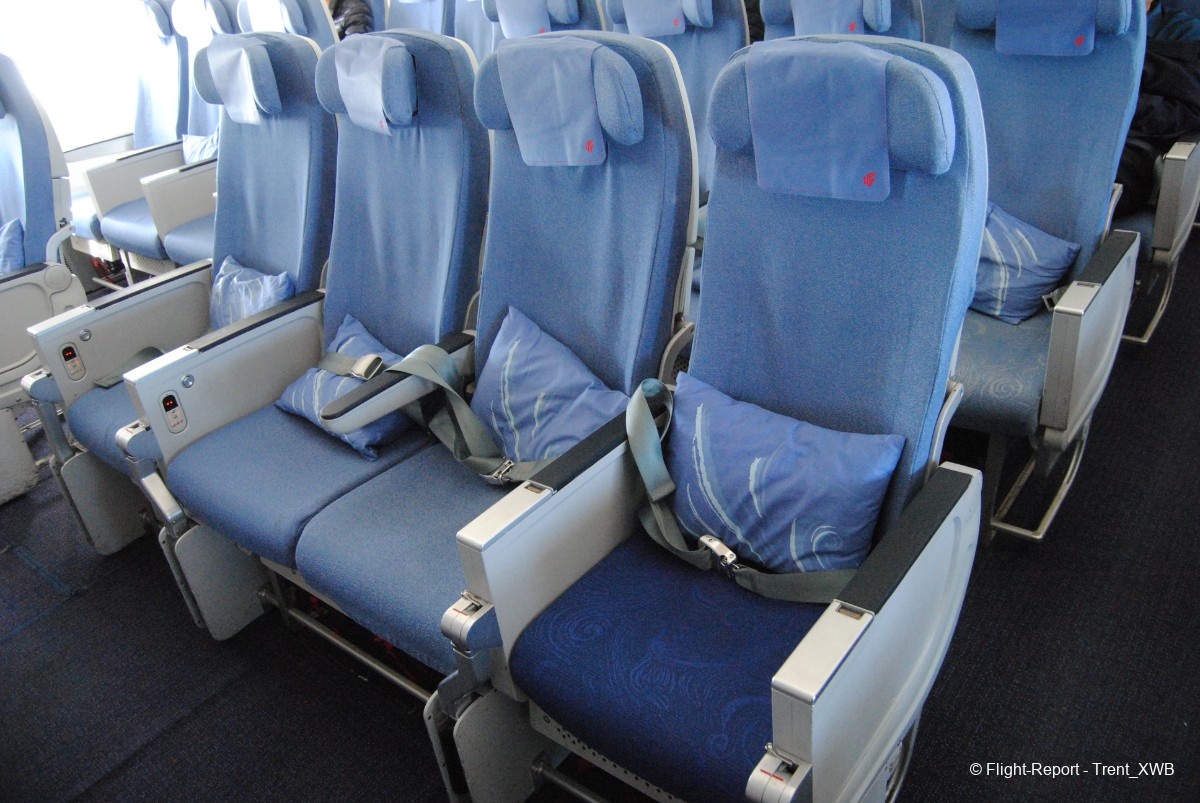
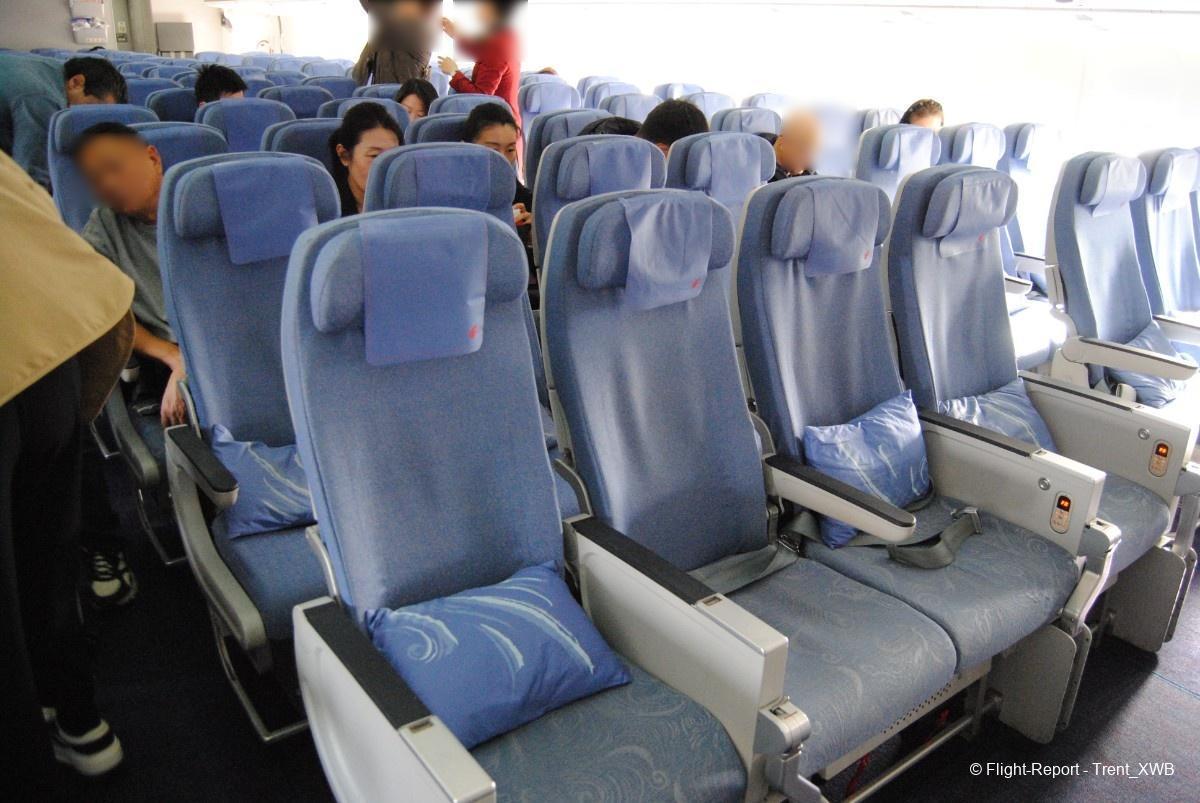
By the way, the photo above gives an answer to the question that may have arisen after reading of the aforementioned article about the interiors: where are the images of phoenix on the economy seats? Well, one can see that in the past some seatblocks had dark blue upholstery with phoenix and some had blue upholstery with phoenix, but they were reupholstered since. One can guess that the original upholstery with phoenix faded away too fast and was replaced, and the same is applicable to the antimacassars (which were replaced with the simple ones, featuring just small CA logo).
The Economy Cabin
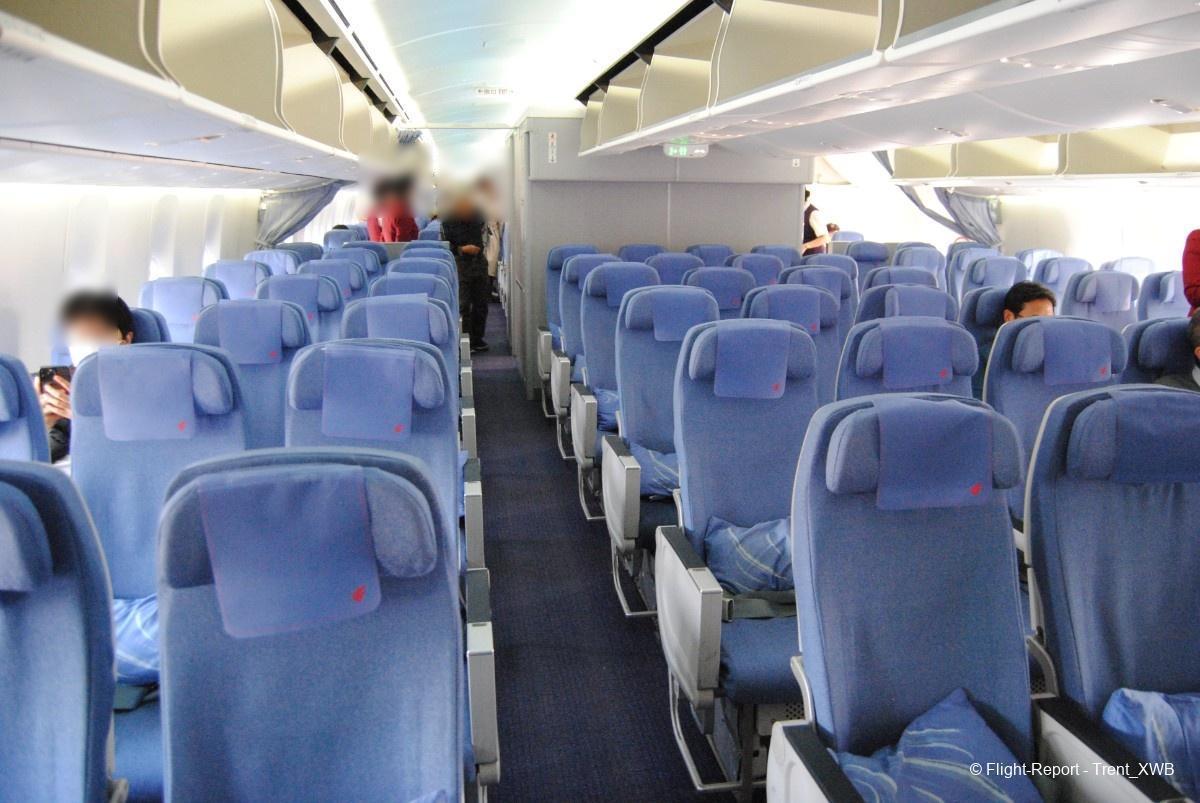
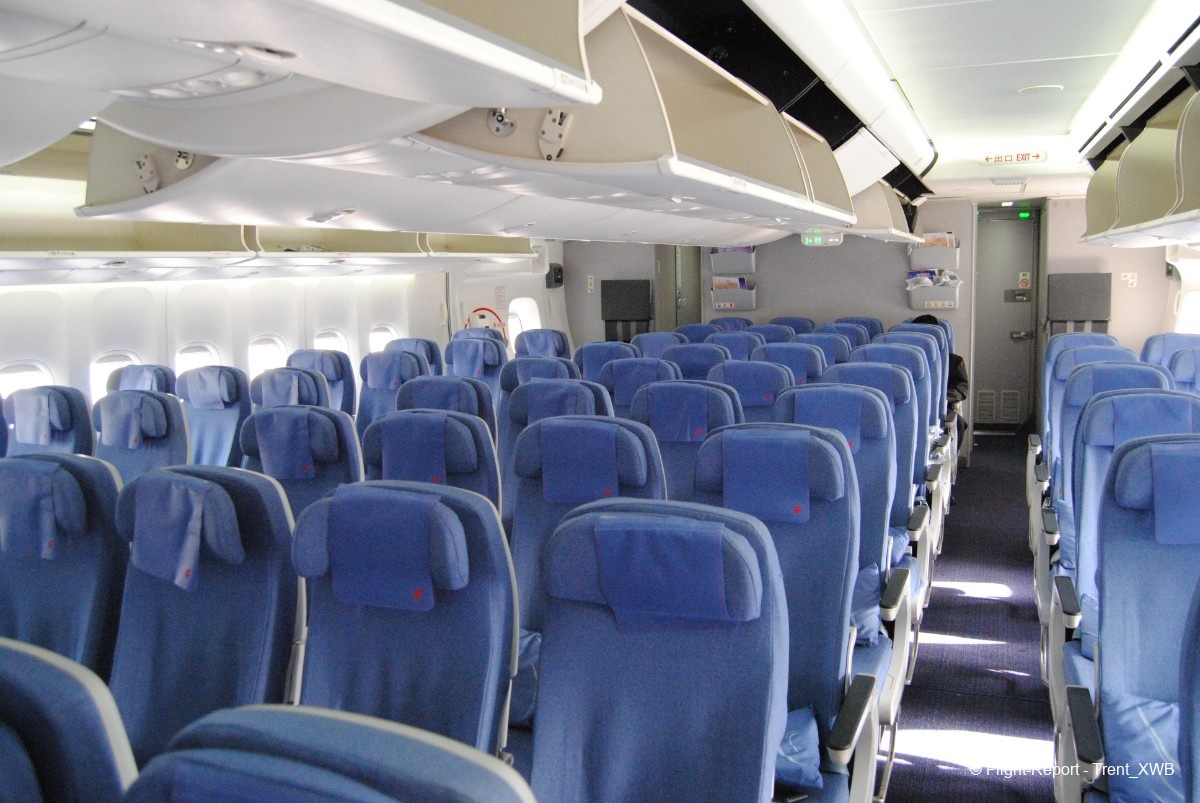
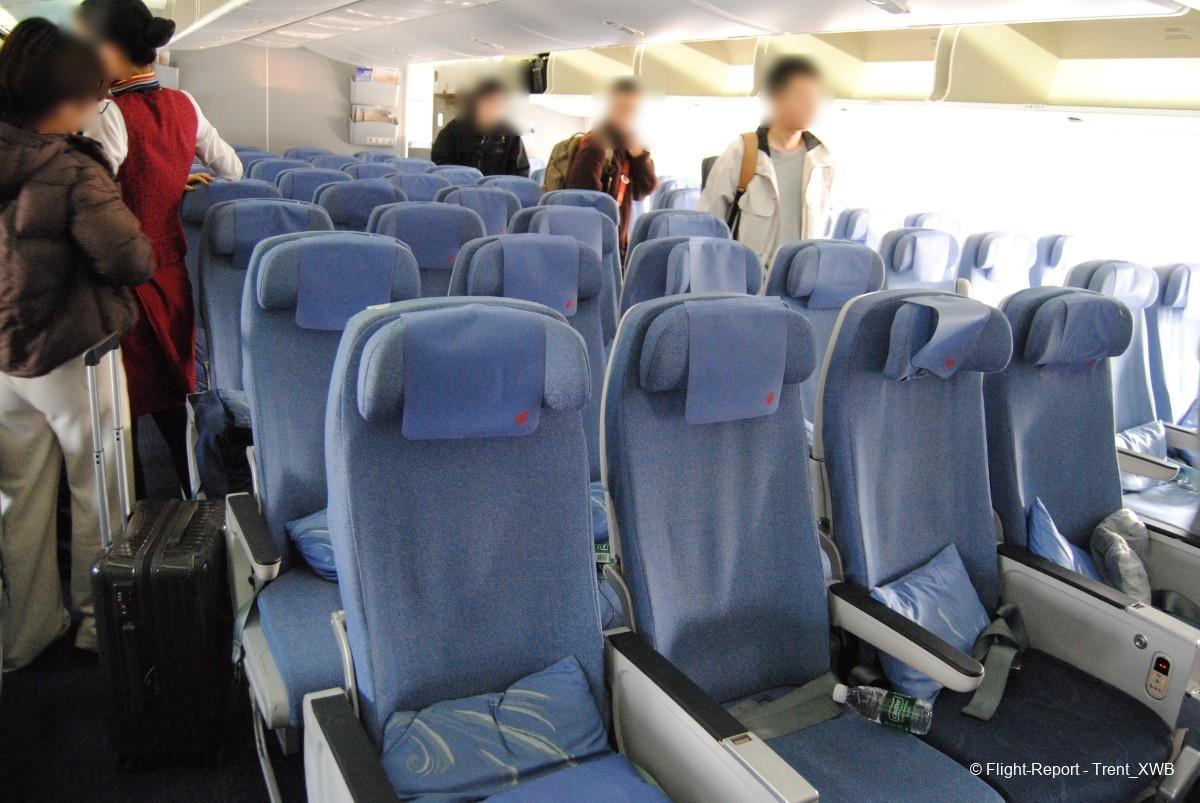
The regular economy consists of 233 B/E Aerospace Star Plus seats in 3-4-3 layout (which has been standard for B747s for almost 25 years since the B742 era). The front regular economy cabin (rows 38-47) is located between 3L/R and 4L/R doors and is separated from the "economy plus" cabin by 4 lavatories, located between 3L/R doors.
The large rear regular economy cabin (rows 48-64) is located between 4L/R and 5L/R doors and is separated from the preceding economy cabin by a large galley near 4L/R doors. One can also see the remnants of the original phoenix upholstery on the bulkhead quadruple seatblock (row 50).
The rows in the rear part of this cabin don't have evident traces of the phoenix - just dull blue upholstery. In the very rear there are 4 lavatories and the door of the crew rest bunk, whose protrusion is noticeable over the very last rows. By the way, the man sitting in 64D is kind of "air marshal", who is responsible for the onboard security.
The Economy Seat: B/E Aerospace Star Plus
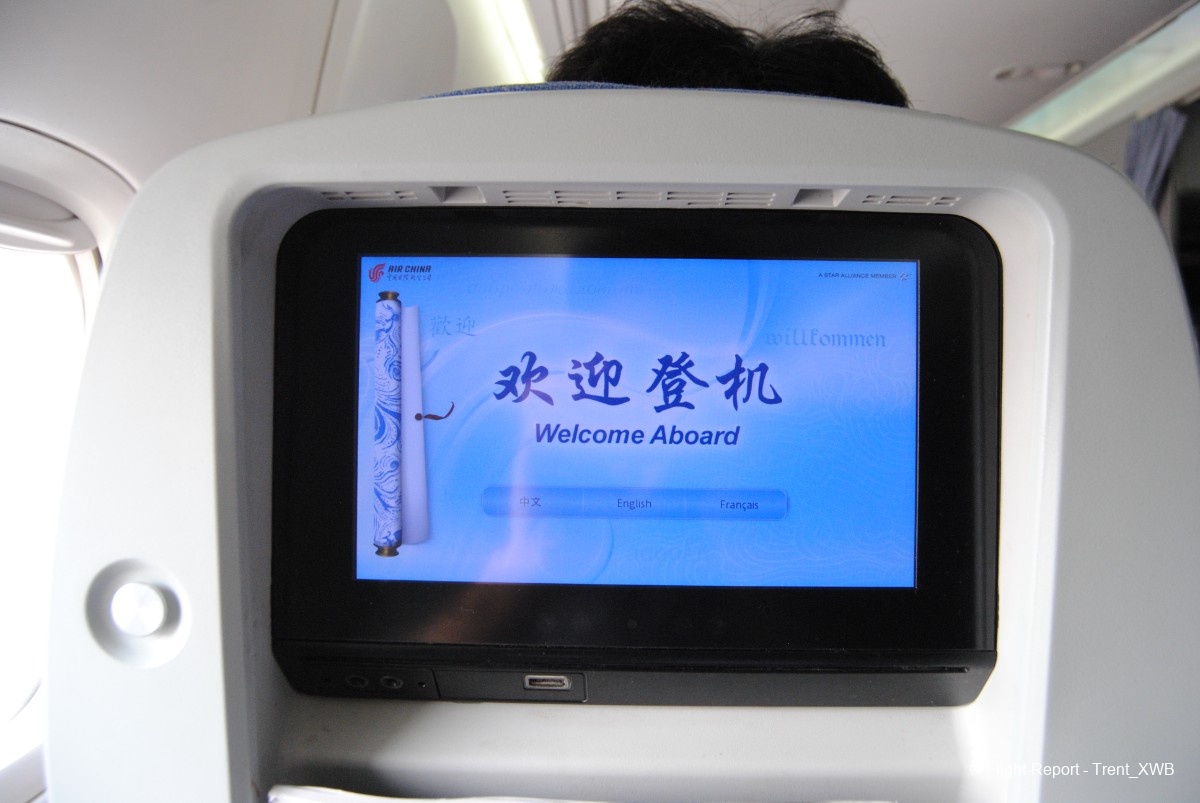
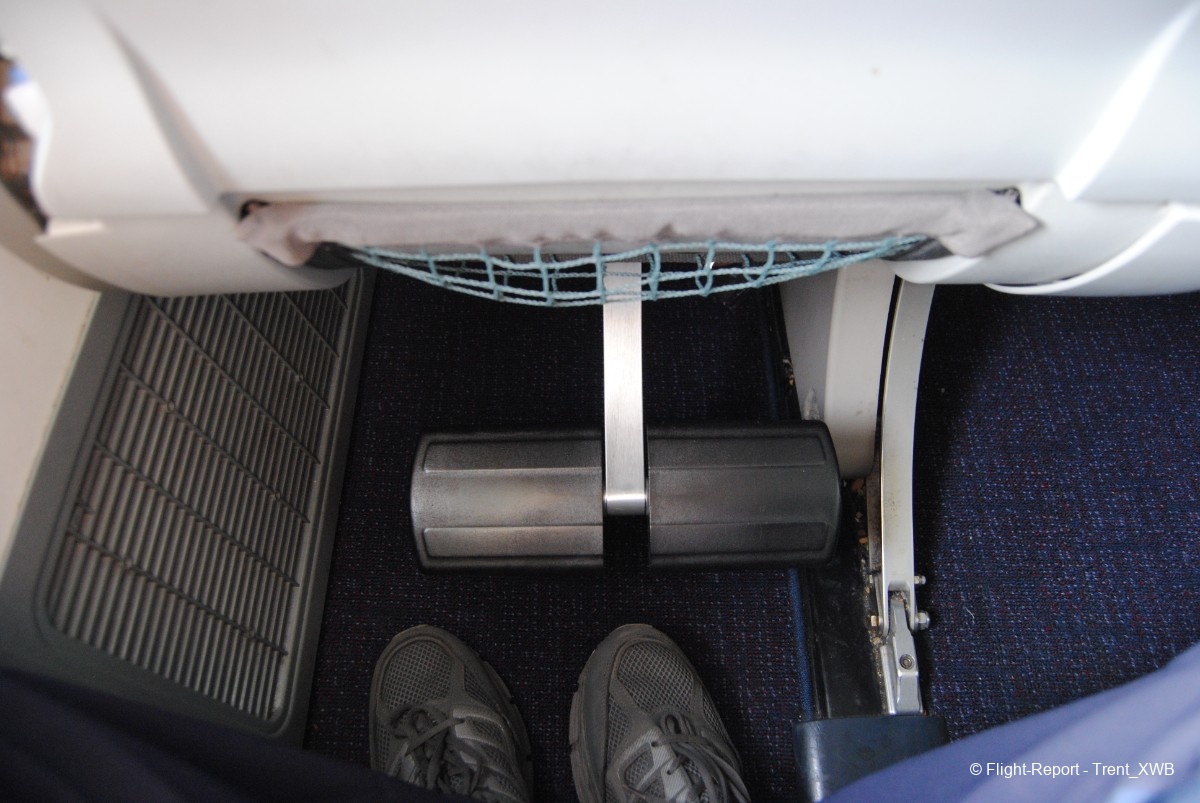
My seat 50A is located in the front part of the large rear economy cabin. The seat model, as was said above, is B/E Aerospace Star Plus. The seat has adjustable headrest, fabric upholstery (one can notice that the seat bottom of 50A retains the old "phoenix" upholstery, whereas 50B does not!), Panasonic eX3 IFE with rather smallish (by today's standards) but responsive screen and USB port, coat hanger, upper hard literature compartment, bi-fold tray table with cup holder, lower soft seat pocket, adjustable legrest and underseat universal power socket. The IFE is powered by an underseat box which is, thankfully, rather slim and not bothersome (for comparison, Panasonic eX2 IFE in LH B748 economy is powered by very bothersome box and its screens have completely deteriorated for more than decade). Waiting on the seat and in the seat pocket were, respectively, pillow (as per aforementioned article, its design contains elements of the phoenix) and headset (of rather good quality). The armrests were in bad state and were literally dangling in lateral direction, making one unable to properly measure the seatwidth. Thankfully, on my return CA1558 flight on B-2487 the seat was in much better state with sturdy armrests, so the answer is 17.3" (the same as in 3-3-3 Dreamliners). B747 in 3-4-3 layout with the standard aislewidth (ample, compared to 3-4-3 B777's and 3-3-3 B787's narrowish aisles) and full-sized armrests cannot have seatwidth wider than 17.3" (for comparison, KE B748s with Safran Z300 seats also have 17.3" seatwidth and LH B748s with Recaro CL3520 seats have 17.1" seatwidth). No one B747 passenger operator opted for narrower aisles and wider seats. The adjacent seat 50B remained empty, significantly boosting the lateral space.
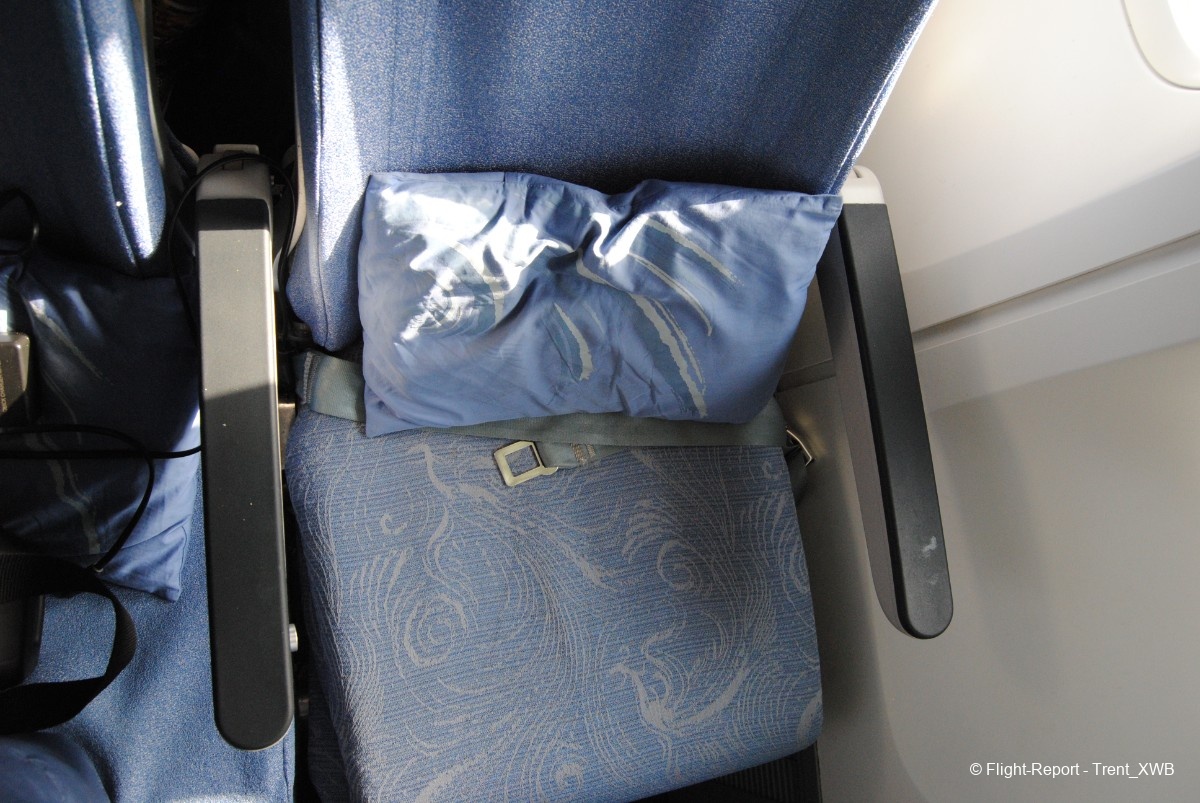
And now it's the moment to reveal the provenance of this seat model (one may have noticed that it's named in the aforementioned article about interiors). B/E Aerospace Star Plus is an example of what can be called a "Star Alliance delusion". In the late 2000s - early 2010s the leading alliances - Star Alliance and Skyteam - were obsessed with standartization of the hard product across the member airlines. In the case of Star Alliance it was Lufthansa who was pushing the idea of the unified economy seats, which resulted into production of 3 seat models of so-called "Star Plus" lineup:
1) B/E Aerospace Star Plus, which was produced from 2012 to 2017 and is effectively a deep modification of well-known Collins Pinnacle (B/E Aerospace became a part of Rockwell Collins). This model firstly made their way to CA "international" A333s (2012-2017-built ones with C30_Y+16_Y255 layout), then - to LH A346s in 2014 (when they were reconfigured and got updated cabins) and then to CA B748s also in 2014.
2) Recaro CL3520 "Star Plus edition", which was produced from 2012 to 2015 and was installed into LH B748s. These seats have common armrests and seatbacks with B/E Aerospace Star Plus.
3) Another Recaro model (aerolopa states that it's CL3510, which doesn't seem to be correct), which was installed into LH A343s when they were reconfigured around 2014. This model has common armrests with the two former models, but a simplified seatback with single-piece tray table.
Sadly, but it seems like every seat, developed with the participation of Lufthansa, is a disaster (or close to disaster) in terms of comfort. Recaro CL3520 "Star Plus" in LH B748s, which I experienced on MEX-FRA and FRA-MEX flights in 2016-2017, is literally the worst long-haul economy seat model I've ever sat in (even worse that the ultrapopular slimline CL3710). B/E Aerospace Star Plus is also the seat I already experienced, as in 2017 I flew MEX-MUC on a LH A346: even though the economy cabin on that flight was far from full and I had 2 seat at my disposal, I didn't manage to feel comfortable and was unable to sleep the whole flight. But at least I have to admit that this seat was anyway better than LH B748's Recaro.
And now, having settled in the B/E Aerospace Star Plus seat of CA's B748, I immediately felt deja-vu: despite looking like having decent padding, the seat is de-facto hard and quite uncomfortable, just like in LH A346 8 years ago. It's hard to believe, but Lufthansa managed to spoil even the excellent Collins Pinnacle seat, turning it to something very mediocre (speaking of Recaro models, they're badly designed initially, so it's hard to make them worse than they are). B/E Aerospace Star Plus is definitely not a seat I dream to sit in on a long-haul flight to/from IAD, JFK or FRA, so I was glad having experienced it just on short domestic flights this time. For comparison, all my longhaul flights in the standard Pinnacles (GRU-MXP on former JJ B763, AMS-MEX-AMS on AM B789s, DME-ATH-ADD on ET B789, BUD-PVG on FM B789) always were very comfortable.
A couple of words about "Skyteam delusion" with the standartization of economy seats in late 2000s - early 2010s. It was Air France who was pushing Sicma Airgonomic seats (Sicma later became a part of Safran), which had very mediocre design and rather bad ergonomics, to the member airlines. These seats made their way to AF A380s (retired during the pandemic), some AF B77Ws (at least the ones in high-density "leisure" layout; they were reconfigured during the pandemic), CZ A380s (retired shortly after the pandemic), SU A333s (these aircraft were meant to be replaced by new A359s before February 2022, but are retained indefinitely due to the sanctions) and VS A333s (VS back then was not a Skyteam member yet, but had long and strong ties with this alliance). It's crazy, but, as I mentioned earlier, Sicma Airgonomic seats even made their way to the oldest A333s and A332s of CA - a Star Alliance member!
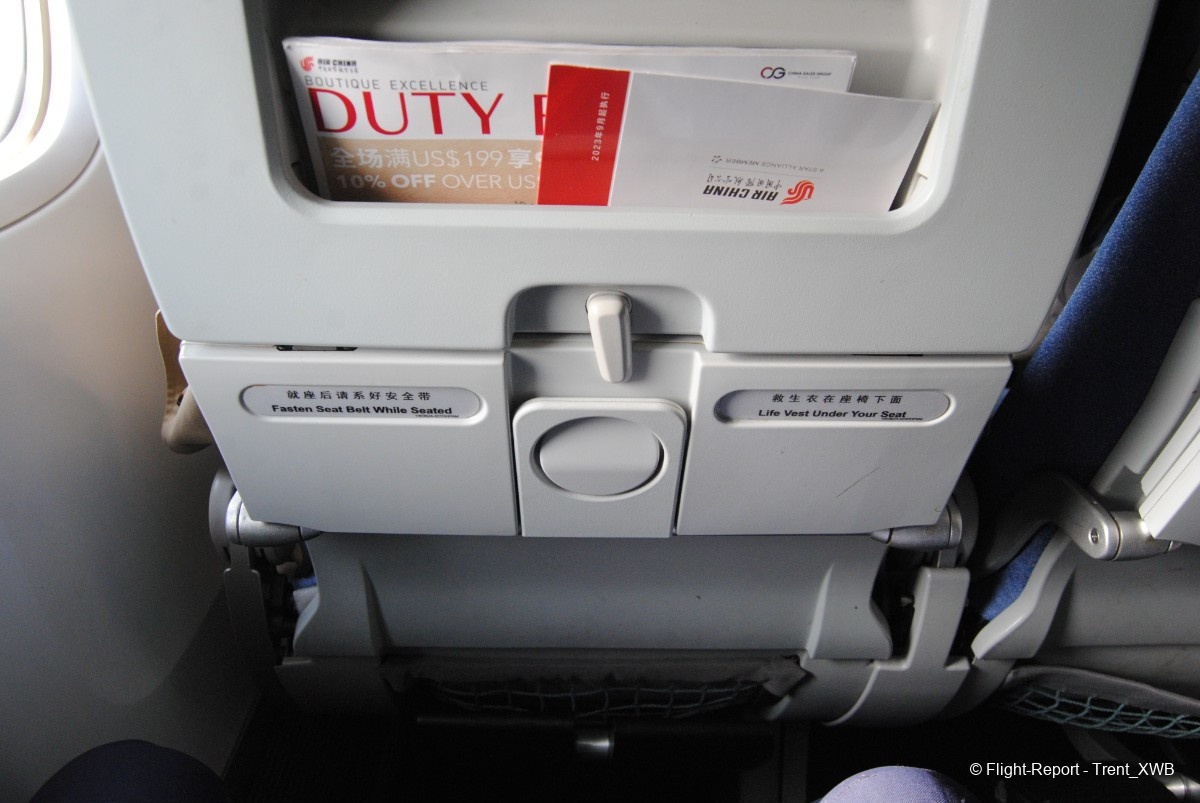
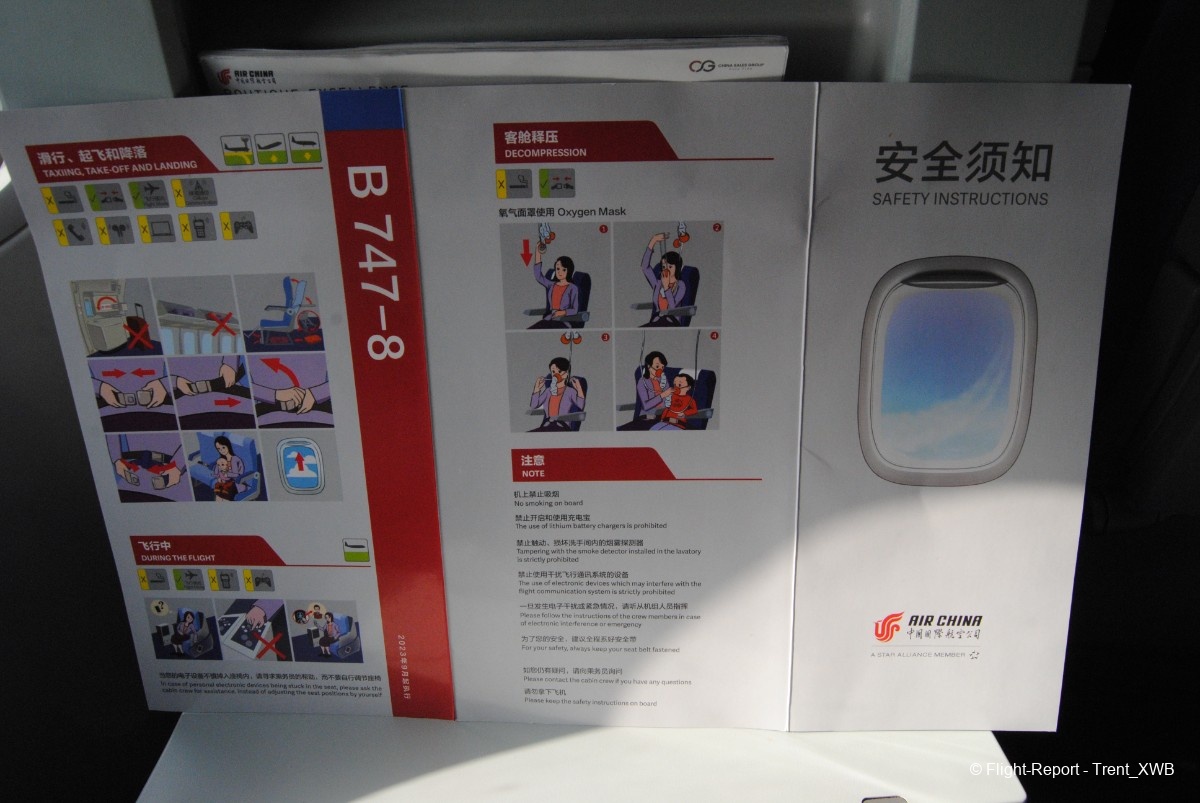
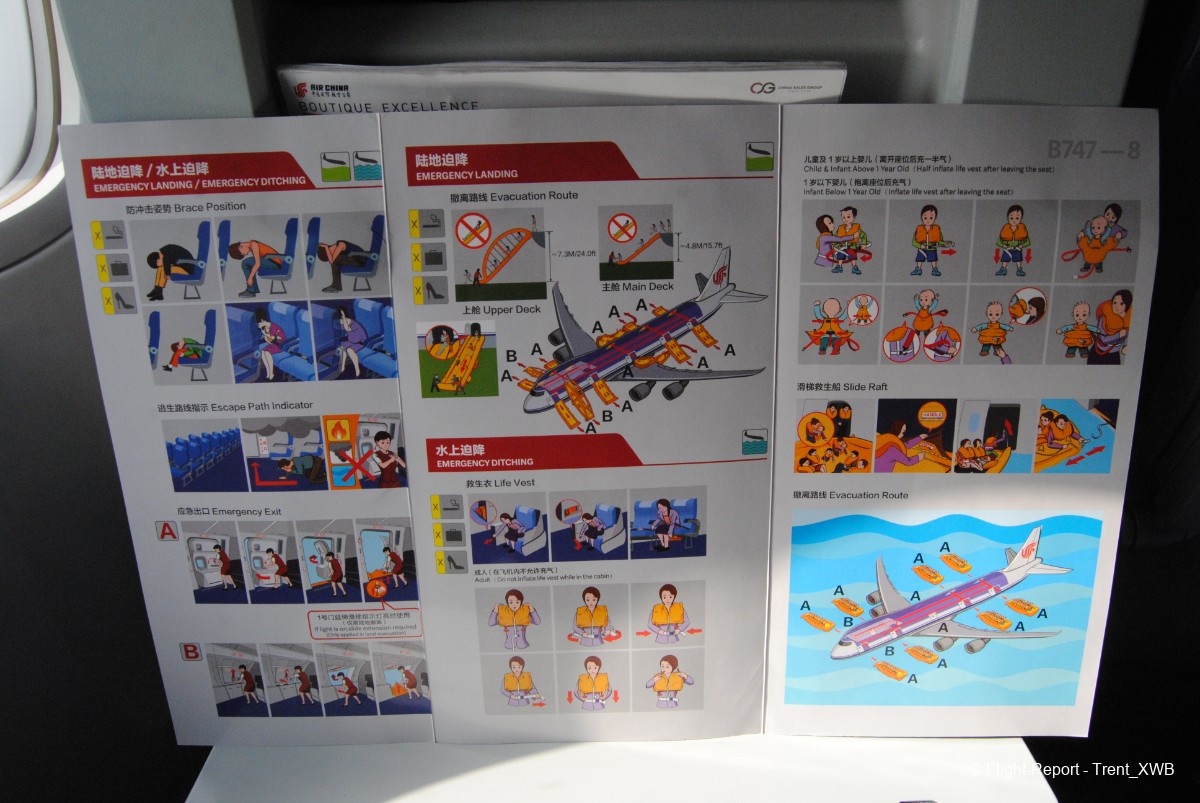
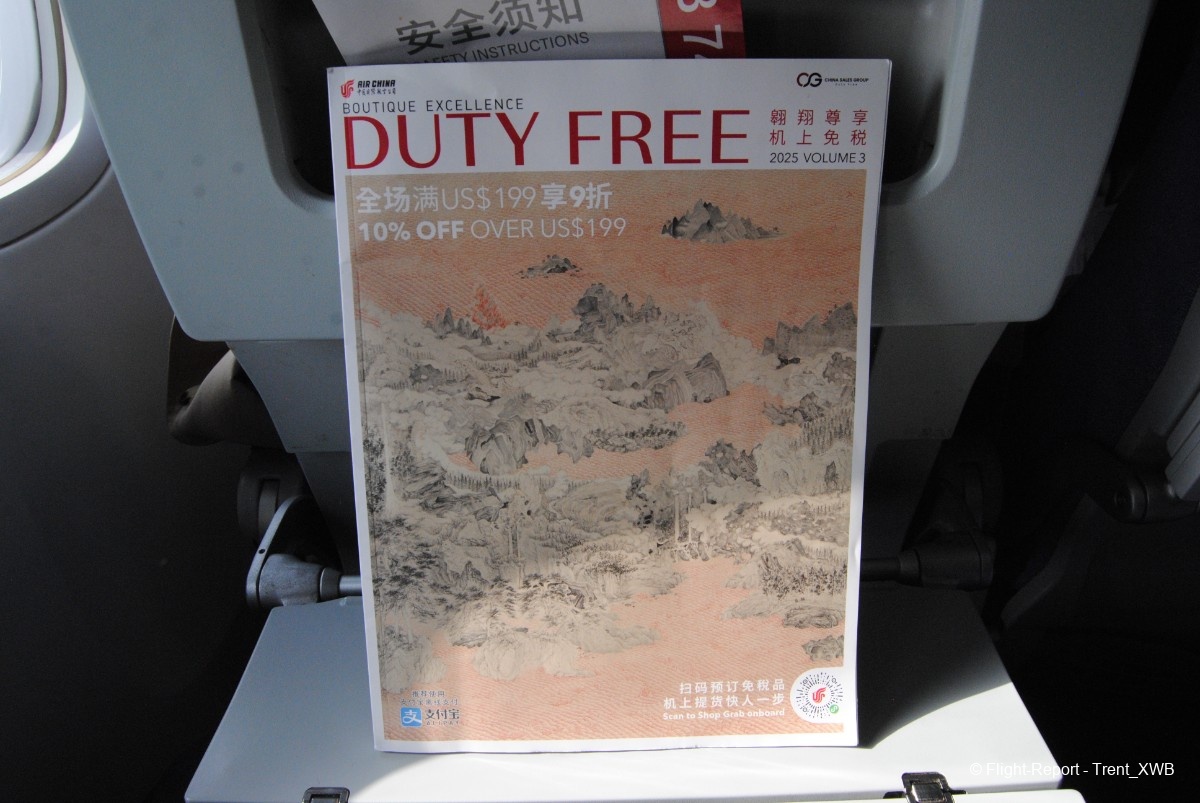
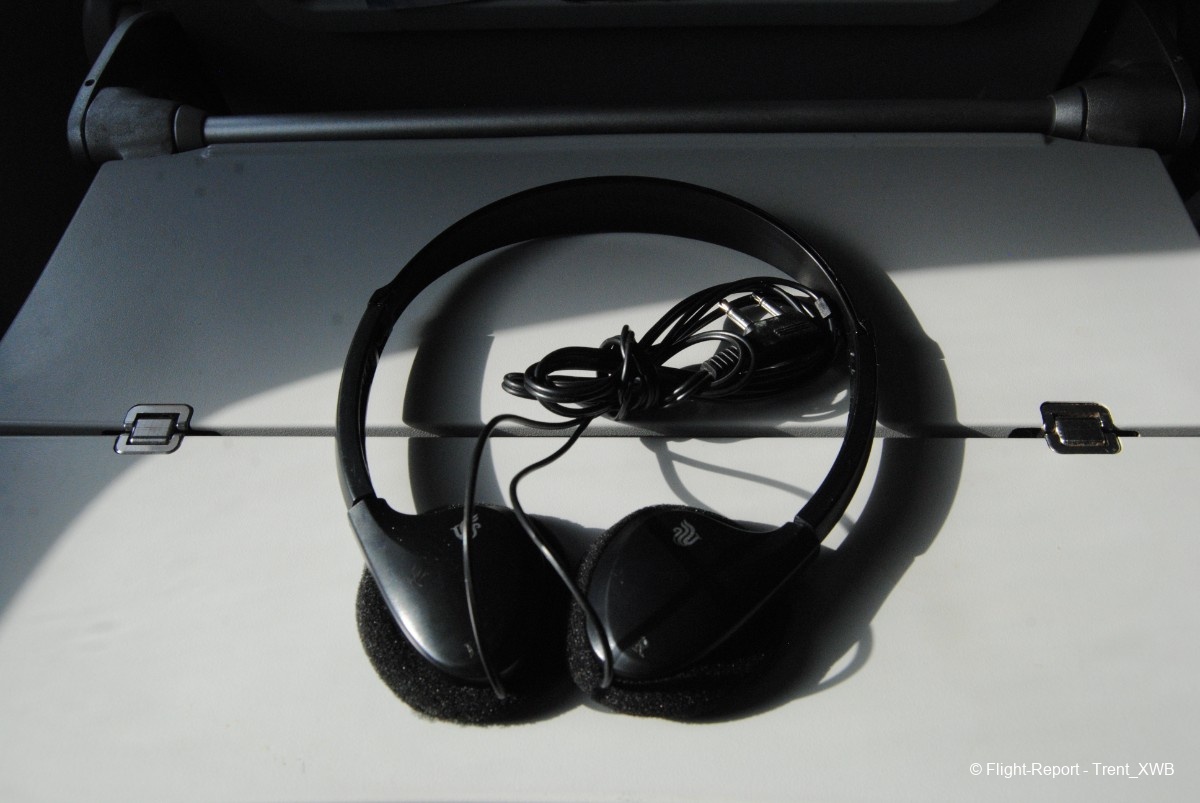
Let's return to our muttons. The literature compartment contained safety card and duty-free magazine, and inside the seat pocket there were headphones of rather good quality.
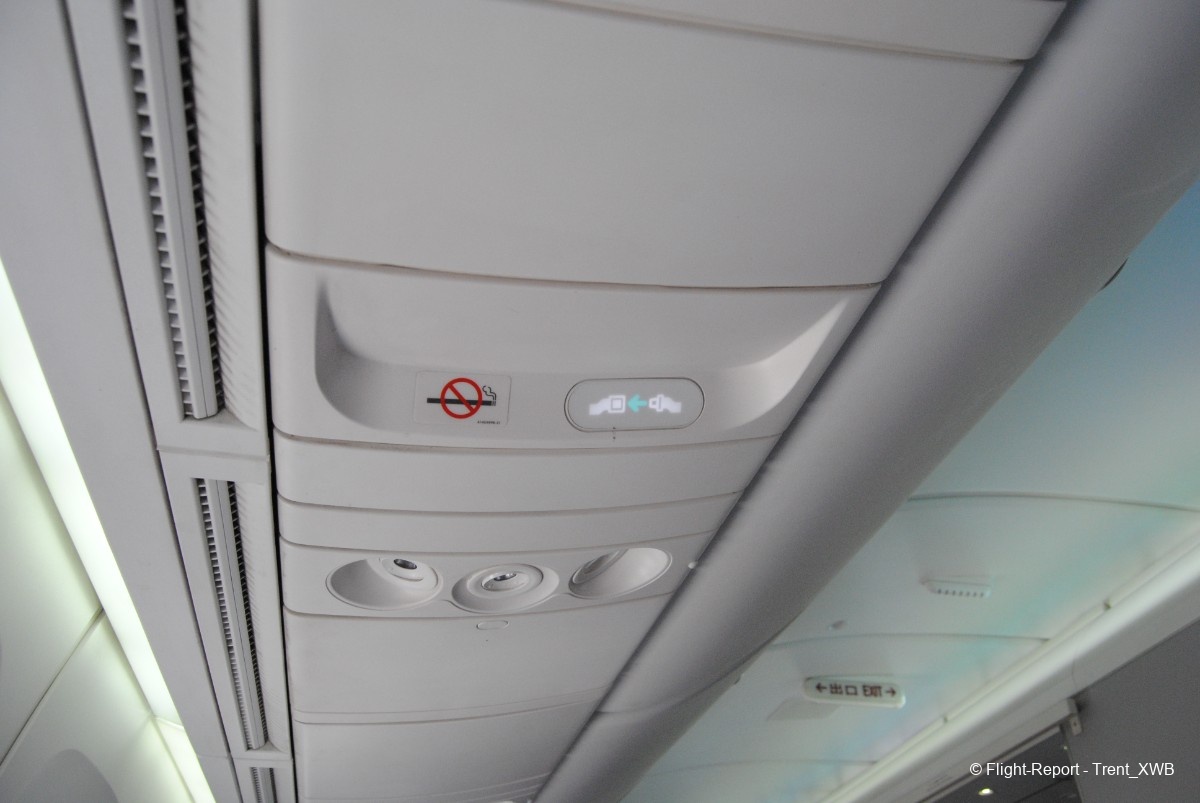
The overhead panel is standard for B748, without airvents. As one can see, the pre-departure moodlighting is turned on.
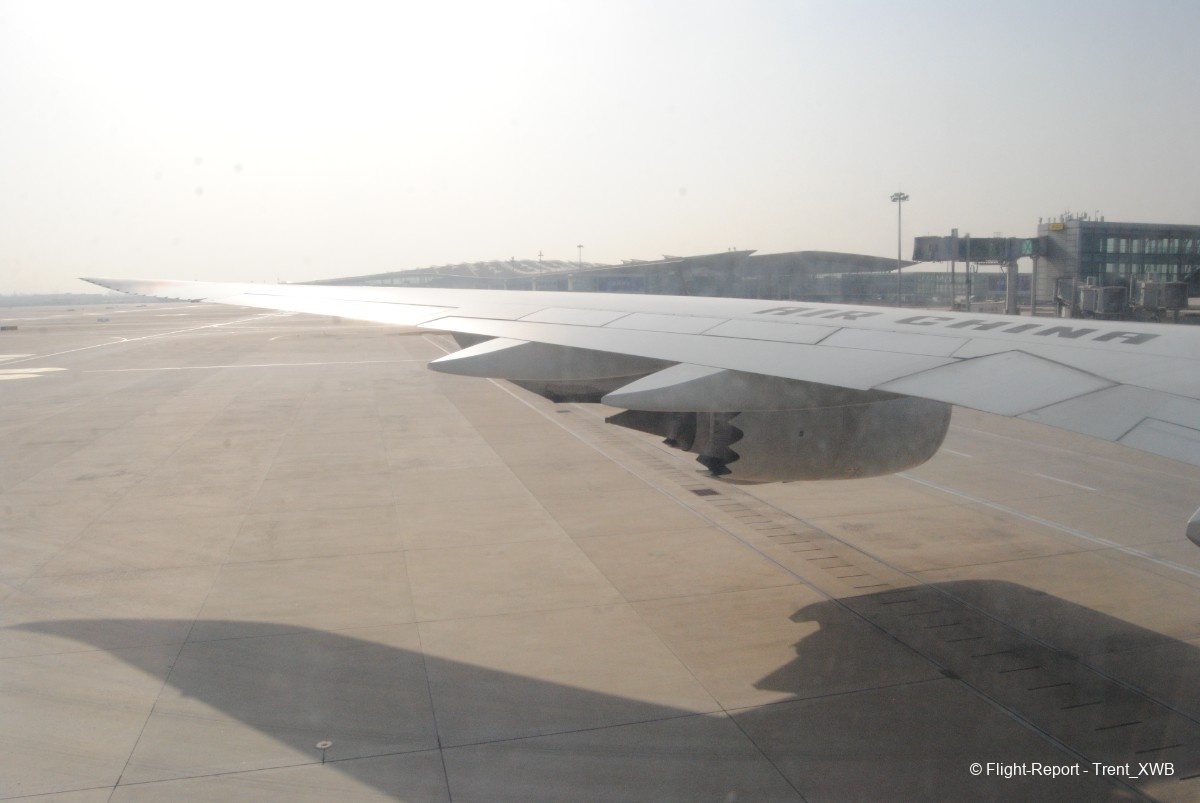
A view from the window (needless to say that 50A has 2 well-aligned windows). Row 50 provides a rather good view of the wing (and its control surfaces) and of the outer engine. On the backdrop is T3C with its wave-like roof.
The Flight
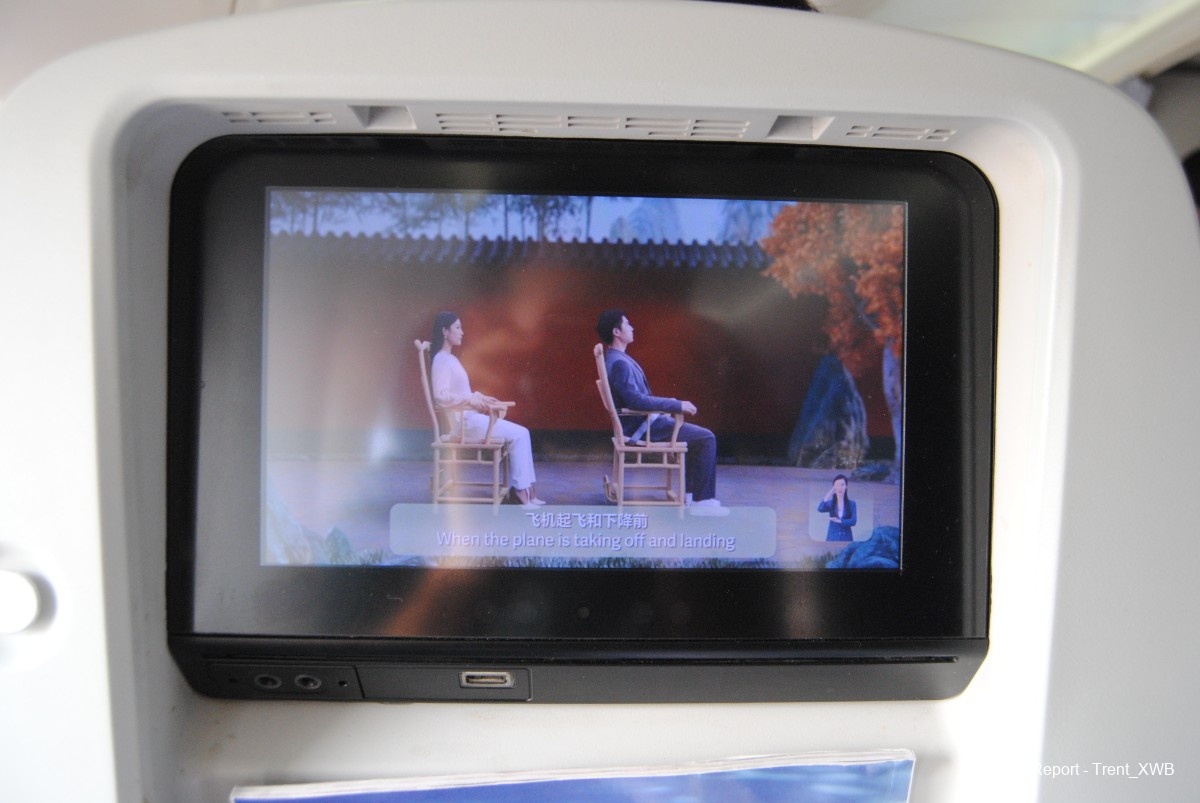
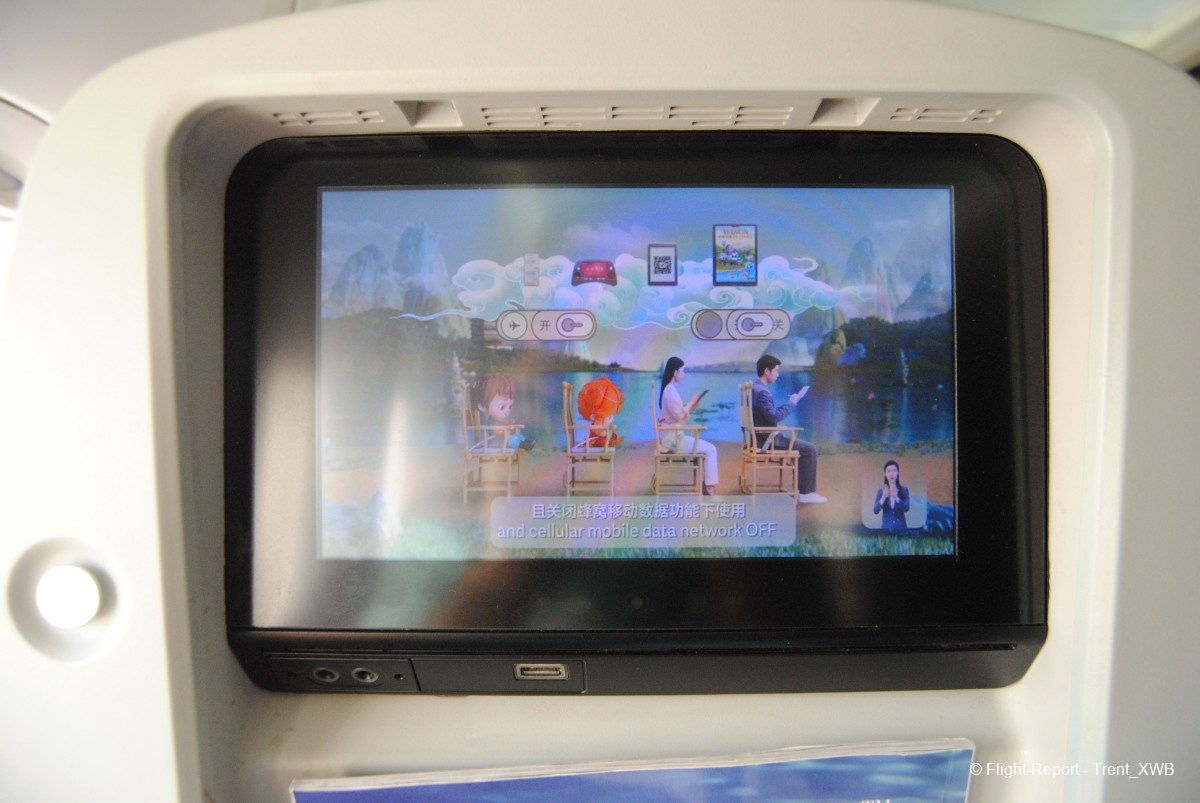
Pushback begins and safety video is played. I found it to be very nice and creative, promoting the Chinese identity and symbolics.
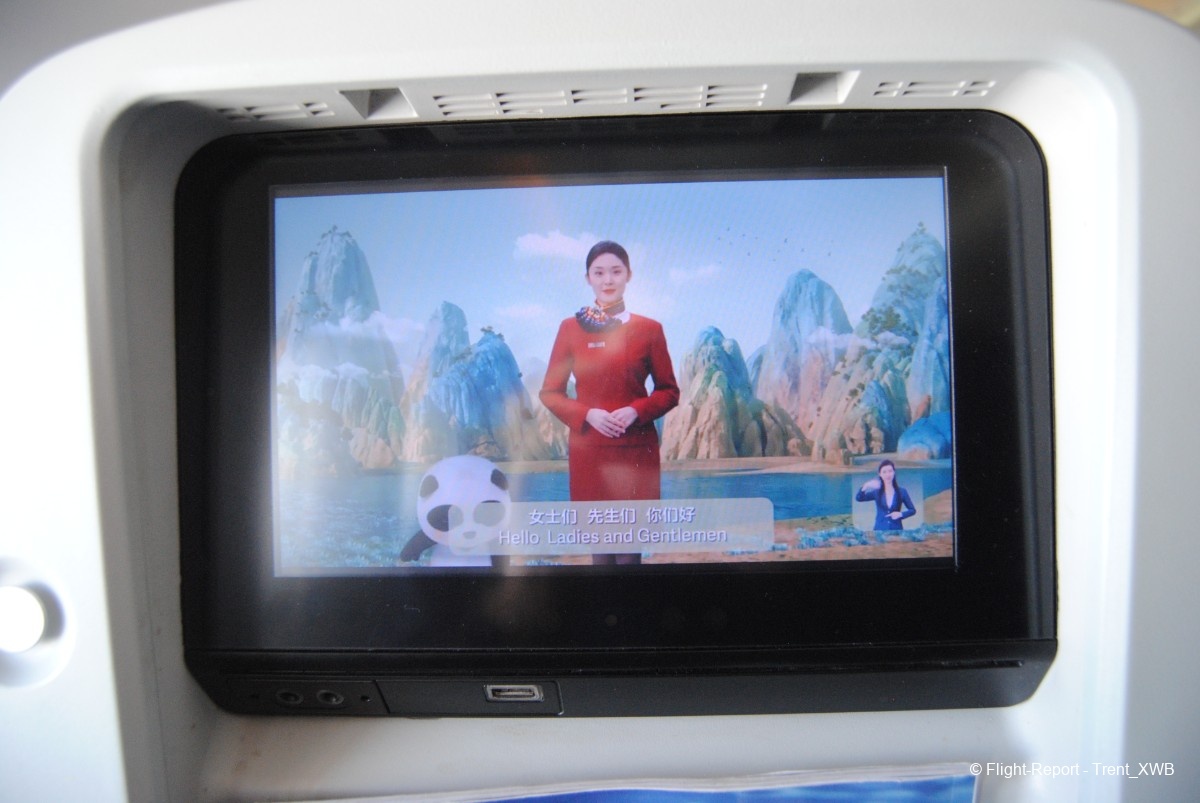
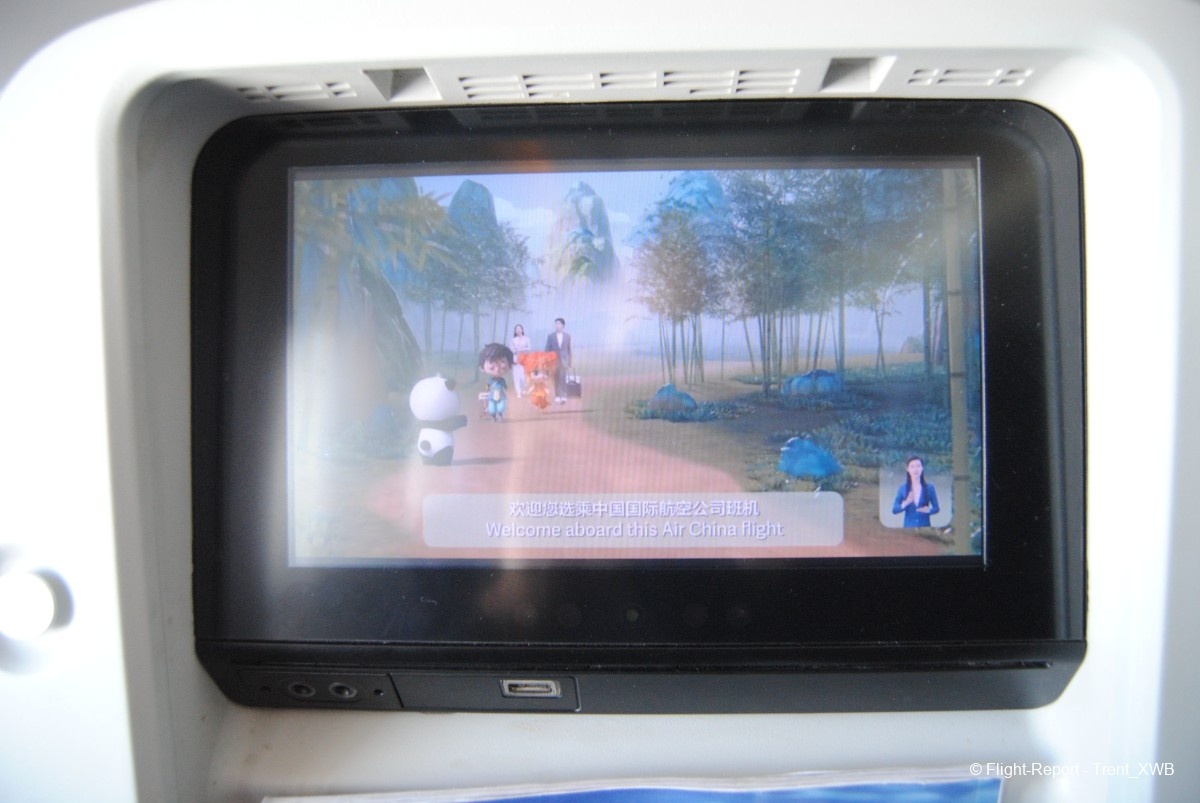
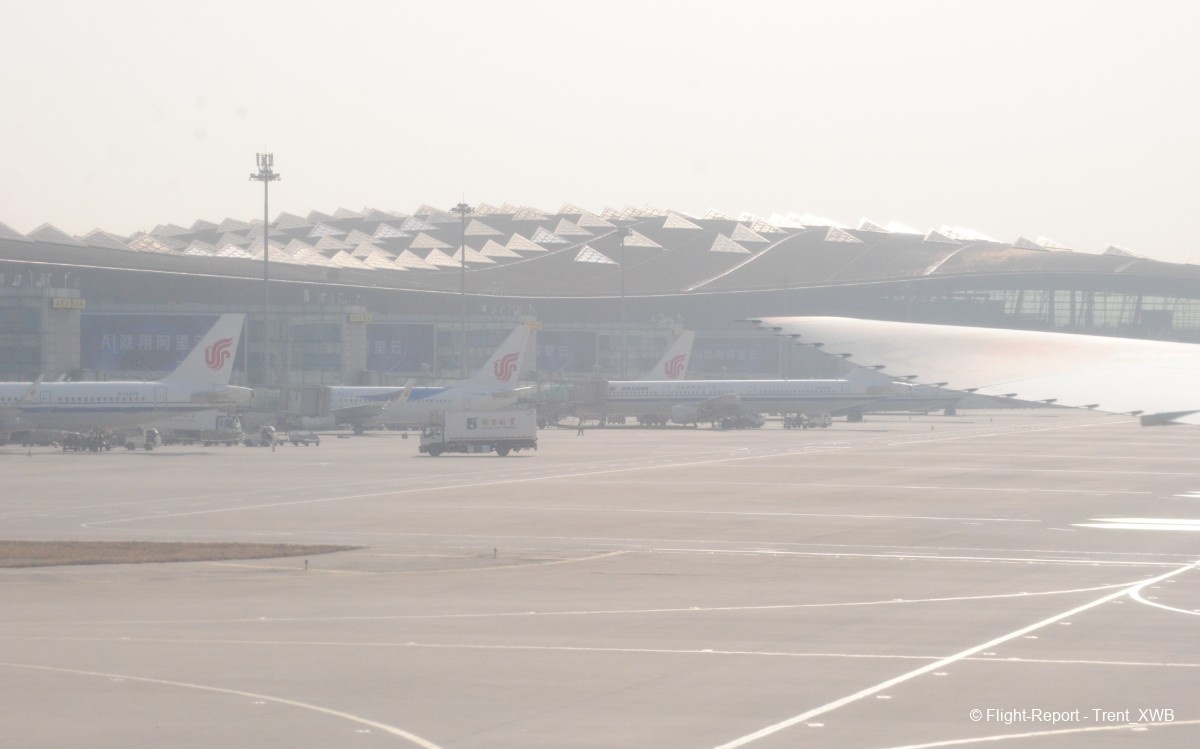
Taxiing past T3C with CA narrowbodies.
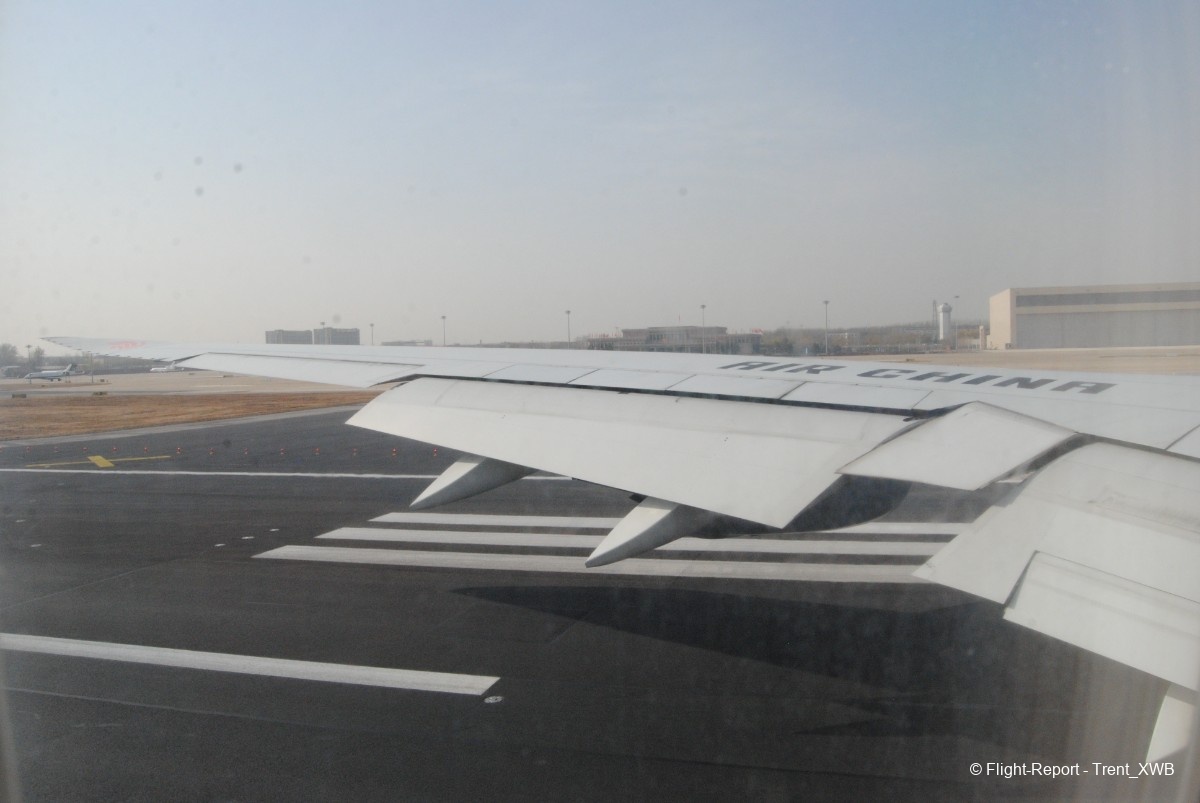
Lining up with 18L/36R runway, located between T3 and T2. With the wing mechanization in takeoff config, one can clearly see, how the features of B777 and B787 wings were implemented into the classic B747 wing.
Takeoff video.
Takeoff with T2 in sight with HU and MU aircrafts.
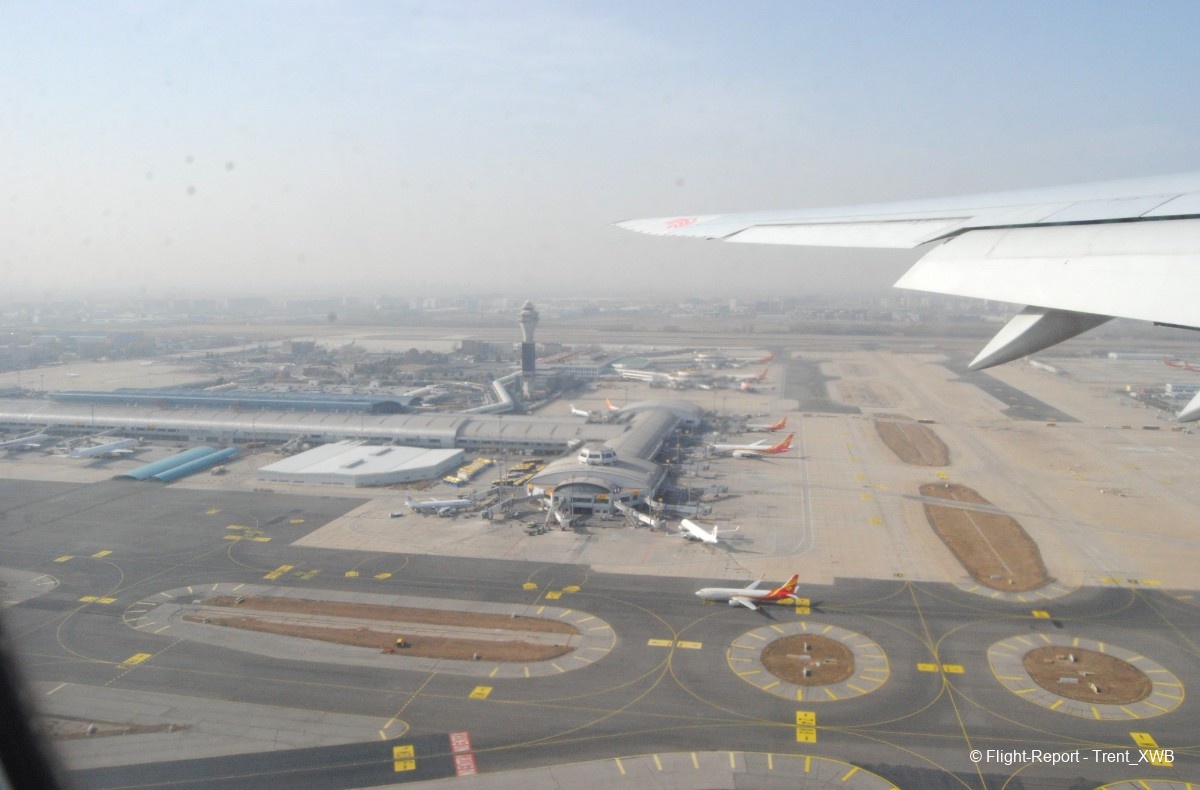
Maneuvring over the Beijing's smog. Smog over the largest cities is the problem China is yet to solve compared to its East Asian neighbours like Republic of Korea, Japan and Taiwan.
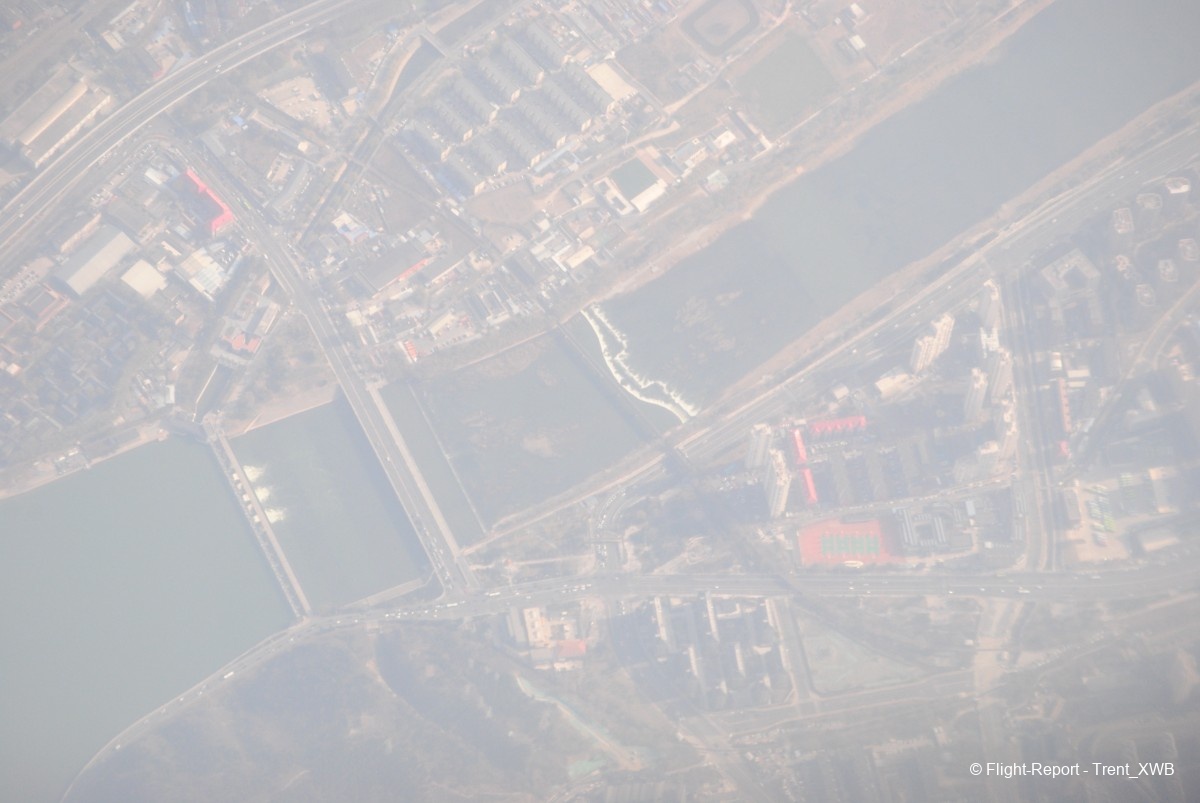
Overflying a river with a small waterfall.
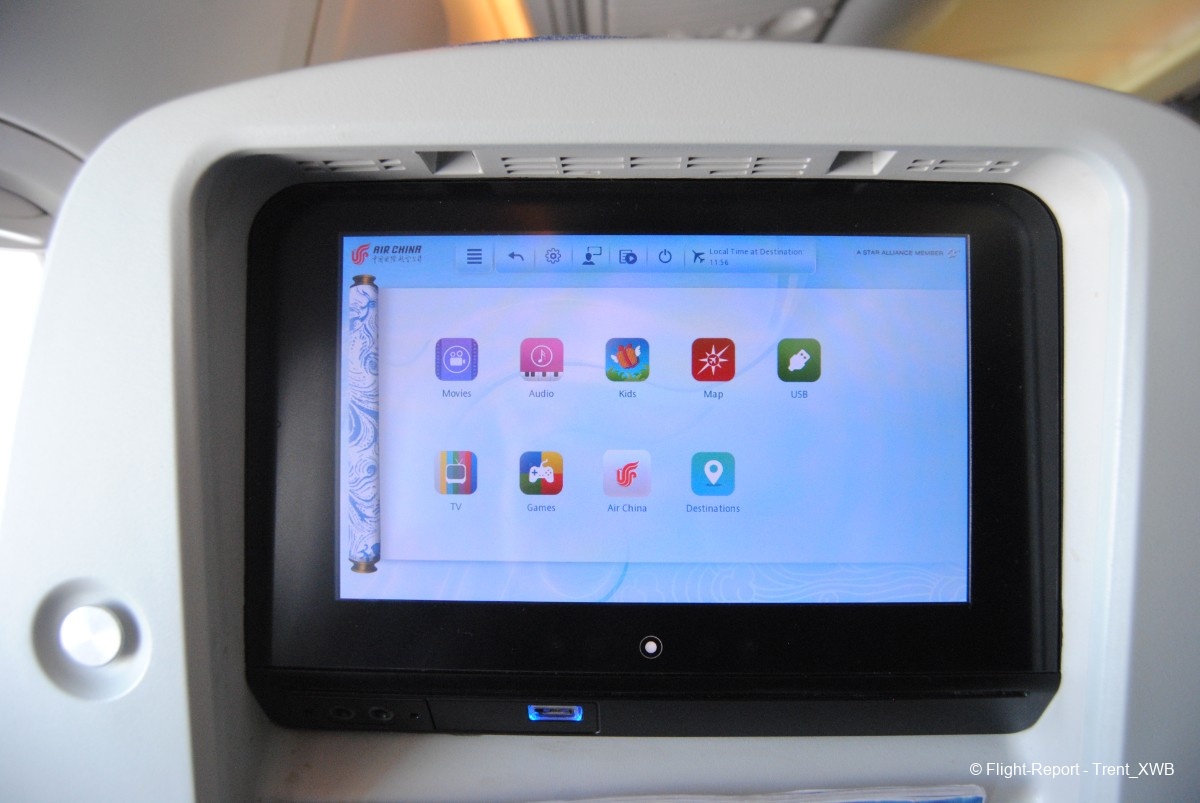
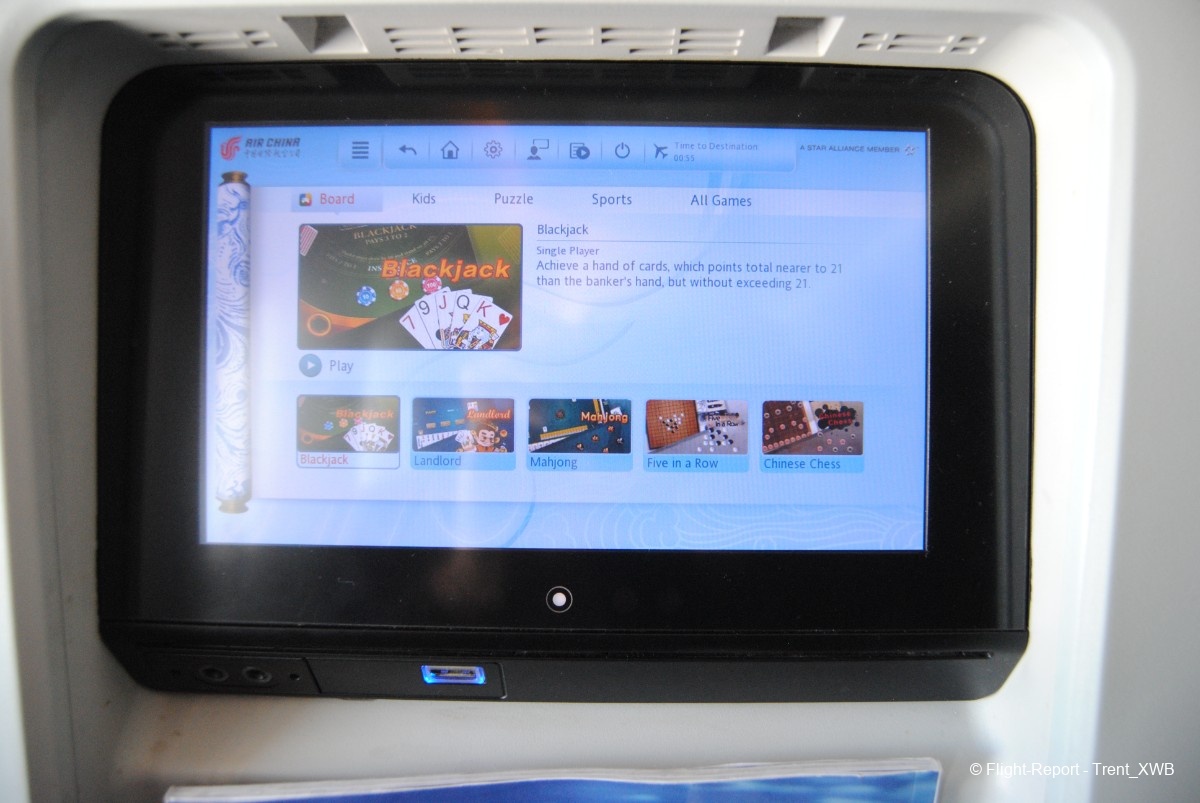
Let's dive a bit into IFE. The main menu.
An example of the gaming content.
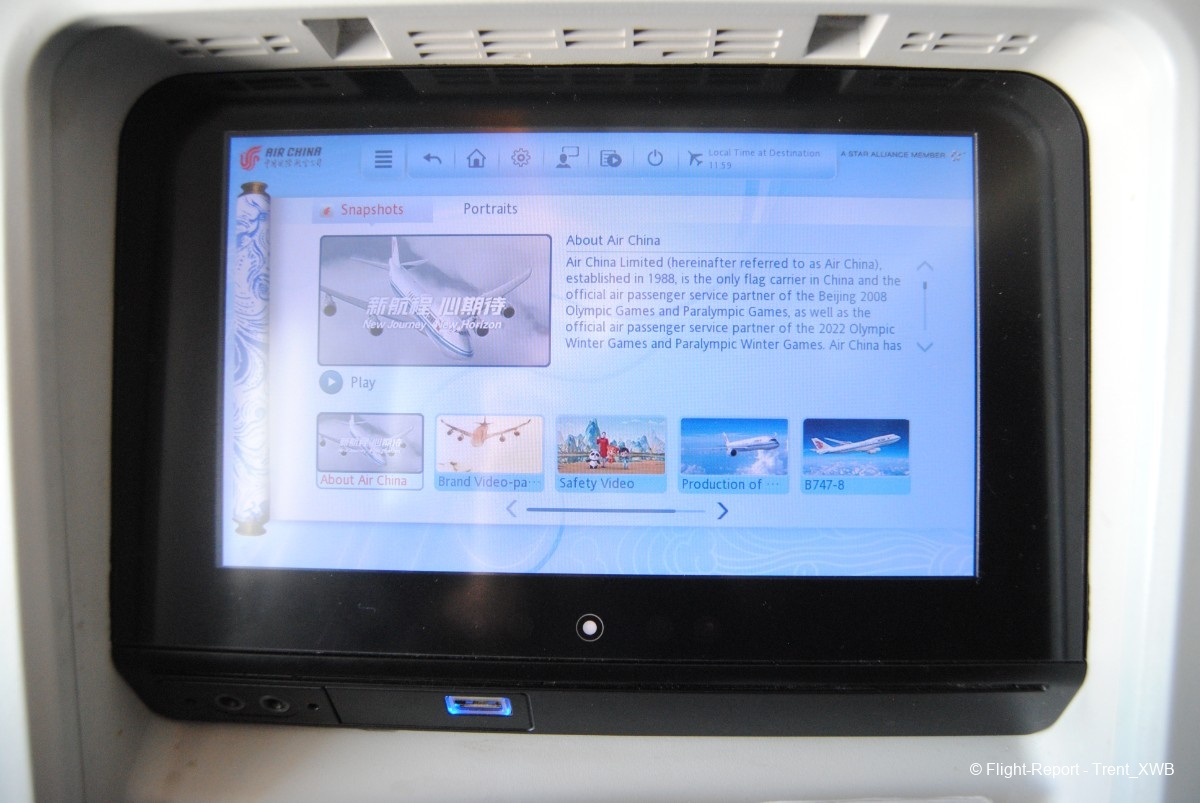
The section about Air China…
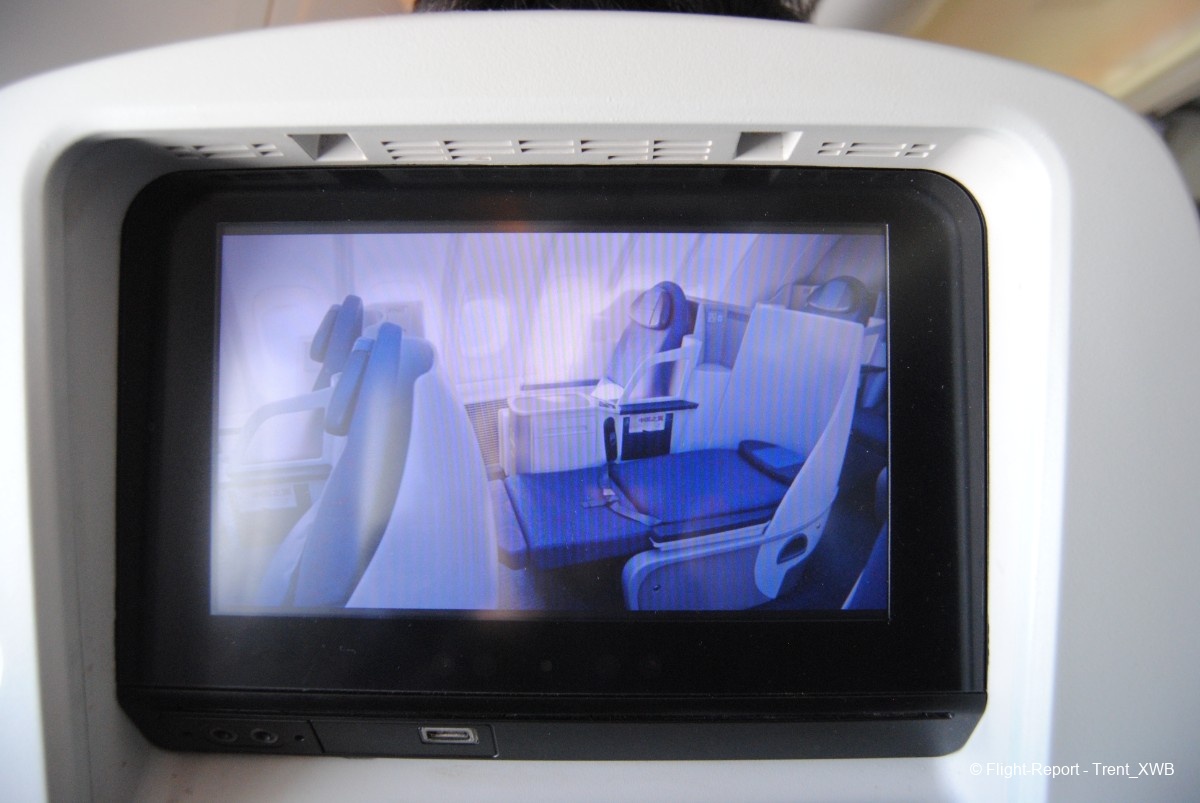
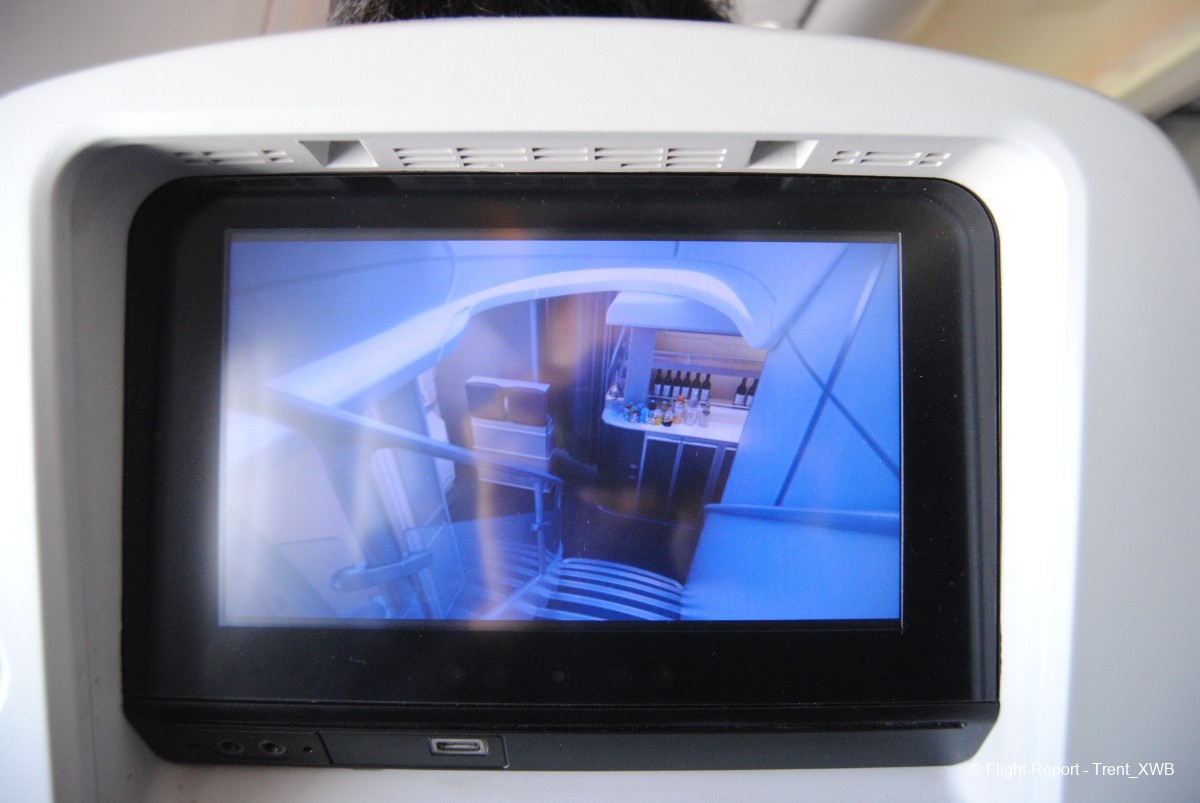
… and some screenshots from the video about B748, demonstrating the premium cabins of the Jumbo.
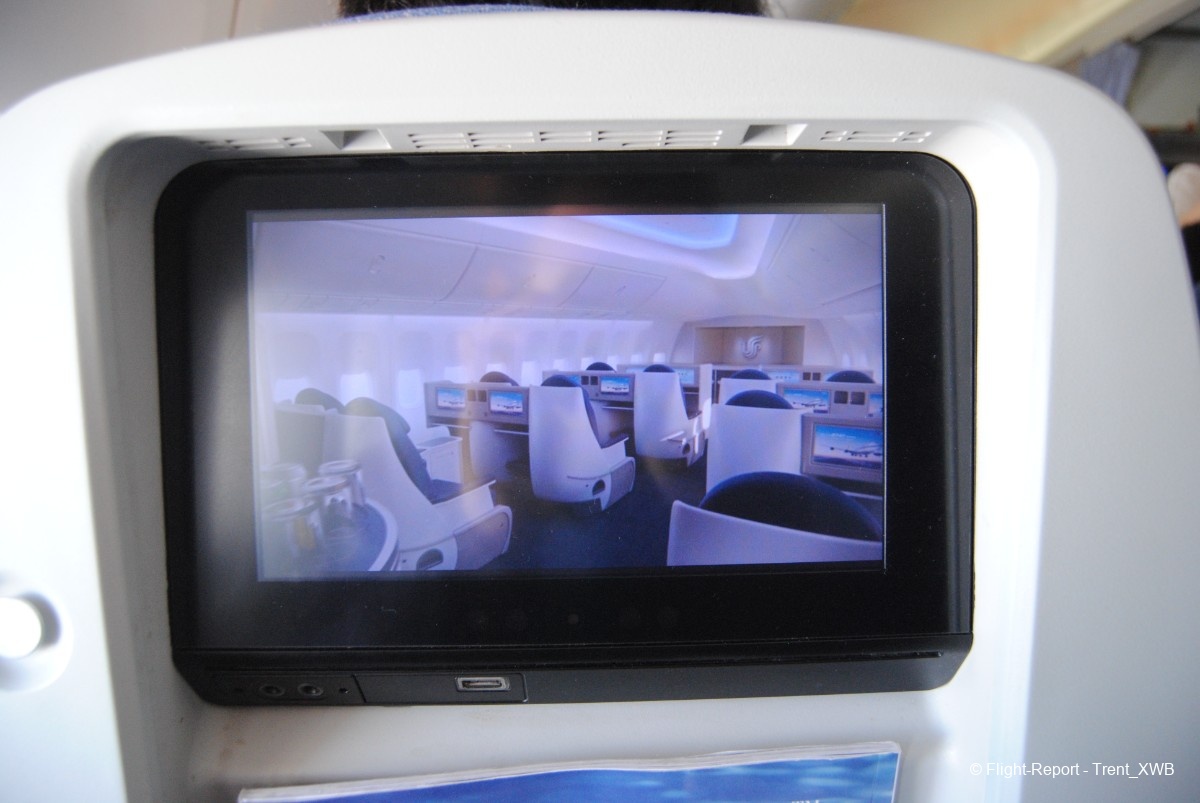
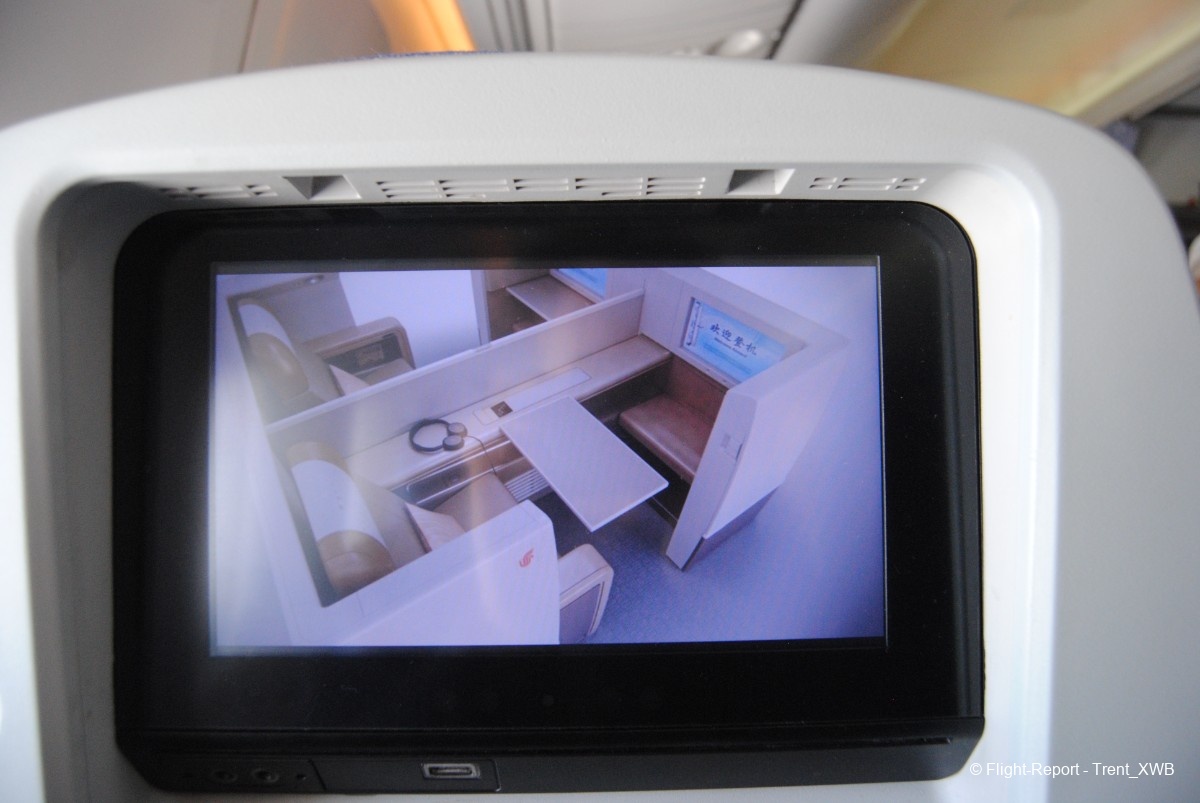
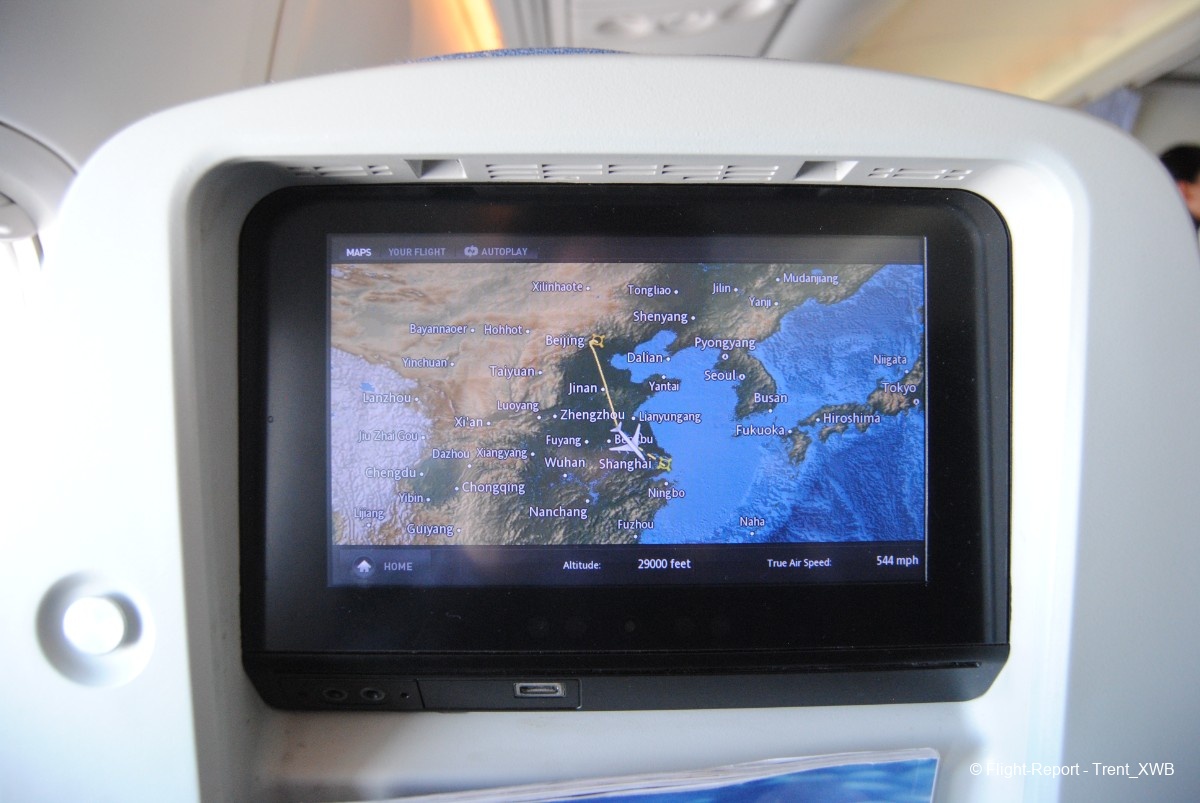
Having reached the cruising FL, we've already covered 1/3 way to SHA.
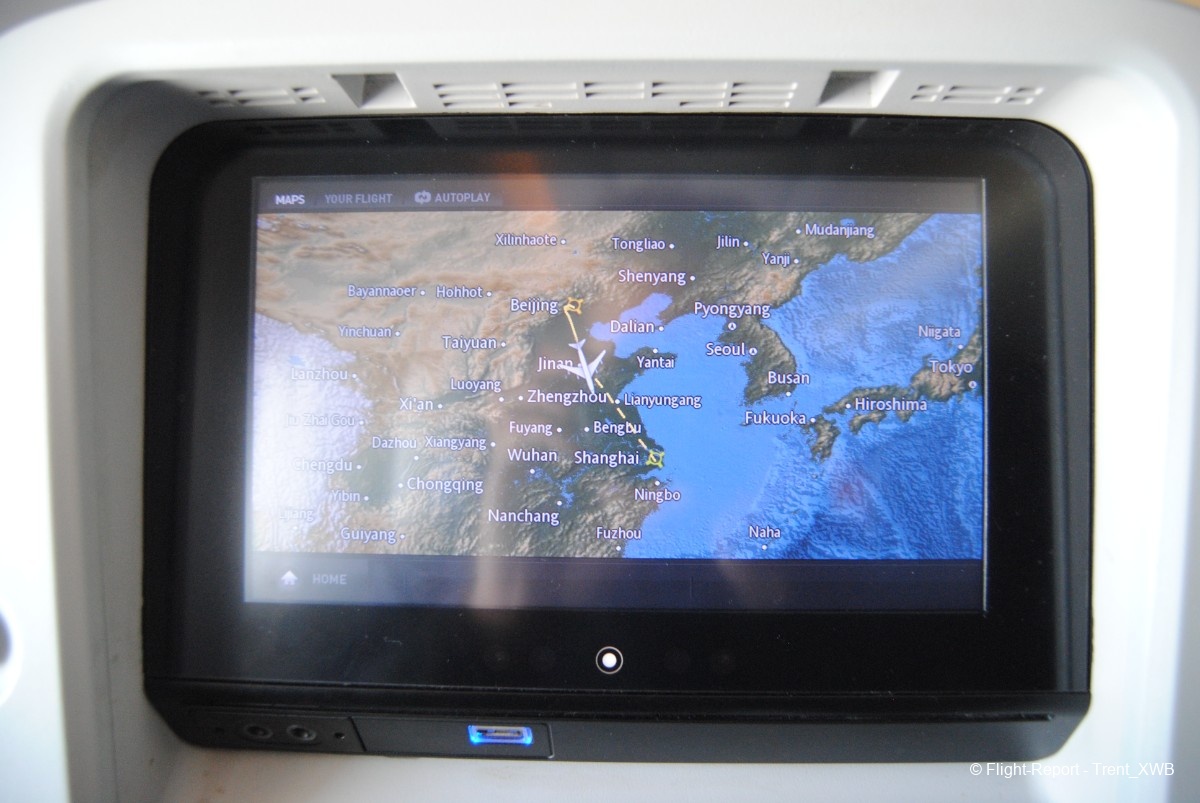
Let's stretch the legs a bit.
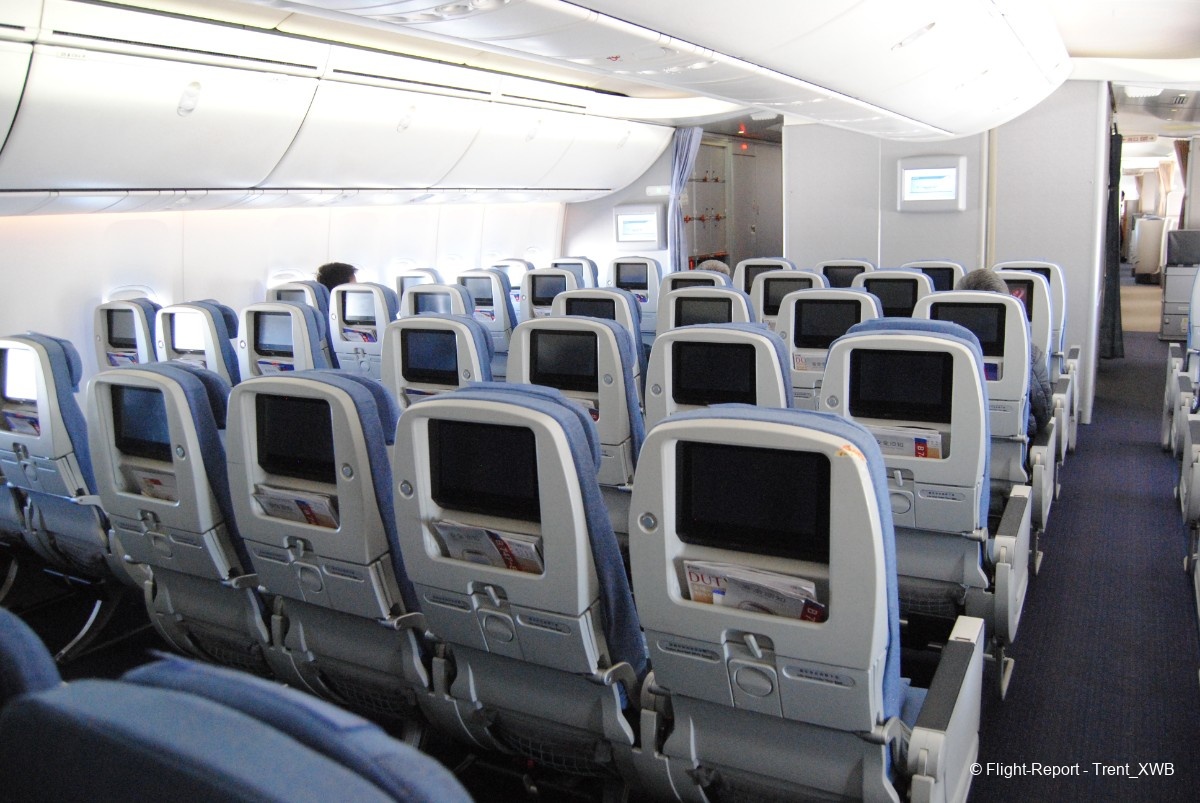
An inflight view of the large rear economy cabin. One can notice that the rows 60-62 have only duo lateral seatblocks (B/C and J/K) due to fuselage tapering in the rear. These duos has large gaps between B/K seats and the wall, significantly boosting the space, but making hard to look into the window and to lean on the wall while sleeping. One can also see the large galley between 4L/R with the crew being busy while preparing the meal service.
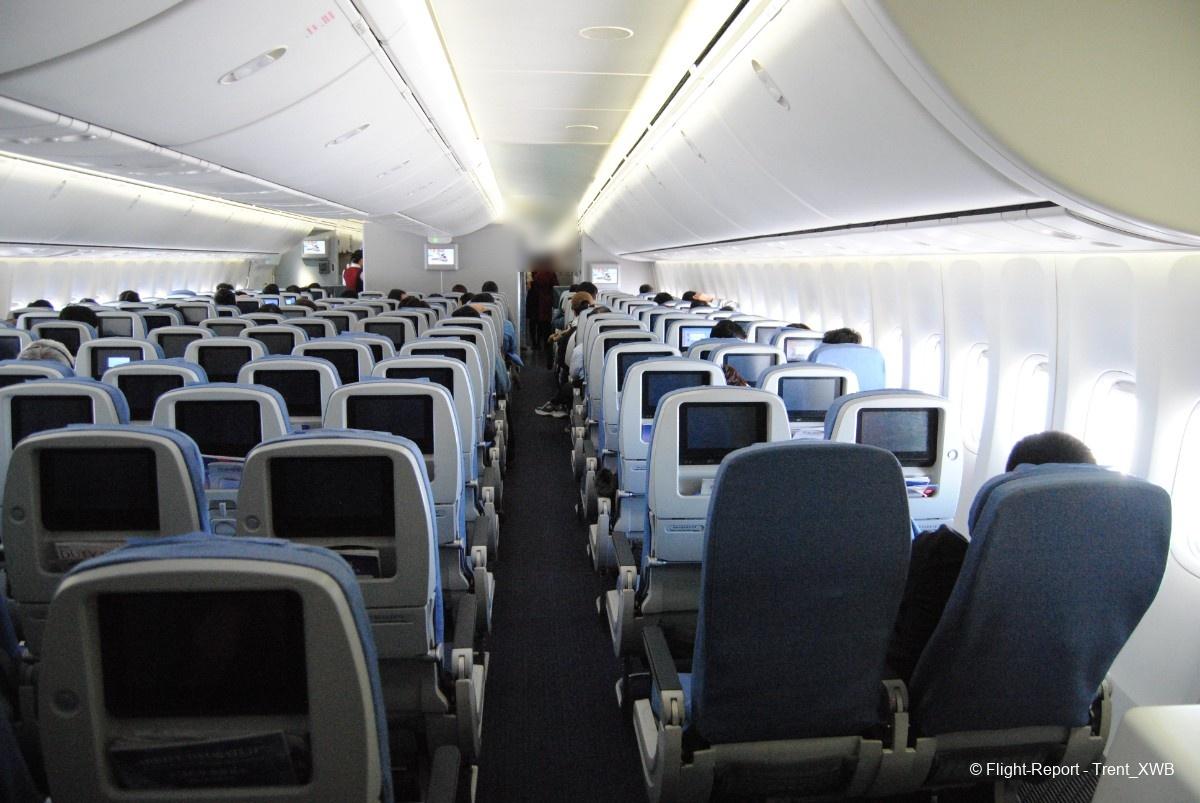
An inflight view of the front smaller economy cabin. One can see the cluster of 4 lavatories, divides this cabin from the "economy plus" cabin.
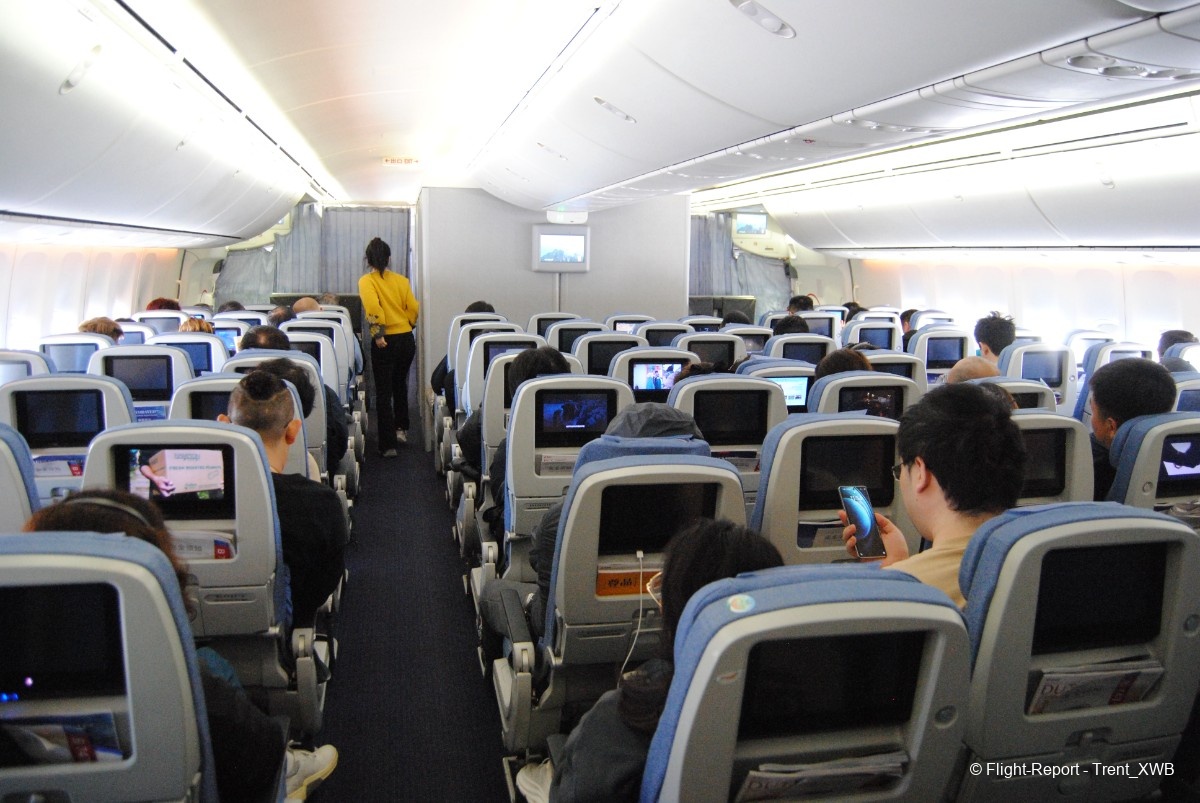
An inflight view of the "economy plus" cabin (the photo was made after meal service, but I put it here for the logical continuity), which was almost emply - no surprise taking into account the steep fares CA charges here compared to the regular economy. Most probably the 3 passengers here were from long-haul transit flights, operated by A359s.
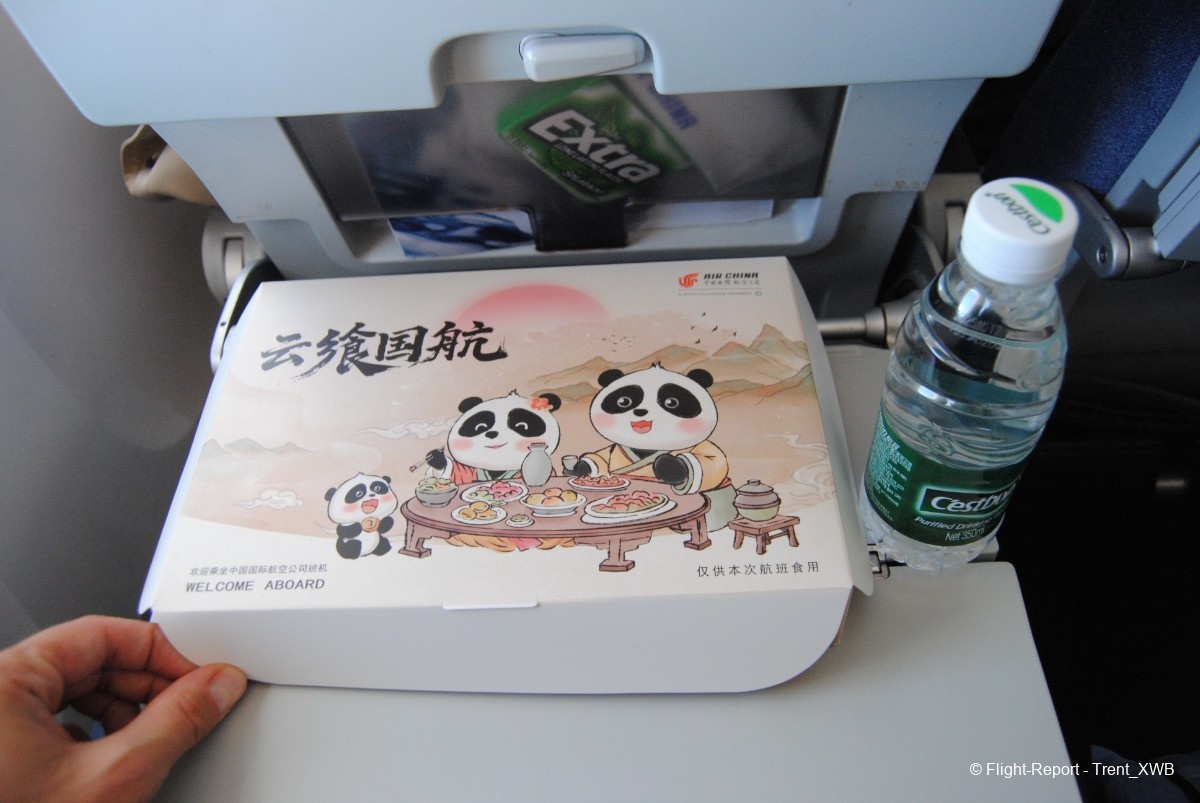
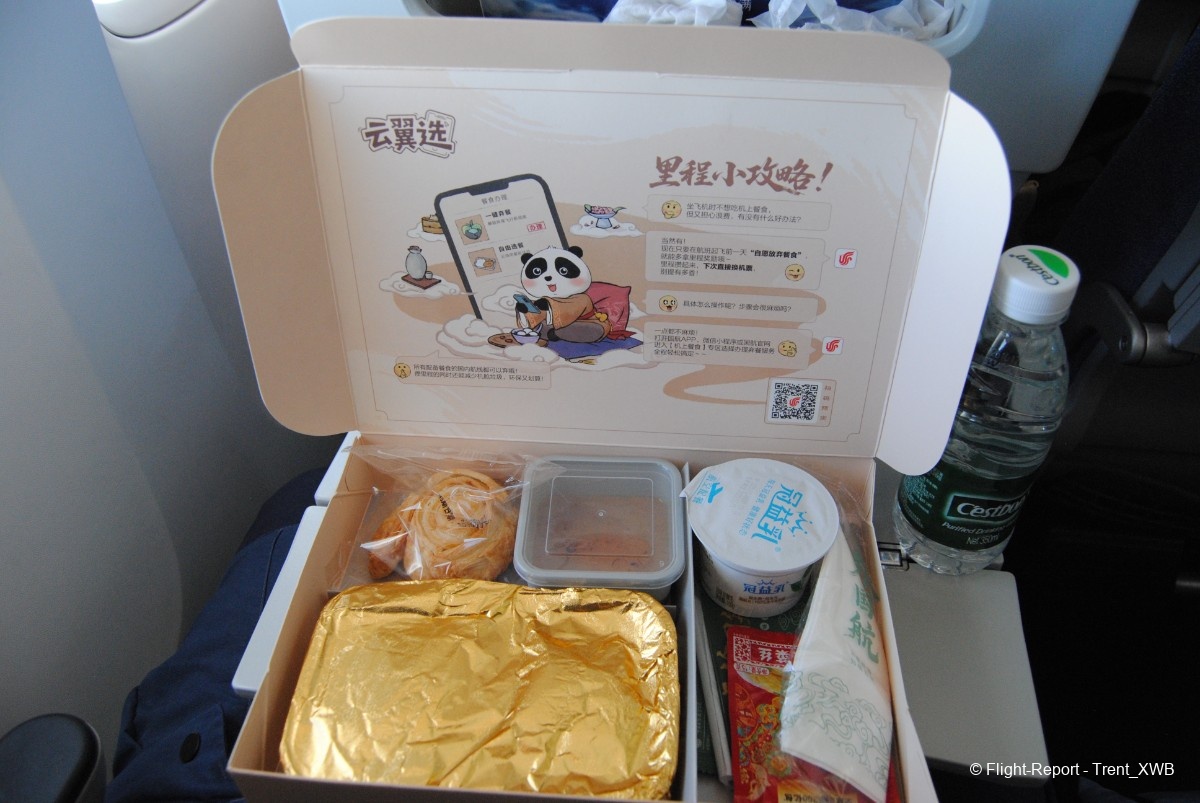
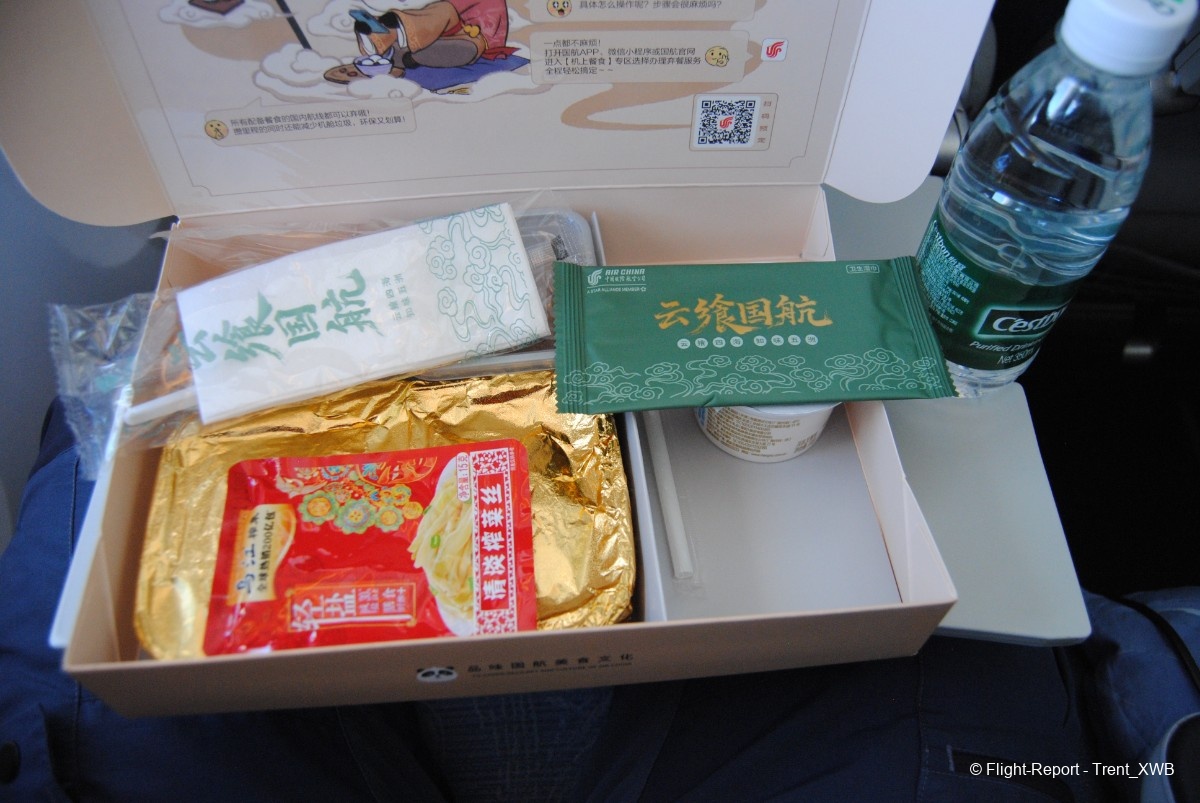
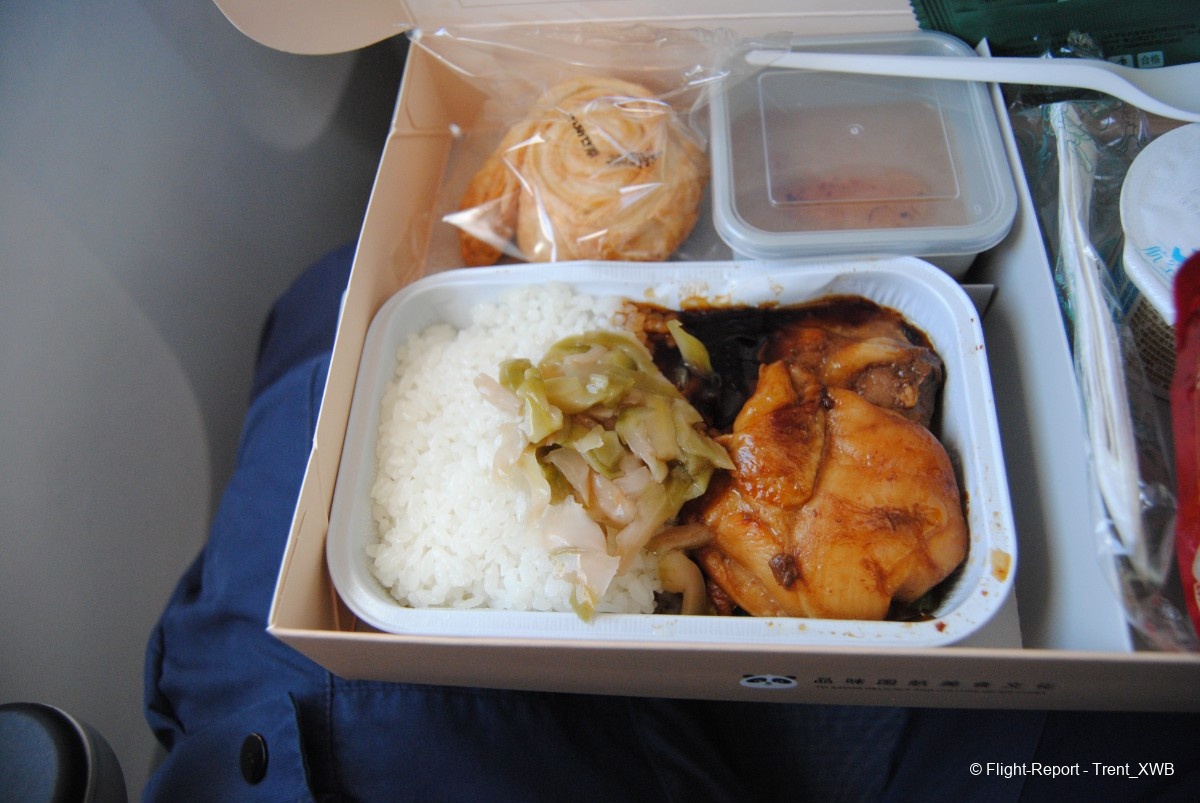
Meanwhile the meal service begins. When flying domestically in China, it's important to understand that the meal service heavily depends on the timing of the flight. CA serves meals on flights with block time over 1.5 hours and if the cruising phase of the flight overlaps with one of 3 daily intervals of traditional Chinese meal time, which are approximately (as these times may fluctuate): 07:00-09:00 (breakfast time), 12:00-14:00 (lunch time) and 18:00-20:00 (dinner time) - you get a hot meal (in the case of breakfast it's porridge, in the case of lunch and dinner it's a filling meal), otherwise you get just some snacks. Thankfully, as the cruising phase of CA1557 flight overlaps well with the lunch time, I got a very beautiful panda-decorated box, containg chicken with rice and salsa, optional spicy vegetable seasoning, dessert, pastry and yoghurt. There was also a smallish bottle of water, which was barely enough to get hydrated and no additional drink service was provided. Except limited drinking service, this meal service was on par with, for example, Asiana flights between ICN and NRT. On my return CA1558, whose cruise phase doesn't overlap with any traditional meal time, I got much poorer snack service.
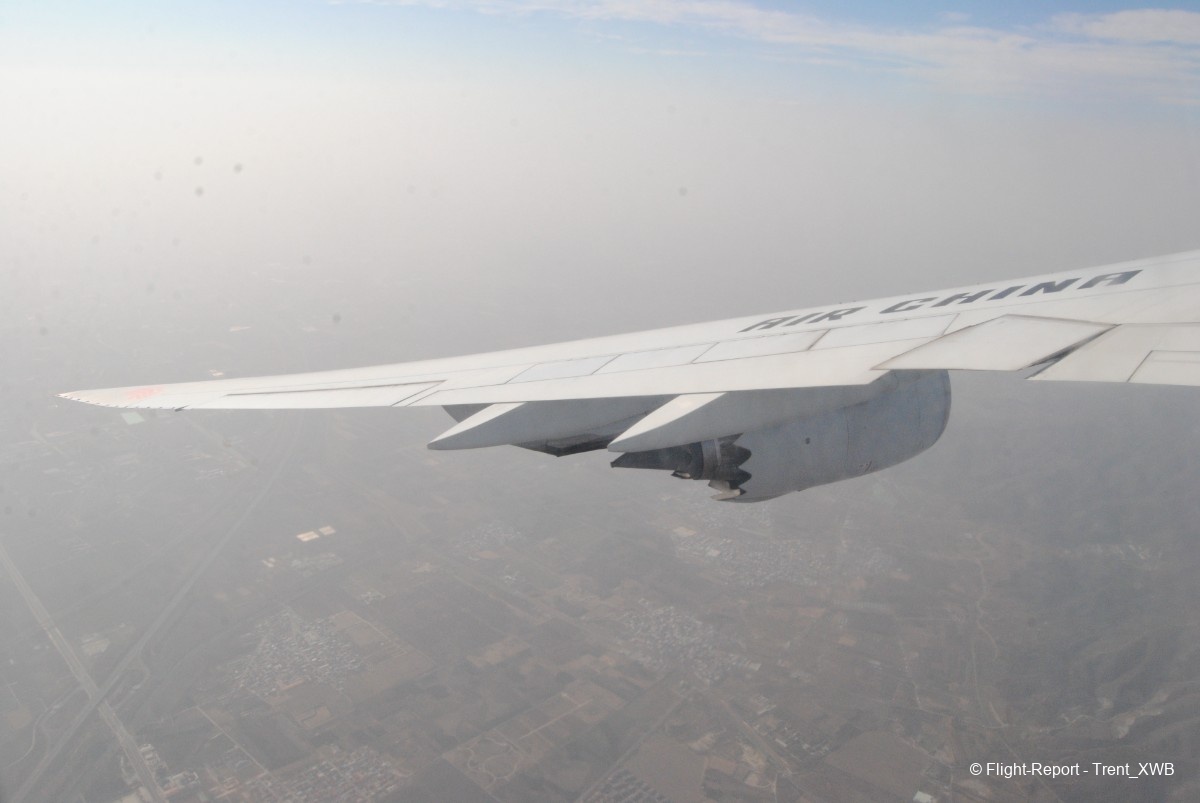
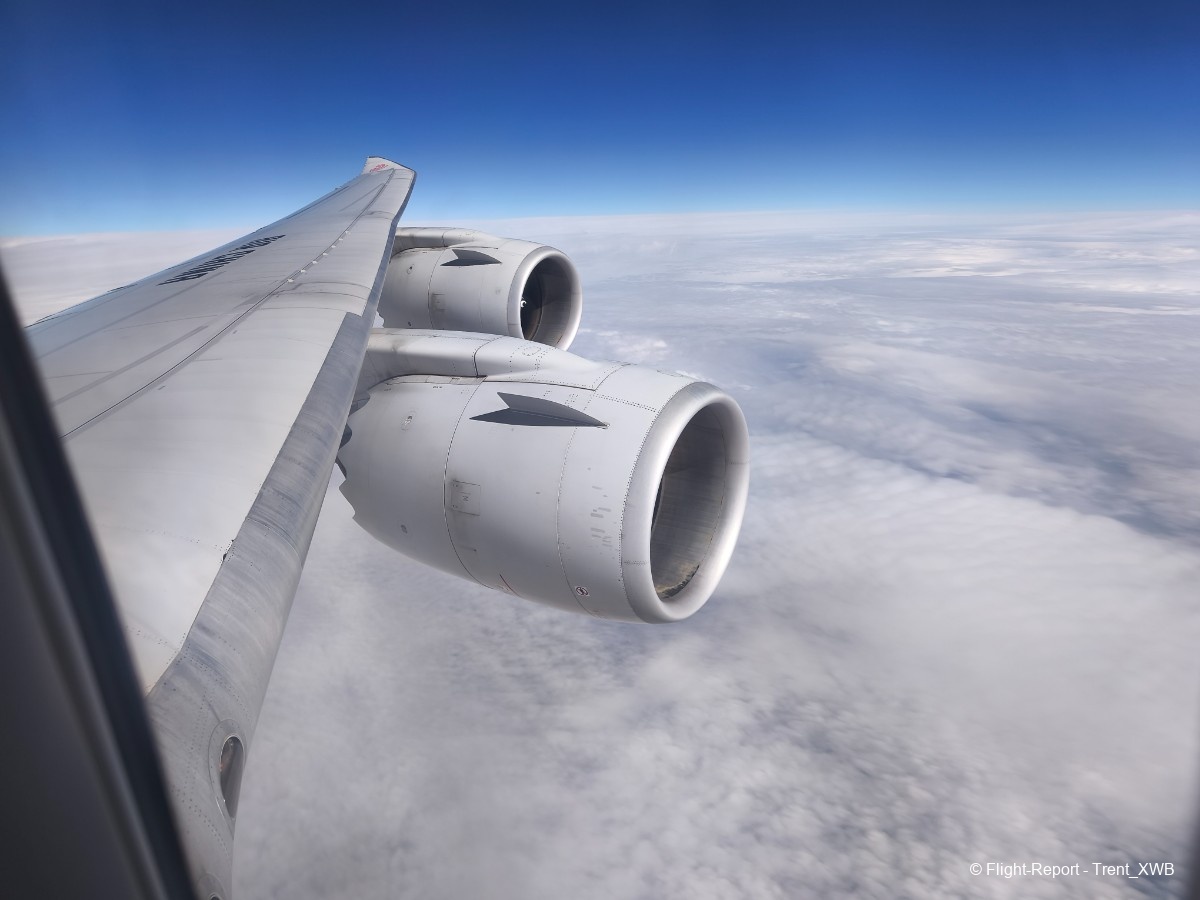
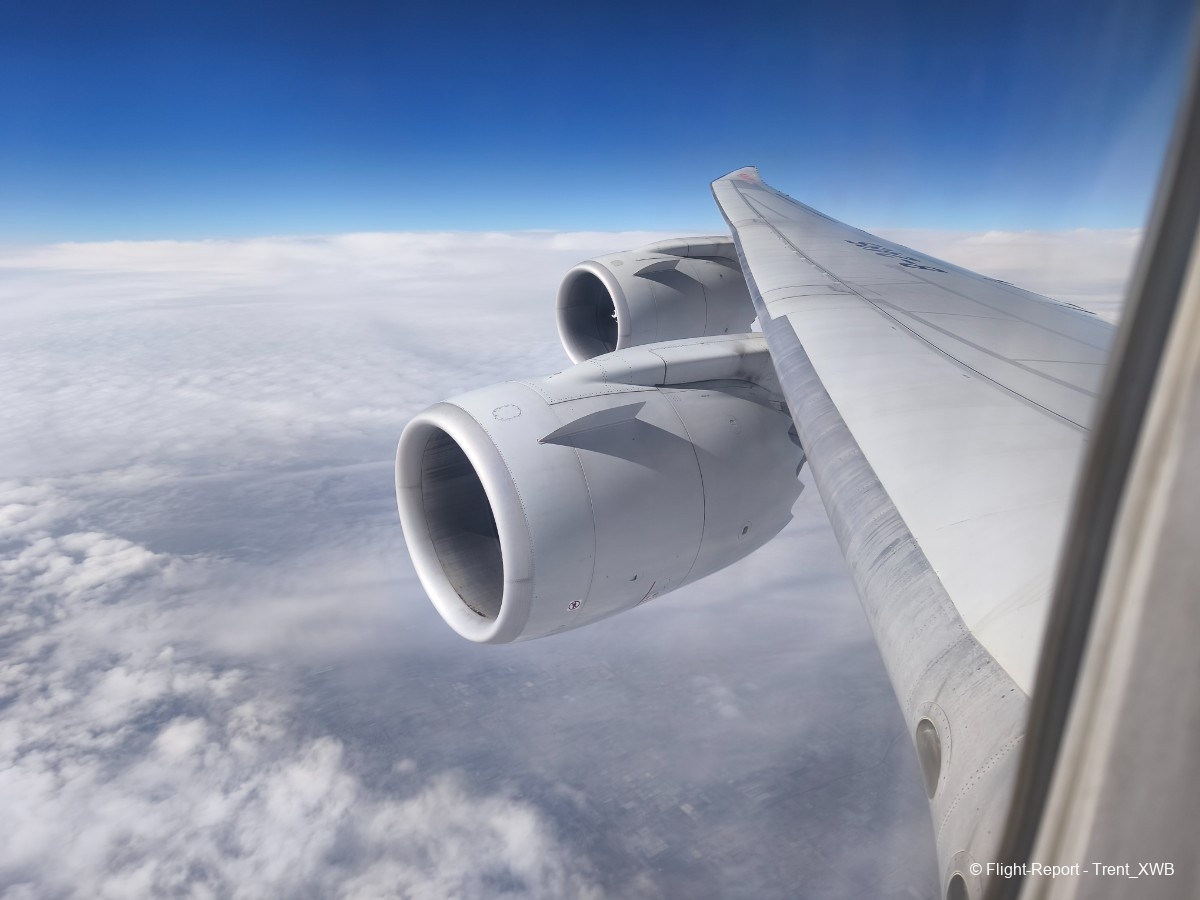
After the meal service the crew (which were very nice and welcoming - on par with KE and BR crews!) thankfully permitted me to go to 2L/R doors to capture the magnificent wing/engines views (I want to emphasize that in the end of November CA1557's schedule coincides with the most favorable light, when the sun is at its highest position). Though, they didn't let me to visit the first class cabin again inflight - it turned out that F was not empty (probably a connecting first class passenger came close to the end of the boarding time, thus I didn't see him/her).
Meanwhile, having crossed 2/3 distance, we start our slow descent to SHA.
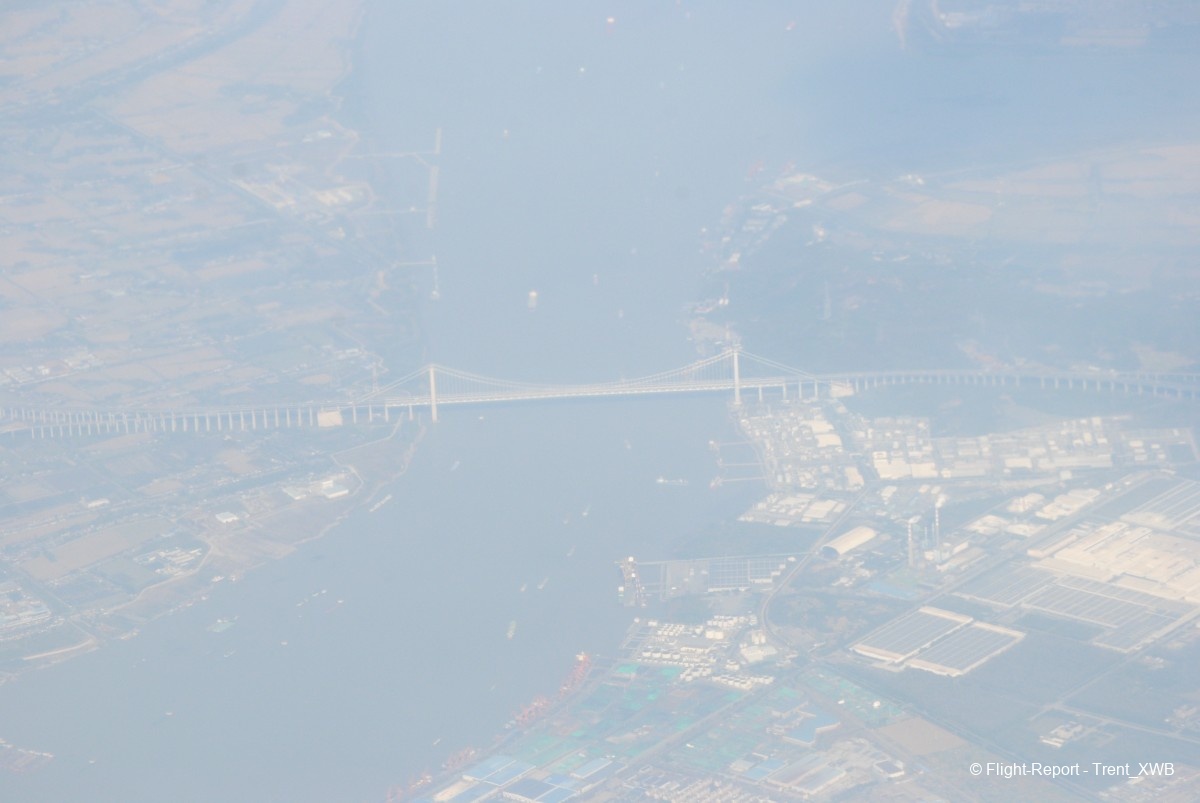
Overflying Yangtze river with some of its impressive bridges.
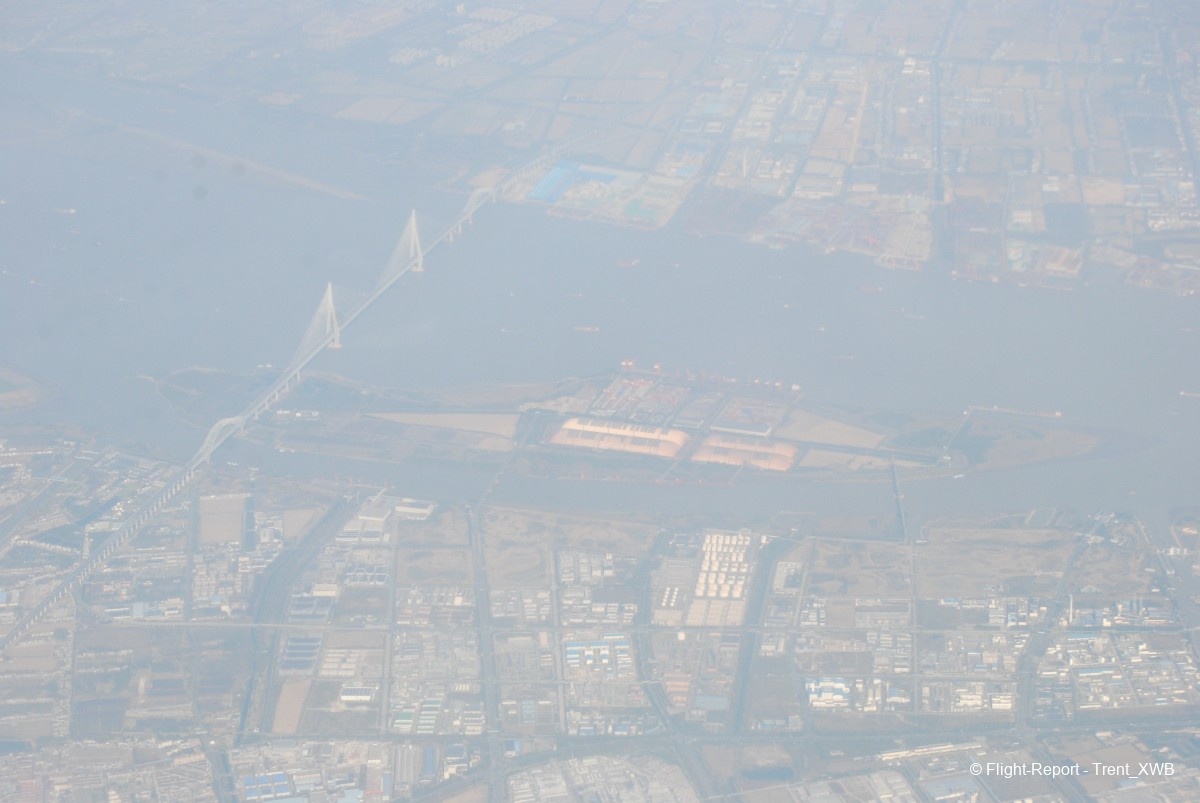
A beautiful view due to the clouds above and some fog below.
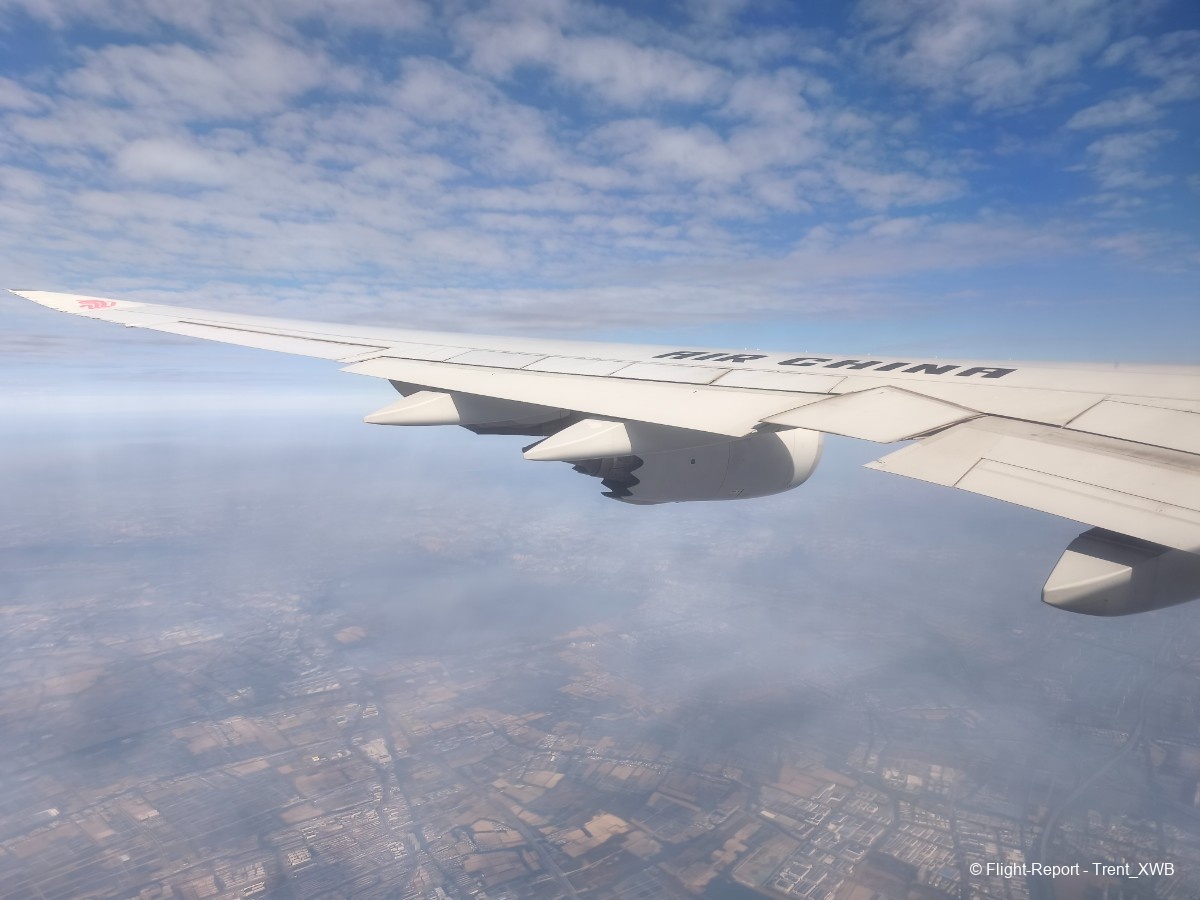
Descending over Shanghai's vast metro area.
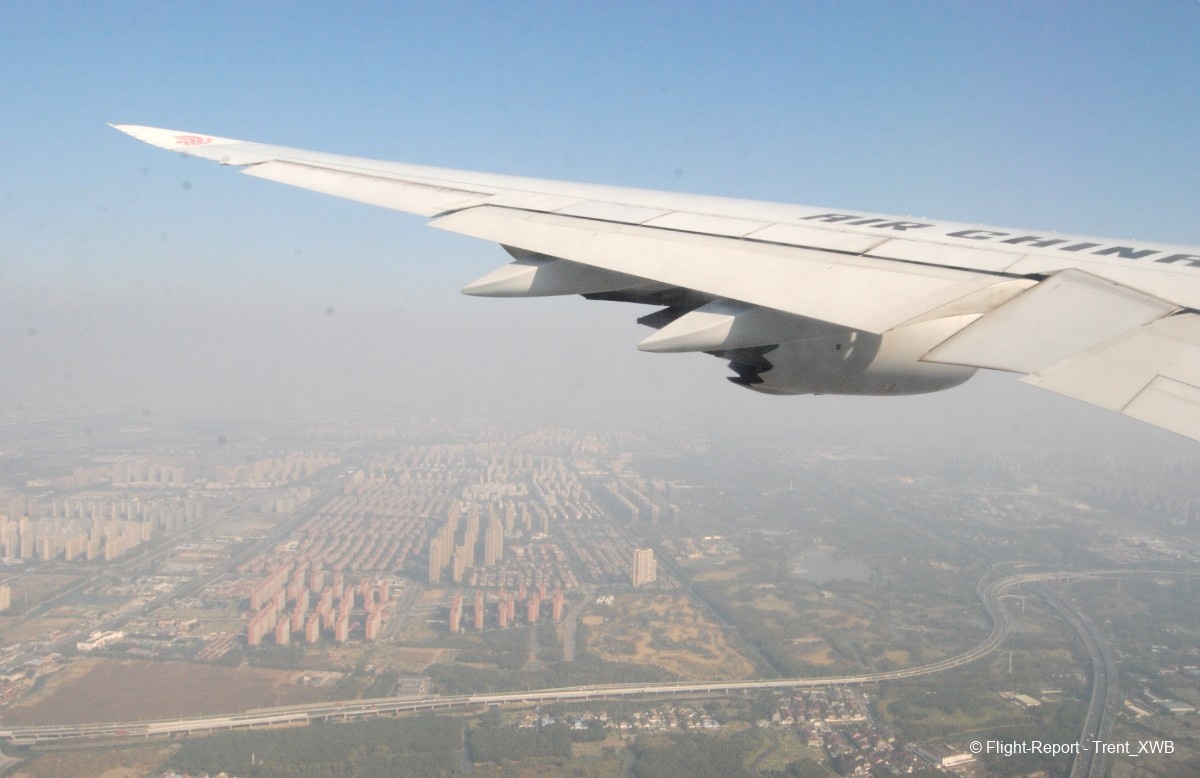
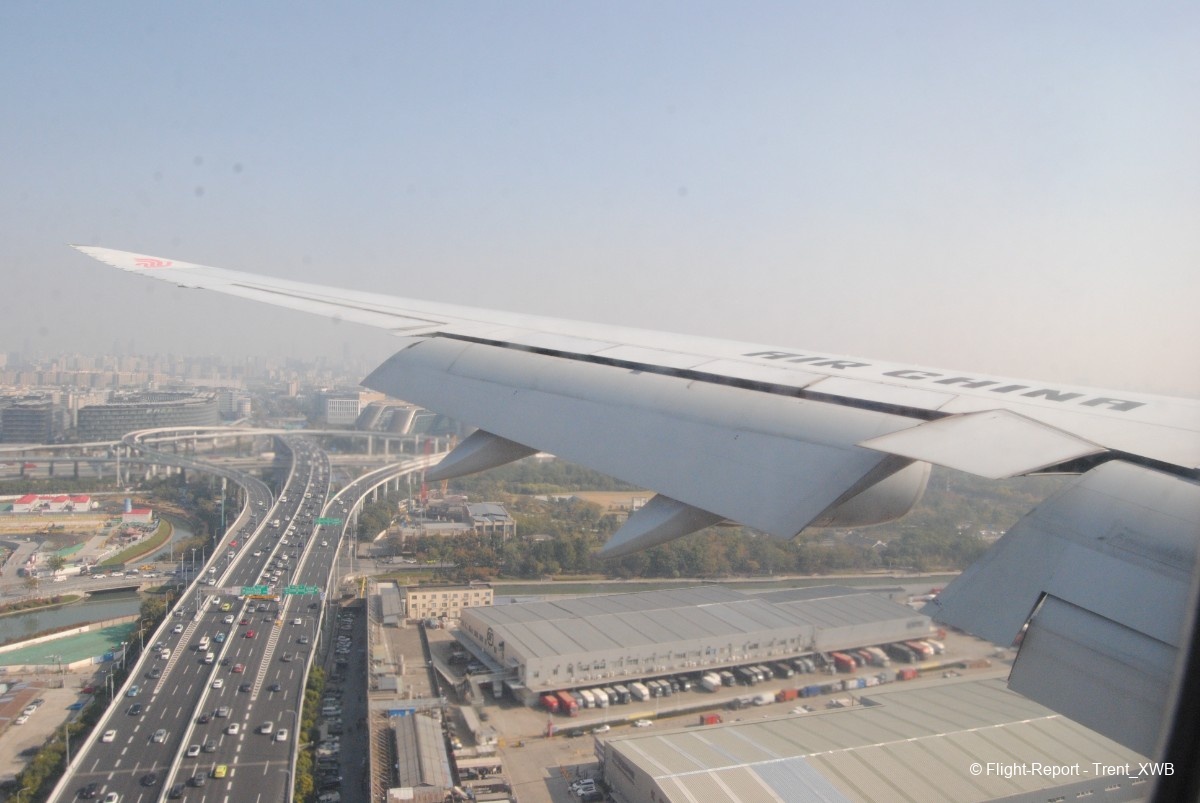
Crossing a busy highway north of SHA moments before landing.
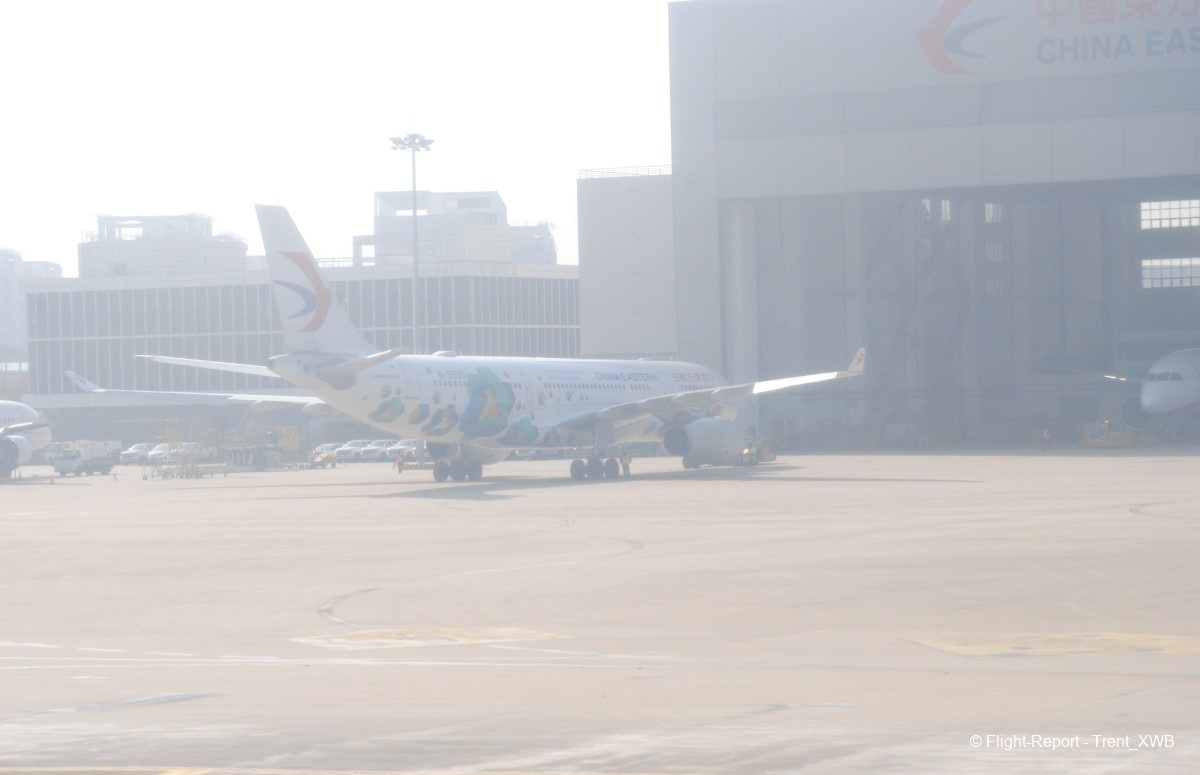
Landing on runway 18L/36R of SHA with smaller international T2 and CX A333 in sight. We landed whopping 45 minutes before the scheduled arrival time. One can see that the schedule of these flights has very abundant "padding".
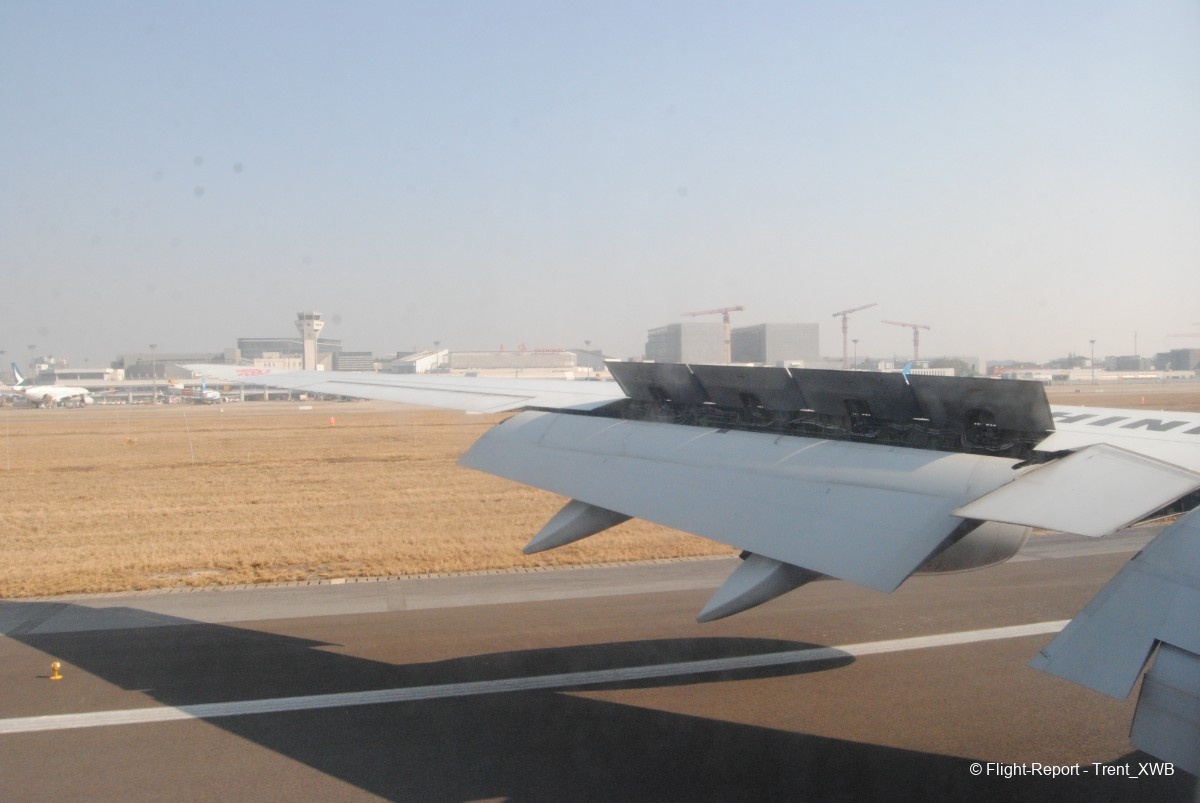
Landing video. One can see the impressive amplitude of flaperon oscilattions and smoke from MLG tires upon touchdown.
As we're taxiing to the large domestic T1, the fascinating planespotting begins.
MU A332 (B-5920) in "WorldSkills Shanghai 2022" livery (in May 2026 it was repainted into "WorldSkills Shanghai 2026" livery) near MU's MRO hangar. MU is the world's largest A332 operator with 30-strong fleet. 28 of them (including this one) have C18_Y246 layout in 2 different variants: the older frames feature Zodiac Aura Lite seats in business in 2-2-2 layout, whereas the newer ones feature Zodiac Cirrus II seats in business in 1-2-1 layout. All of these 28 A332s feature very comfortable Weber 5751 seats in economy. 2 MU's oldest A332s (2007-2008-built) have C24_Y242 layout with B/E Aerospace Minipod angle-lie seats in business in 2-2-2 layout (these seats can also be found in KE A380s in lie-flat version and in SU A333s in angle-lie version) and Weber 5751 seats in economy.
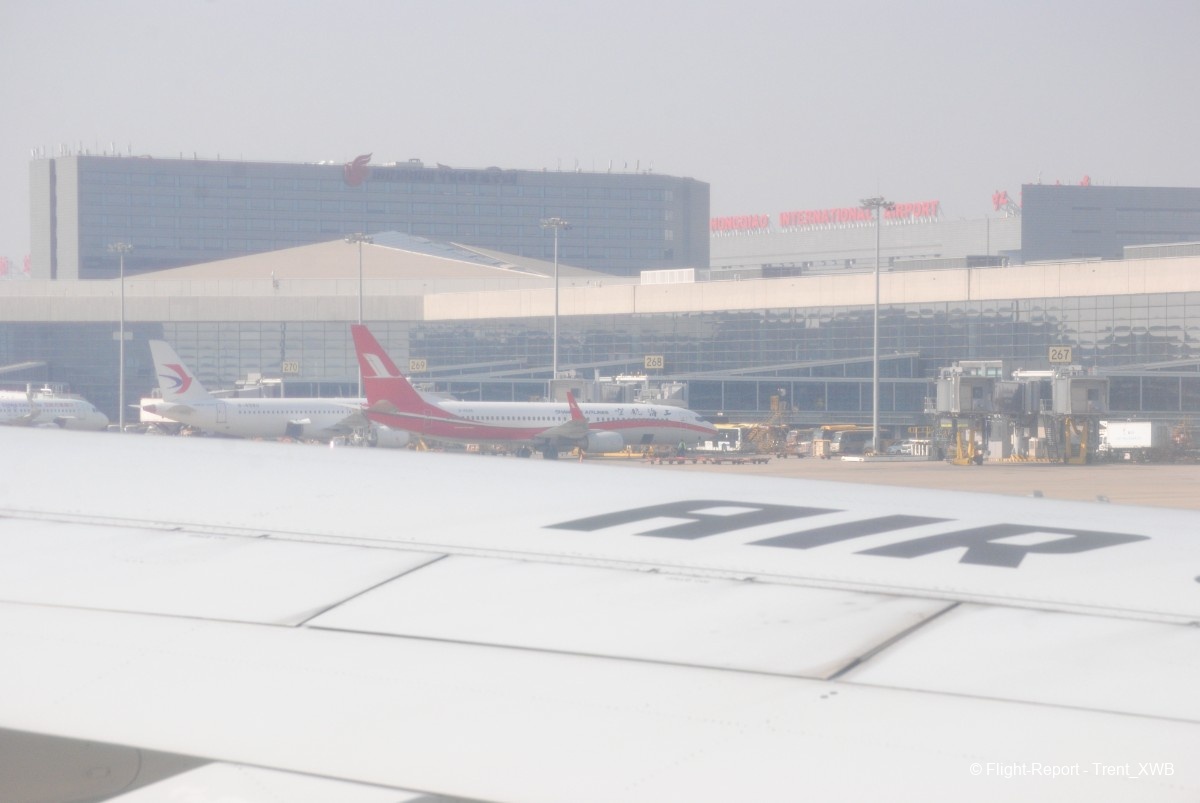
SHA T1 (domestic) with FM B738 (B-6545) and MU C919 (B-658U). FM is a subsidiary of MU, operating 10 B789s (identical to the mainline MU ones), 17 B7M8s, 59 B738s and 4 B737s. MU, as well as CA, is one of the C919 operators and has 16 of them in the fleet with C8_Y156 layout.
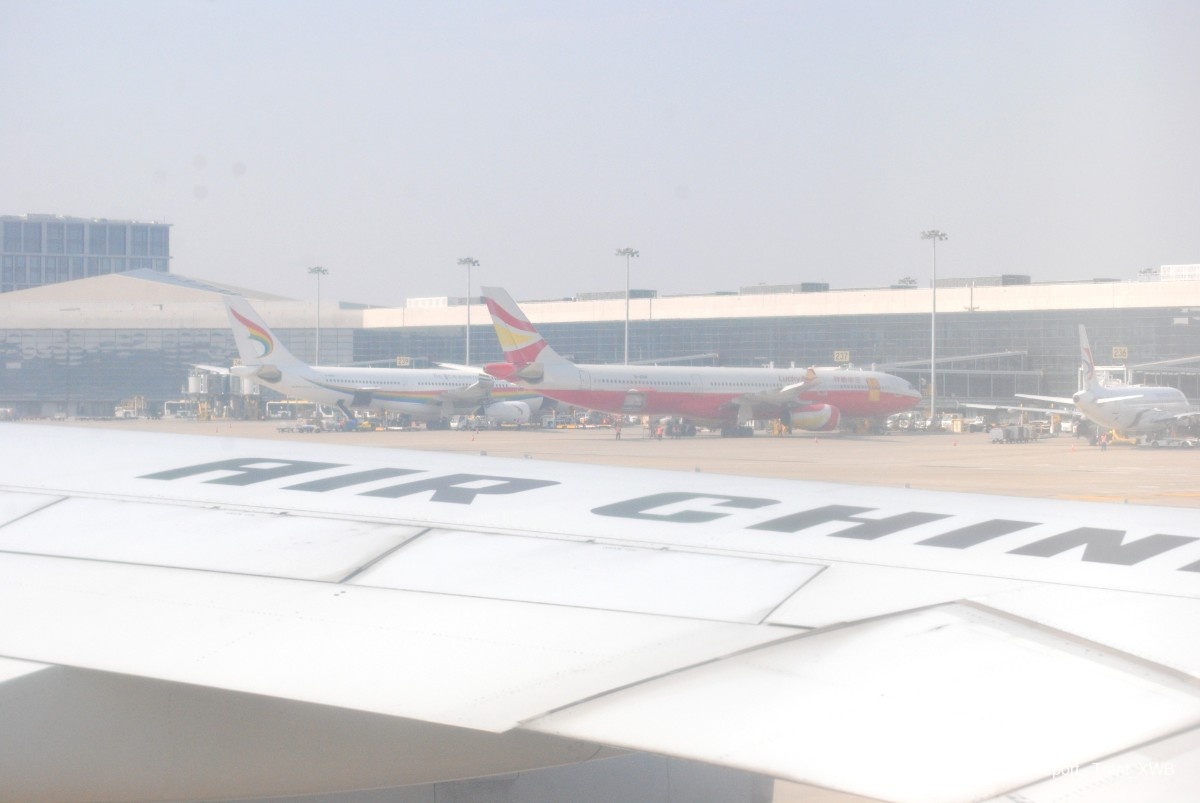
Lucky Air A333 (B-1014) and Tibet Airlines (now Xizang Airlines) A332. Both airlines are rather small for Chinese standards and are very little known outside of China. 8L, based in Kunming (KMG), operates 4 2017-2018-built RR-powered A333s (C24_Y279), 3 2025-built A21Ns (C8_Y198), 6 A20Ns, 6 A320s, 5 7M8s, 20 B738s and 9 B737s. 8L livery looks like it was copy-pasted from BA livery and, AFAIK, there were some tensions between BA and 8L on this matter. TV, based in Lhasa (LXA), operates 5 2016-2018-built RR-powered A332s (C12_W32_Y235), 6 A320s, 13 A19Ns (whose outstanding takeoff capabilities are very useful in high altitude airports) and 27 A319s.
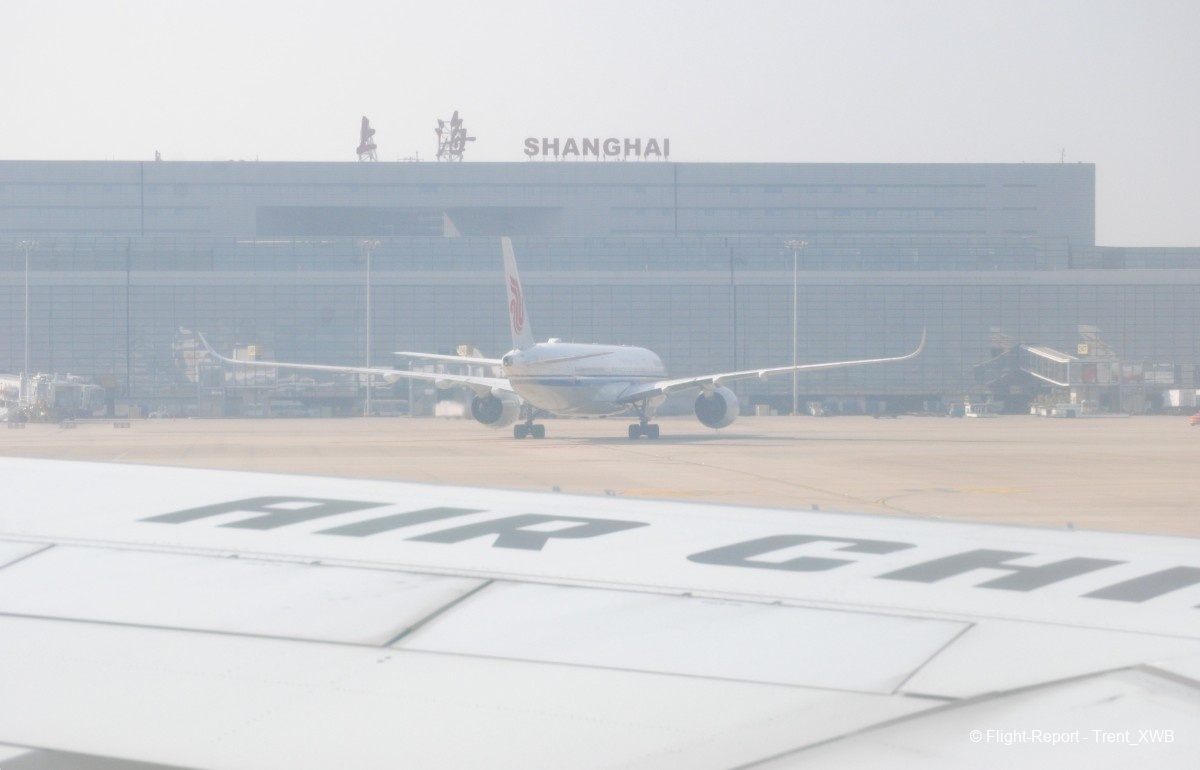
The central part of T1 (where we're about to park at the centralmost gate 48) and a CA A359 (B-32AL). Currently CA has 28 2018-2023-built A359 in C32_W24_Y256 layout (featuring dedicated 2-4-2 premium economy and thus making A359 the first CA's widebody type with proper W) with 2 types of business class seat: part of these frames (seemingly 2018-2019-built ones) has Collins Super Diamond seats in C and Collins MiQ seats in premium economy, the other part (seemingly 2020-2023-built ones) has Recaro CL6720 seats in business and Recaro PL3530 seats in premium economy. Sadly, for the economy cabin in all these A359s CA chose uncomfortable slimline Recaro CL3710 seats. CA actively uses these A359s on EU flights to secondary large airports like MXP.
The Economy Cabins After The Flight
A view of the rear large economy cabin during disembarkment…
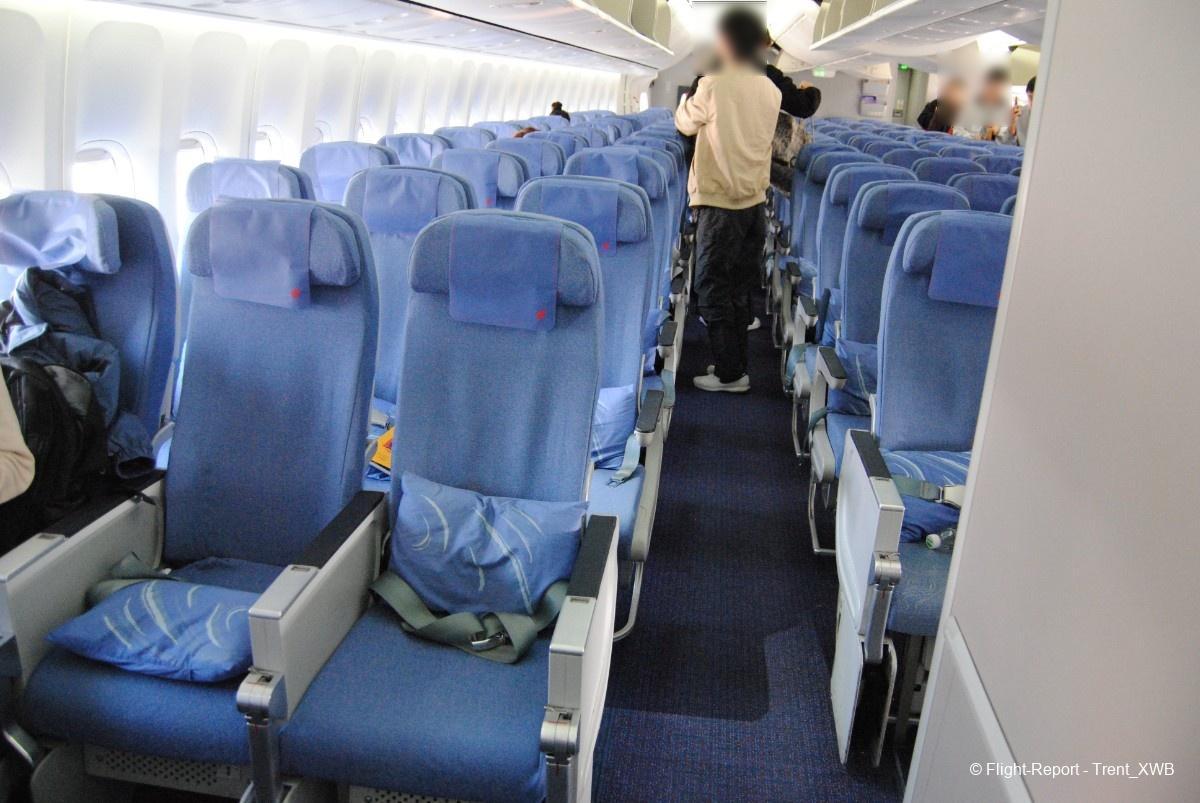
… and of the front smaller economy cabin. One can notice that its bulkhead quadruple seatblock (row 39) had dark blue phoenix upholstery in the past with its remnants on 39E seat.
The Upper-Deck Business Class Cabin
And now some dreams come true - the crew thankfully permitted me (and also to the another avgeek - guy from 50L) to visit the upper-deck business cabin after the flight.
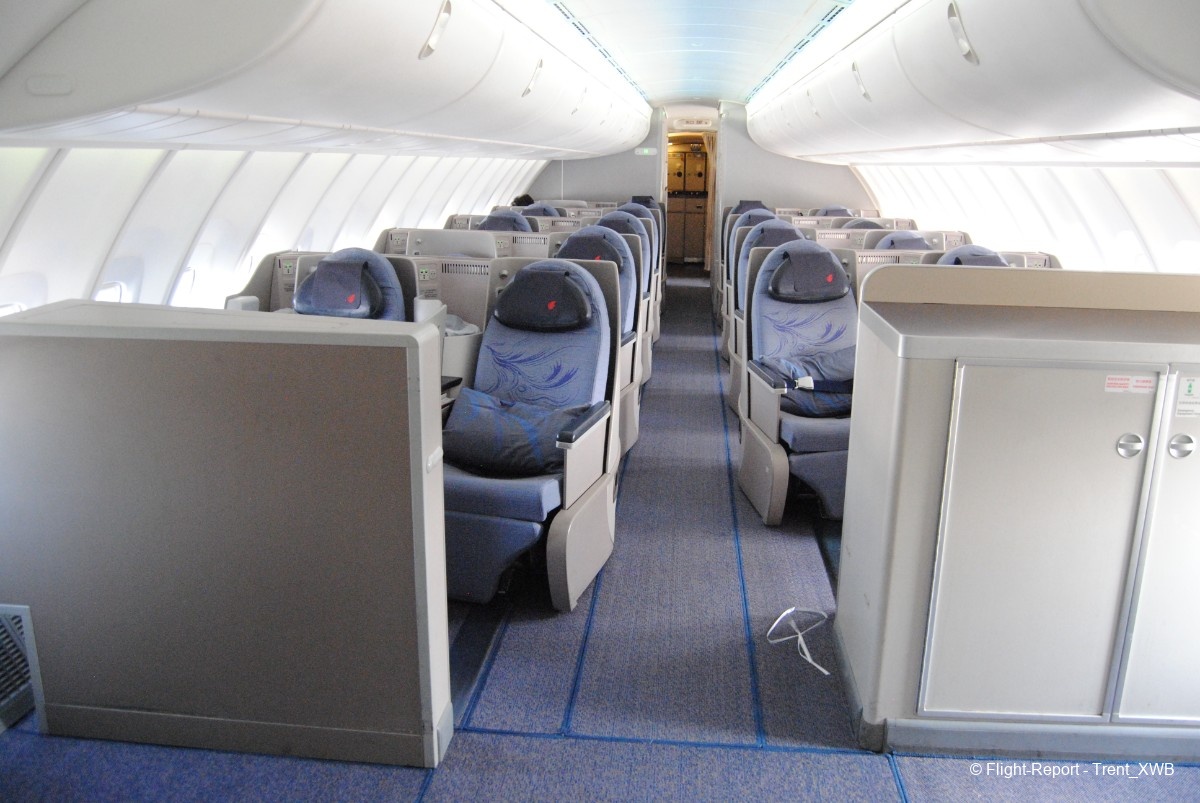
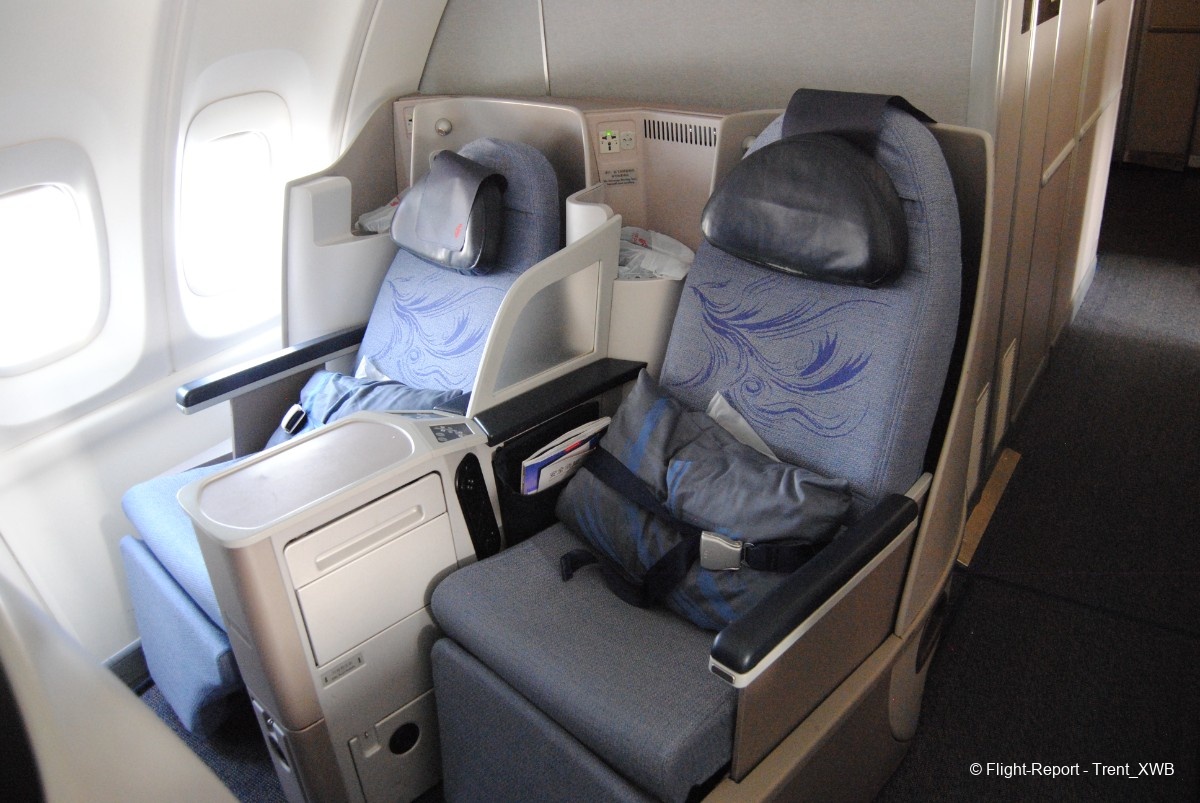
General views of the upper deck from the front and from the rear with the variable multicolor moodlighting (on these photos one can also see the second "air marshal", responsible for the premium cabins). The upper-deck business class consists of 30 Collins Parallel Diamond seats in 2-2 layout (rows 80-87), naturally separated by the upper deck exit doors to 2 parts: rows 80-82 and rows 83-87.
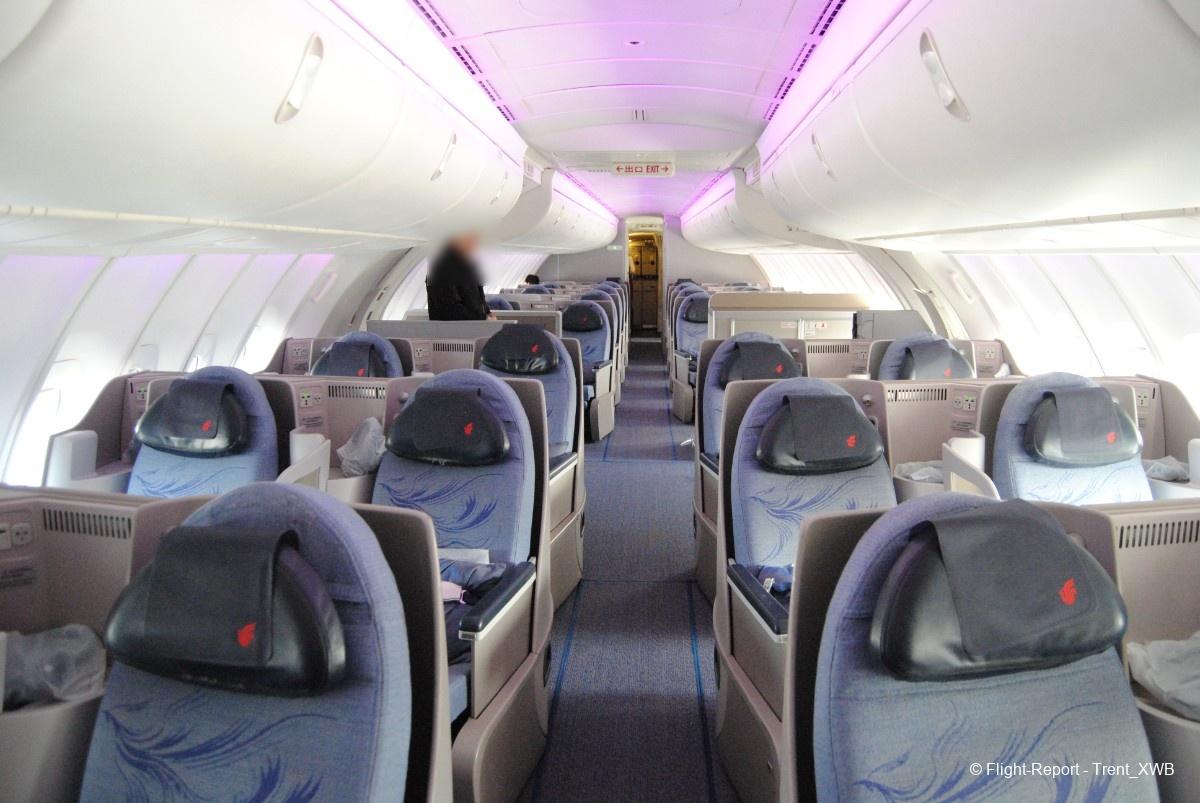
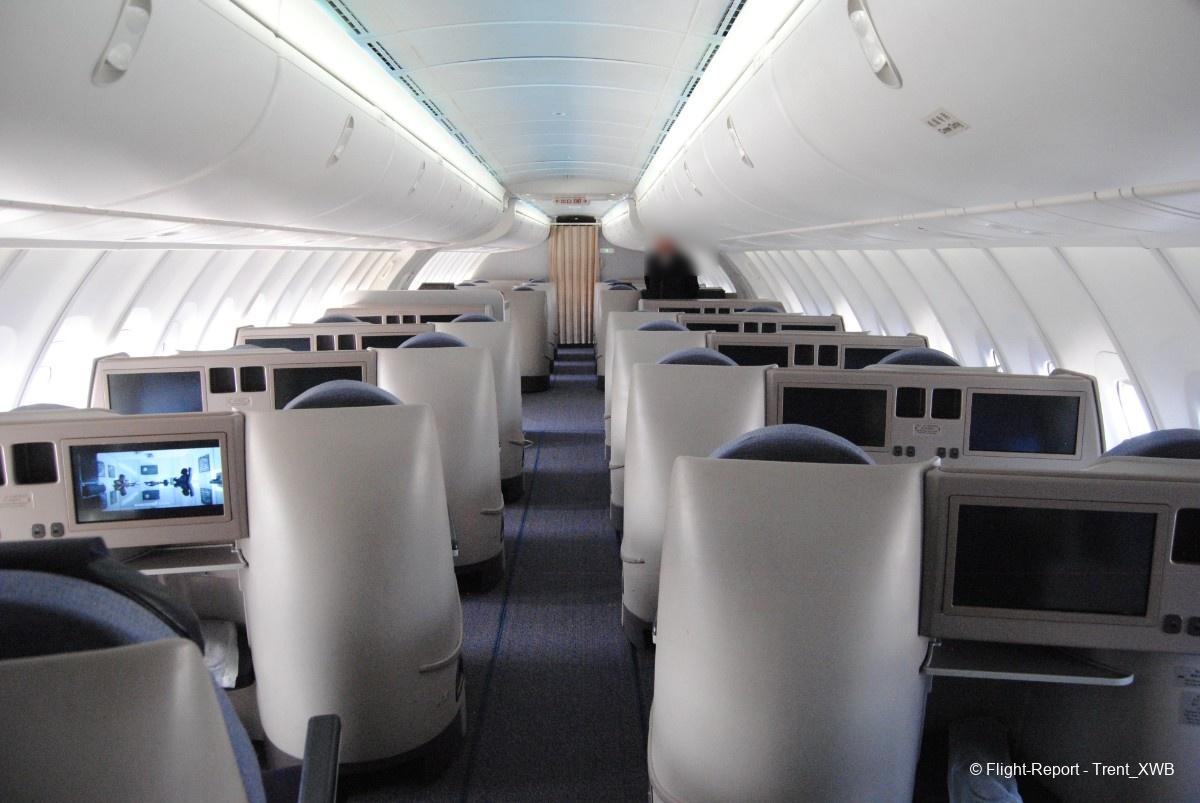
The front section of this cabin (rows 80-81). On the first photo one can see the standard footwell of the Parallel Diamond seats, which looks (and actually is) rather tight.
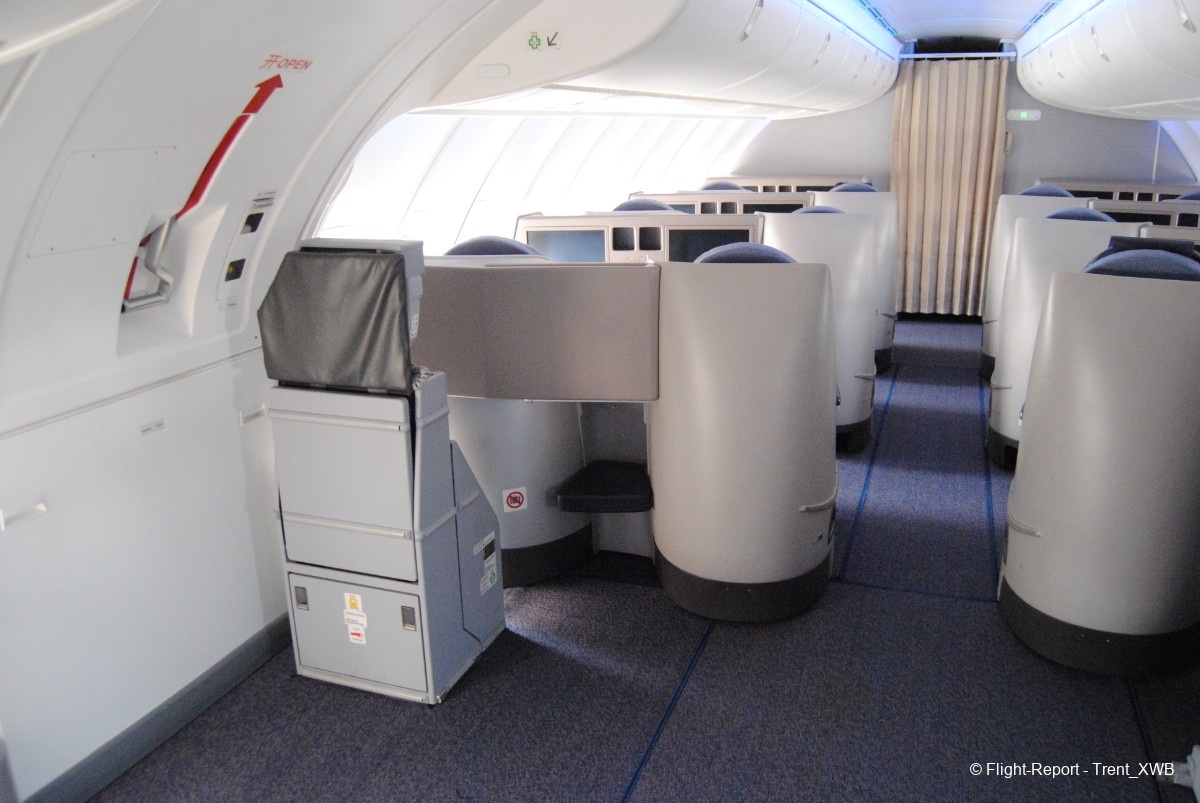
In this section only the bulkhead row 80 provides ample footspace. One may have noticed a strange thing: the upper deck of CA B748s doesn't have Jumbo's signature sidewall compartments! They were removed in order to allow the installation of these bulky Collins Parallel Diamond seats. For comparison, KE installed their Prestige Suites (with excellent privacy and unrestricted footspace) into B748's upper deck without the removal of sidewall storages. LH also keeps the sidewall storages in B748s because their Collins Diamond Parallel (even more obsolete seat model than Parallel Diamond) are less bulky.
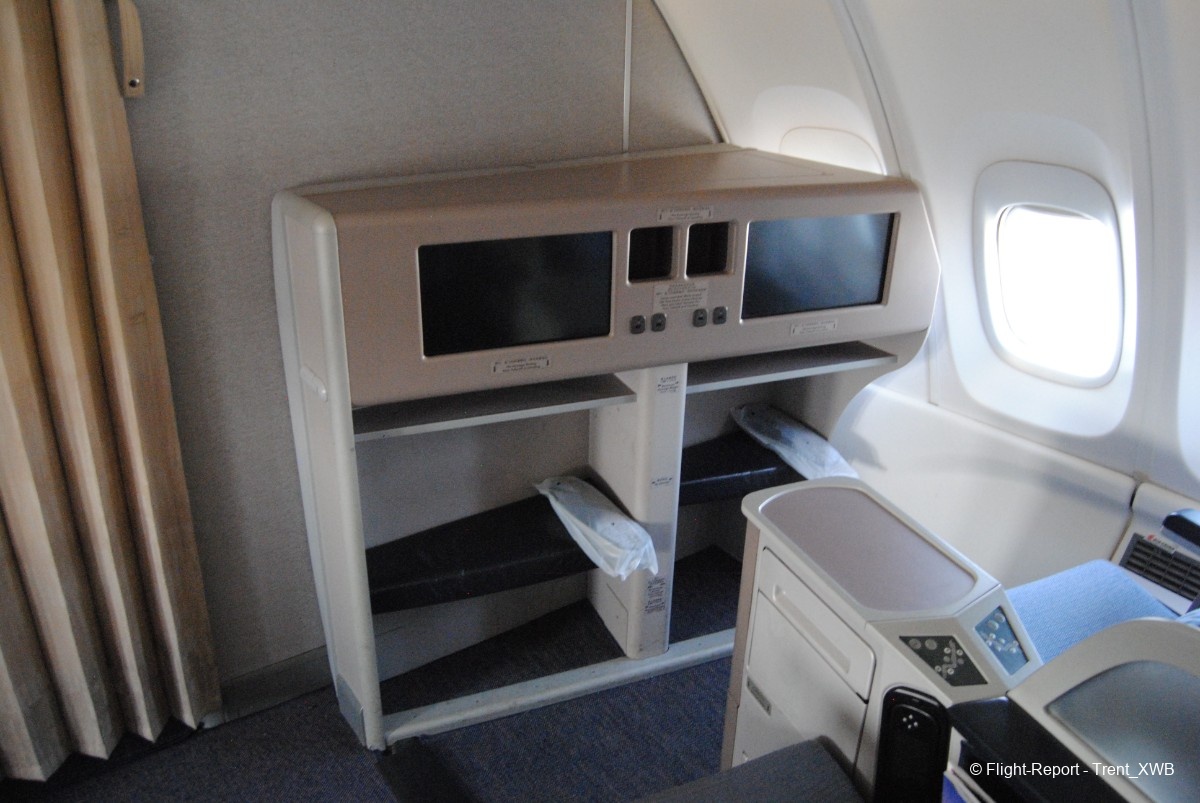
View of the rear part of the cabin (rows 83-87) from the bulkhead. Here only the bulkhead row 83 has spacious footwells.
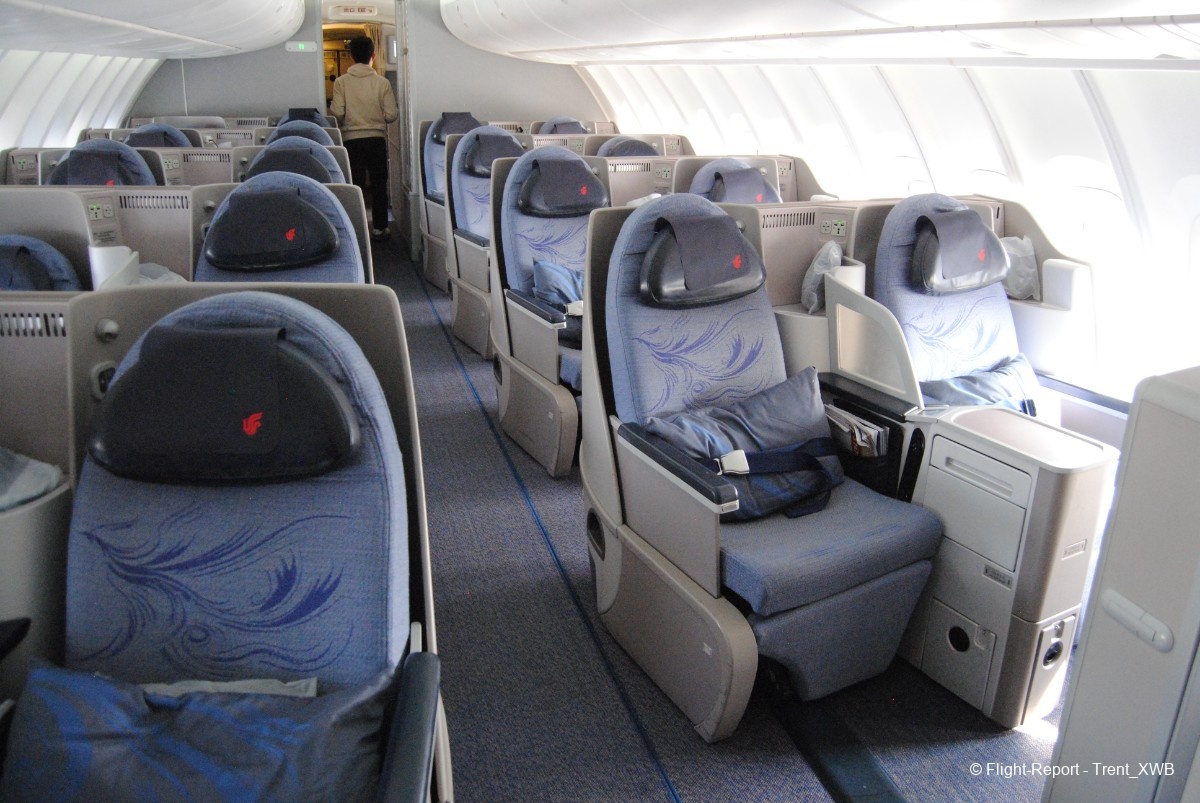
This is how the footwells of the regular rows of Collins Parallel Diamond seats look like - quite tight. One can also see that the footwells of the window seats must align with the wall, that's why sidewall storages were removed.
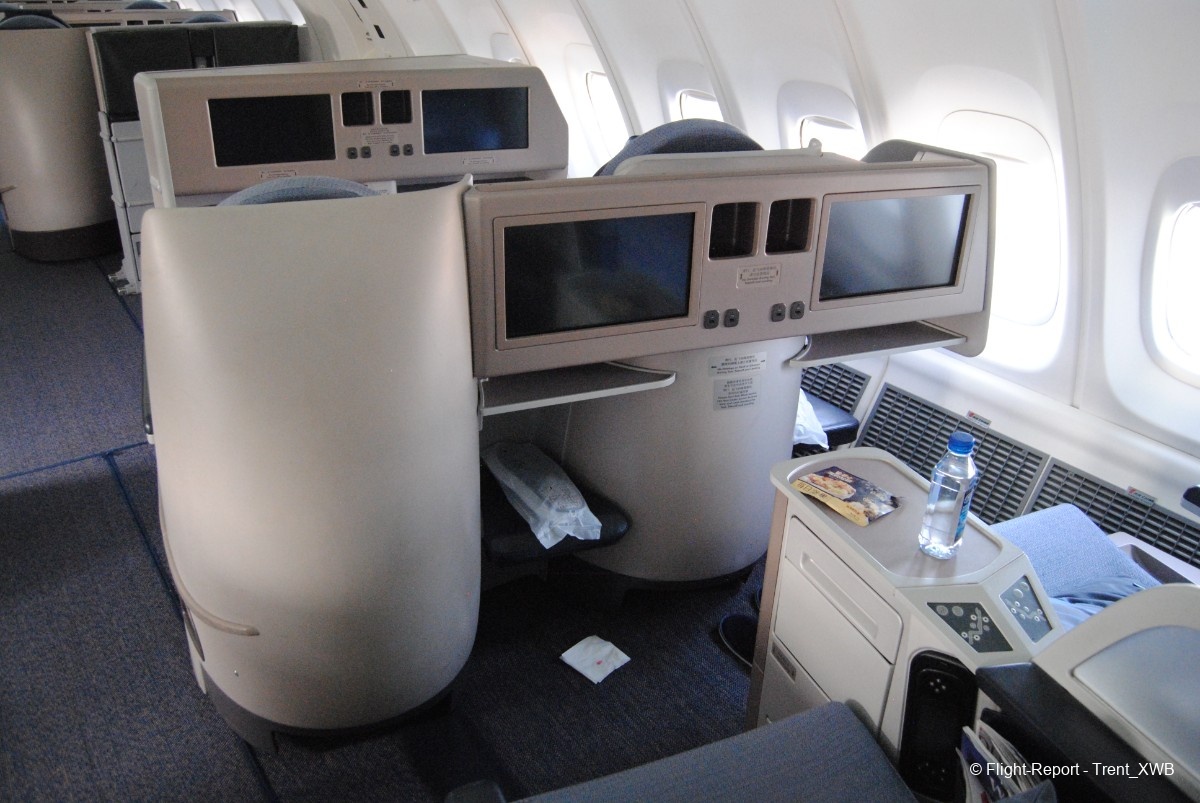
And this is the last row (87) of this cabin, which has only right seatblock. This row provides an excellent view from above on the wing and engines, but I forgot to make a glance in a hurry. Though, on my return CA1558 flight I eventually corrected this mistake.
Many thanks to the crew, allowing to spend enough time on the upper deck. And now it's time to go downstairs, as the cleaning staff has entered the aircraft.
The First Class Cabin After The Flight
The last glance on the first class cabin. Thankfully I had time to explore it earlier during boarding.
The Nose Business Class Cabin After The Flight
Thankfully, the crew permitted me to spend some more time onboard and to visit the front business class cabin in the nose, which, let's remind, consists of 12 Collins Parallel Diamond seats in 2-2 layout (rows 11-13). As one can already guess, only the bulkhead row 11 provides ample footspace, whereas rows 12-13 have standard tight footwells. The nose cabin is remarkable by the facts that due to the nose tapering it provides some forward views and that it located forward in relation to the cockpit (located upstairs). In the front part of the cabin a closet is located and in the rear part one can find a bar.
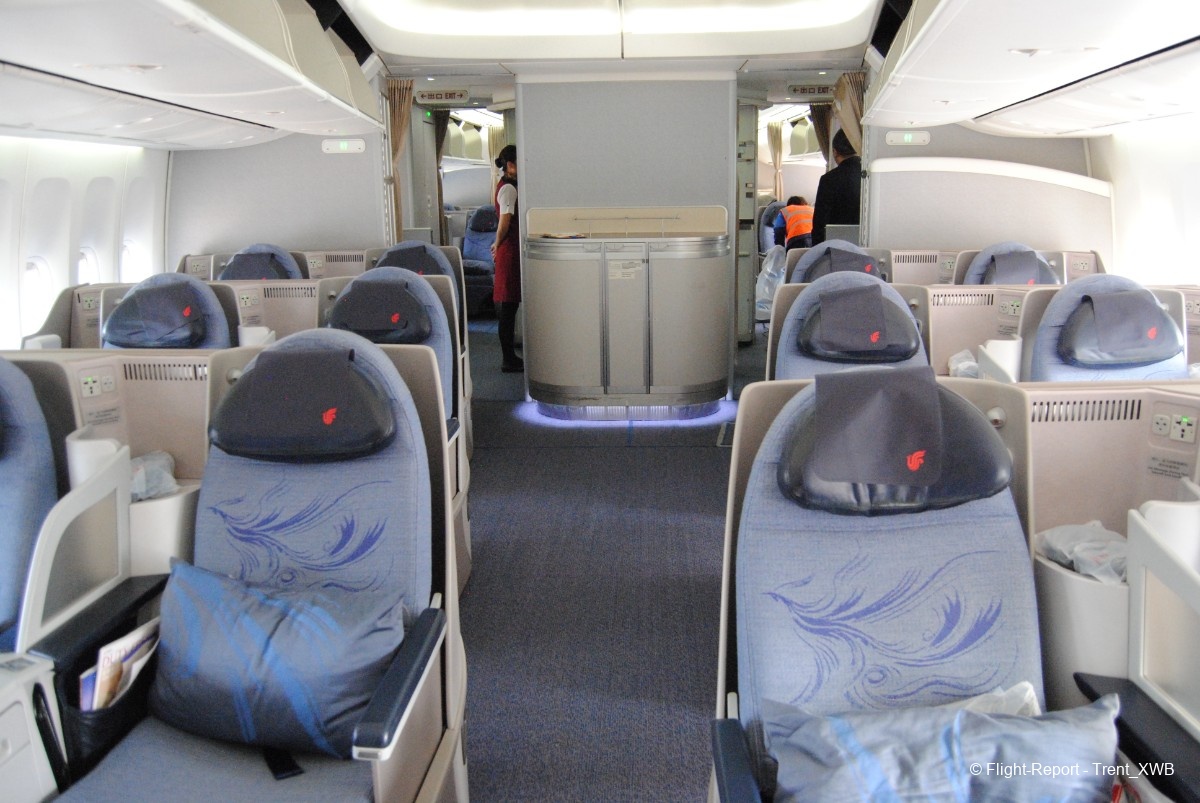
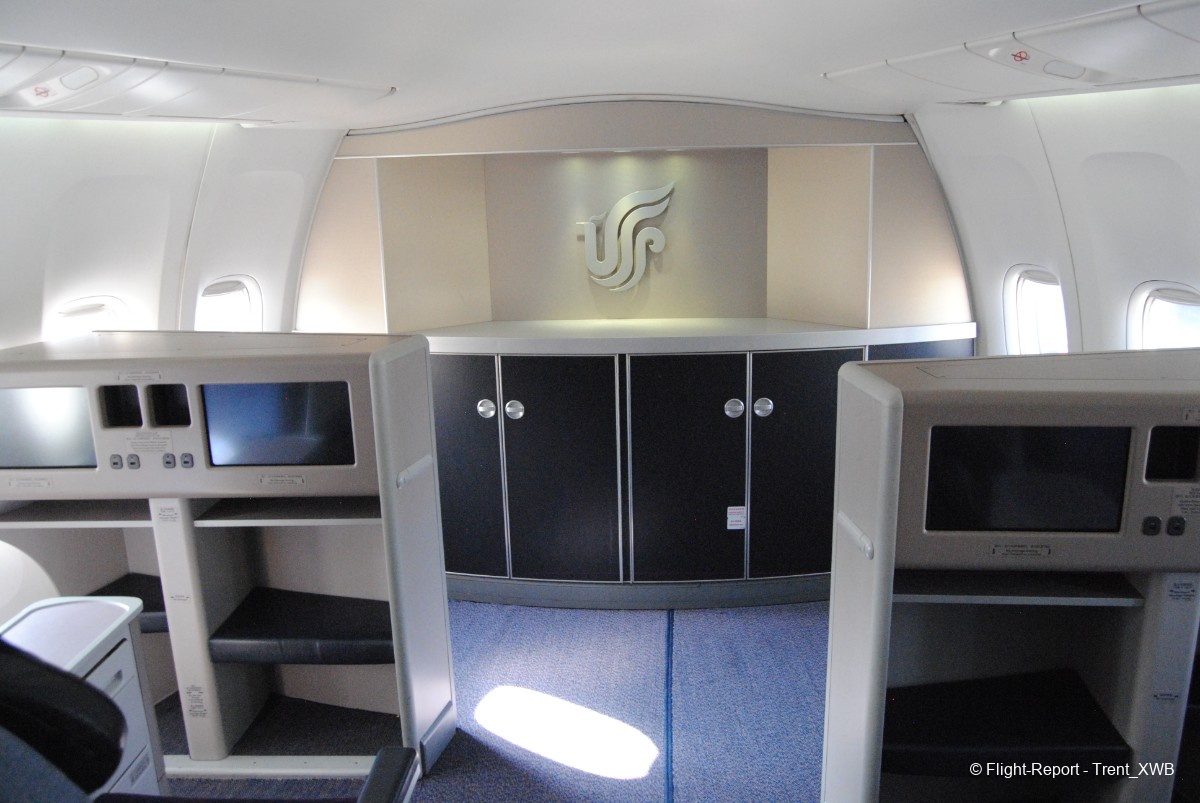
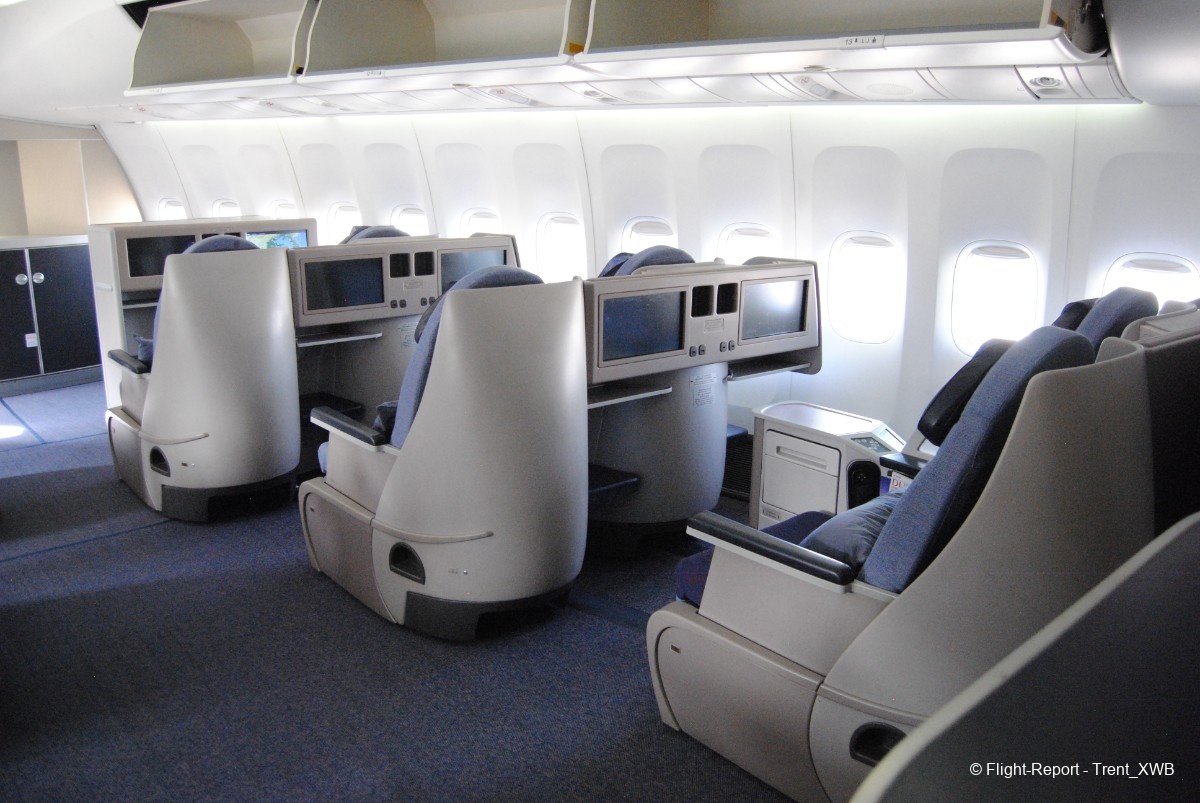
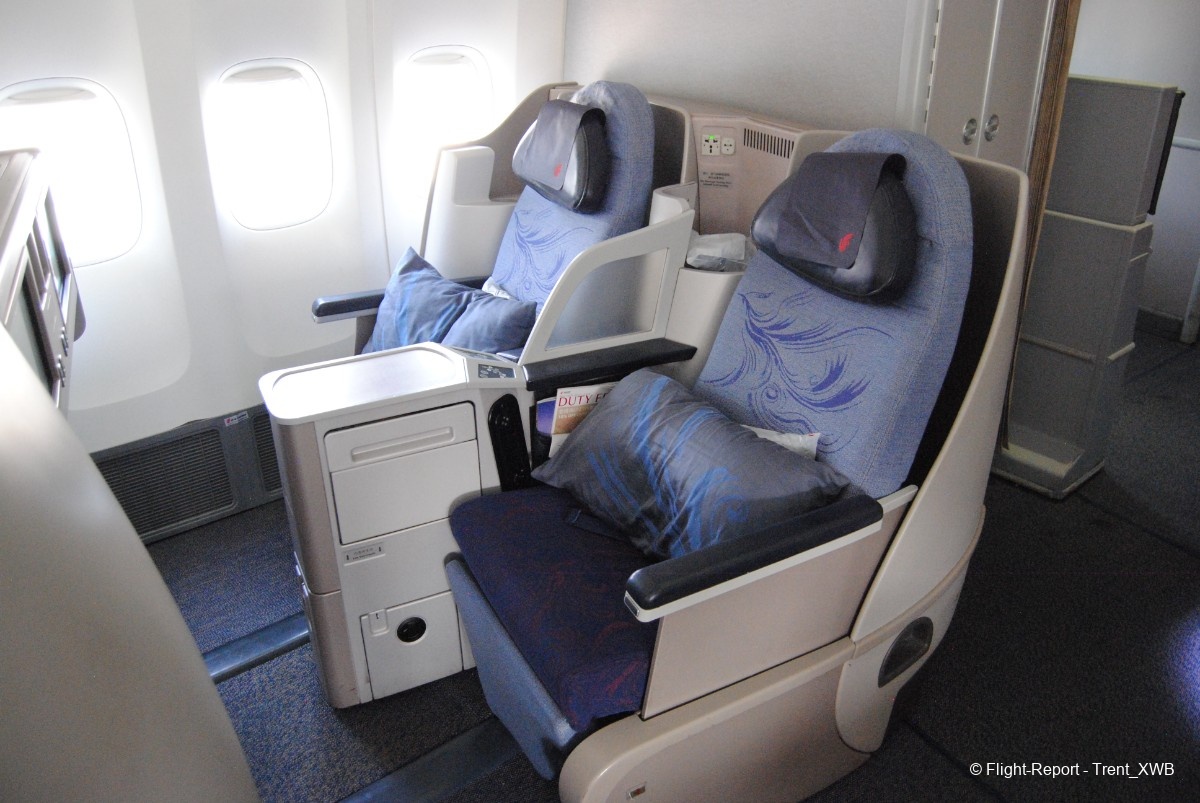
And then it was time to finally leave the aircraft. Due to the hospitality of the crew, allowing to visit all the premium cabins of the Jumbo, this flight turned to be very memorable! Many thanks to them!
The Aircraft After The Flight
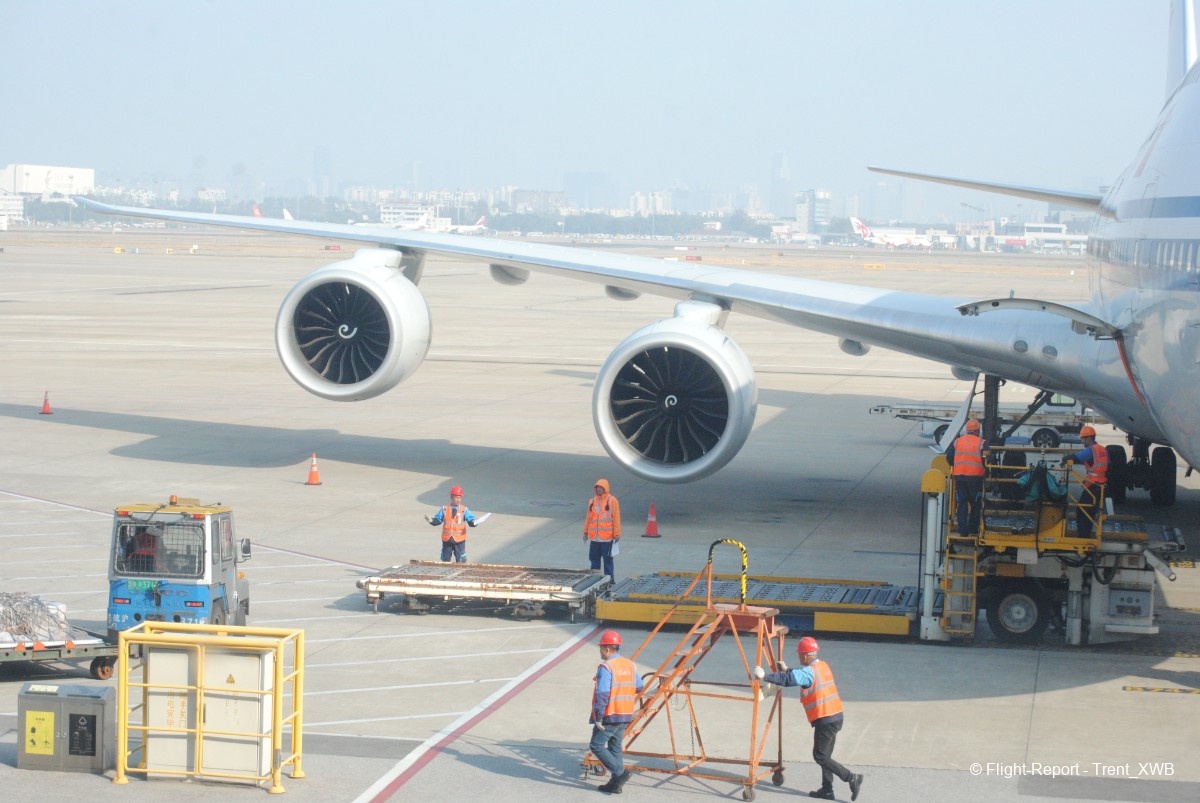
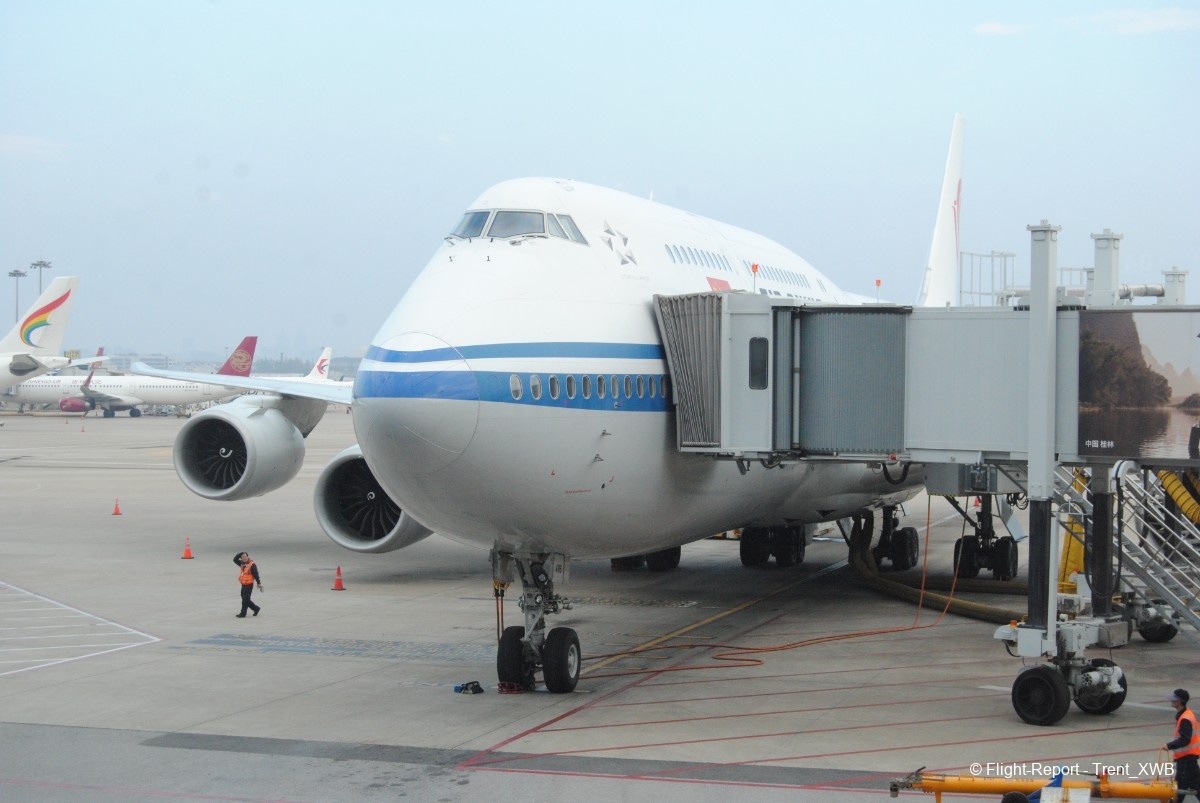
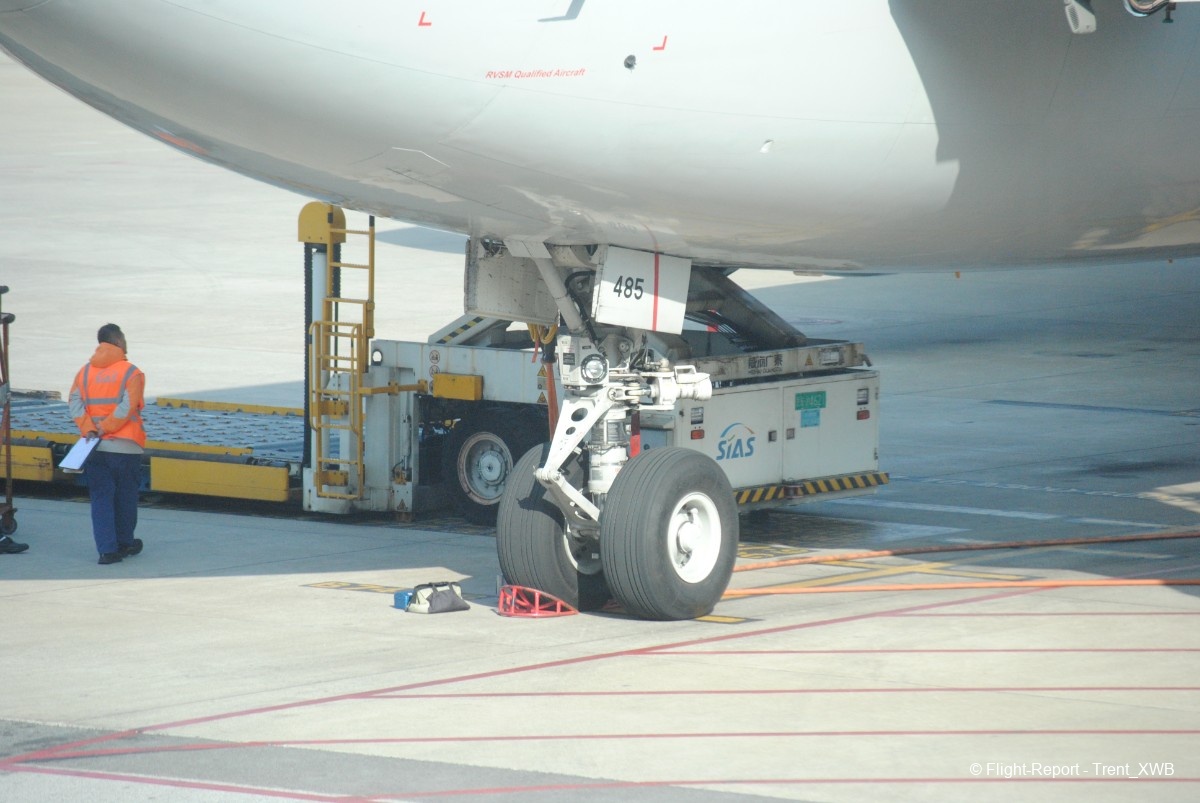
Some views of the beautiful Jumbo (being prepared for the return CA1558 flight near the gate 48) from the transit zone. On the 4th photo one can notice words "RVSM Qualified Aircraft" over the NLG bay. It means that the aircraft is allowed to fly between FL290 and FL410 with vertical separation 1000 feet (instead of usual 2000) with other aircraft, which needs some advanced avionics.
Planespotting From T1 SHA
SHA, being kind of hybrid between GMP and HND, is an avgeek paradise due to diverse traffic, including a lot of widebodies of Chinese and some foreign East Asian airlines.
JL B77W, departing from T2 to HND. JL B77Ws, which have 4-class premium-heavy F8_C49_W40_Y147 layout with 3-3-3 Sky Wider economy (based on Zodiac/Safran Z300 seats) - these B77Ws are the most spacious ones in the world. Sadly, JL is gradually retiring them (currently there are 8 2006-2009-built frames left), replacing by 4-class A35Ks, which has mediocre economy with much narrower and uncomfortable Recaro CL3710 seats. In 2025 JL phased out JA732J - the B77W prototype, which is going to be scrapped for parts, which is sad, because the venerable prototype of the most successful 777 modification deserves to be preserved in a museum.
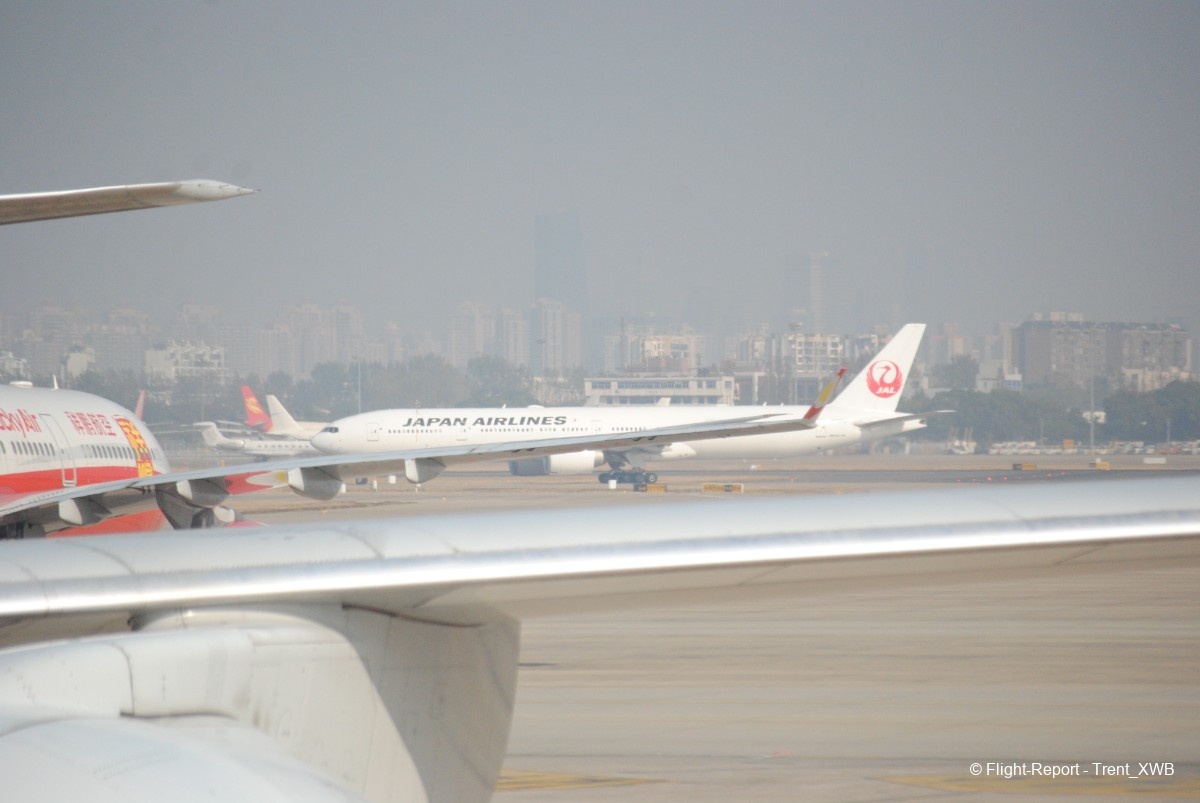
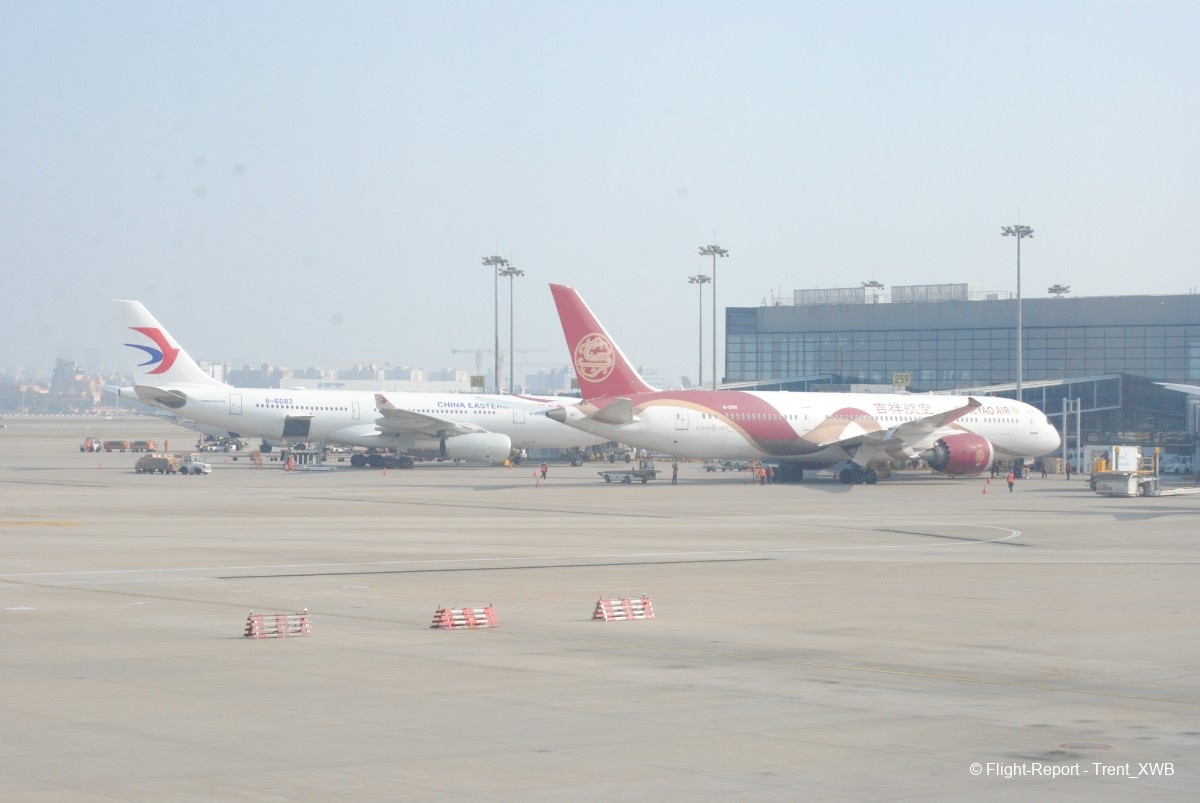
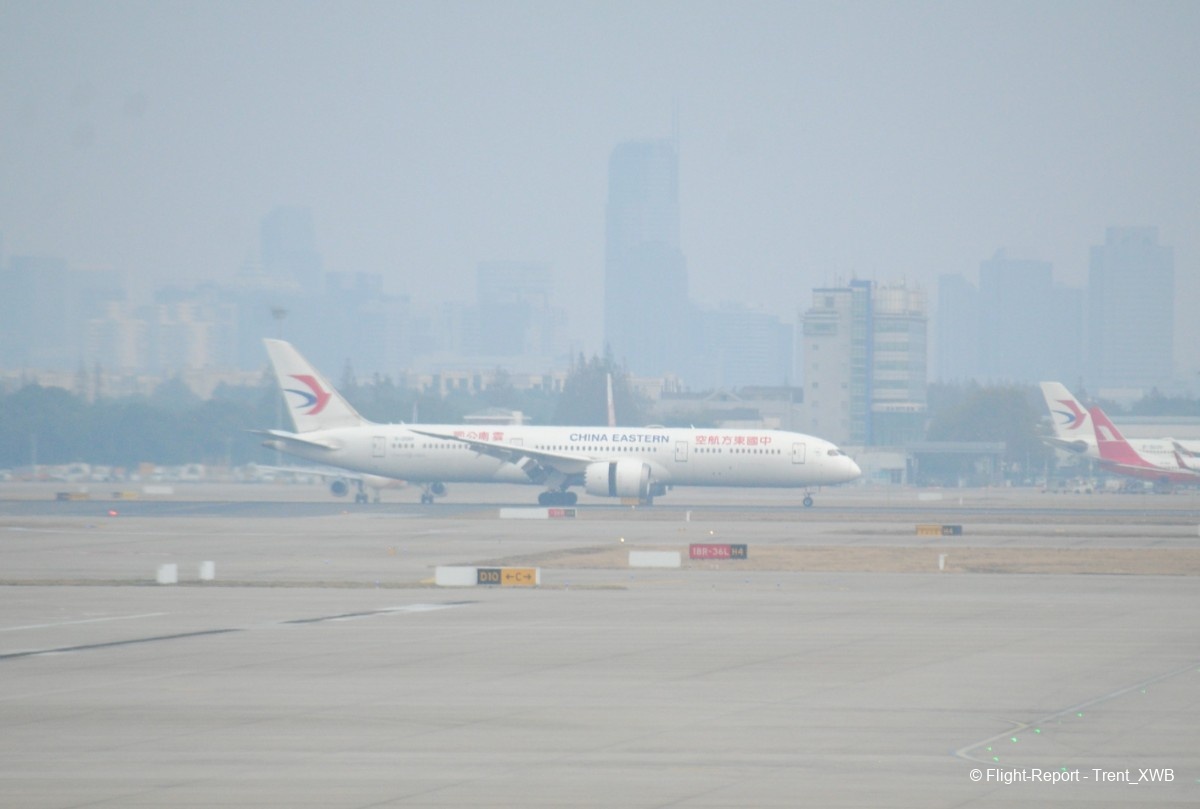
B789 (B-207N) of Juneyao Airlines in "Chinese Silk Ribbon" livery and MU A332 (B-6082) - the MU's oldest A332 with C24_Y242 layout (with obsolete B/E Aerospace Minipod angle-lie seats in business and comfortable Weber 5751 seats in economy).
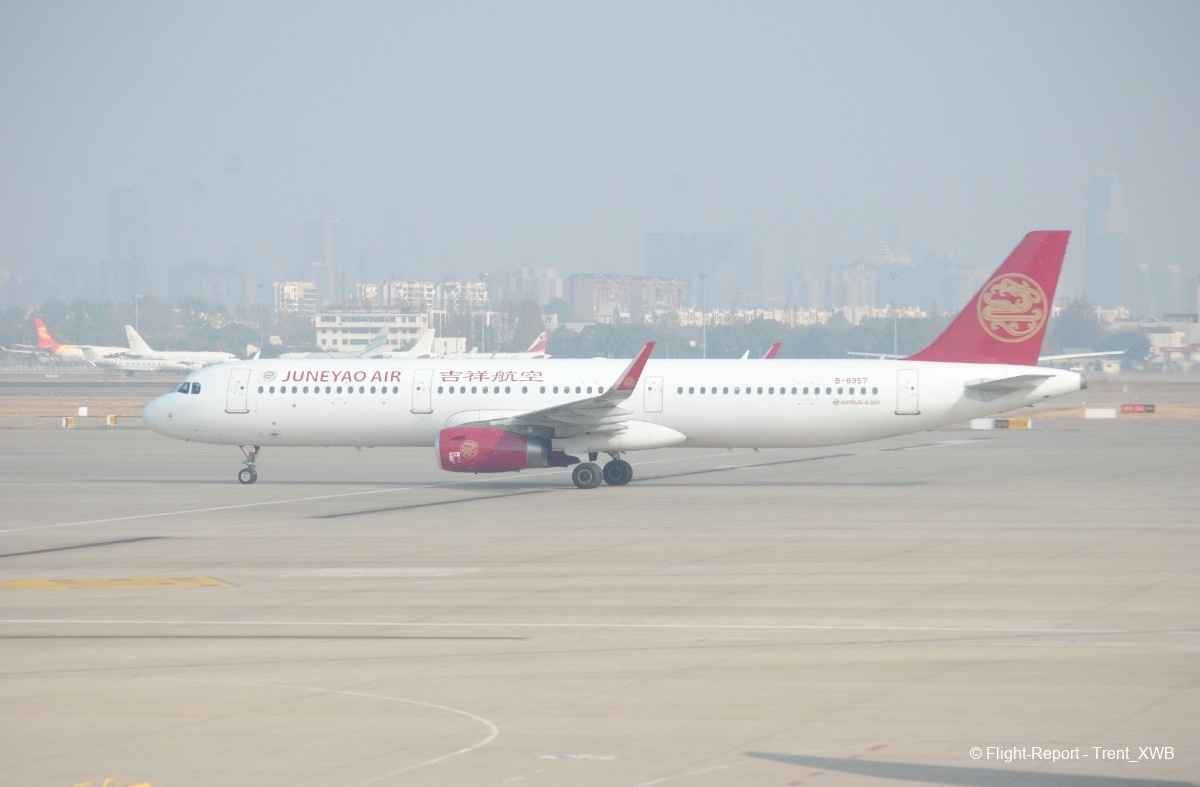
Speaking of Juneyao (HO), this airline, relatively little-known outside of China, operates 10 2018-2025-built B789s (C29_Y295 layout with Thompson Aero Vantage XL seats in business and Recaro CL3710 seats in economy), 14 A21Ns (C8_Y199 with Recaro CL4710 recliners in business and Recaro BL3530 in economy), 27 A321SL (C8_Y190 with Weber 7700 recliners in business and Weber 5700 in economy), 22 A20Ns (C8_Y156 with Recaro CL4710 recliners in business and Recaro BL3530 in economy) and 30 A320s (C8_Y156 with Weber 7700 recliners in business and Weber 5700 in economy).
Juneyao A321SL (B-8957) in the standard livery.
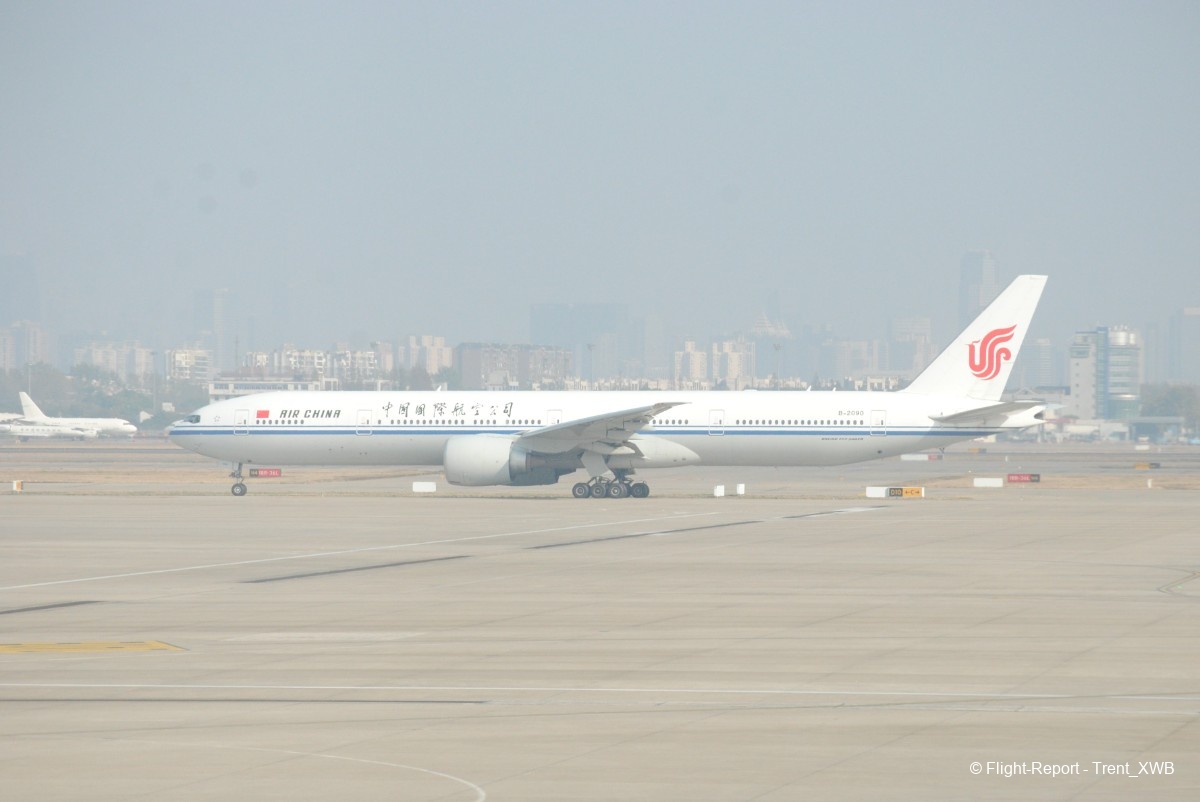
CA B77W (B-2090). All the CA B77Ws with B-20XX regs (20 2012-2014-built frames) are 3-class ones with F8_C42_Y261 layout, featuring the same Zodiac Aerospace Venus first class suites and Collins Parallel Diamond business class seats as CA B748s. Though, CA 3-class B77Ws have just 8 F suites (compared to 12 in B748s), and the space between the first class cabin and 2L/R is occupied by a huge galley, which is pretty inefficient. These 3-class B77Ws are the most comfortable CA widebodies, as they have very spacious 3-3-3 layout with wide and comfortable Weber 5751 seats (of early production years). As was said earlier, JPA Design took some part in designing of the interiors of these B77Ws, thus they also feature phoenix inside, but to a lesser extent than in B748s. CA uses its 3-class B77Ws to some primary EU destinations like LHR, CDG, FRA and MUC. Also CA has 8 2016-2018-built 2-class high-density B77Ws with C36_Y356 layout, featuring Collins Parallel Diamond business class seats and Collins Pinnacle economy seats in 3-4-3 layout (the comfortable seat model offsets some drawbacks of this layout), which are used for some high-volume EU destinations like FCO.
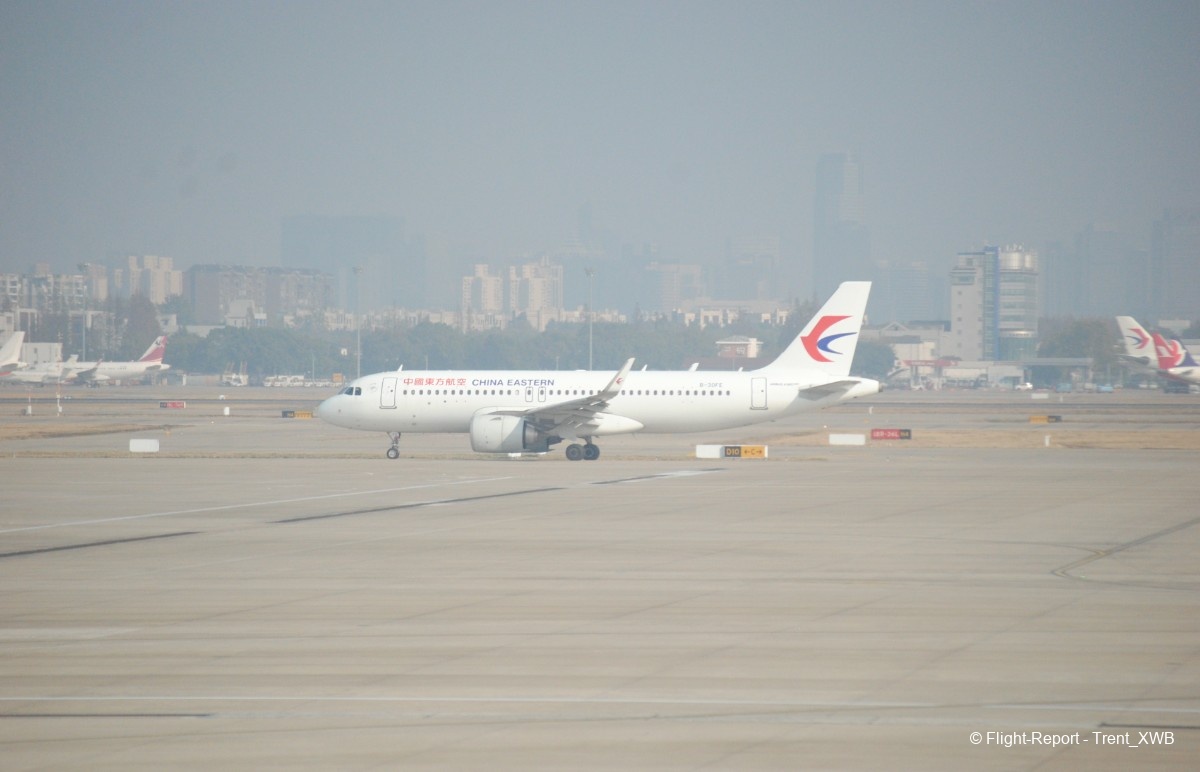
MU A20N (B-30FE). MU has a whopping number of 125 A20Ns in C8_Y150 layout.
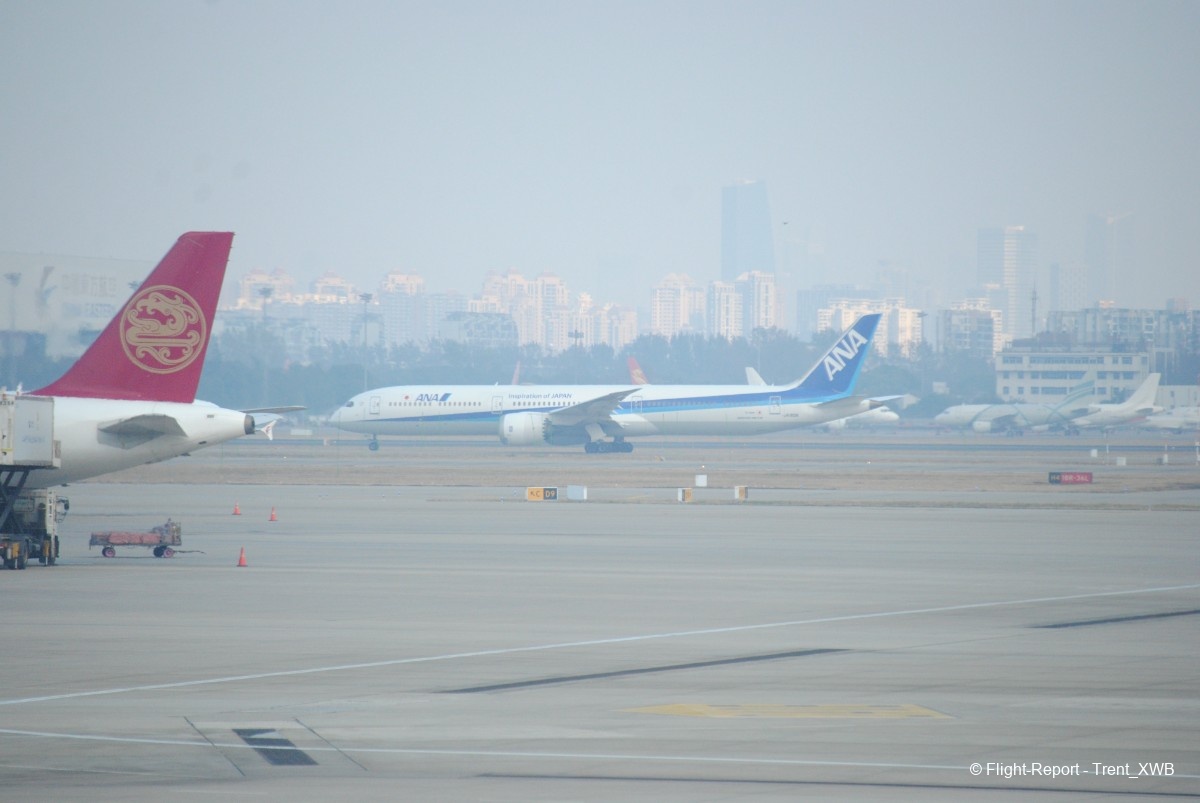
NH RR-powered B78X (JA901A) in 3-class C38_W21_Y235 layout (featuring Safran SkyLounge III seats in business, ZIM Magic seats in premium economy and Recaro CL3710 in economy), departing from T1 to HND. There are only 3 operators of RR-powered B78Xs in world: SQ, BA and NH, and there'll never be more, as RR has completely lost B78X market (for example, the newest batch of BA B78Xs will be GE-powered). Whereas SQ's and BA's RR-B78X fleets are large (28 and 12 frames respectively), NH has just 3 RR-B78Xs. They have international layout, but don't have crew rest bunks, thus NH uses them just on some mid-haul Asian destination. At the same time, NH has received 7 GE-powered B78X in dense domestic layout C28_Y401 (featuring Safran Z600 recliners in business and Japanese-produced Toyota Boshoku seats in economy), which are gradually replacing the old NH domestic B773s and B772s. Obviously, NH had to correct its strategy for B78X, as the "international" frames didn't work well for the airline.
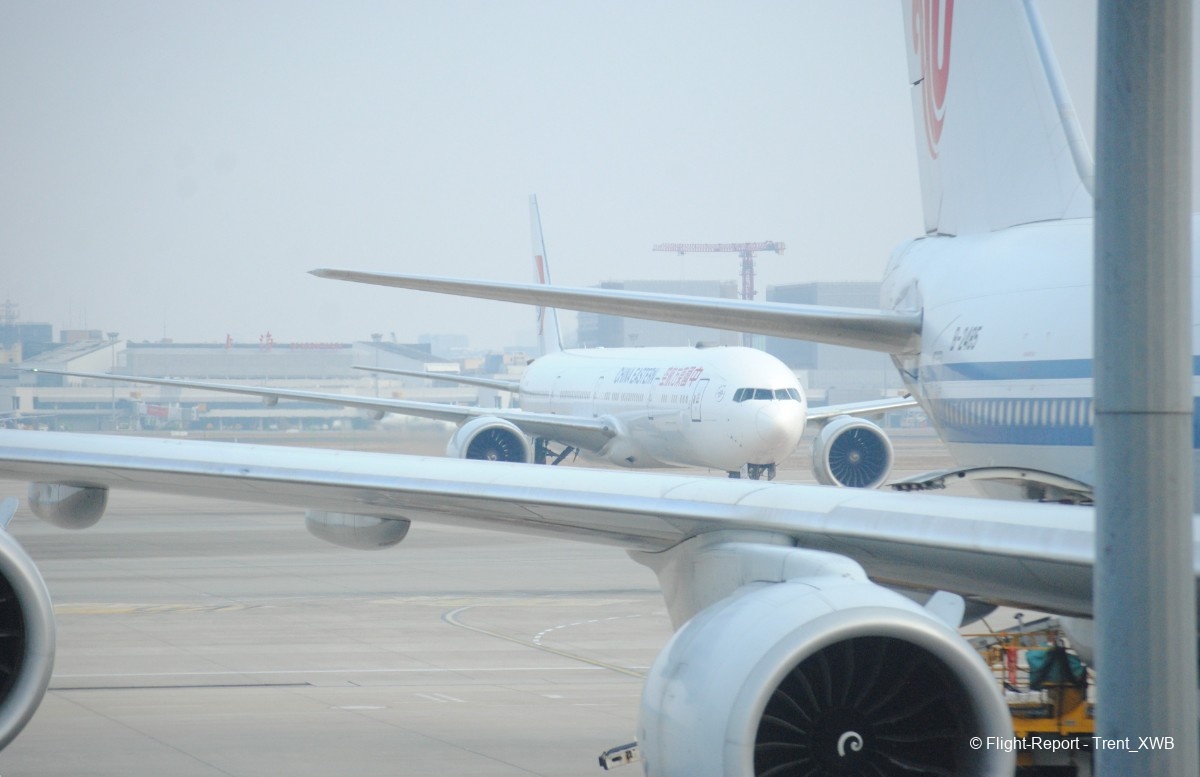
MU B77W, arriving to T1. MU has 20 2014-2017-built B77Ws in 3-class F6_C52_Y258 layout, featuring the best first class suites in China (with high walls, electrochromic window shades and multiple storages), Safran Cirrus II reverse herringbone seats (far from cutting-edge product) in business class and Safran Z300 seats in 3-4-3 layout in economy. In March 2022 I flew a MU B77W on longhaul PVG-AKL flight in economy and the flight was comfortable due to excellent seat model, offsetting some drawbacks of the laterally densified layout, and the service was almost top-notch.
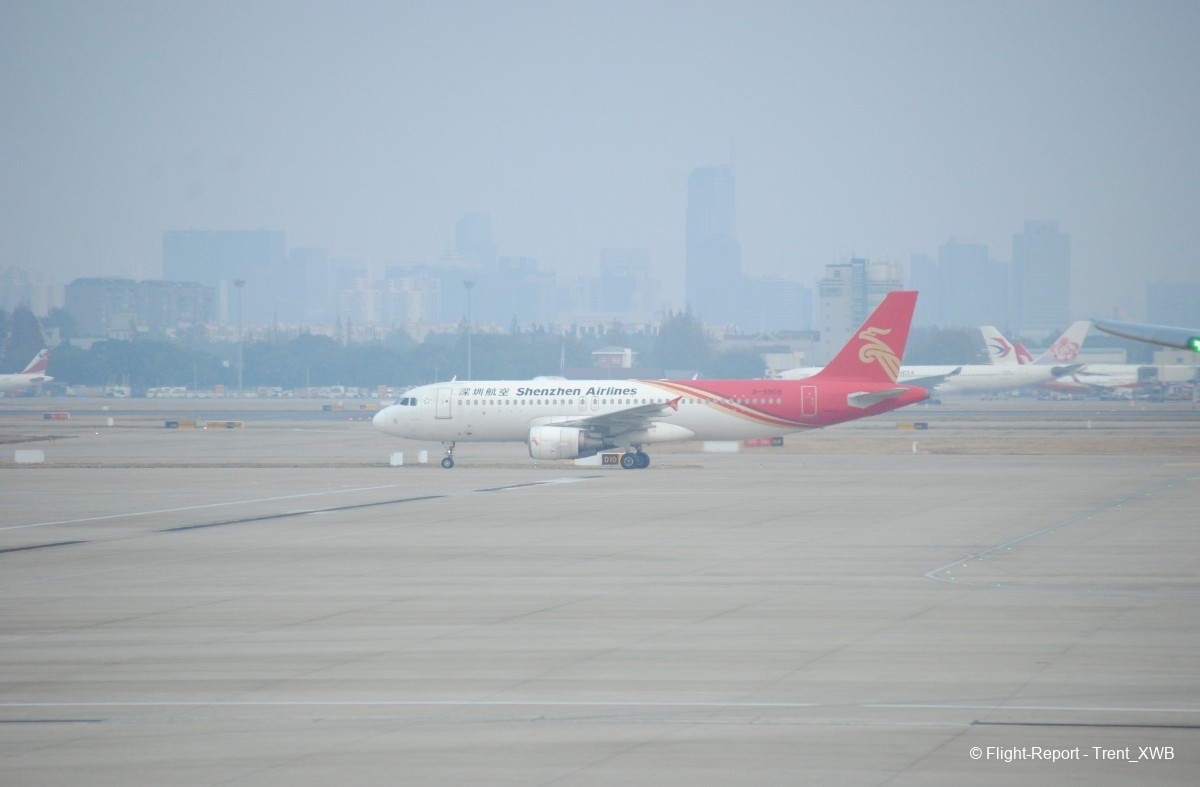
A320 (B-9909) of Shenzhen Airlines and CI A333 (from TSA) near T2 on the backdrop. ZH is an airline, relatively little-known outside of China, operating 6 2017-2019-built A333s with C18_Y+24_Y267 layout (featuring Collins Diamond Parallel seats in business and Collins Pinnacle seats in "economy plus" and economy), 8 2022-2026-built A21Ns with C12_Y172 layout (featuring Collins Diamond Parallel seats in business and Collins Meridian seats in economy), 35 A20Ns (3 different layouts), 72 A320s (with 3 different layouts), 16 B7M8s and 71 B738s (3 different layouts).
MU B789. MU has 7 B789s with first 5 of them having 3.5-class C+4_C26_W28_Y227 layout featuring the best business class in China - suites with doors based on Thompson Aero Vantage XL seats, with the front row being kind of "business plus", Collins MiQ seats in premium economy and Collins Pinnacle seats in economy. It's arguably one of the best layouts in the world for a 3-class B789 with 3-3-3 economy. MU's subsidiary Shanghai Airlines (FM) has 10 identical B789s, and in March 2024 I flew one of them on BUD-PVG flight, and the experience was very nice with almost top-notch service. The 2 last MU B789s have 2.5-class C+4_C26_Y289 layout without premium economy.
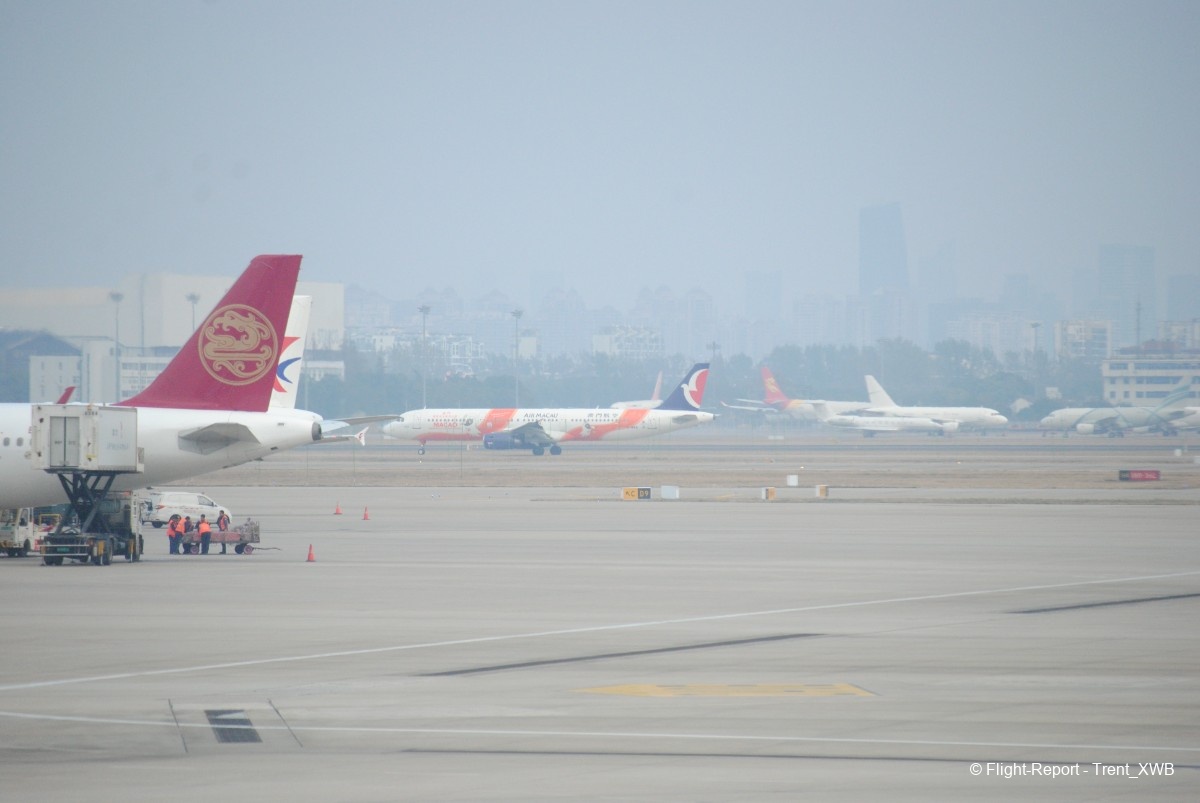
Air Macau A321 (B-MBB) in "Creative City of Gastronomy / The Historic Centre of Macao" livery. NX is a small airline, based in MFM and operating 5 A21Ns (C12_Y186 with Collins MiQ recliners in business and Collins Pinnacle in economy), 8 A321s (with 7 of them having C24_Y155 layout with unusually large business class and 1 of them having C12_Y170 layout; all of them have Collins Pinnacle seats in economy), 4 A20Ns and 6 A320s.
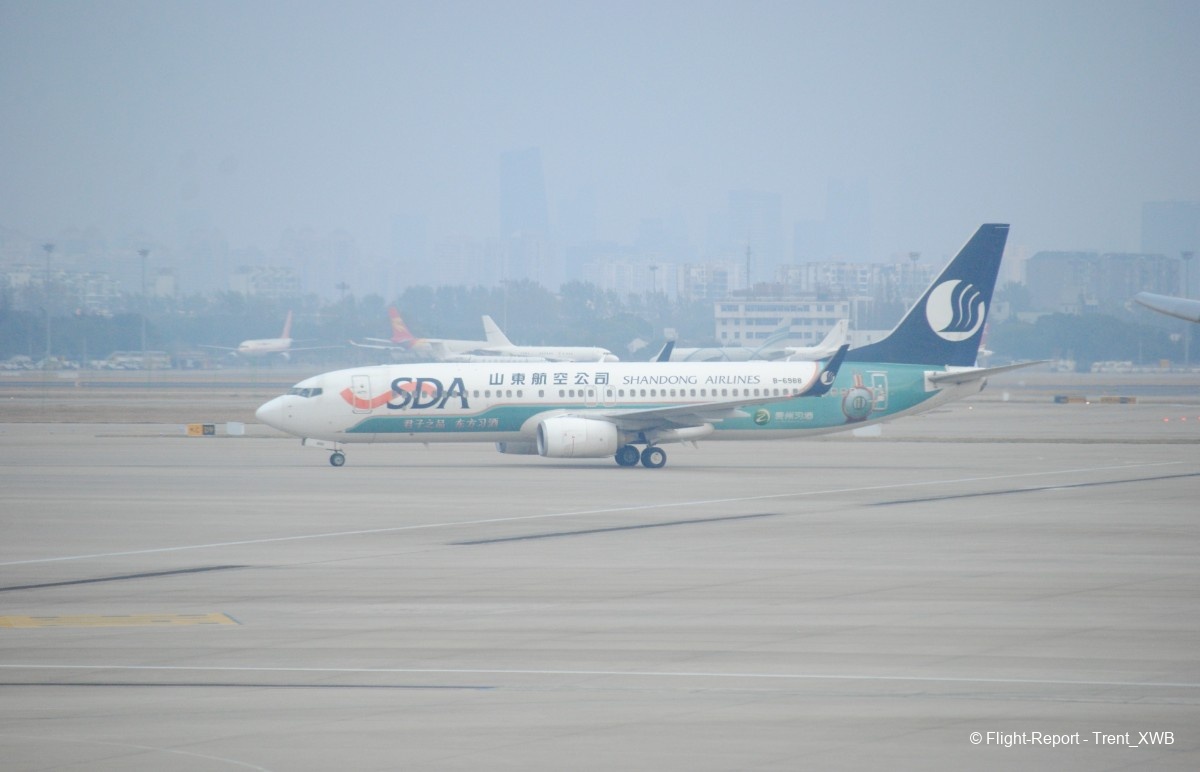
Shandong Airlines B738 (B-6988) in "Guizhou Xijiu Wine" livery.
Shanghai Hongqiao International Airport (SHA), T1 (Domestic)
A beautiful panel in the transit zone of T1.
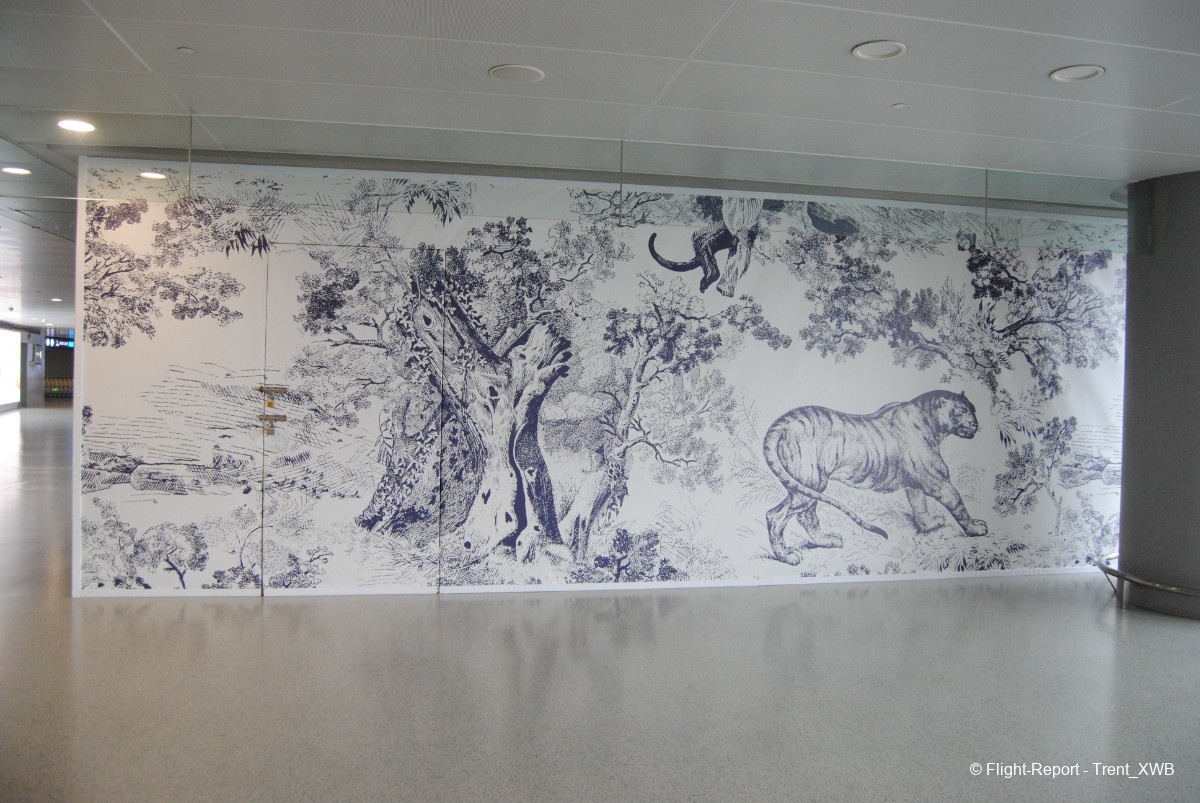
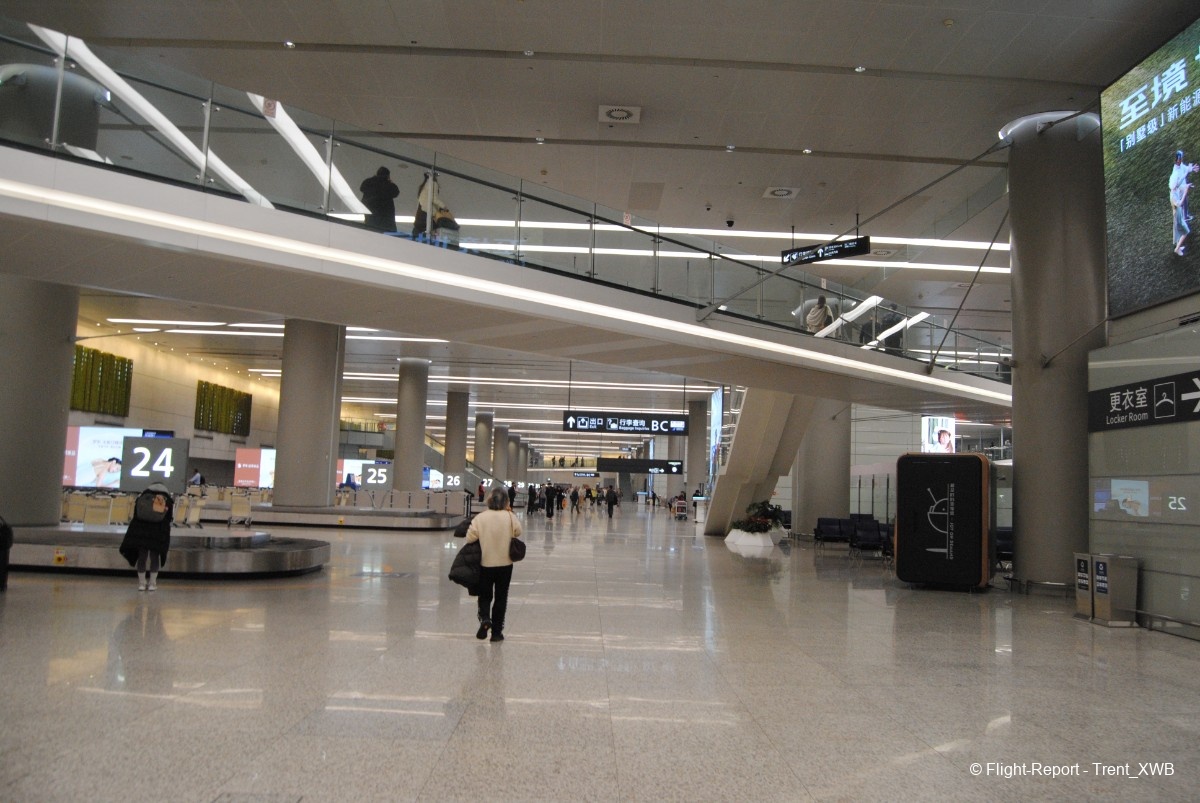
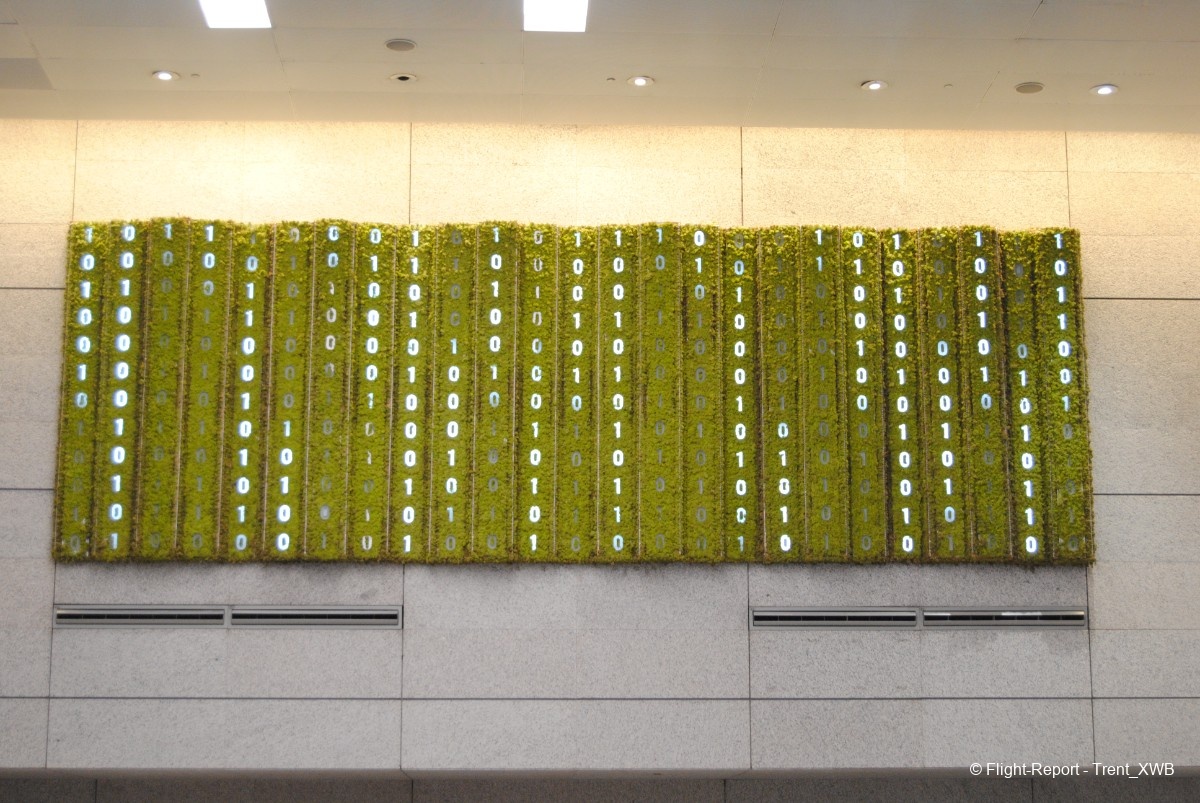
Luggage claim hall, decorated with binary tableaus.
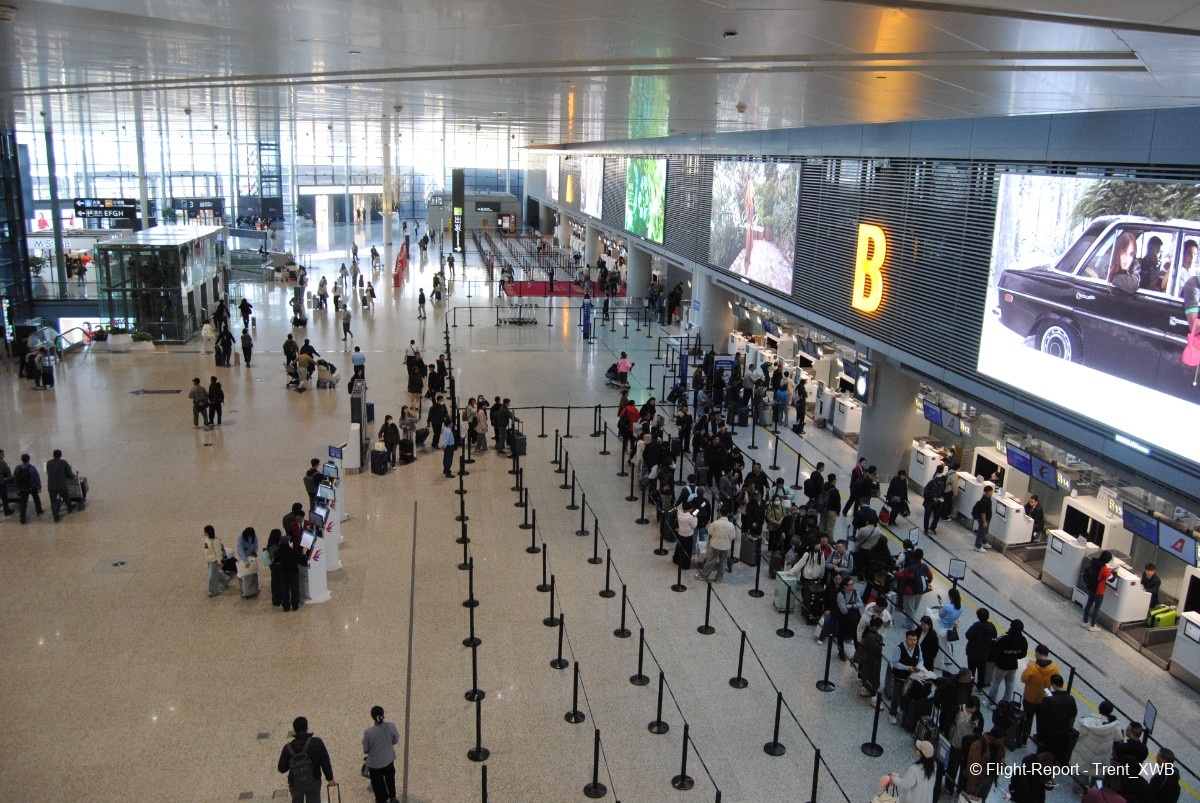
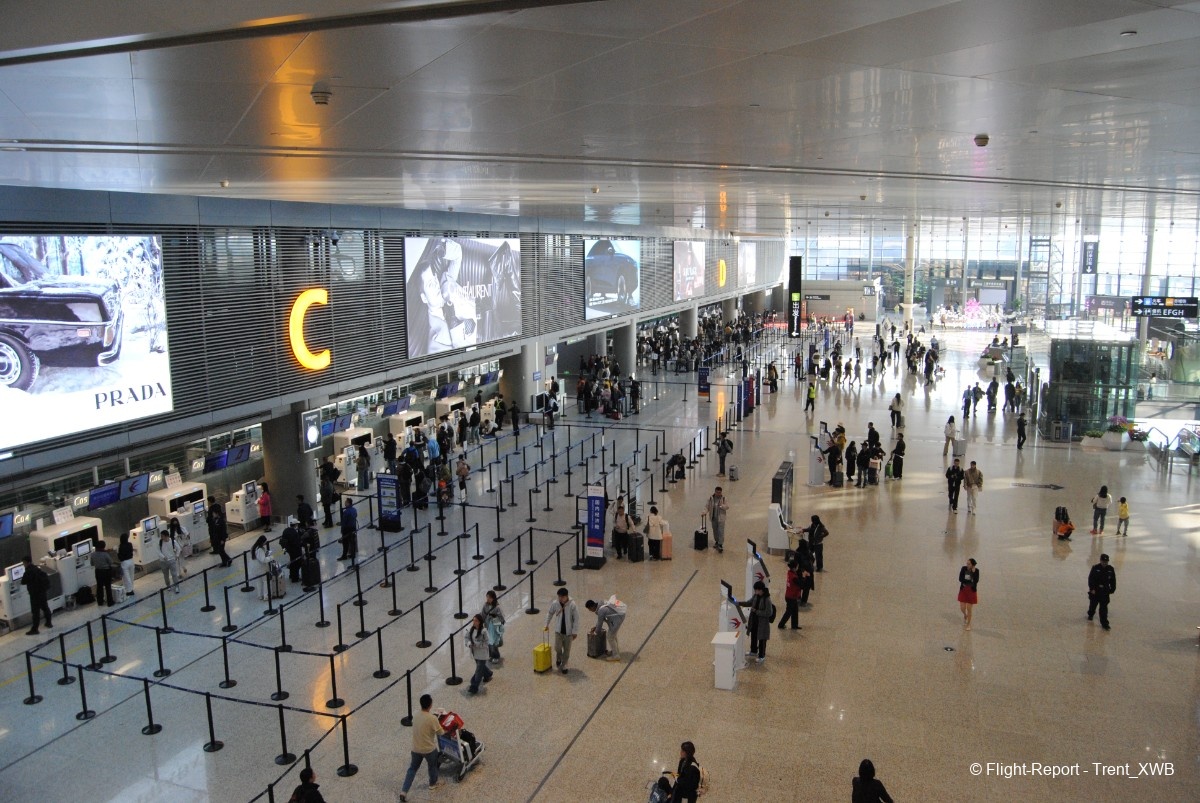
General views of the check-in hall of T1 SHA from the higher level. I will cover this terminal in details in the FR of the return CA1558 SHA-PEK flight.
Thank you for your attention and welcome to the FR of the return CA1558 SHA-PEK flight, also on a B748!