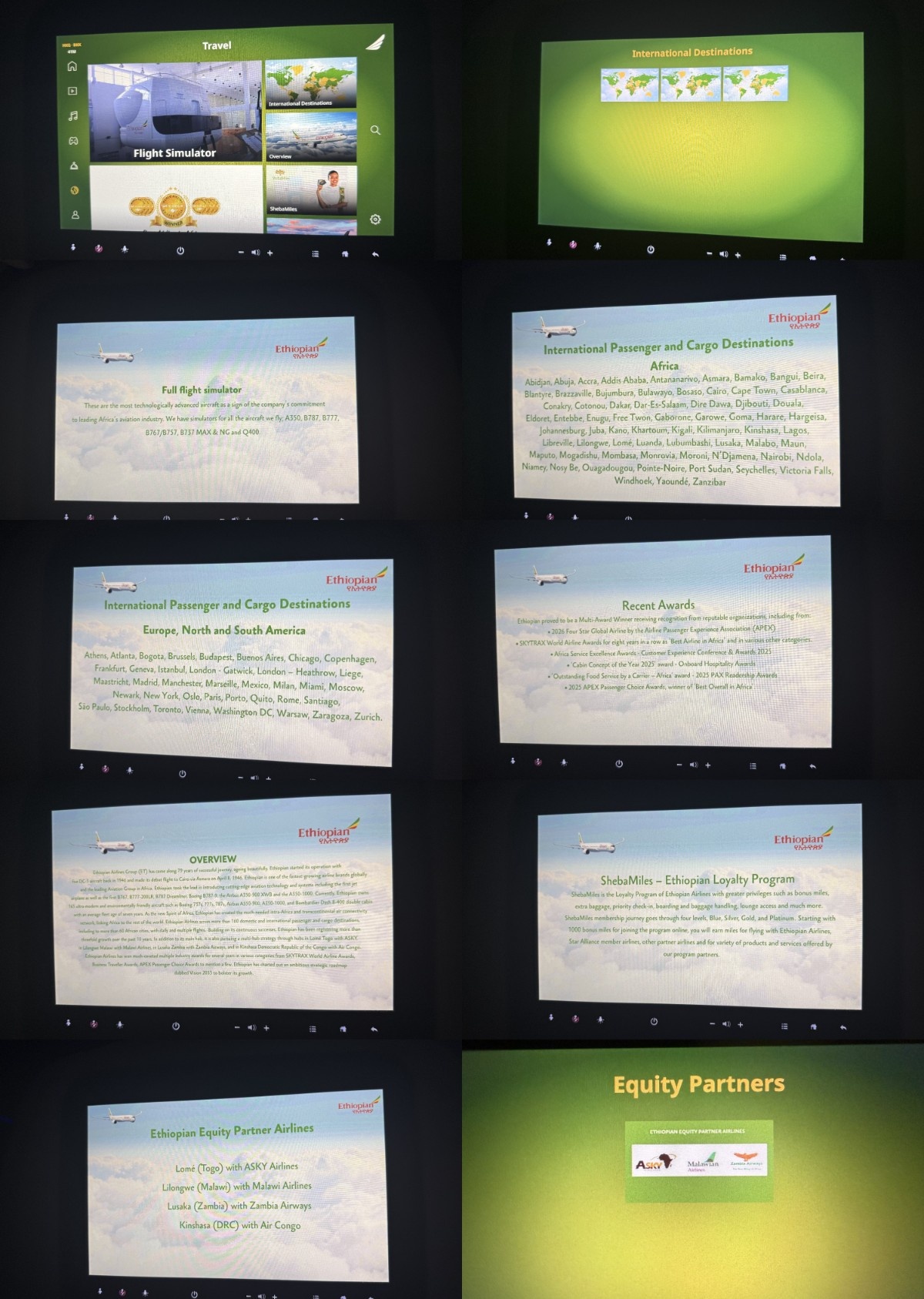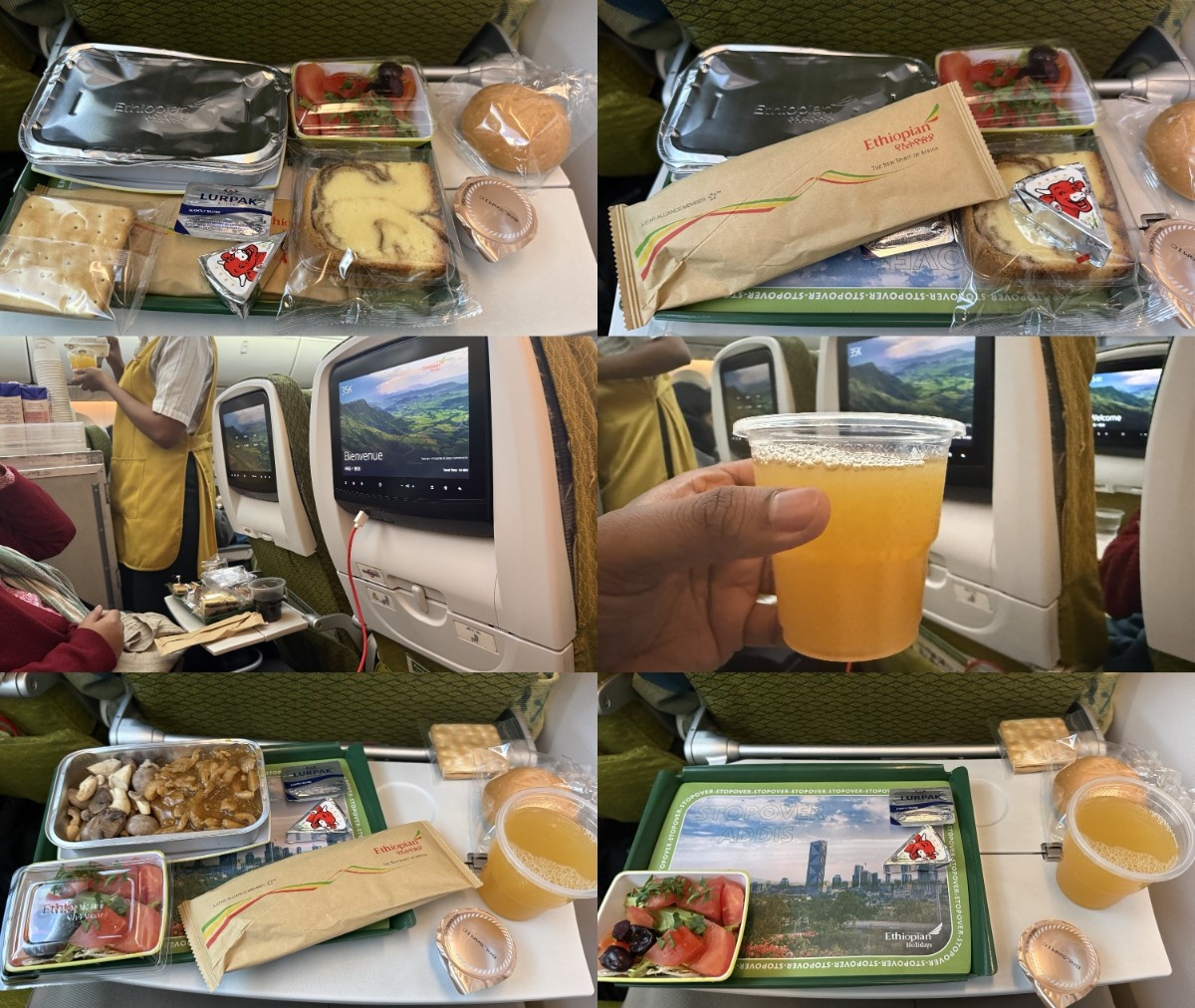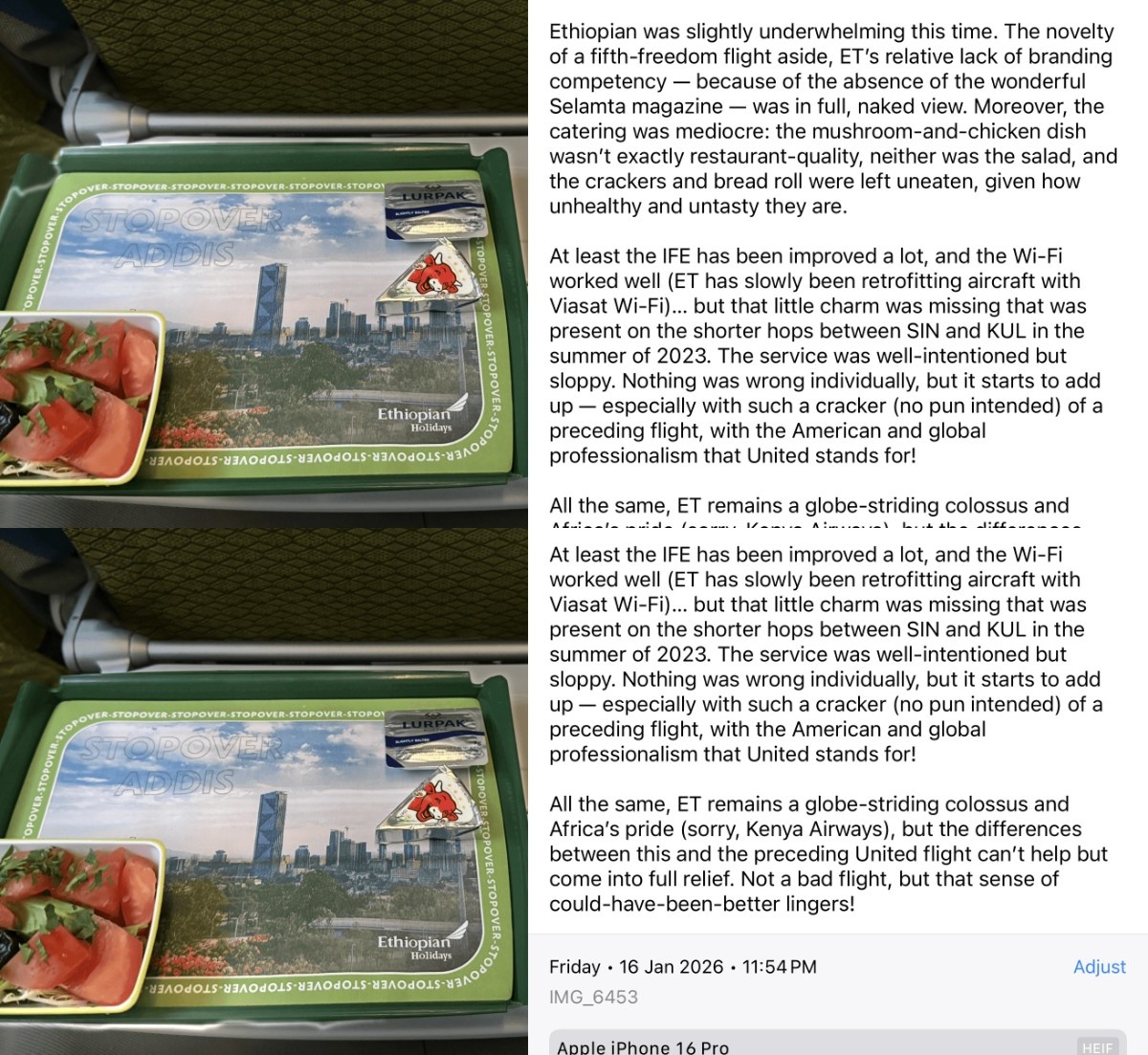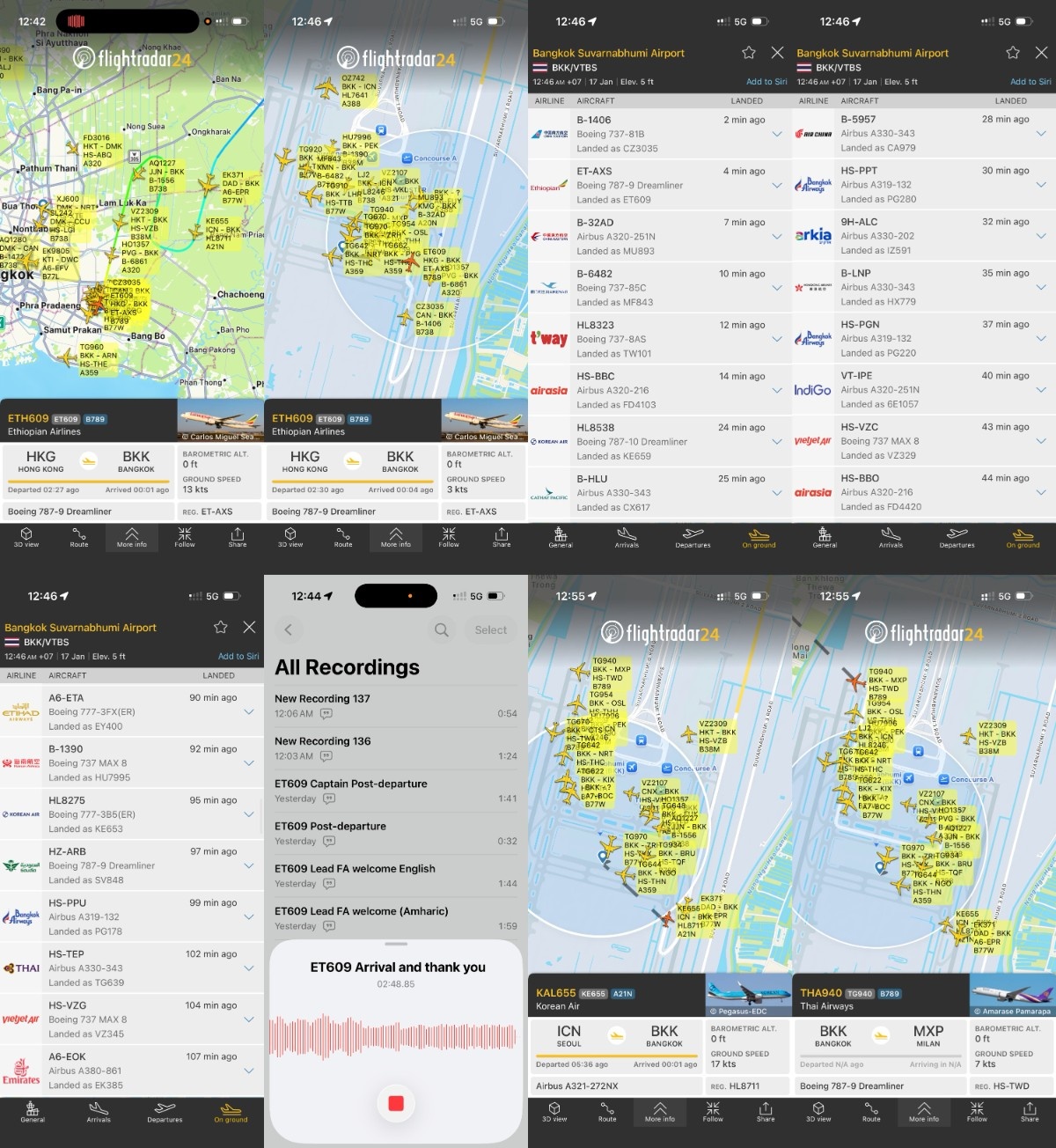



Note: While the central focus of this report is United Airlines’ BKK–HKG fifth-freedom flight, I think it would remain incomplete without the Thai Airways and Ethiopian Airlines flights that preceded and followed it. Hence I’ve also briefly touched upon the TG flight from Bengaluru at the beginning, followed by Thai Airways’ Royal Orchid dining experience, before coming to the United Airlines flight to HKG. In the Travelling Bonus at the end, I’ve also covered the Ethiopian Airlines fifth-freedom flight from HKG back to BKK, as I don’t think it was noteworthy enough to warrant a separate report by itself. Happy reading!
Introduction: Ten flights in a month (six in a weekend) — sheer craziness in January 2026
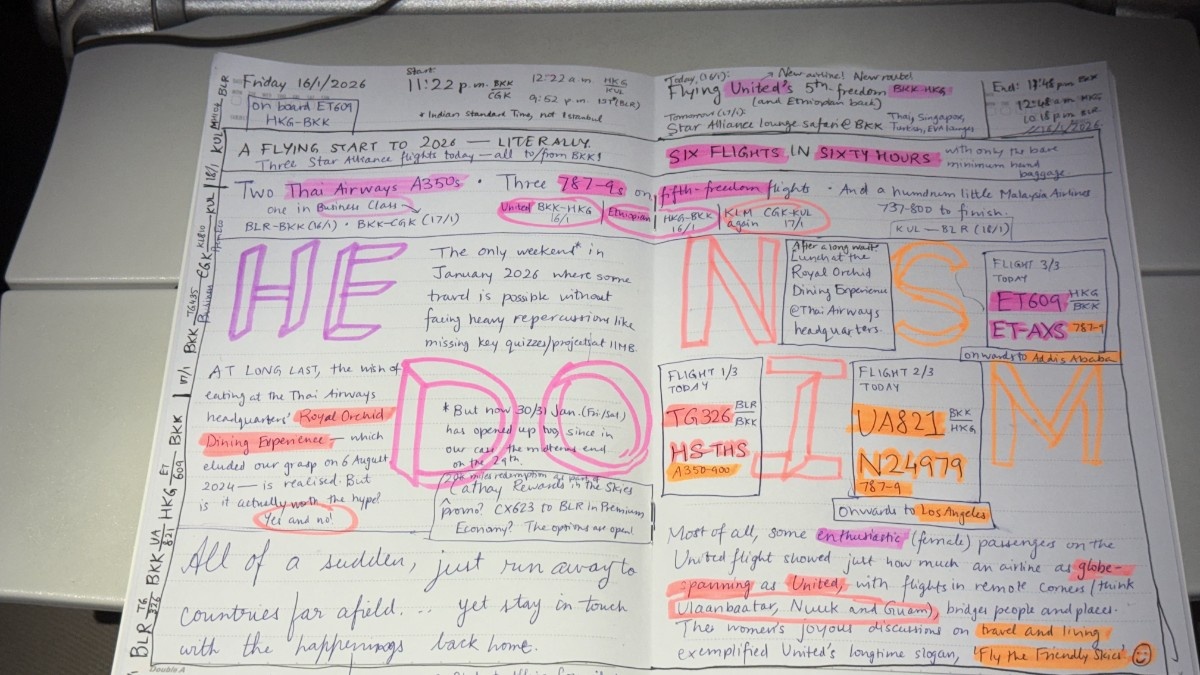
You should know by now, if you’ve read my previous trip reports, that I tend to burn cash — and, every so often, credit-card miles — on flying new airlines and cabin products within South and Southeast Asia whenever I can. Especially if it’s a fifth-freedom route. (What’s that? See here.) Considering that I live through the frenetic schedule of an Indian MBA student, finding the time to squeeze out a weekend — and some part of whatever savings I had from my previous career in Singapore — is simply amazing. And all this for being an avgeek!
Just look at my previous trip report series: in mid-November 2025, while my B-school — the illustrious IIM Bangalore, one of the country’s best — was holding an ‘Inter-IIM’ sports tournament, I escaped to Denpasar for a weekend. Why? So that I could fly Saudia’s new 787-10 fifth-freedom route — which I’m abbreviating here as FFR — from Singapore to Denpasar, and Malaysia Airlines’ new A330neo from Denpasar to Kuala Lumpur. All in the span of a little over three days! But that would be nothing compared to what I did two months later, in January 2026. Over two periods (16–18 and 29–30 January), I squeezed in a whopping TEN flights between India and (South)east Asia, all for the purpose of reviewing new airlines and routes. (See spoiler below.)
Among these, an airline that had long been in my sights was United Airlines, easily the most global of the three biggest airlines in the US. With it launching FFR flights from Hong Kong (HKG) to Bangkok (BKK), Thailand, and Ho Chi Minh City (SGN), Vietnam, in October 2025, it was absolutely non-negotiable that I had to fly the Star Alliance’s biggest airline. The international expansion that UA has been doing in Asia and elsewhere has been nothing short of INCREDIBLE: Tokyo (Narita) to Ulaanbaatar, Mongolia, and Kaohsiung, Taiwan; Newark to Nuuk, Greenland; and so many European, African and Australia/New Zealand routes. Neither American nor Delta — or, for that matter, Alaska, which now has 787-9s after its merger with Hawaiian (which has also joined Oneworld now) — can even dream of such far-flung routes. Much of this is only possible because of UA’s 737 bases at Tokyo (Narita) and Guam, which enable many of its intra-East Asia short-haul routes.
The only problem? Tickets for either of the FFR routes — HKG–BKK and HKG–SGN — were mighty expensive throughout the winter (December and January): almost never below US$300 one-way for the dates and times I needed, and significantly higher than competitors. In fact, HKG–BKK is also served by two other FFR airlines — Emirates’ A380 (EK384/385) and Ethiopian’s 787 (ET609/610) — which often cost very little. There was also the challenge of getting to either BKK or SGN from India at decent times and schedules. It was only for Friday, 16 January, that I managed to snag the UA821 evening flight from BKK to HKG for the slightly lower price of SGD$330 (US$260) one-way. However, there was much more to this jam-packed weekend than that!
Three fifth-freedom flights in all — all on 787-9s — during a single weekend
To spice things up further, I wouldn’t even be spending more than two hours in Hong Kong! Immediately after UA821 I’d be returning to BKK on Star Alliance partner Ethiopian’s ET609 fifth-freedom flight that I just mentioned — which was also operated by a 787-9. But even more action was in store in Bangkok — mostly involving the local flag carrier Thai Airways, another Star Alliance co-founder like United. On the morning of the 16th — before the United and Ethiopian flights — I finally fulfilled my long-cherished dream of visiting Thai Airways’ Royal Orchid dining experience at the TG headquarters. I tried to visit this in August 2024, but it had closed for the day, and now was when I could finally eat tasty, cheap Thai food at the airline’s HQ — seated amidst cutouts and decorations inspired by TG’s rich history. (To get to Bangkok I took a Thai Airways A350 from Bengaluru, which became my first flight of 2026.)
Astonishingly enough, even these flights on United and Ethiopian would not be the centrepiece of this trip. The most special thing was coming the very next day (Saturday, 17 January — also my mom’s birthday): a Thai Airways A350 in BUSINESS CLASS to Jakarta, operated by HS-THQ in the STAR ALLIANCE livery!!! I’d been saving my KrisFlyer miles (26,500 in all) for this specific flight, TG435, being a comfortable 3-hour journey instead of the shorter 2-hour hops to Kuala Lumpur or Singapore. This afternoon flight also gave ample time to check out the Star Alliance lounges at BKK, including the TG Royal Orchid Prestige Lounge, the Singapore Airlines SilverKris Lounge, the Turkish Airlines Lounge and the EVA Air Lounge. Much as I’m not a fan of either Bangkok as a city or Suvarnabhumi Airport — there being much nicer airports, like KUL, CGK and especially SIN and HKG, in East Asia — the lounge selection at BKK is simply unparallelled.
And just an hour after TG435, I’d be giving another shot at KLM’s fifth-freedom flight, KL810, from Jakarta to Kuala Lumpur — this time in Premium Economy. Despite being let down by the first time I’d flown Royal Dutch Airlines’ 787-9 on this very CGK–KUL route in June 2024, I felt this was as good a way as possible to (a) get closer to returning to India the next day and (b) add a third FFR flight — all on 787-9s! — in a single trip. This meant that I’d be flying from the Thai to the Indonesian to the Malaysian capitals, all in the span of a few hours! Finally, on the morning of Sunday, 18 January, I flew home on Malaysia Airlines’ morning, 3x-weekly MH104 to Bengaluru — the only narrowbody (a regular 737-800) of the six flights on this trip.
All-in-all, there were six flights during this weekend, one of the craziest I’ve been on (even by my own standards!): two A350s (both TG), three 787-9s — all on fifth-freedom routes (UA, ET and KL) — and that last MH 737. This report will discuss the first three — TG326 (BLR–BKK), UA821 (BKK–HKG) and, in the Travelling Bonus, ET609 (HKG–BKK) — plus TG’s Royal Orchid dining experience. In the next report I’ll cover Thai Airways’ Star Alliance-liveried A350 in Business Class to Jakarta, as well as all the Star Alliance lounges in BKK, and the KLM 787-9 from CGK to KUL. Let’s get this started!
Some quotes from One Mile at a Time regarding United’s INSANE international expansion — with special credit to Patrick Quayle and the incredible network he’s built: (Emphases mine.)
Source 1: Given the amount of summer seasonal expansion we’ve seen from US airlines in recent years, I always think “well, what’s really left to add?” I think this round of additions highlights a level of creativity we’ve never seen before at a US airline. I didn’t think we’d see the day where a US airline flies to Greenland or Mongolia. United’s SVP of Global Network Planning and Alliances, Patrick Quayle, has simply built a network that’s unrivaled, and it’s nice to see how there’s no end in sight to the growth.
There’s something to be said for the overall halo effect of having an unrivaled, global network. If United can keep using this as a point of differentiation, I think it’ll make more people loyal to the airline. It’s worth keeping in mind that this expansion is coming at a time when United is limited in terms of its growth, as the airline isn’t growing its fleet much, due to delivery delays at both Boeing and Airbus. So I almost feel like United is intentionally taking a different approach this time around, focusing on breadth rather than depth.
Source 2: Gosh, I love that attitude, and willingness to try new things, and I wish it’s something we saw at more airlines. Not all of United’s new route endeavors work out well, but I commend the airline for being willing to try, and then adjusting quickly when things don’t work out.
Source 3: That’s such an awesome attitude. It’s not “oh, let’s go with whatever the safest option is,” but instead it’s “let’s try something different.” United CEO Scott Kirby also deserves credit here, as clearly he’s onboard with this strategy. Quayle could be as creative as he’d like, but if he didn’t have the support of the CEO, this strategy would go nowhere.
Enchainement de vols
- 1TG326 | Bengaluru to Bangkok | 16 January 2026 | A350-900 | HS-THS
- 2UA821 | Bangkok to Hong Kong | 16 January 2026 | 787-9 | N24979
- 3ET609 | Hong Kong to Bangkok | 16 January 2026 | 787-9 | ET-AXS
- 4TG435 | Bangkok to Jakarta (Royal Silk Class) | 17 January 2026 | A350-900 | HS-THQ (Star Alliance livery)
- 5KL810 | Jakarta to Kuala Lumpur (Premium Comfort) | 17 January 2026 | 787-9 | PH-BHM
- 6MH104 | Kuala Lumpur to Bengaluru | 18 January 2026 | 737-800 | 9M-MXB
1. Friday, 16 January: Thai Airways TG326, Bengaluru (BLR) to Bangkok (BKK), operated by HS-THS, Airbus A350-900.
2. Friday, 16 January: United Airlines UA821, BKK to Hong Kong (HKG); operated by N24979, Boeing 787-9. This is the central focus of this report.
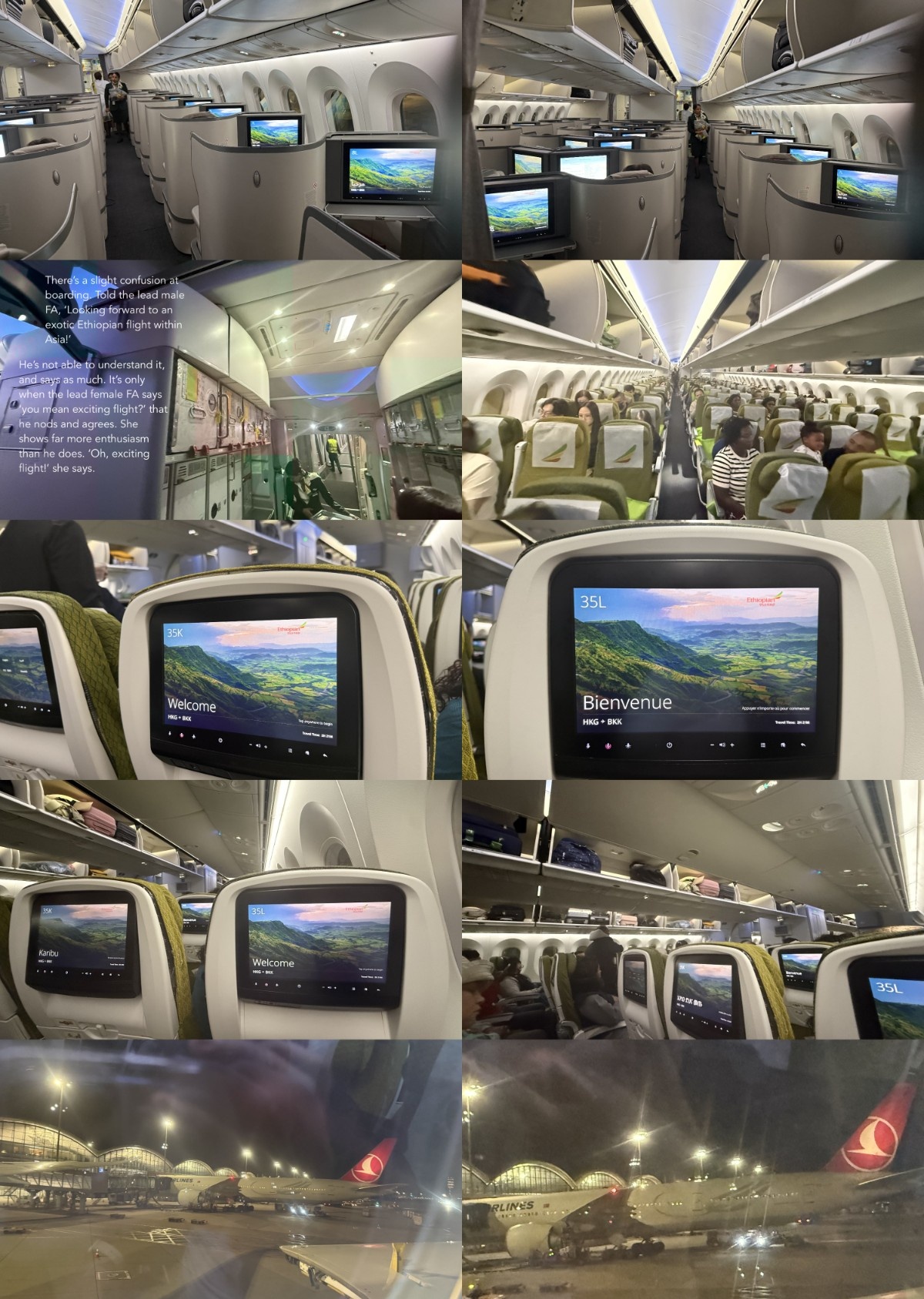
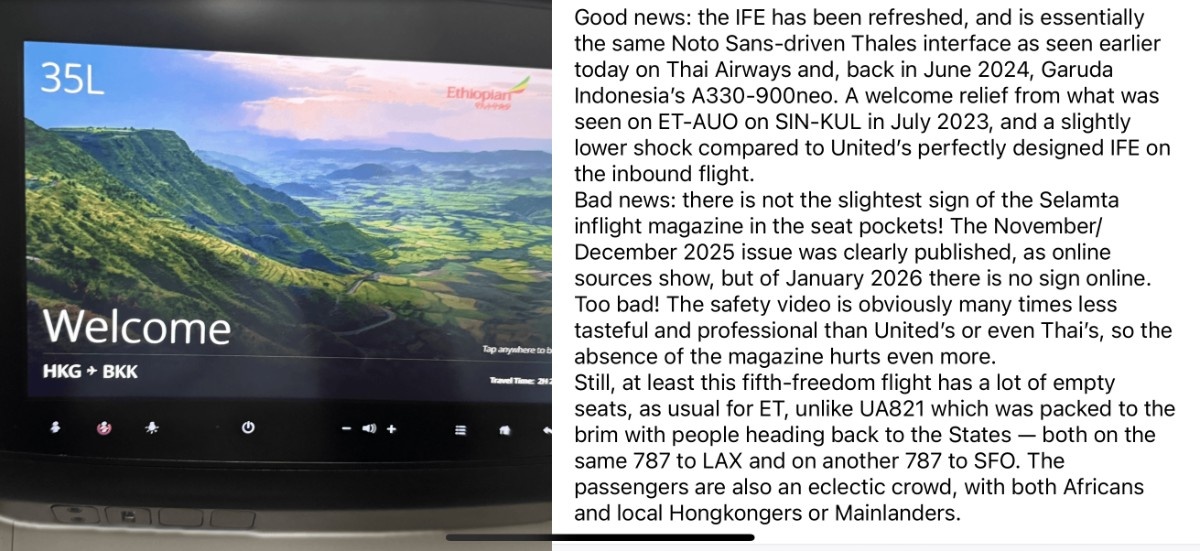
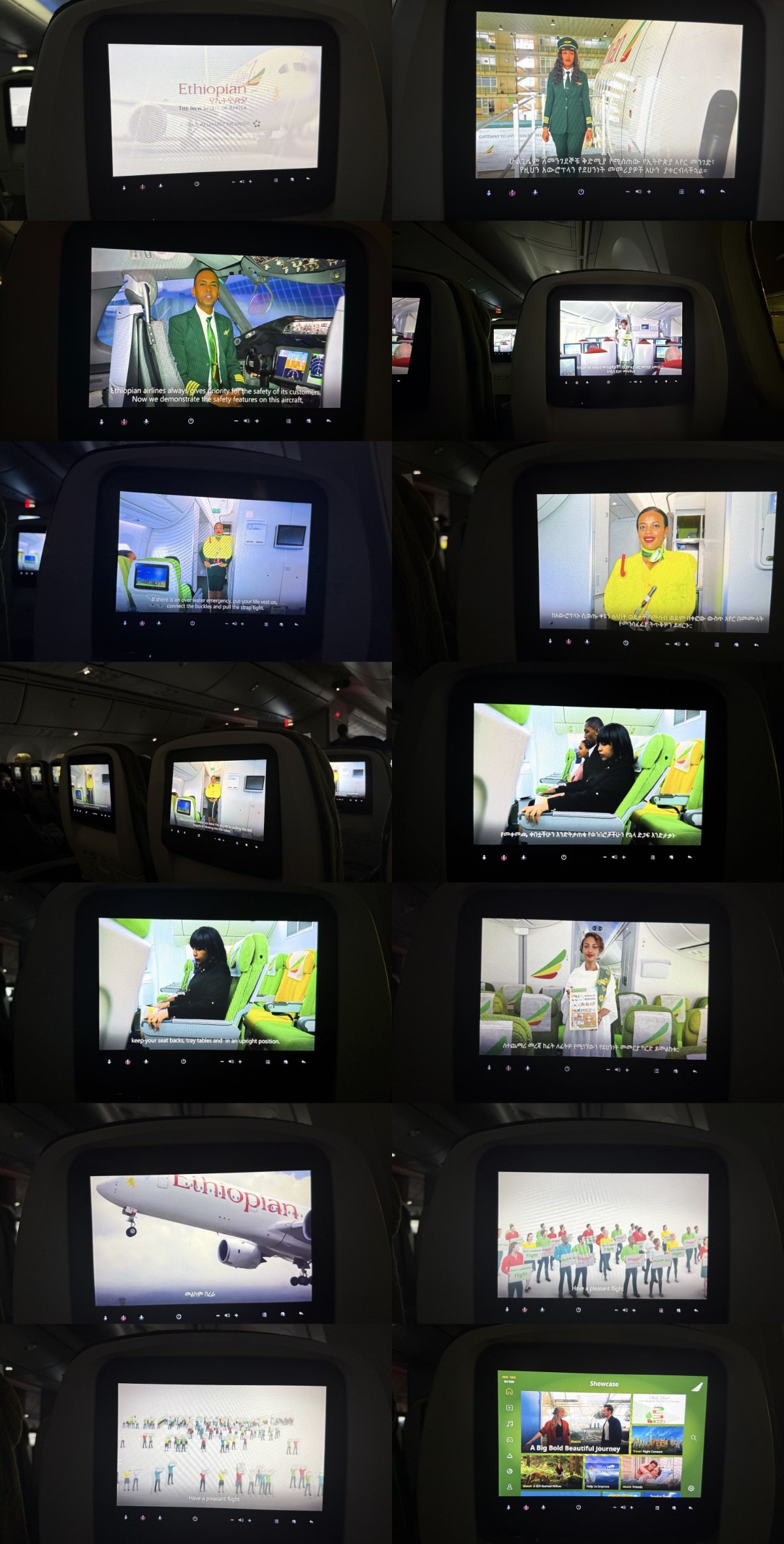
3. Friday, 16 January: Ethiopian Airlines ET609, HKG to BKK; operated by ET-AXS, Boeing 787-9.
4. Saturday, 17 January: Thai Airways TG435, BKK to Jakarta (CGK), operated by HS-THQ, Airbus A350-900. This flight was extra-special for two reasons: it was in Business Class with lie-flat beds (though not fully private!), and this particular A350 was in the STAR ALLIANCE livery!!!
5. Saturday, 17 January: KLM Royal Dutch Airlines KL810, CGK to Kuala Lumpur (KUL), operated by PH-BHM, Boeing 787-9. I’d flown this exact route in June 2024, but that experience was somewhat disappointing. Moreover, I’d be flying Premium Economy this time around.
6. Sunday, 18 January: Malaysia Airlines MH104, KUL back to BLR, operated by 9M-MXB, Boeing 737-800.
And another trip at the end of the month — just a few hours in Hong Kong (and the Cathay Shop in particular) — before flying Cathay’s A350 back to Bengaluru.
7. Thursday, 29 January: Air India AI2820, Bengaluru (BLR) to Delhi (DEL), operated by VT-EXF, the airline’s oldest A320neo that was recently repainted into the new Air India livery.
8. Thursday, 29 January: Air India AI2380, DEL to Singapore (SIN), operated by VT-ANE, Boeing 787-8. Ordinarily this DEL–SIN flight was operated by the ex-Vistara 787-9 — though not any more since February 2026, since it now flies to Tokyo (Haneda) instead). Unfortunately on that day it was swapped to an old 787-8 for the first (and only) time. (I did, however, manage to fly the ex-Vistara 787-9 in Premium Economy in April 2026, on the domestic Mumbai to Delhi route.)
9. Friday, 30 January: Singapore Airlines SQ882, SIN to HKG, operated by 9V-SHK, an Airbus A350-900 that I’d flown twice before. The main purpose of this flight was to facilitate an inflight delivery of goodies from KrisShop, since SQ doesn’t have a physical merchandise store like Thai Airways and Cathay Pacific do.
10. Friday, 30 January: Cathay Pacific Airways CX623, HKG back to BLR, operated by B-LRD, Airbus A350-900. I’d flown CX624 in the reverse direction (BLR–HKG) in December 2023, which was my first flight on this airline.
Part Zero: My first flight of 2026 (I never take TG A350s ex-India for granted!)
Friday, 16 January, just after midnight in Bengaluru. I’ll keep this brief, and I’ll be writing only a teensy bit about this — my first flight of 2026 — because there was not that much novel that it added to the overall journey… other than the fact that I was relieved to be getting an A350. Just know that this was only my second time flying a Thai Airways A350 ex-India: the first being on the same TG326 from BLR in November 2024, which I haven’t written about so far on this website. (You may well be familiar with my travails with the horrible, ancient TG 777-200ER on Indian flights — including twice on the infamous HS-TJW in August 2024 alone. Fortunately, TG is down to only two 777-200ERs (HS-TJV/TJW) in 2026, and that ugly aircraft doesn’t fly to Bengaluru any more — but it unfortunately does fly to Mumbai on TG317/318 very often.)
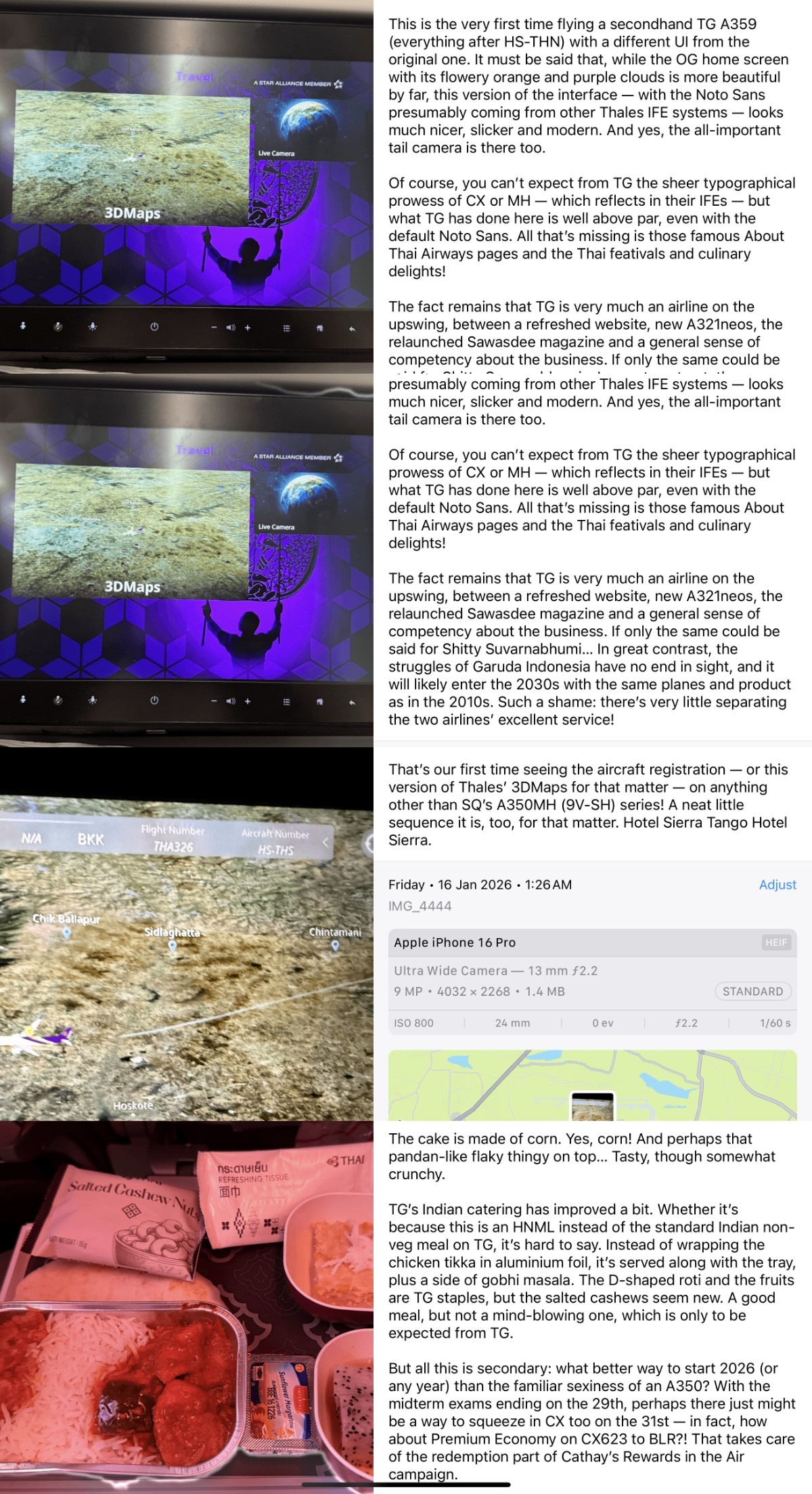
This was also the first time I flew a TG A350 outside the initial batch of 12 A350s (HS-THB–THN) — and hence I wasn’t expecting this different IFE system and interior upholstery! Unlike the previous TG A350s I’d flown, which were all delivered direct to the airline, HS-THS, my first aircraft of 2026, originally flew for Hong Kong Airlines before that (and parent Hainan Airlines) retired all their A350s. As such, the IFE system is from Thales, which can be identified by the Noto Sans font — and I’d also be seeing this same system (though in lime-green rather than royal-violet hues!) later that night on Ethiopian’s 787-9.
Thai Airways International TG326 | Friday, 16 January 2026 | Bengaluru (BLR) to Bangkok (BKK).
Aircraft: HS-THS, Airbus A350-900, named Kanchanaburi
Age: 7 years 6 months at the time (built: 24 July 2018, originally B-LGE with Hong Kong Airlines; delivered to TG: 28 February 2024)
Seat: 55K (starboard side, window)
Boarding: 12:30am Indian Standard Time (IST), UTC +5:30 (2:00am Indochina Time (ICT), UTC +7)
Departure: 1:30am IST (3:00am ICT)
Arrival: 6:20am ICT (4:50am IST)
Duration: 3 hours 20 minutes
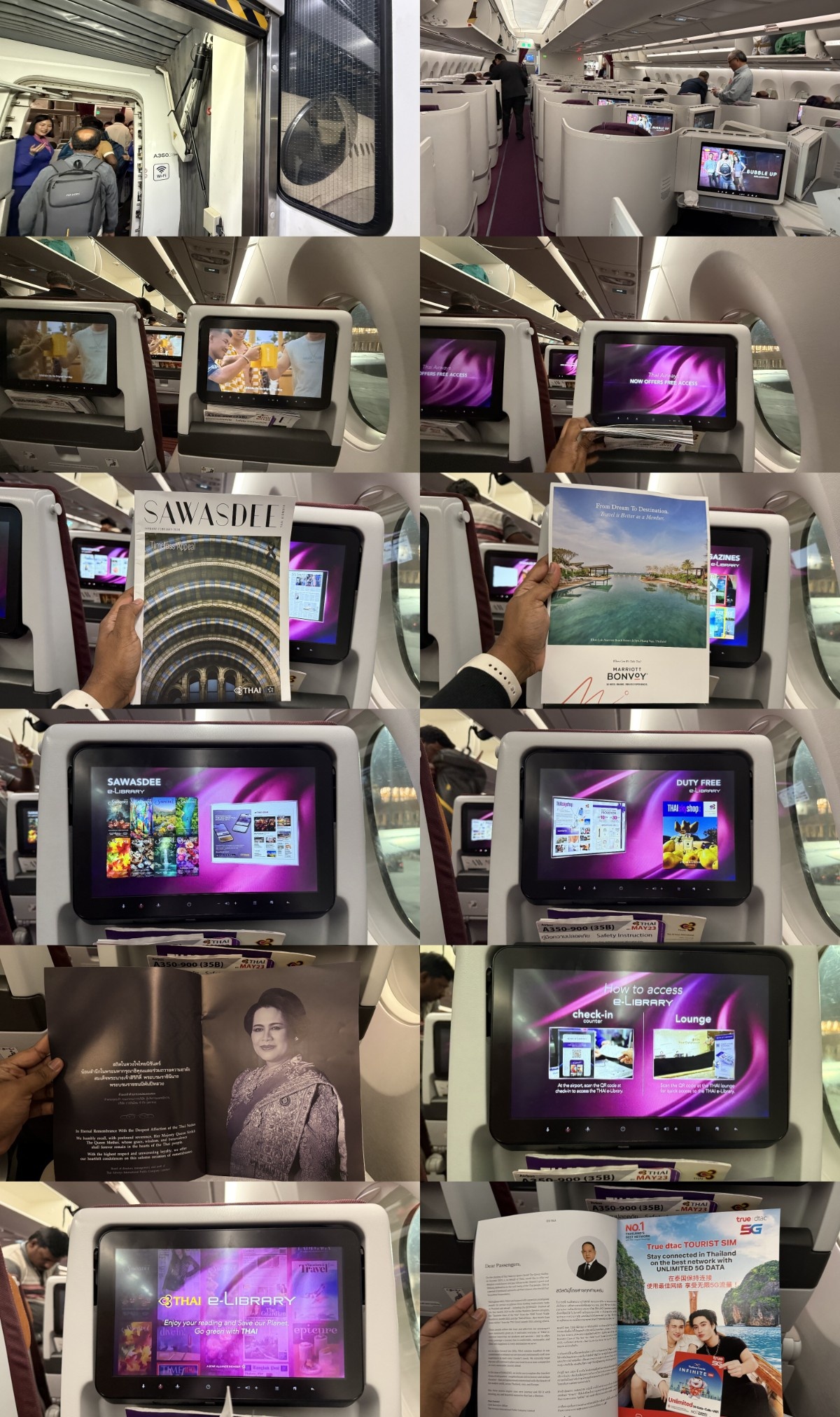
At a time when most airlines in the West and the Middle East have permanently removed their inflight magazines, it’s heartening to see Thai Airways bring back its physical Sawasdee glossy. I first saw it in May 2025, on a morning A320 flight (TG637) from Taipei — it was crammed with Indians! (there being no nonstop flights between India and Taiwan) — and indeed the physical Sawasdee magazine had been reinstated in that very month. While not to the outstanding level of Westernisation and informal language that some other magazines — and Malaysia Airlines’ Going Places in particular (as I wrote about at length in my previous instalment) — have, TG’s renewed, 2020s-era Sawasdee is still a lovely read… much like the rest of the airline.
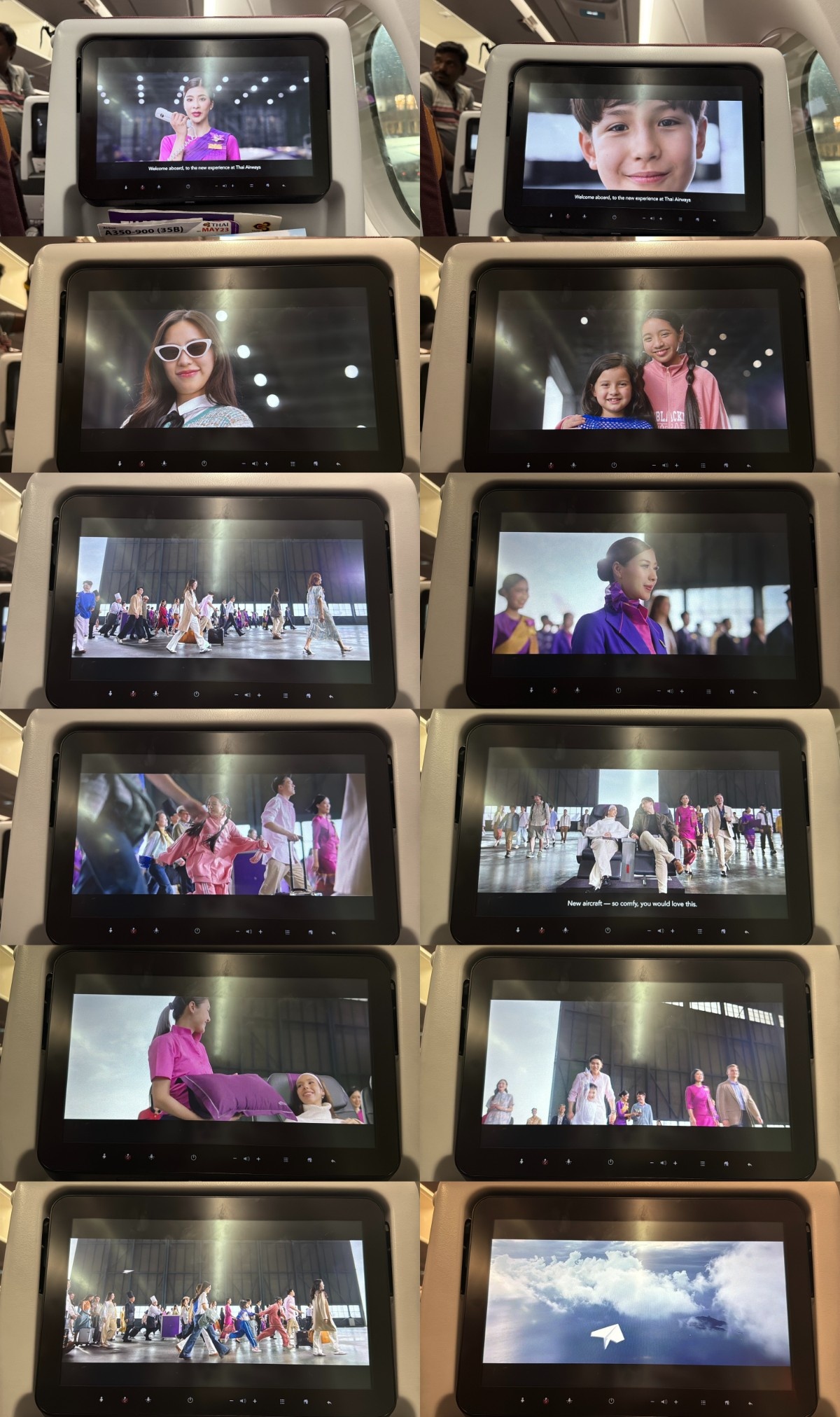
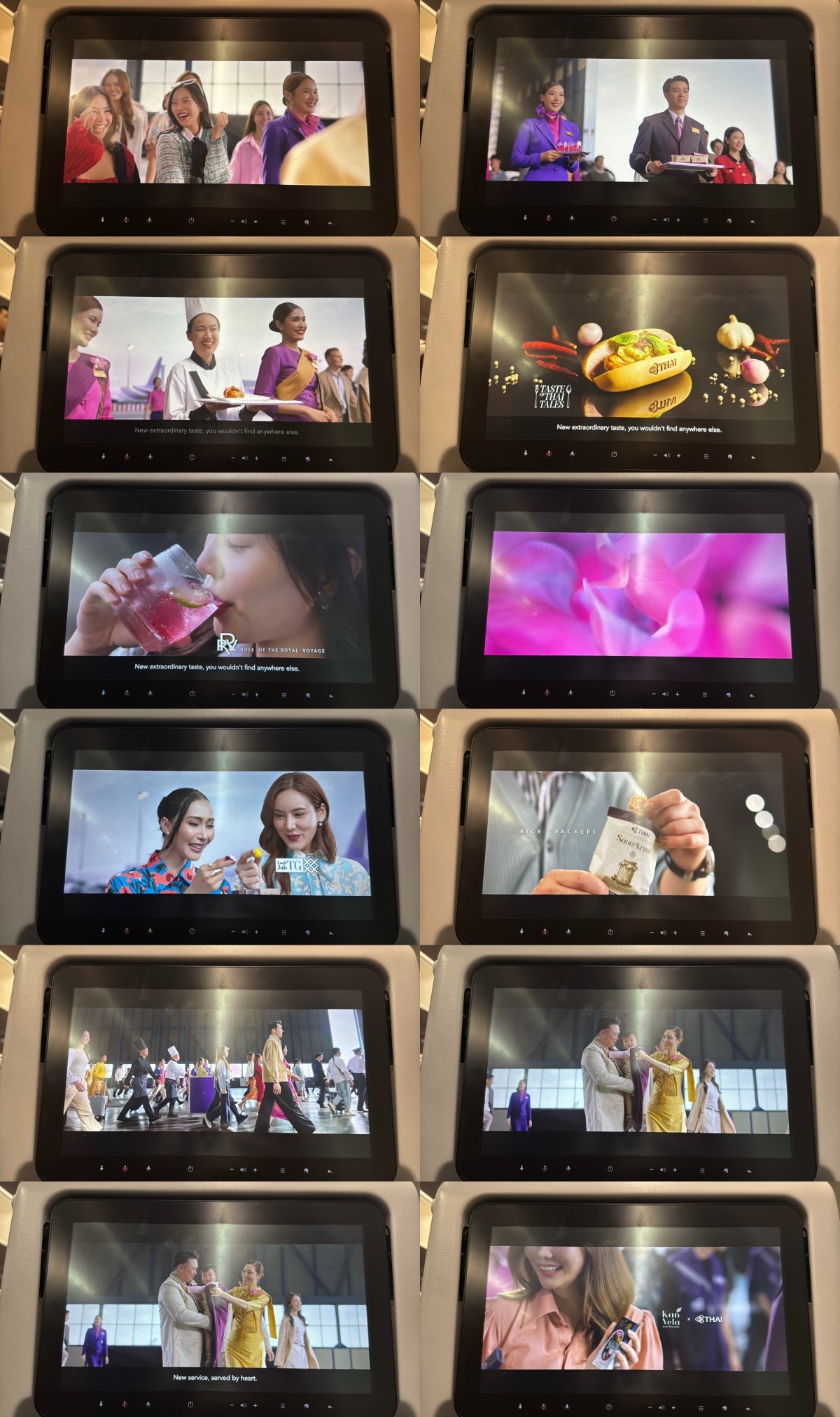
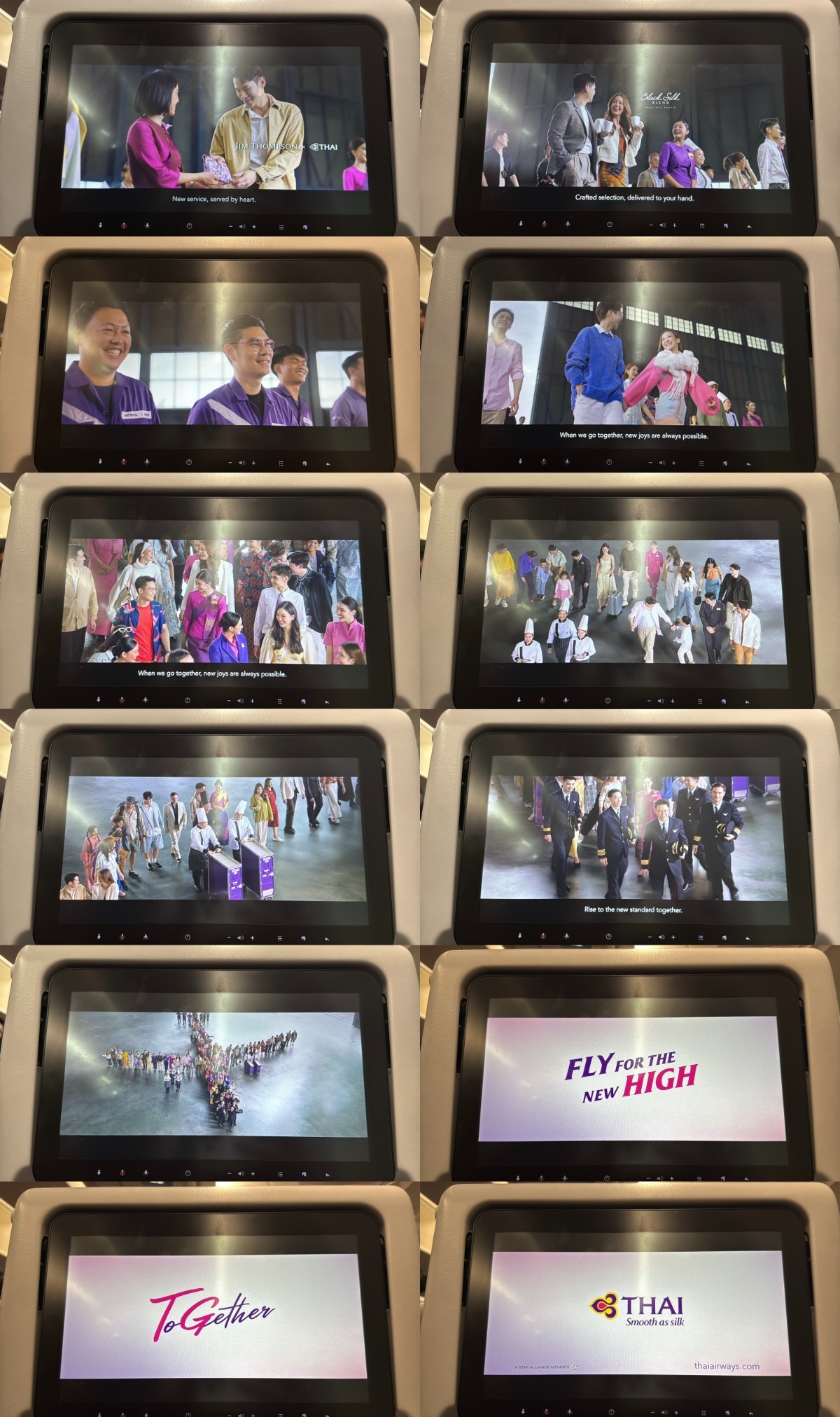
Before boarding was even completed, TG’s latest brand video — ‘Fly for the New High ToGether’ — was shown, filmed in a hangar, which showcased the best of the airline’s new hard and soft products. Between the new A321neo with lie-flat beds, a fresh take on Thai cuisine and new amenity kits, coupled with both inflight and on-ground employees, the video went a long way to reinforce the airline’s turnaround in the 2020s to be more competitive.
I was certainly impressed by the video, and it shows how far TG has come since the money-bleeding, mismanaged late 2010s and early 2020s. I continue to cheerlead Thai Airways’ remarkable reinvention, and I will happily give it my business whenever possible. Nothing exempified this more than my A350 flight the following day in BUSINESS CLASS to Jakarta — that too in the Star Alliance livery!!! — as my forthcoming instalment will explain in more detail.
In contrast, Garuda Indonesia — which had a brief period of global acclaim in the 2010s — hasn’t been as lucky, and its struggles continue with no end in sight to the mess it’s created. Between the complete lack of a widebody order — GA is the only major flag carrier in Southeast Asia not to operate a single A350 or 787 — the mothballing of many A330s and 777s, the steadily outdated cabins, the minuscule international destination network and the general sense of disrepair and mismanagement, it’s no wonder that GA remains frozen in financial and organisational quagmires, when TG and MH are steadily and firmly marching into a brighter future.
Some brief comments on the picture collages:
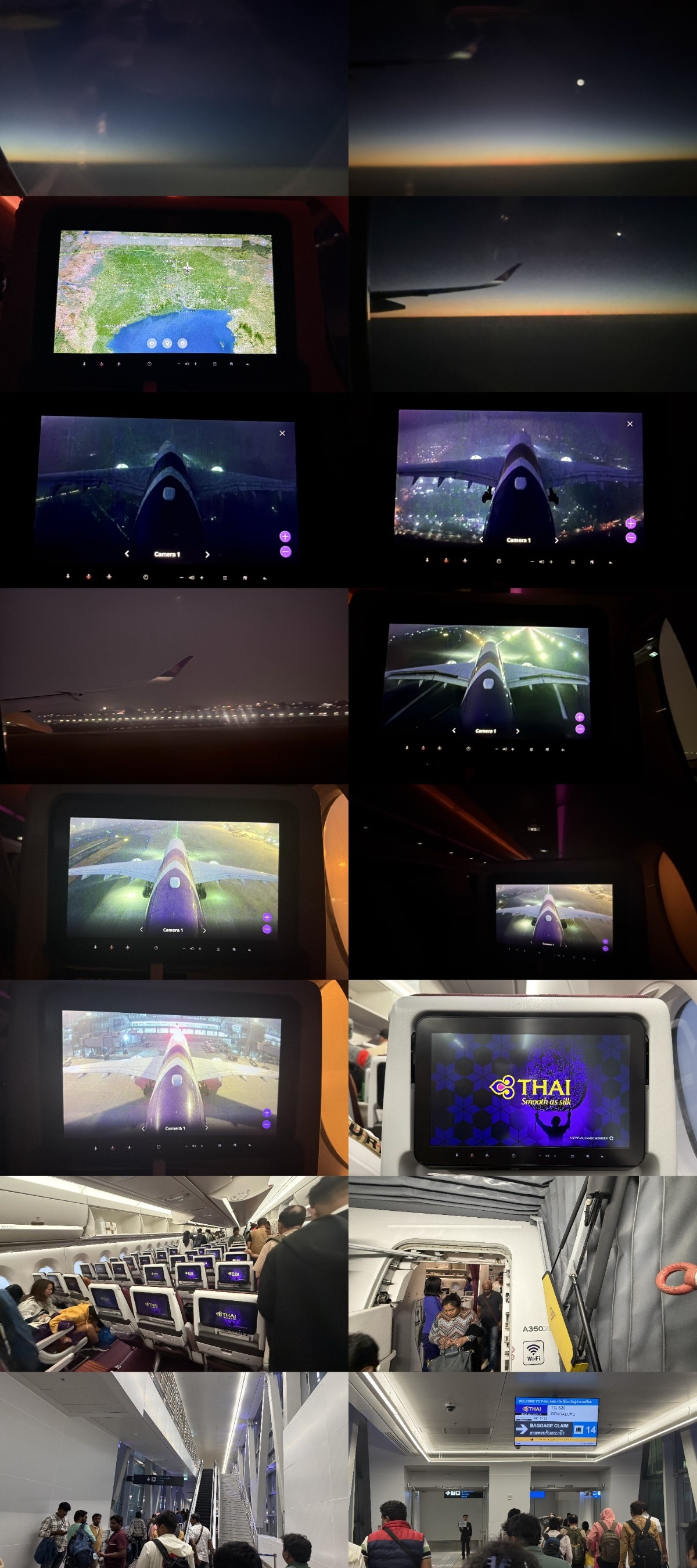
1. Just your standard view of the apron at BLR, what with midnight being peak hour for all manner of international traffic — with a JAL 787-8 standing right next door. This and Oneworld partner Cathay Pacific are the only Northeast Asian airlines to serve South India, with the latter also serving Chennai and Hyderabad. (All Nippon Airways briefly served Chennai from 2019–21.) In short order, I started the tail and nose camera views — one of my favourite things about the TG A350. As if that splendid royal-violet livery wasn’t enough! After this, Thai Airways’ longstanding rainforest-themed safety video was screened, which I’m very familiar with at this point, so I don’t need to rehash things here.
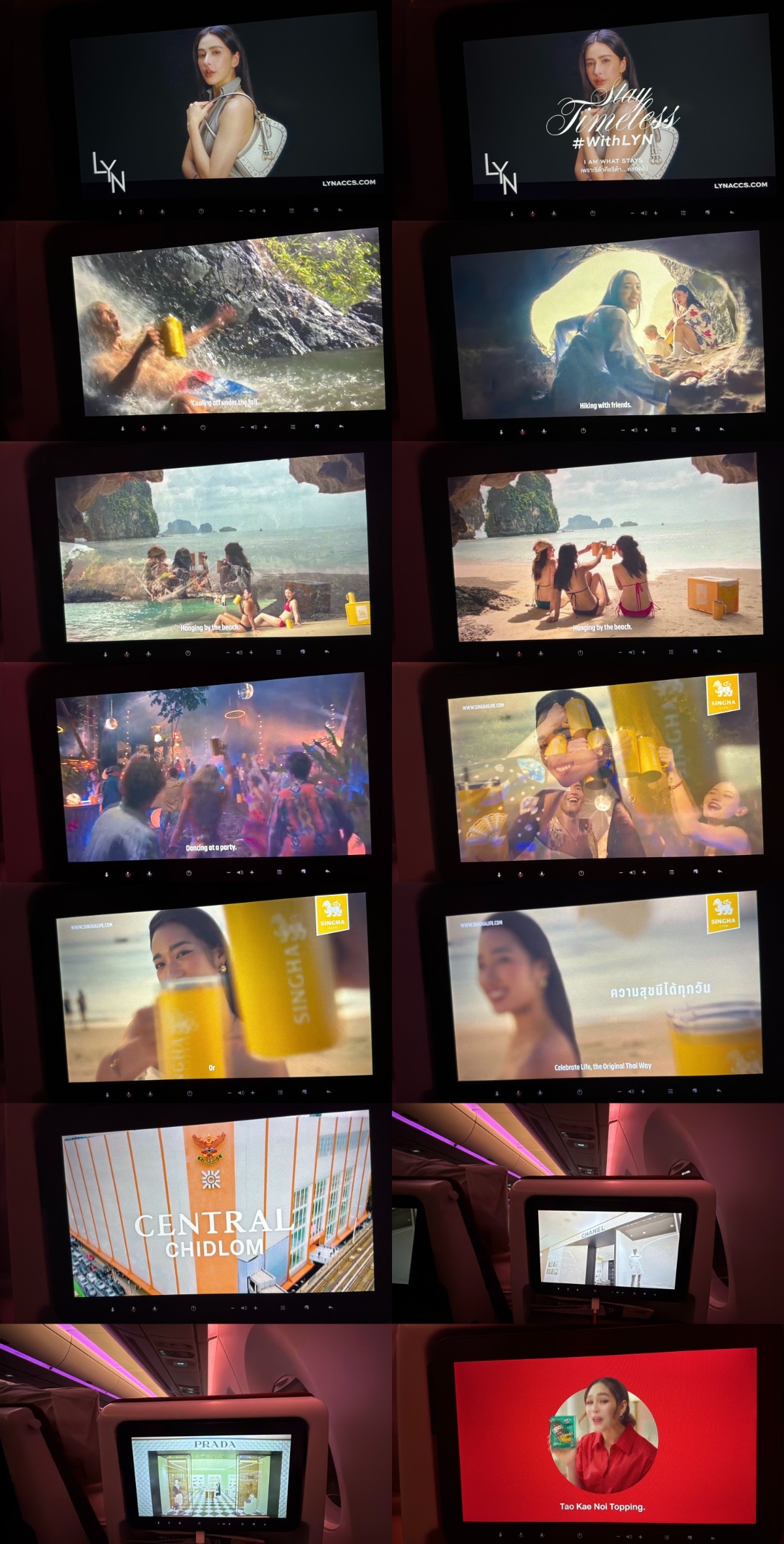
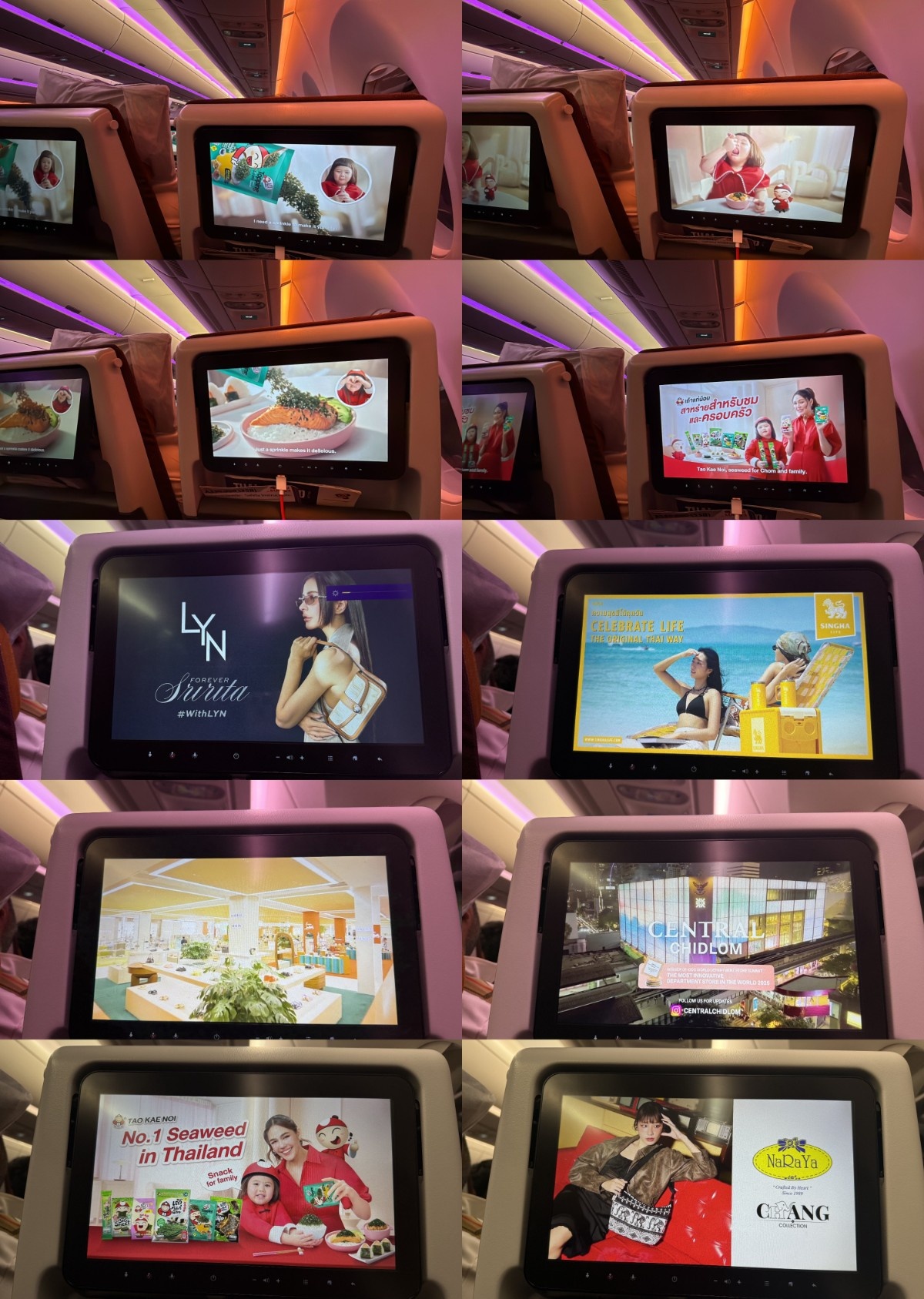
2 and 3. Shortly after takeoff, a series of ads was screened, most of them with only Thai audio and not English. These included Lyn and NaRaYa, two homegrown Thai bags and accessories brands; Singha beer, with all manner of beachy backdrops; the luxurious Central Chidlom mall in the heart of Bangkok; and finally Tao Kae Noi, a seaweed topping brand. TG is usually not one for screening post-departure ads, based on my previous flights with them — though this is a common occurrence on several other airlines, as was the case with my Garuda Indonesia A330neo flight in June 2024, where the ads were also mostly tailored towards a local Indonesian audience.
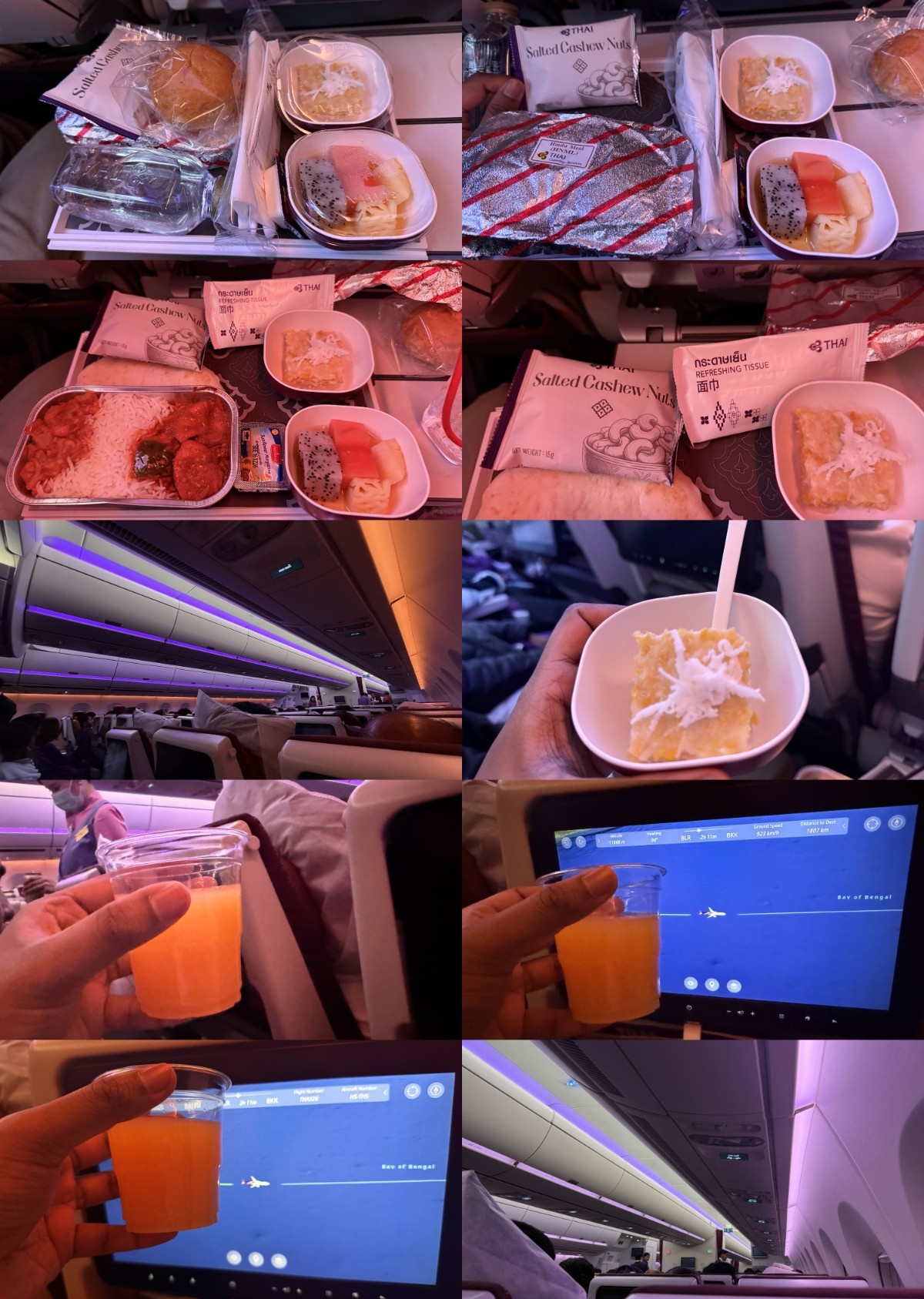
4. The Indian meal was served roughly an hour into the flight, and I must admit it was far better than my other ex-India flights on TG. Instead of wrapping the chicken tikka in aluminium foil as TG generally does, it was served separately, along with rice, a side of gobhi masala (cauliflower curry) and a dry bread roll. However, I was very pleasantly surprised by the crunchy corn cake and the salted cashewnuts — neither of which I can recall seeing on TG before — as well as the cup of orange juice. It’s always nice when an airline doesn’t just serve fruits in the name of dessert — as my MH A330neo flight in November 2025 did — and TG went a step ahead by serving both fruits AND a cake for a sweet ending!
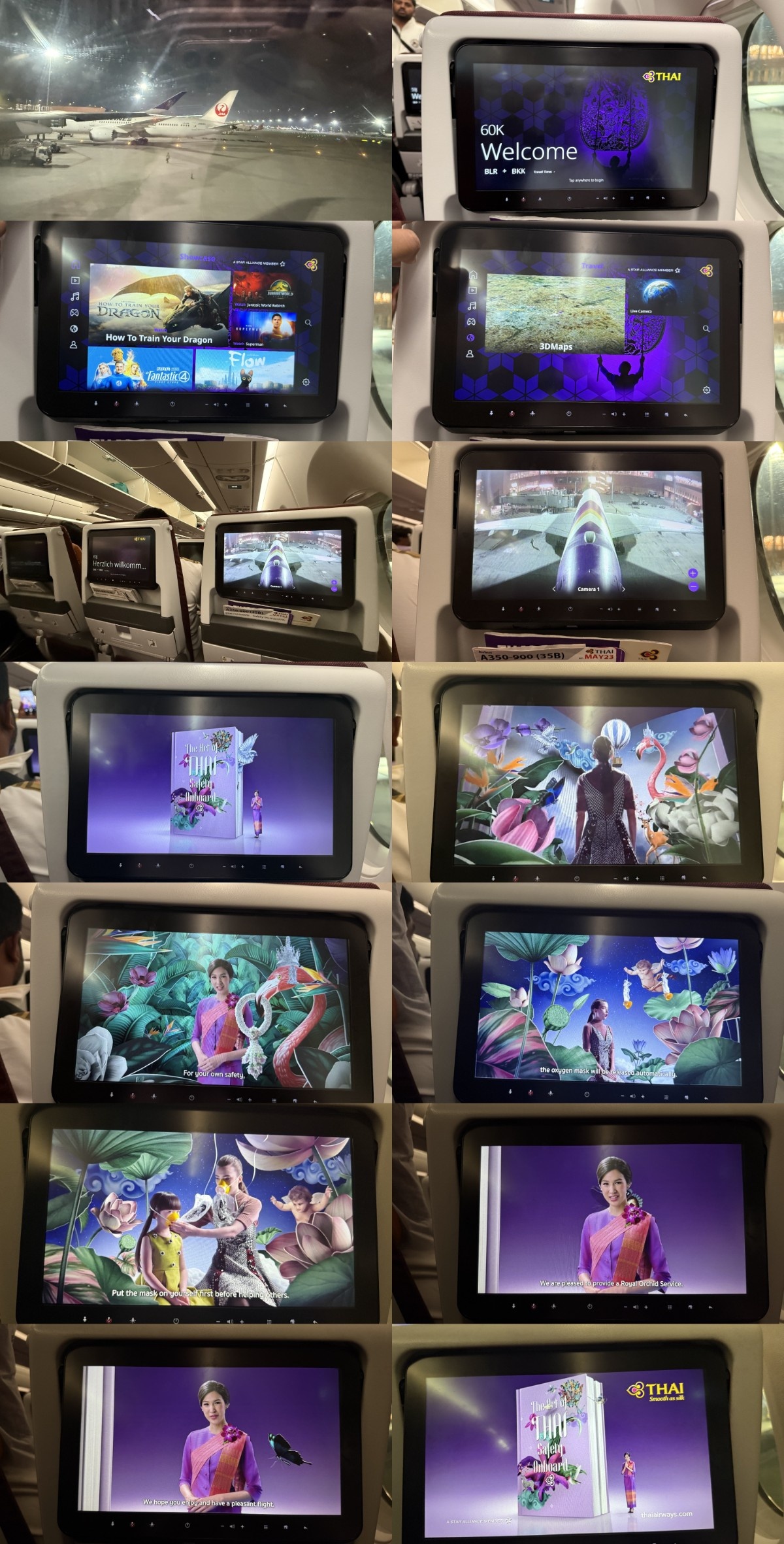
5. These were some of the picture captions I’d written at the time regarding the updated Thales IFE system, which I hadn’t seen before on TG — though I did see it on other airlines like, once again, Garuda Indonesia’s A330-900neo in June 2024… (And also my remarks on the catering.)
6. The early-morning landing at BKK, offering a spectacular use of the crisp tail camera — one of the big reasons why Thai Airways A350s are among the best out there. Again, as if the royal violet livery — easily one of my favourites in the world — wasn’t enough!
7. Fortunately I’d arrived at the newer, nicer SAT-1 midfield concourse, which is a MASSIVE step up from the ugly greyness of Suvarnabhumi Airport in general. But you will still have to take the Automated People Mover from this new, snazzy building to the old, ugly main building for immigration — and you’ll be hit with LONG, LONG lines that can stretch for up to half an hour or more!
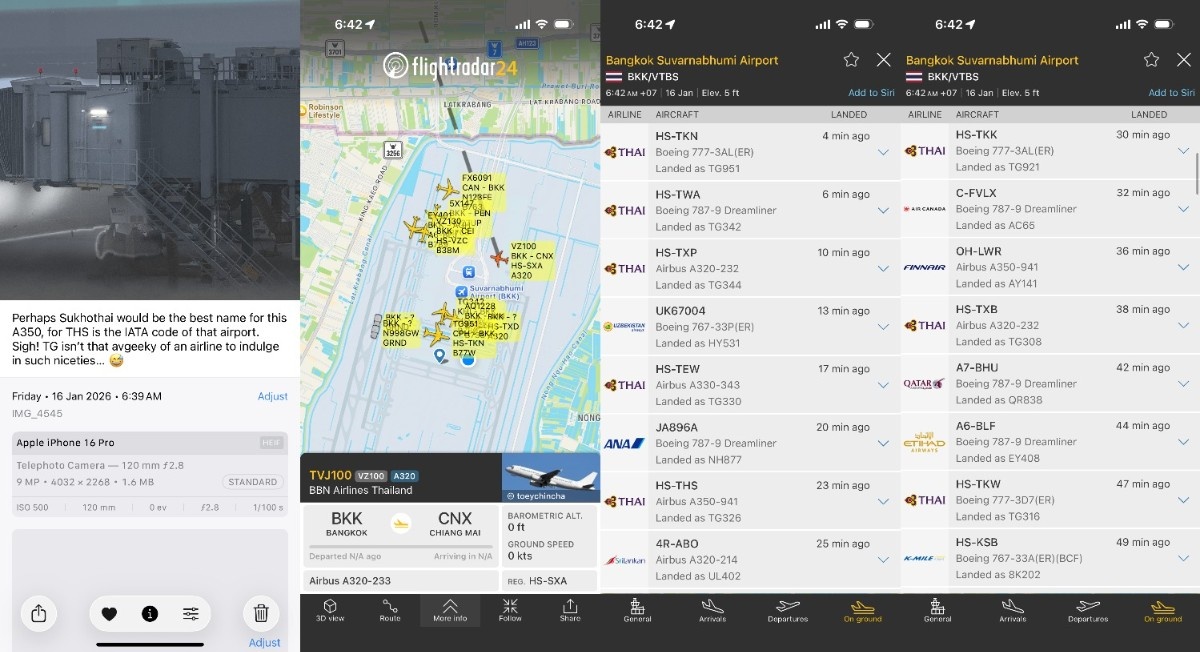
8. My plane’s post-prefix registration, THS, is the airport code for Sukhothai in northern Thailand. Much like the famous island of Koh Samui (airport code: USM), this is operated and owned by the regional operator Bangkok Airways, with all flights from there exclusively on that airline.
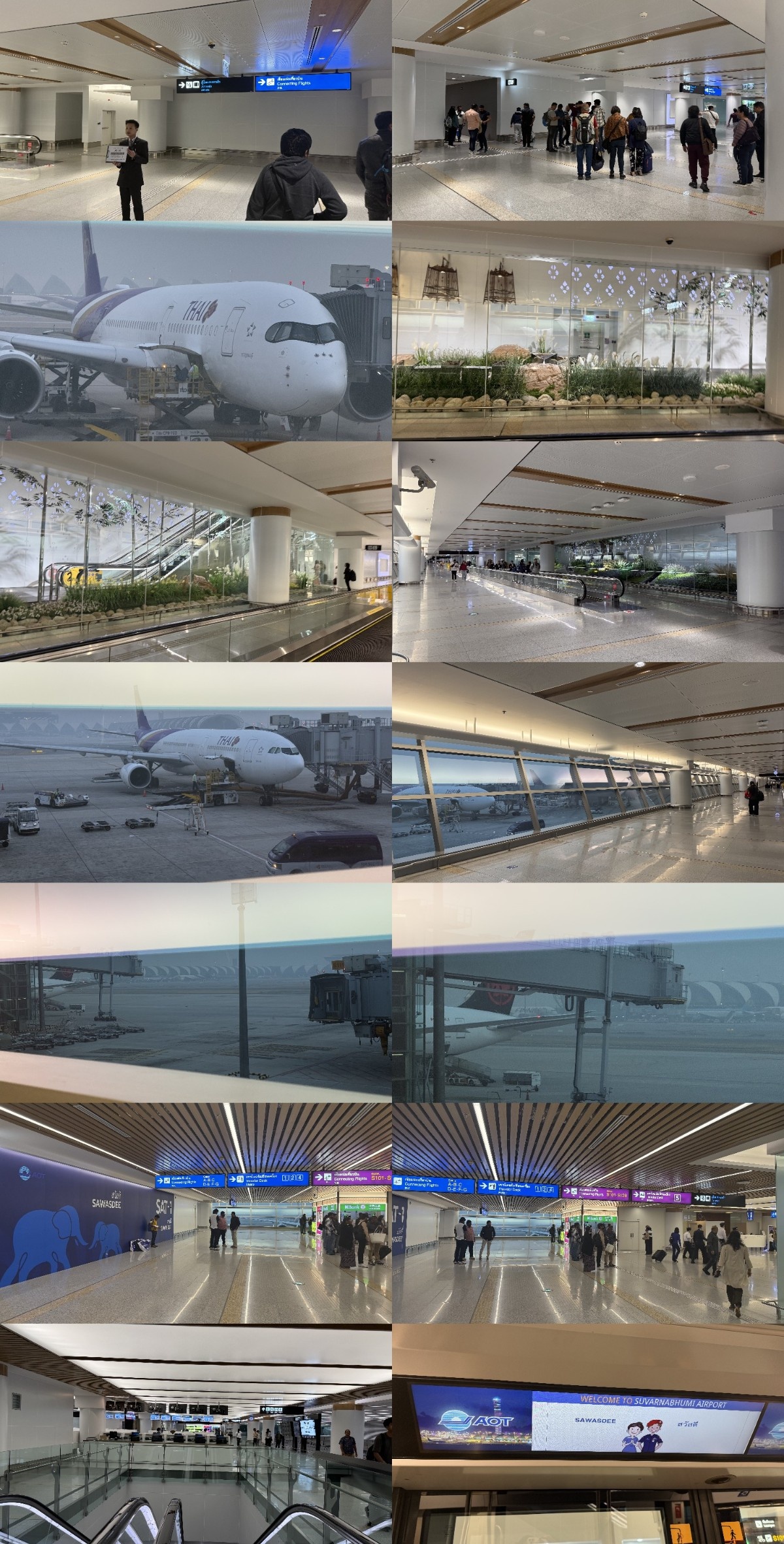
Inbound immigration at BKK is always a time-consuming exercise, and the airport greatly lags regional rivals — and Changi in particular — when it comes to its e-gates. Only Thai nationals, and more recently Singaporeans and Hong Kongers, are allowed to use them, and every other national — no matter how strong the passport — MUST queue up in line for 45 minutes or so and get a physical stamp. (This was evidenced by the lines and lines of Scandinavians — with TG flights all arriving from Copenhagen, Oslo and Stockholm at the same time.)
This in great contrast to KLIA, which has e-gates for a number of nationalities with strong passports (hence NOT Indians!), though both are a far cry from Changi with its passport-less e-gates. At least BKK has automated gates for everyone (all nationalities) on departure — hence no crowds — unlike KLIA, where Indians and Chinese, among others, are forced through the manual counters while many other stronger-passport nationalities can use the e-gates.
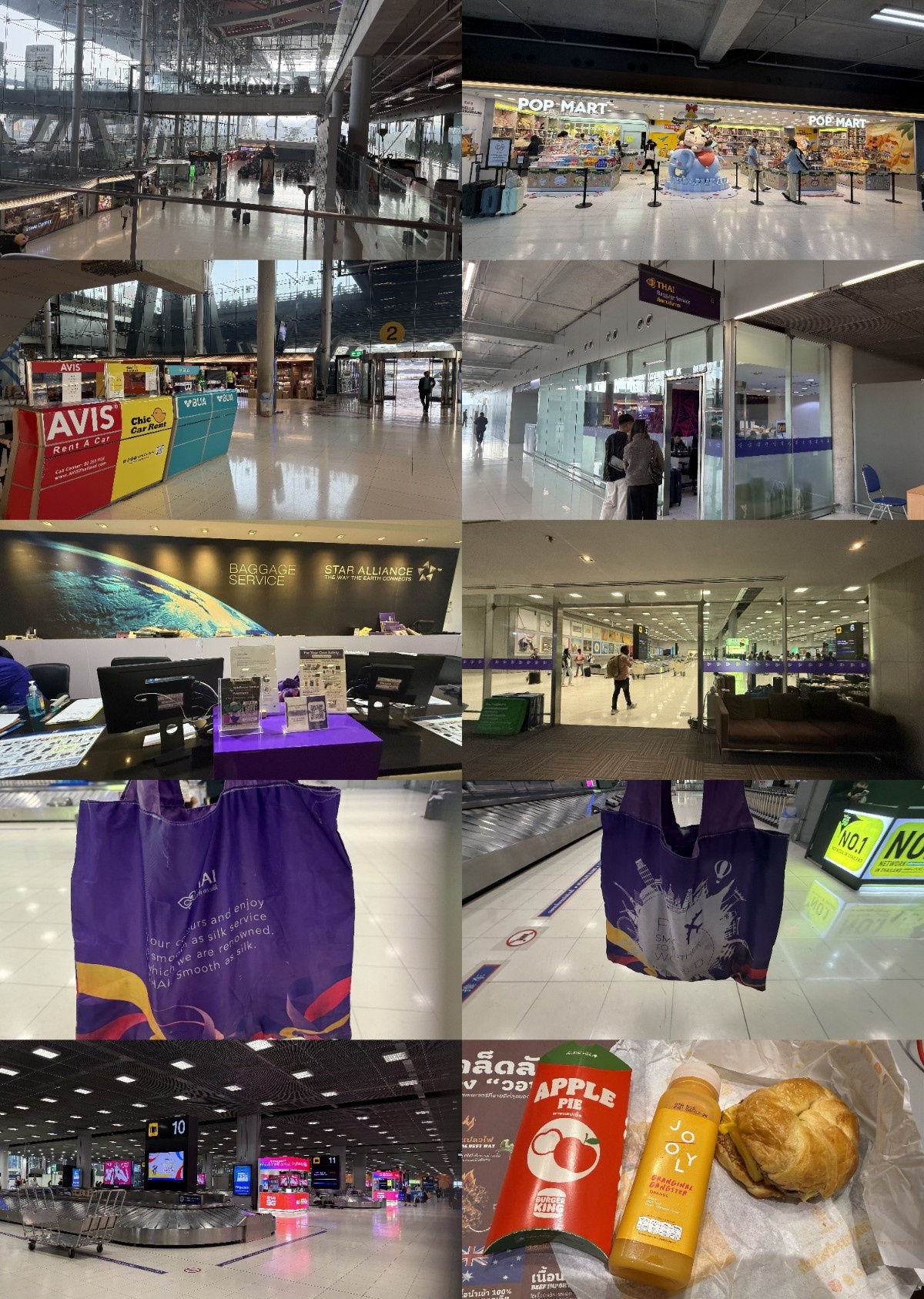
There was a bit of a kerfuffle when — as often happens — I left one of my bags on board. (Thankfully, nowhere close to the drama after my Malaysia Airlines A330neo flight in November 2025, where I almost missed my connecting Batik Air Malaysia flight to Bengaluru — all thanks to the maddening outbound KLIA immigration queues!) So I had to turn all the way to the right to reach the Thai Airways baggage service room to file a ticket.
Meanwhile, as I strolled around all the luggage belts, there is no denying that, among Southeast Asian airports, BKK enjoys service to some of the most whimsical destinations out there. Especially Central Asian cities that will never be served from Singapore — think Tashkent, Almaty and numerous Russian cities, many of which also have flights to Phuket (HKT), the country’s premier tropical-island getaway. I moved past the array of bright restaurants in the arrivals area — I’d never been to this side of the BKK arrivals before — before eventually picking a predicatable, safe Burger King breakfast meal.
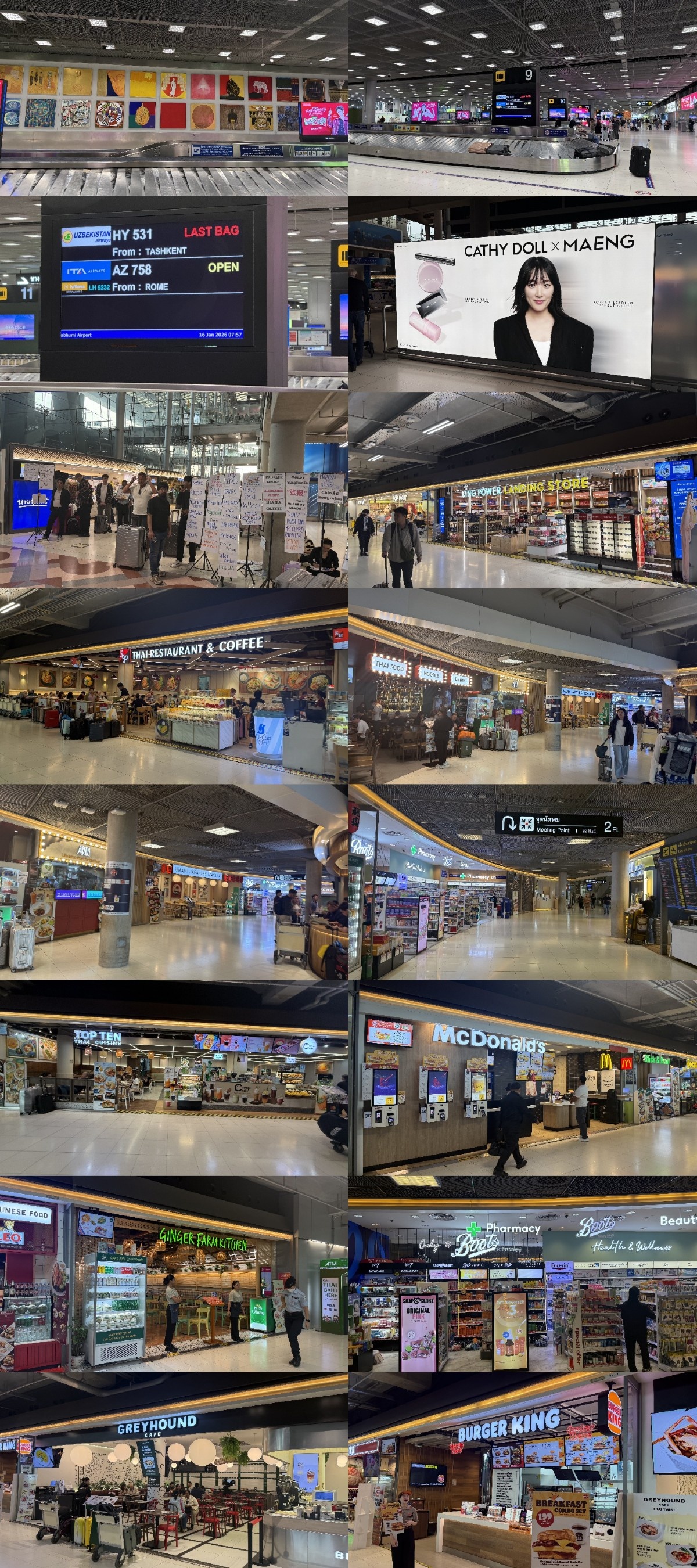
Then I asked the airport security to allow me to re-enter the luggage pick-up area. Soon enough I was ushered back to the same TG baggage-service room, where — lo and behold! — a royal violet TG carry bag (which I’d bought from the Thai Shop in August 2024) was waiting for me.
After that Burger King Croissan’wich, an apple pie and an orange juice, I was ready to hit the city of Bangkok — the Bad Boy of Southeast Asia, rugged and grimy but irresistible to millions of travellers.
Part One: Thai Airways Royal Orchid Dining Experience (at long last!)
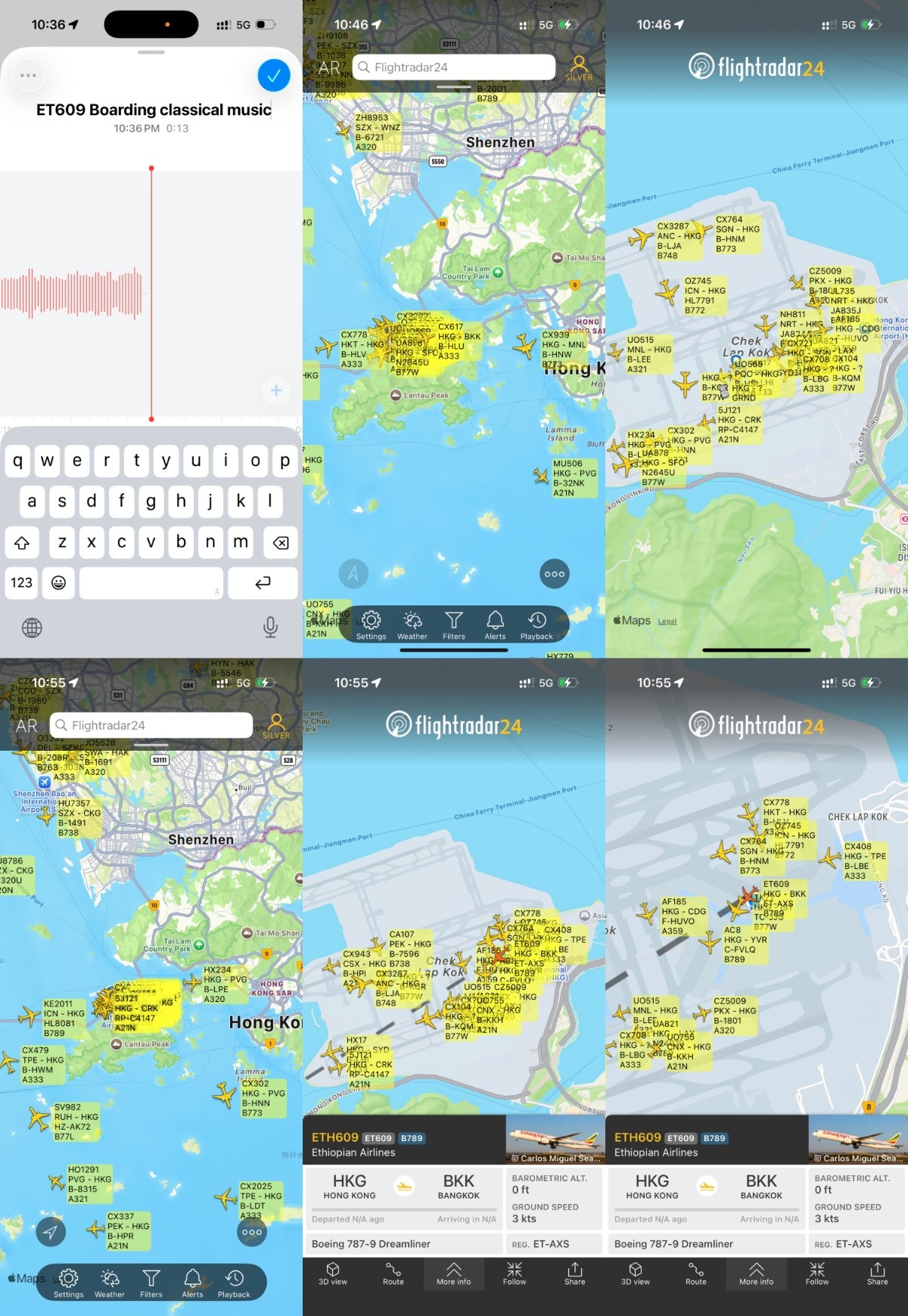
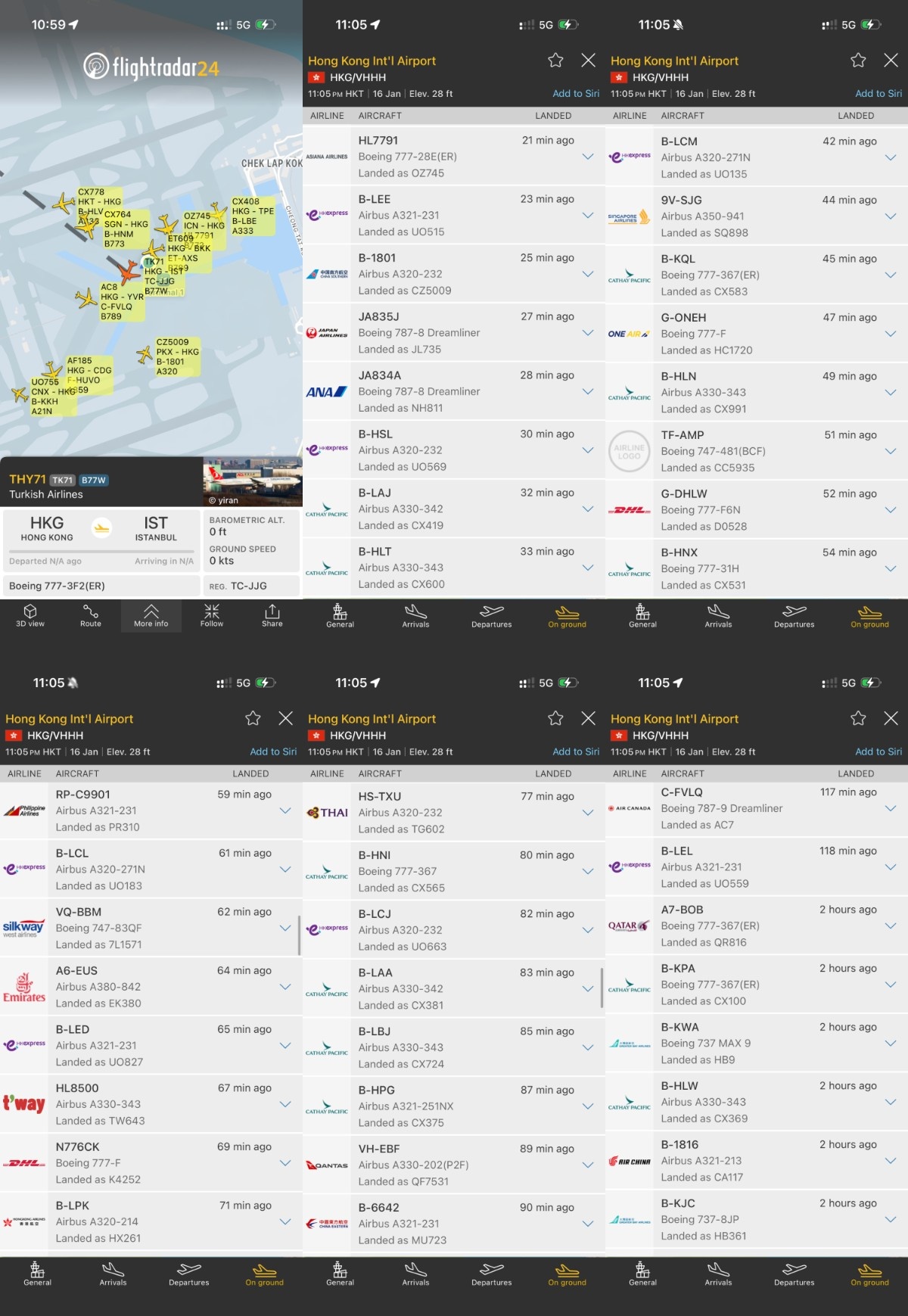
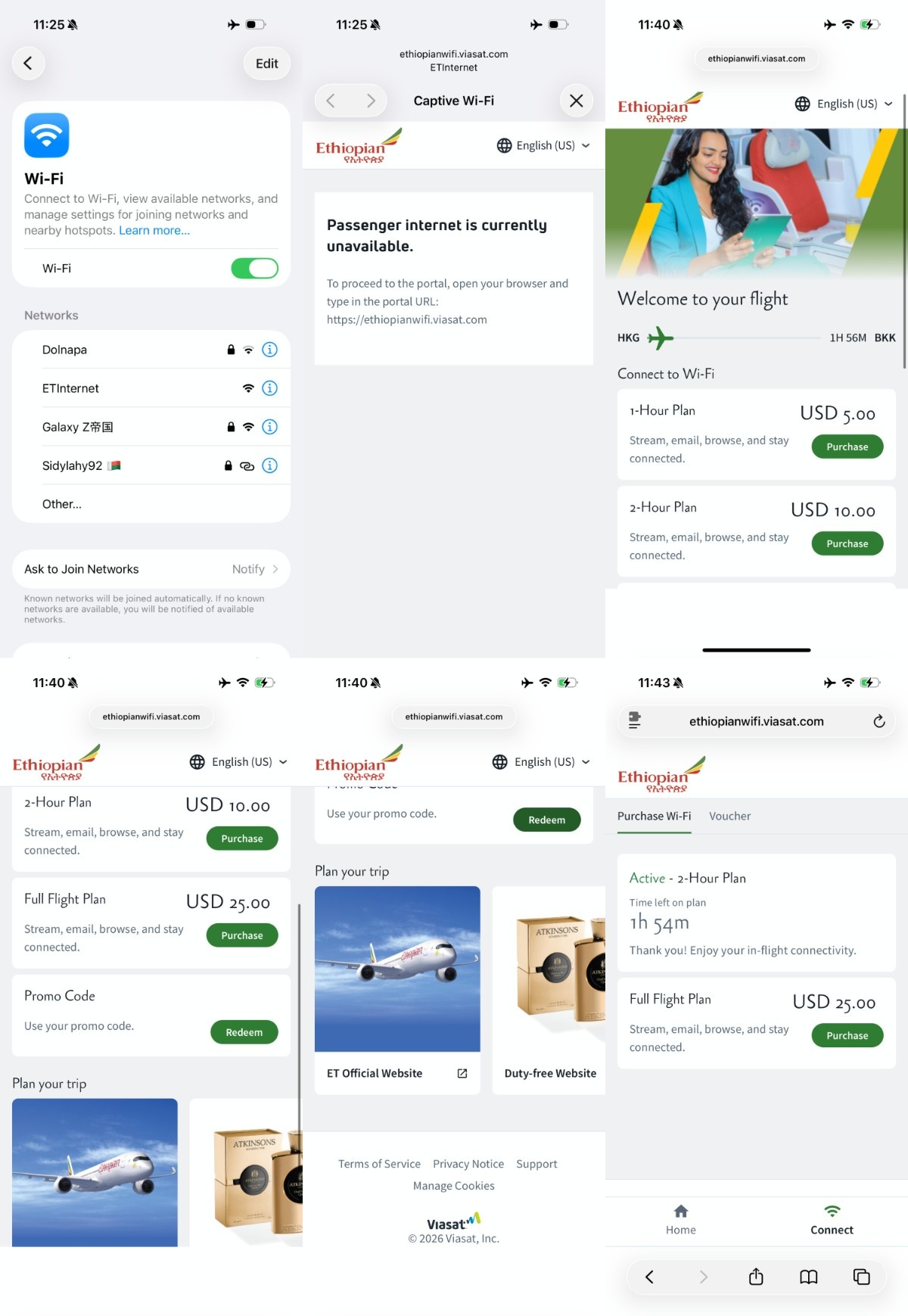
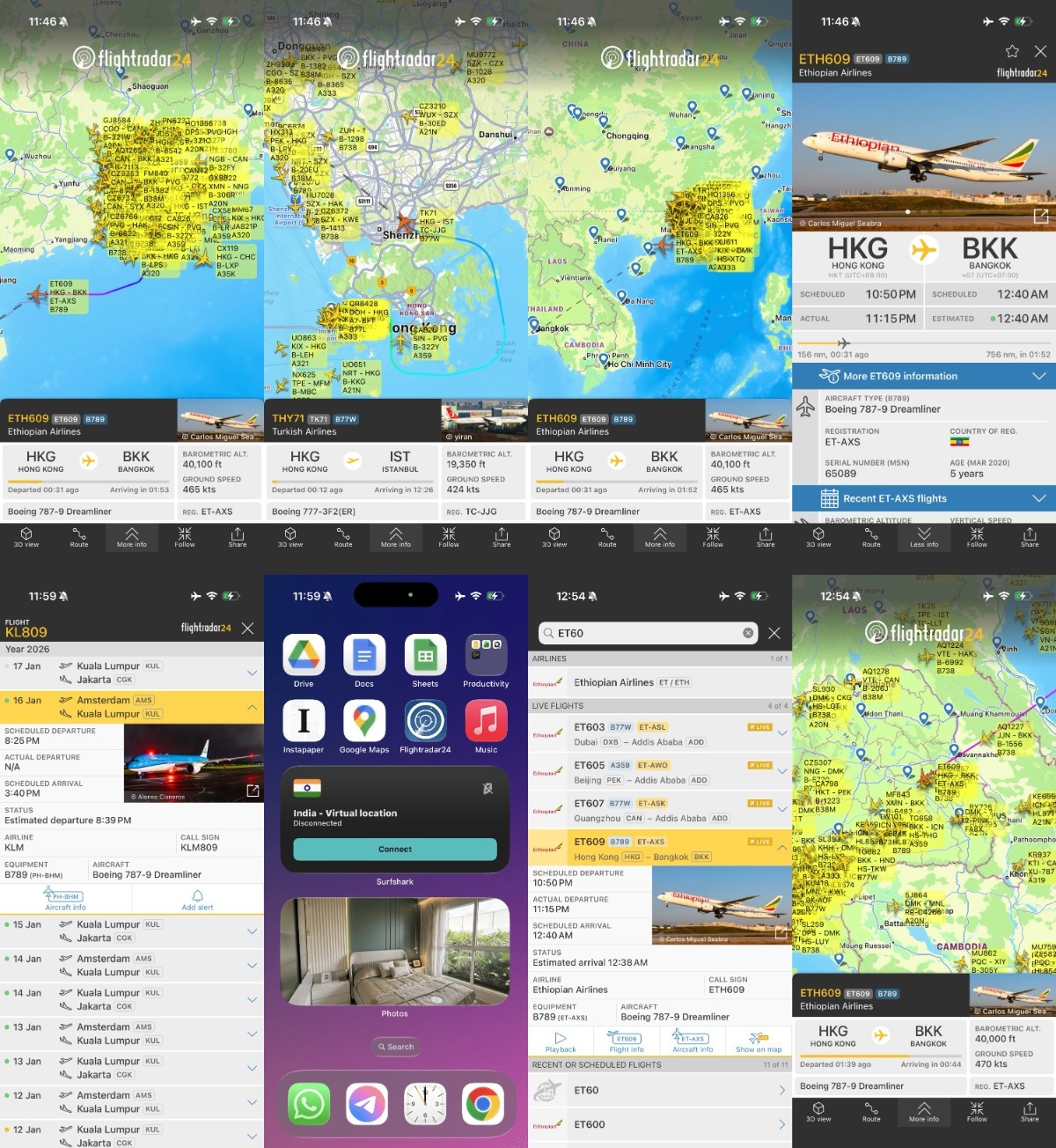
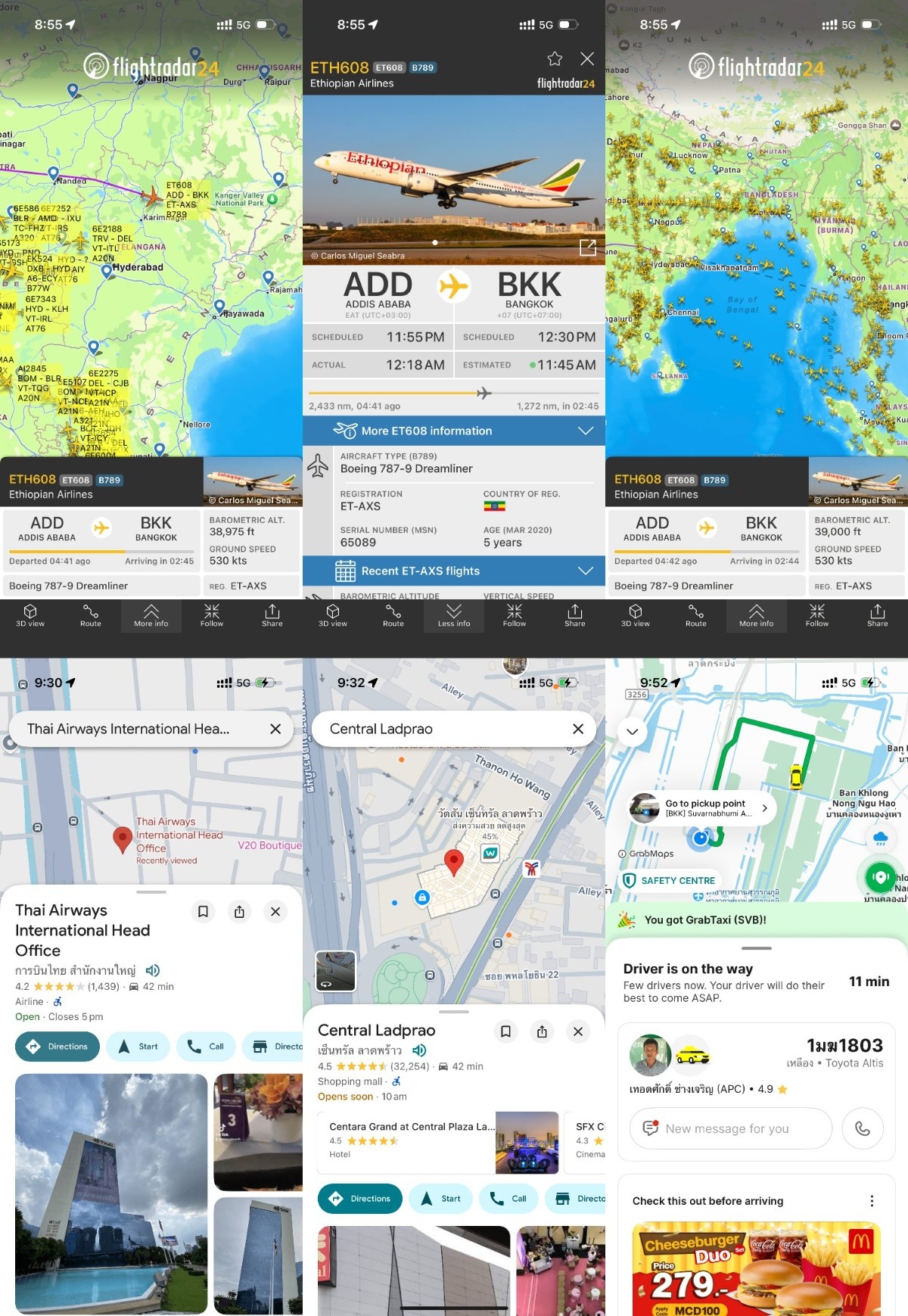
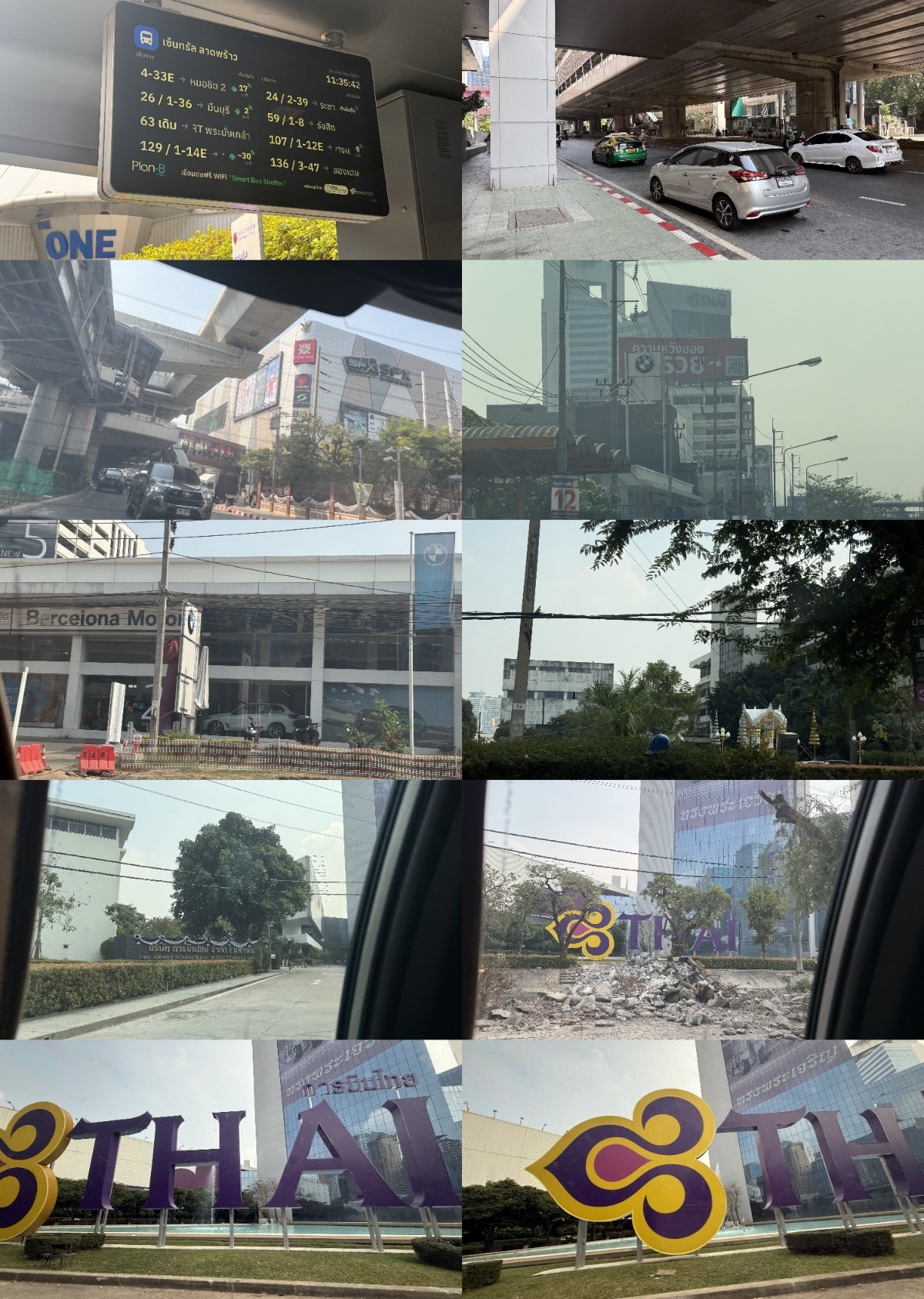
Shortly after that Burger King morning meal, I checked Flightradar24 for one of the flights I would be taking later that night: Ethiopian’s late-night ET609 fifth-freedom service from HKG back to BKK, right after the United one. At that time, it was over halfway into its nearly 8-hour journey, flying over the southern Indian peninsula. An hour later, I was waiting and waiting at the Grab counters at BKK, with the nearest taxis taking no less than 10 minutes (uh-oh!) to arrive.
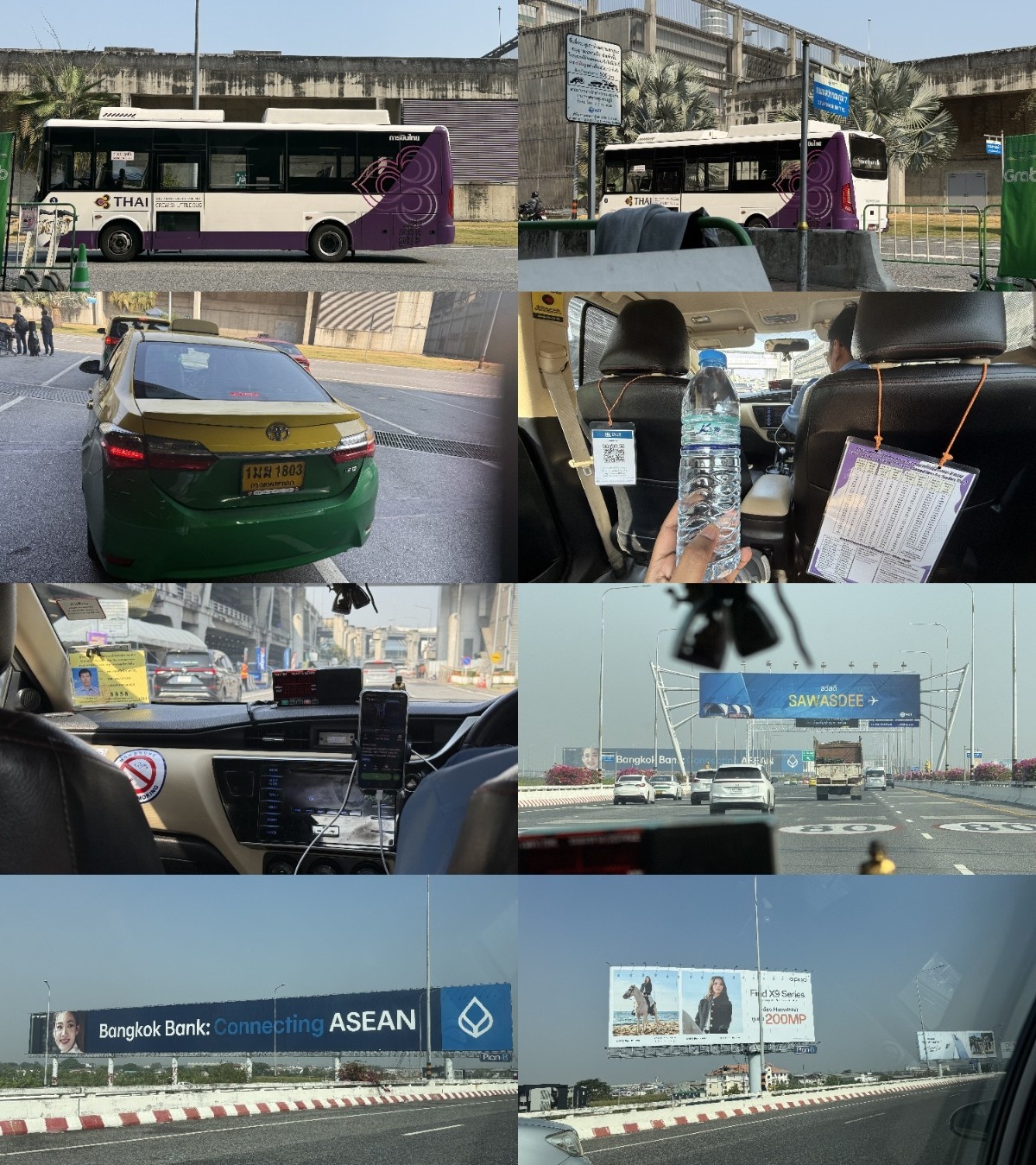
Nothing screams BANGKOK to me like these green-and-yellow taxis — traditionally Toyota Corolla Altises, but increasingly replaced by a bunch of Chinese EVs from brands like BYD, GAC Aion and Denza. Given that Thailand doesn’t have a homegrown car manufacturer — like Indonesia’s Astra Toyota/Daihatsu, Malaysia’s Perodua and Proton, or Vietnam’s VinFast — Thai roads were much less distinctive in terms of their car brands (the same old Nissan, Honda, Mitsubishi, etc.) than other Southeast Asian countries, until the arrival of these Chinese EVs. (That’s in great contrast to Cambodia next door, where, despite the dominance of the older, 2000s-gen Toyota Prius, I was BOWLED OVER by the sheer diversity of the Fords, Cadillacs and older Scions there…)
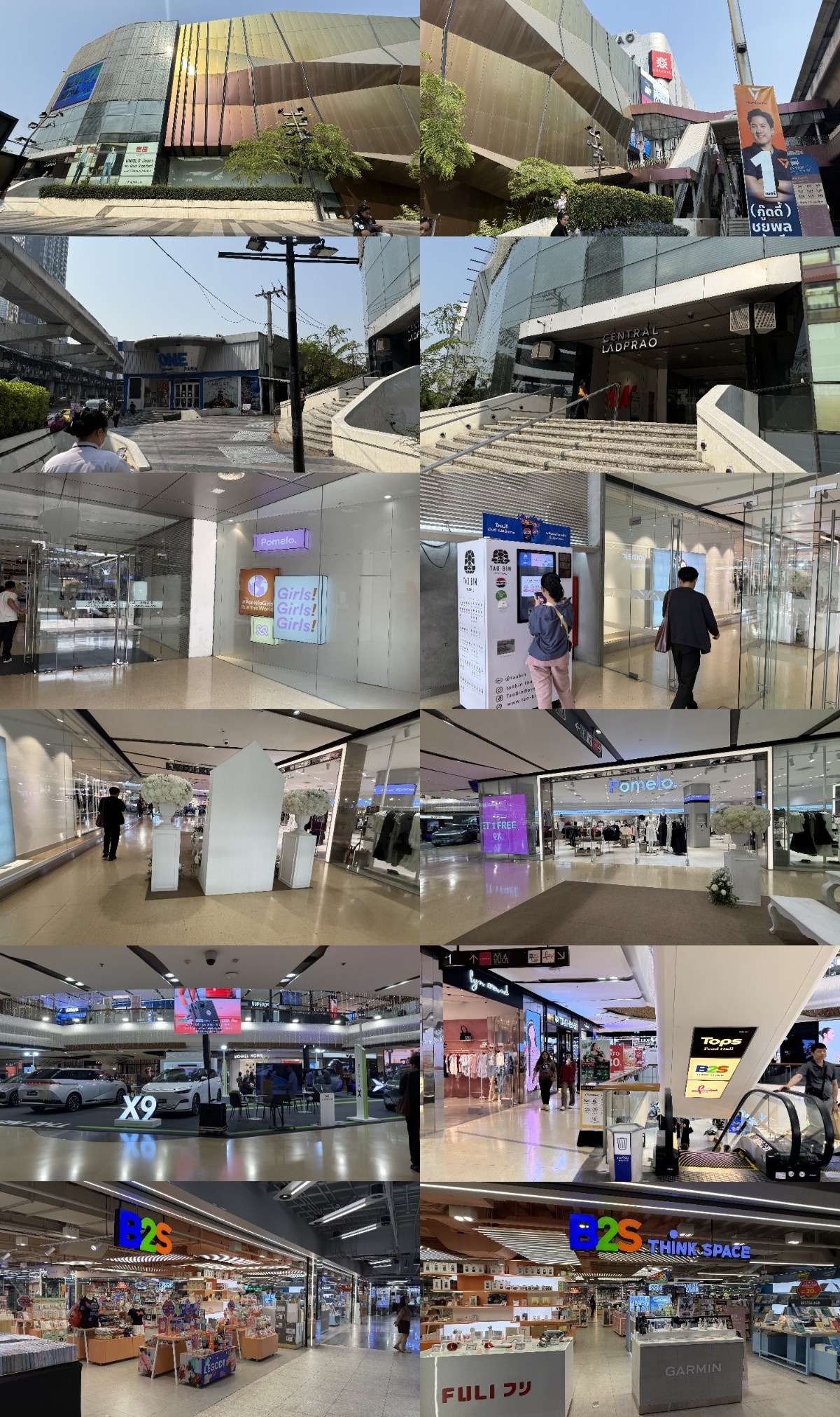
After a 40-minute drive — most of which I slept through — I reached the Central Ladprao mall in northern Bangkok, where I headed immediately to B2S, Thailand’s largest books/stationery store. I spent a while strolling through the space, before deciding that while the books and toys there were all fascinating from end to end, this time around none of them were worth parting my money with. Thereafter, it was only a short ride to the Thai Airways headquarters on Vibhavadi Rangsit Road, my destination for the afternoon, not too far from Don Mueang (DMK) Airport — the city’s main hub before 2006, now home to LCCs like Thai AirAsia and Thai Lion Air.
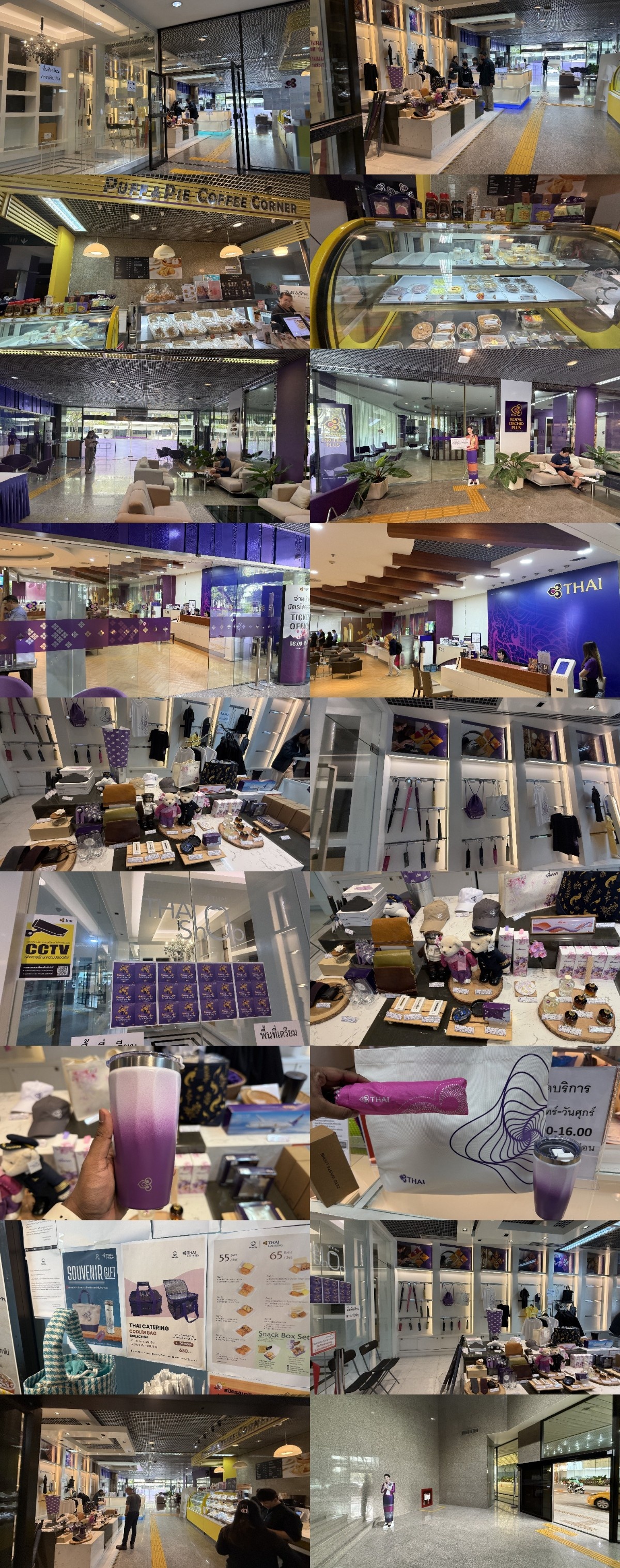
Inside the TG HQ, I noticed that quite a lot had changed since my previous (and first) visit here in August 2024, a little over a year ago. Specifically, the Thai Shop was now a shell of its former self! With most of the model planes no longer available (save for one piddly 787-8) — and the smaller room that used to house those planes completely empty and locked — I was very disappointed at not being able to buy a lot of stuff like I did that time. Poof went my chances of buying a sleek new model A350, with the previous one’s wings having broken! (And it’s not like TG has an online merchandise store either — the opposite of SQ, which has only a KrisShop online store and no physical store…)
Anyway, I did what I could, and picked up a purple sipper cup made from recycled plastic, a white tote bag (in contrast to the violet one above) and a pink umbrella. As a fan of all things purple and pink, Thai Airways is the one airline I can consistently count on to satisfy my obsession with the colour violet!
(Fortunately, two weeks later, on a quick 6-hour trip to Hong Kong at the end of January 2026, I had a much better experience at the Cathay Shop at Cityplaza. This was my second visit there in a year — the first being in March 2025, which I haven’t yet written about here. With CX’s 80th anniversary celebrations having kicked off, there was plenty of special stuff that I bought from the dark-green airline — especially with a special miles bonus on purchases of HK$800 (US$100) or more.)
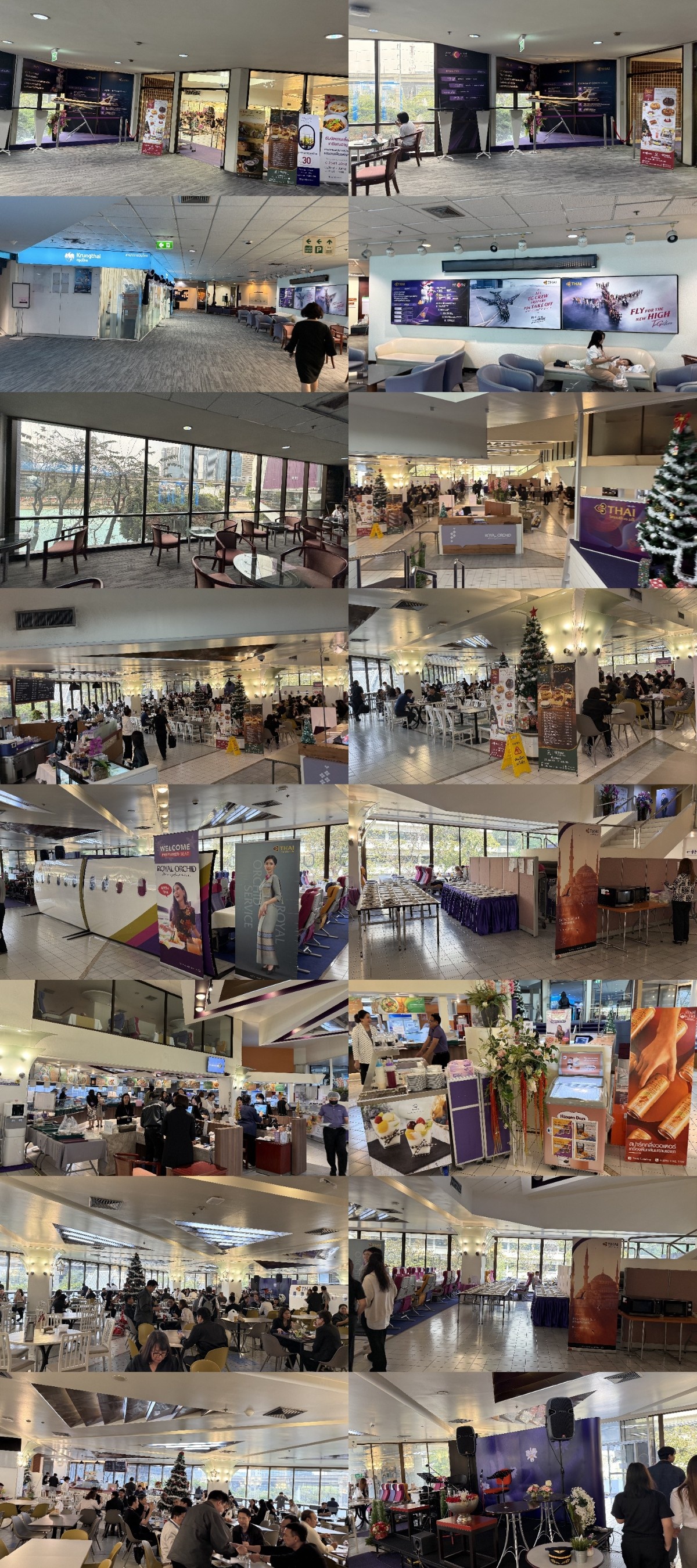
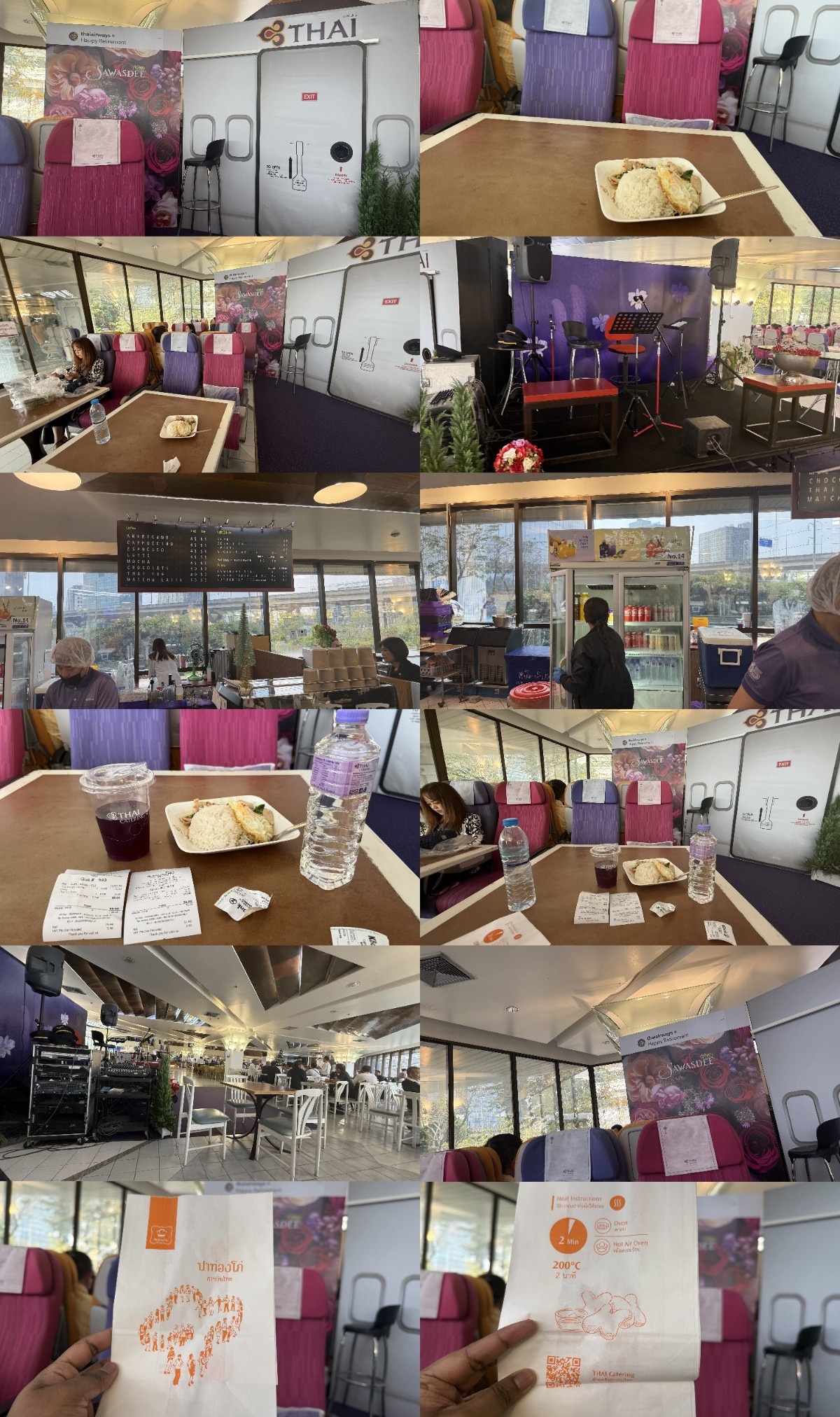
This done, I headed a level upstairs to the restaurant itself, which is open to the public on weekdays but closes at 2 in the afternoon. Having been turned away empty-handed in August 2024 after arriving just after the closing time of 2, I was thanking my stars for having made it well in time. Outside the restaurant were a model 747 in an old 20th-century livery, as well as a set of motivational posters for employees, with the same motto — ‘Fly for the New High, ToGether‘ — as I saw in the video on the inbound plane.
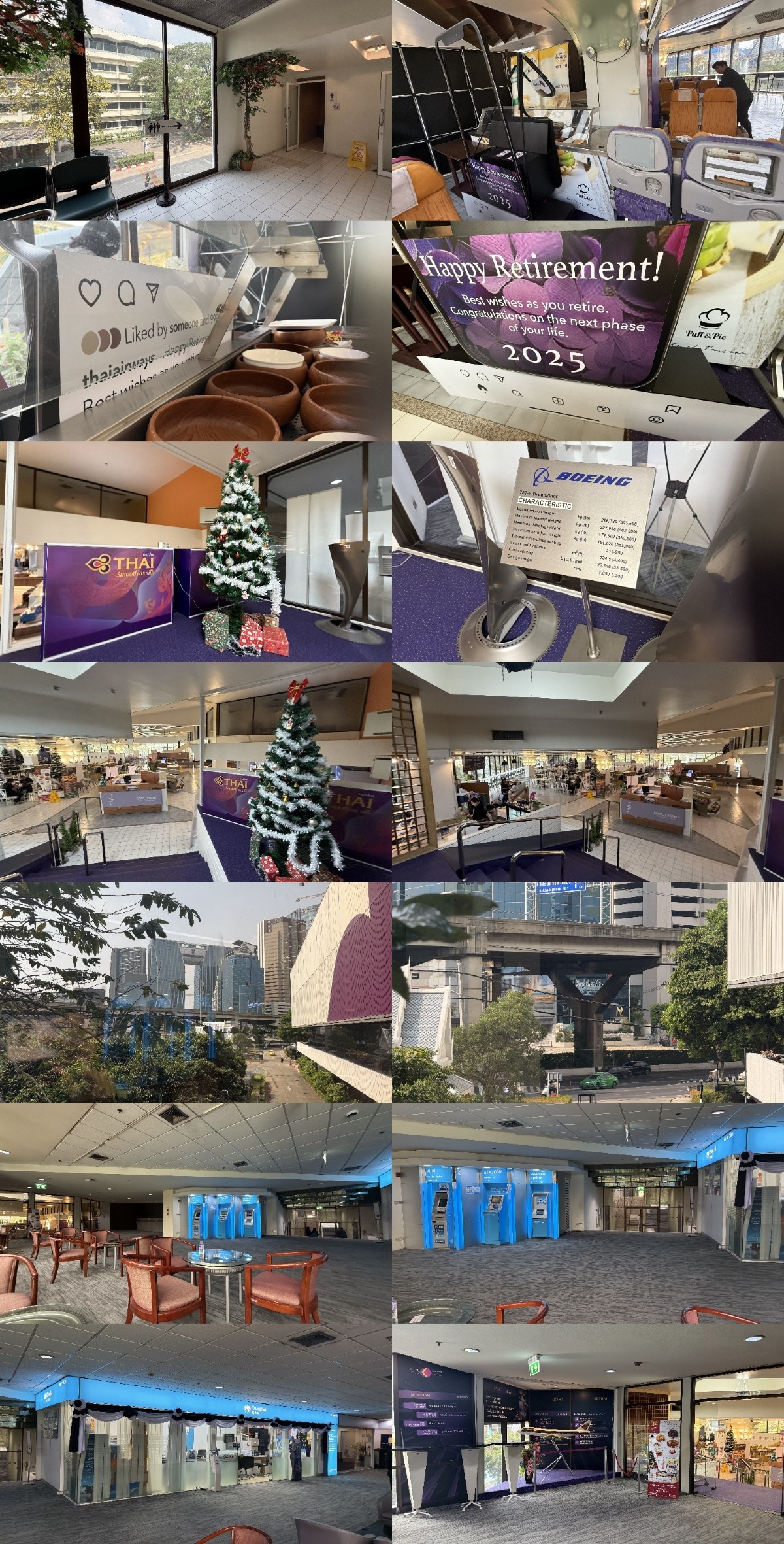
At the entrance was placed a big Christmas tree, with another one at the centre of the restaurant, as people — many of them TG employees — started to fill the place. It was highly gratifying to see TG keep the old-style, 2000s-era aeroplane seats, placed next to a stage — replete with microphone, speakers and all — for live performances. It shows how much this dining initiative, launched during the COVID-19 pandemic in 2020, has proved successful enough to be kept around half a decade later!
Of particular interest to avgeeks is TG’s commitment to showcasing its rich heritage and history. As you walk towards an exit door overlooking the street, you will see a huge propeller cone from a 747-400 of ages past occupying pride of place, situated in between two richly dark violet panels. It was here that I kept my little white suitcase, bought in Shibuya during my Japan trip the previous May. I went to the kitchen counters and ordered a plate of Thai basil chicken with a fried egg on top, all for the princely sum of just THB 85 (US$2.30)! From the dessert and drinks counter I also bought TG’s signature Butterfly Pea limeade for THB 45, which I’d also be drinking the following day in BUSINESS CLASS on the Star Alliance-liveried A350 (HS-THQ) to Jakarta…
These treats in hand, I proceeded to a somewhat secluded part of the restaurant, which, one woman aside, was not so frequented by the TG staffers. There were all manner of panels meant to resemble Instagram posts for the airline’s anniversary, and it was amid this very avgeeky backdrop that I had my very tasty, very cheap Thai lunch. I love it when an airline picks a theme and sticks to it! Quite the contrast to just a few hours before at the IIM Bangalore hostel canteen — while it serves great Indian food (even for a college), this sort of aviation-themed ambience was something else altogether…
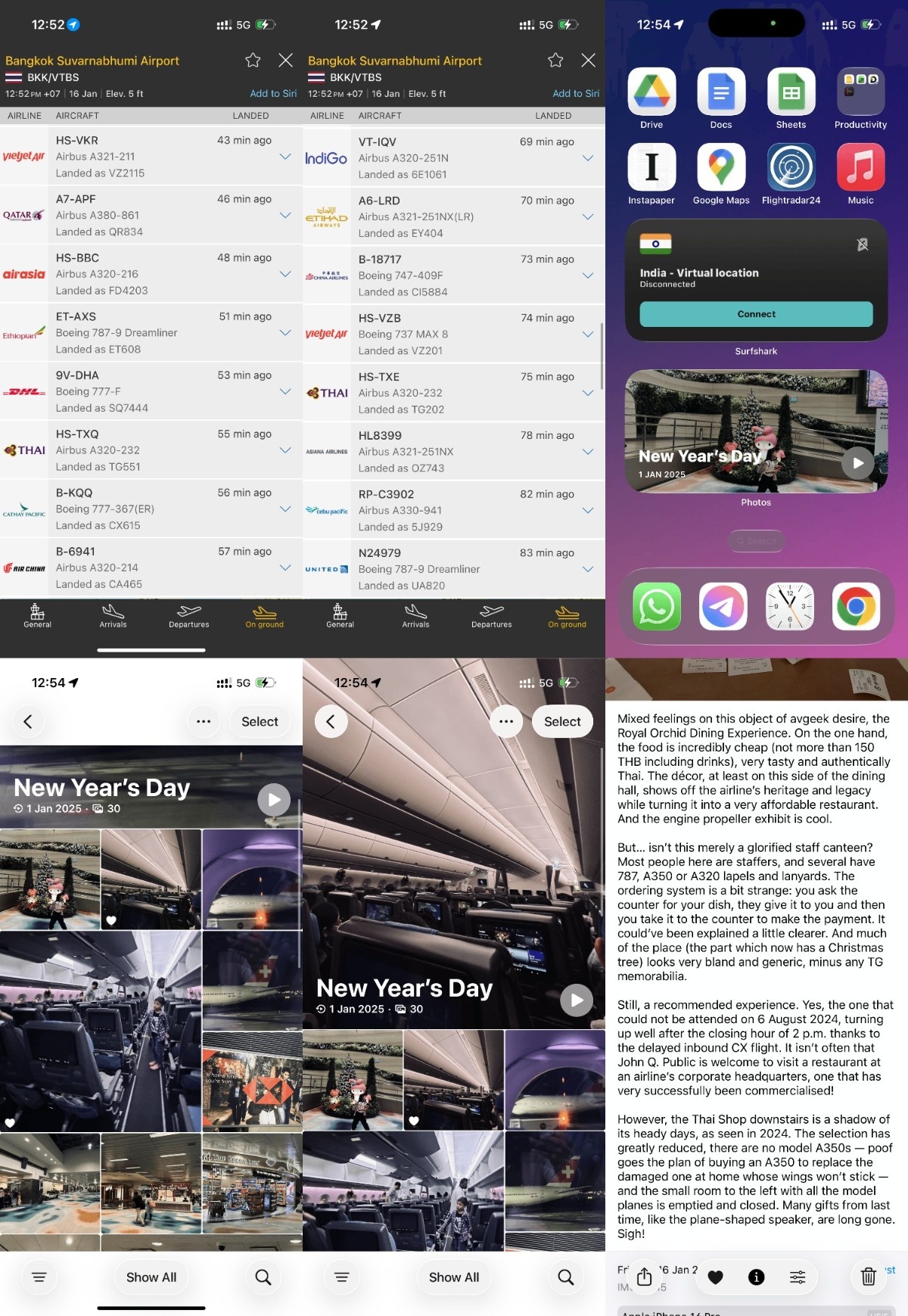
With this box finally ticked off, my mind and my belly were both sated and full, and I enjoyed the Friday-afternoon view across the road overlooking the Bangkok Airways headquarters. I could now proceed to return to Suvarnabhumi, but not before looking at the planes that’d just arrived at BKK — including ET-AXS, the Ethiopian 787-9 that I’d be flying that same evening. Almost as a coincidence, my iPhone’s featured-photos widget showed my first flight of 2025, on New Year’s Day (a first for me!): the leisurely afternoon SQ509 from Bengaluru to Singapore.
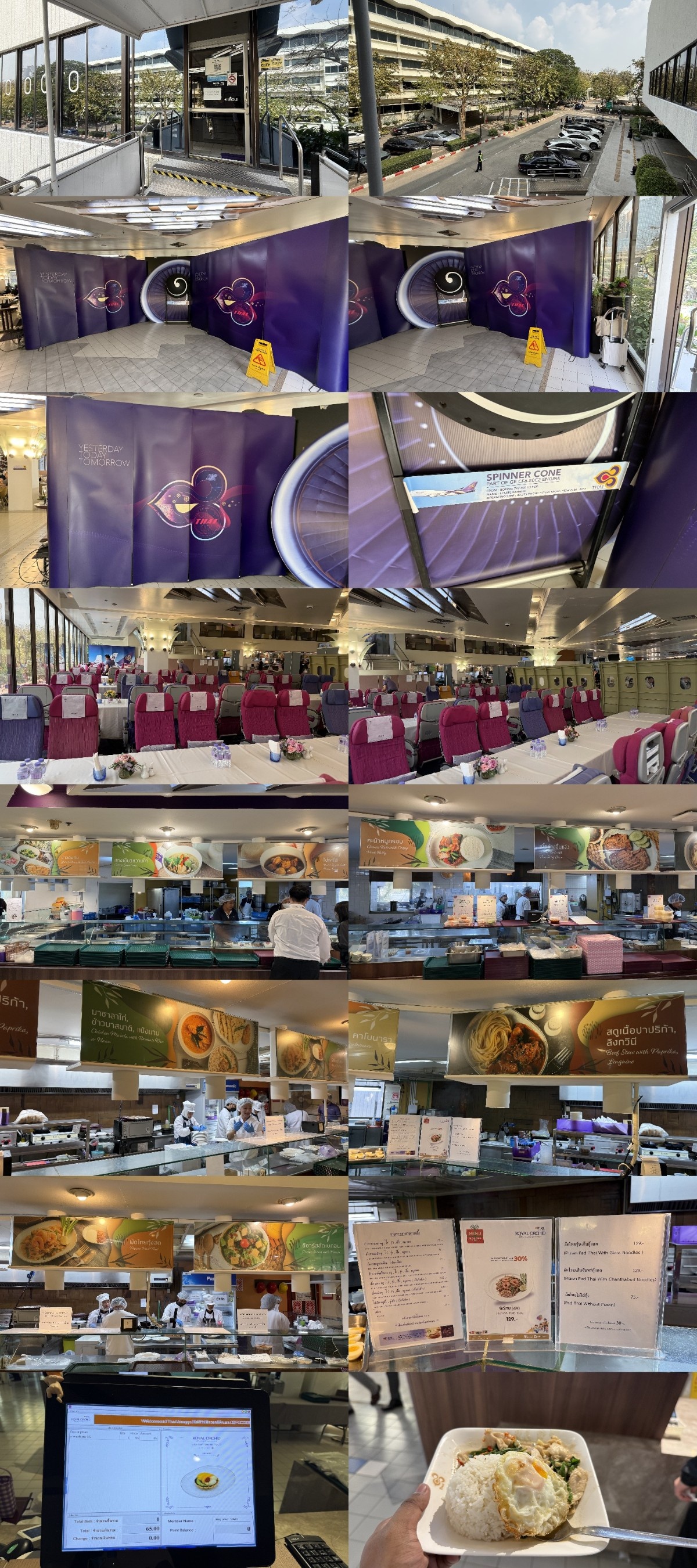
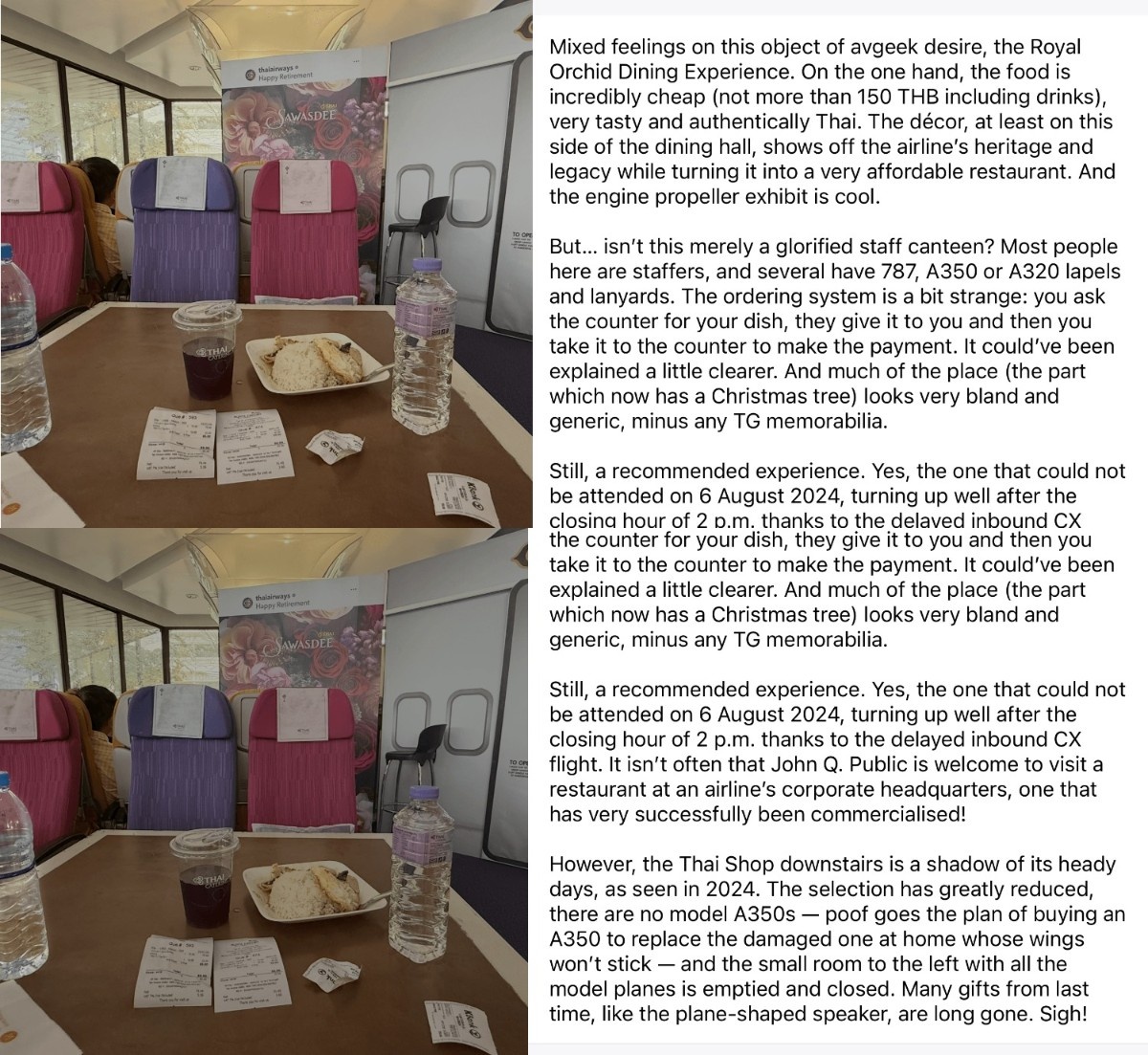
Here I proceeded to write my feelings on the experience that I’d wished to have for so many years, and now finally did. In spite of this being — as I called it — a glorified staff canteen, the effort I took to see TG had taken to showcase its glorious past and promising future through these exhibits was SO WORTH IT!
Part Two: Flying United Airlines’ 787-9 to Hong Kong — for just a two-hour layover before returning!
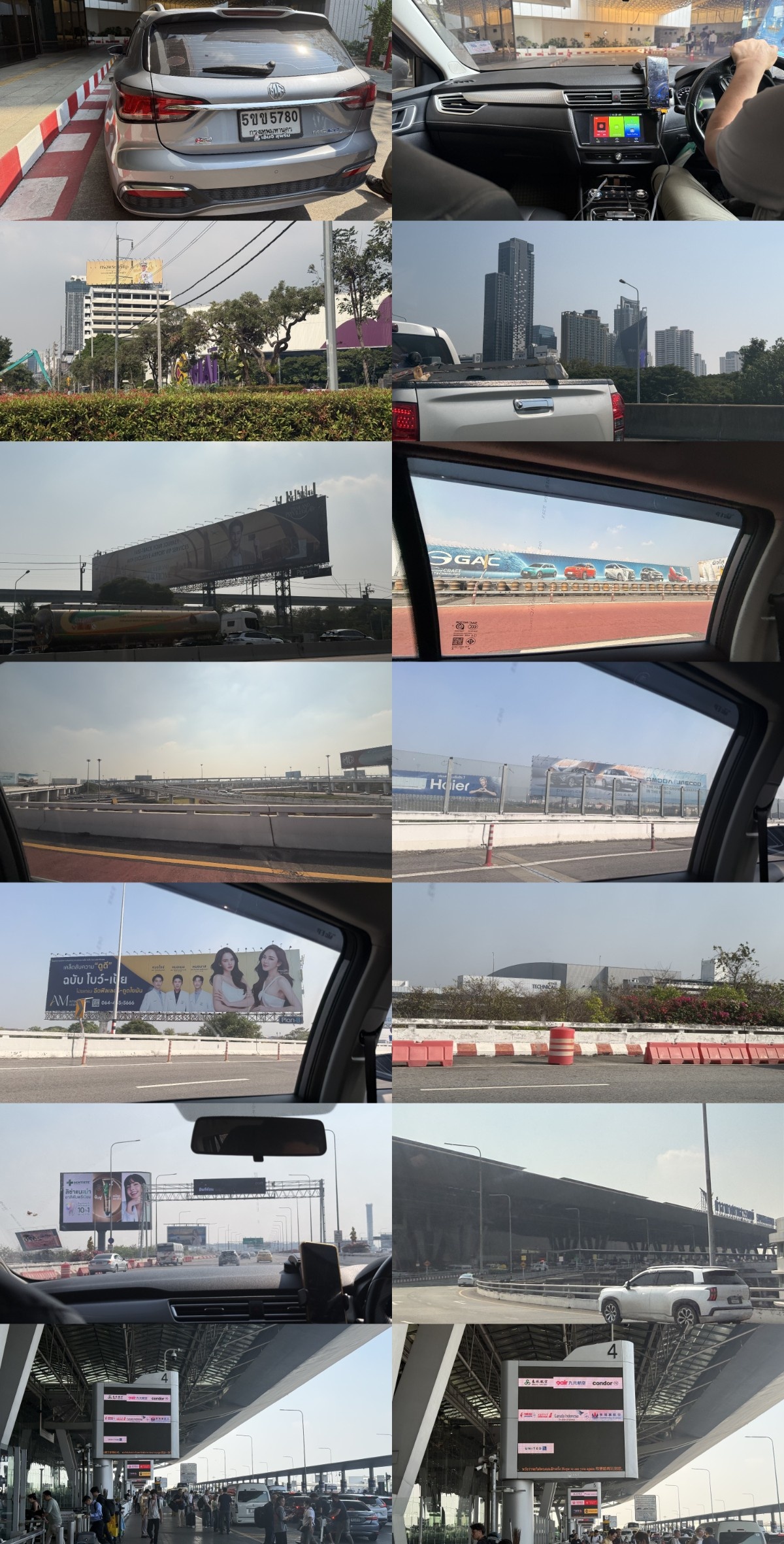
As an MG EP station wagon — this is a Thai-specific name; the car is called the MG 5 elsewhere — turned up, I sped again to Suvarnabhumi Airport all the way east of the city. I reached in less than an hour, something that I consistently find to be the case in Bangkok, Jakarta (not too much traffic to the airport, in my experience!) and even Kuala Lumpur with its very far-flung airport. This is more than can be said for most Indian cities with their bumper-to-bumper traffic, and my curent home of Bengaluru in particular, with an airport journey often entailing two hours…
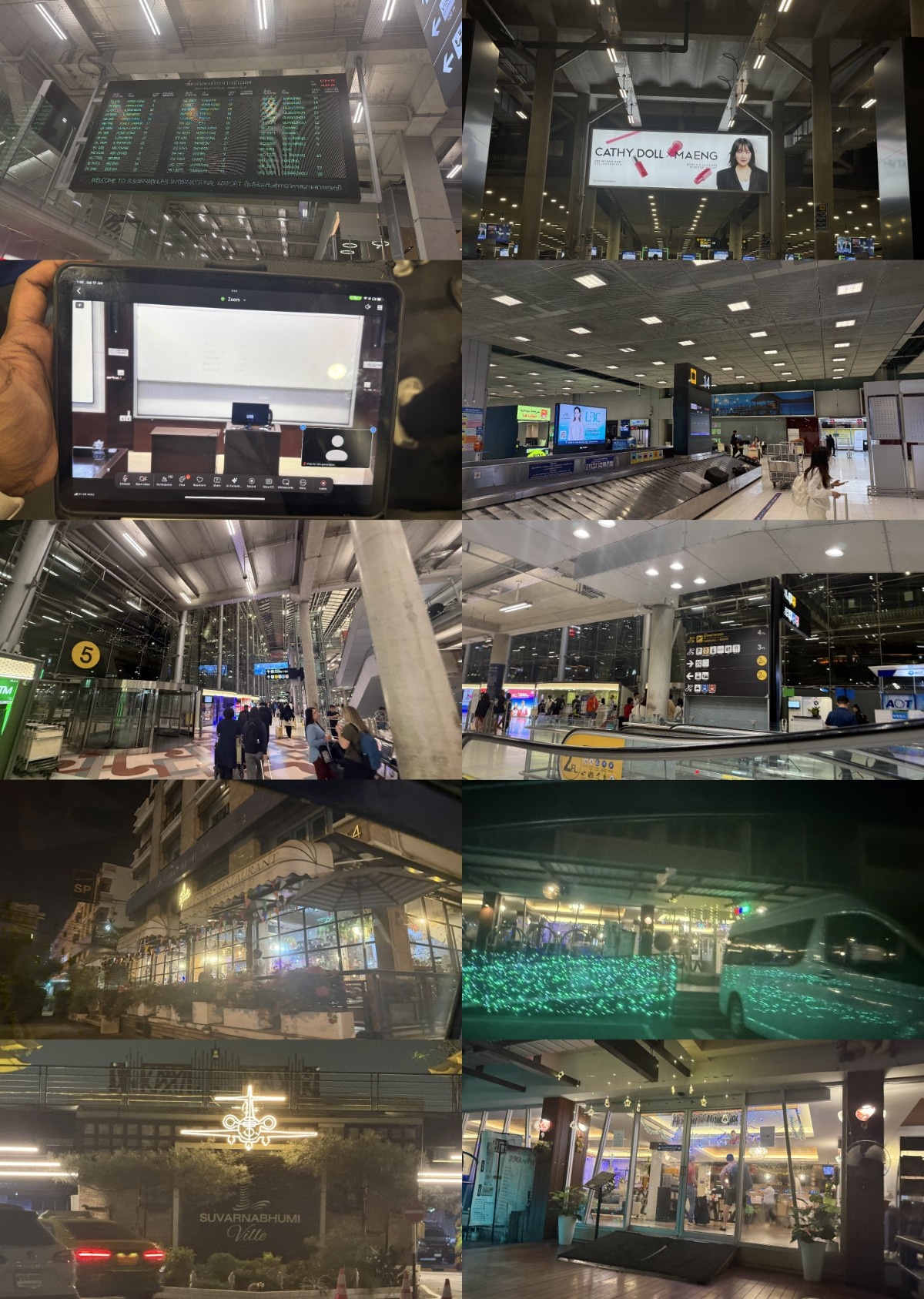
The sheer mind-boggling nature of all the airline logos at the Suvarnabhumi drop-off gates never ceases to amaze me. All the more so as there’s just the one passenger terminal, and so nearly a hundred airlines are all crammed into one driveway space. Of course, those flying the hometown Thai Airways are going to have a somewhat more streamlined experience — as I would the next day — but for now I’d be stepping in and turning towards the counters of its Star Alliance co-founder United Airlines.
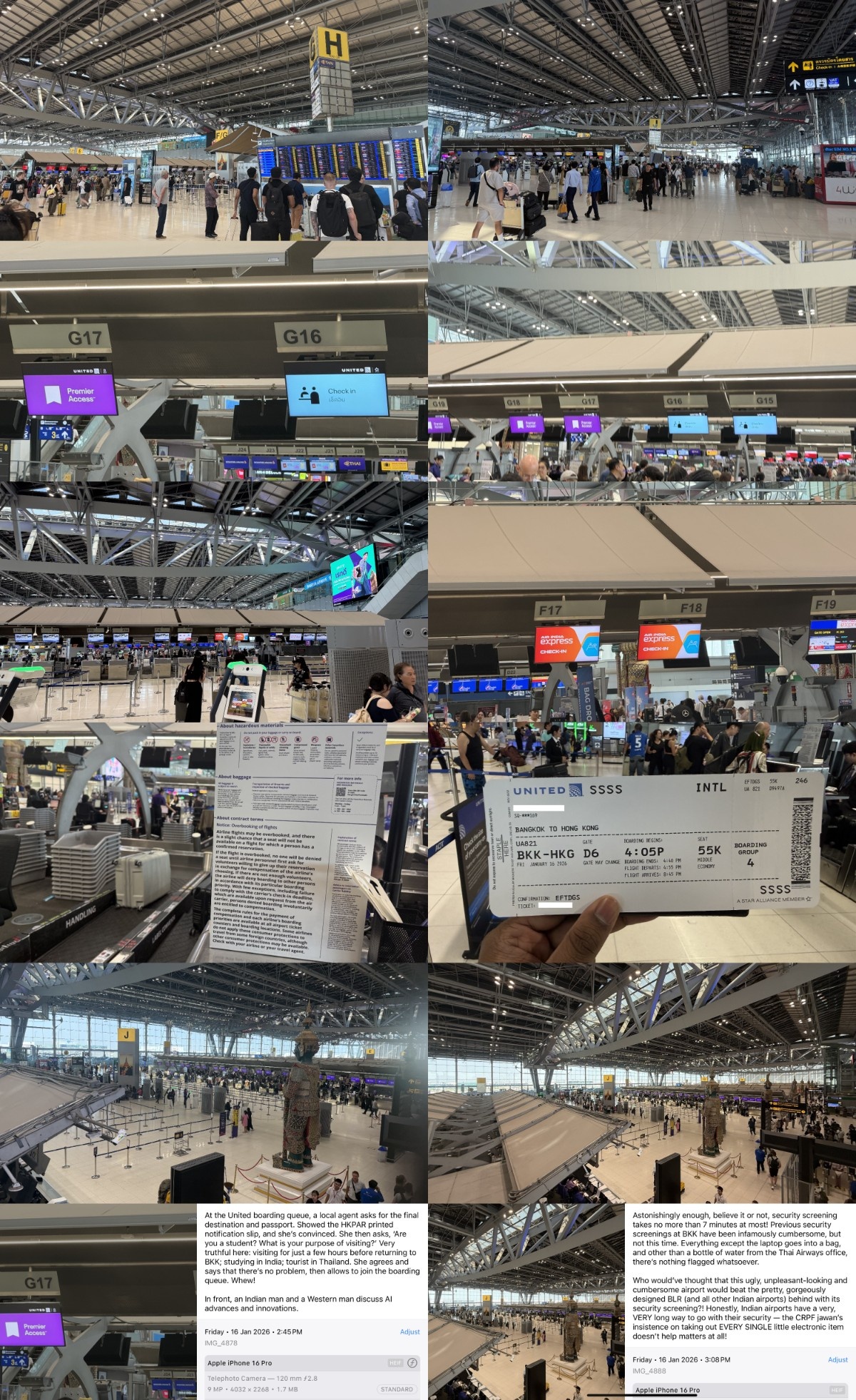
Again, I must state that BKK is most definitely NOT among my favourite airports in Southeast Asia in terms of its design. There are so many places, above all Changi with its four terminals, that do a much nicer job than these steely grey slats of metal on the ceilings. However, BKK is a necessary evil in my travel journey, and the flexibility and convenience it provides as a stepping stone to much of Southeast (and Northeast) Asia is unparallelled — like this fifth-freedom flight to the much nicer-looking HKG.
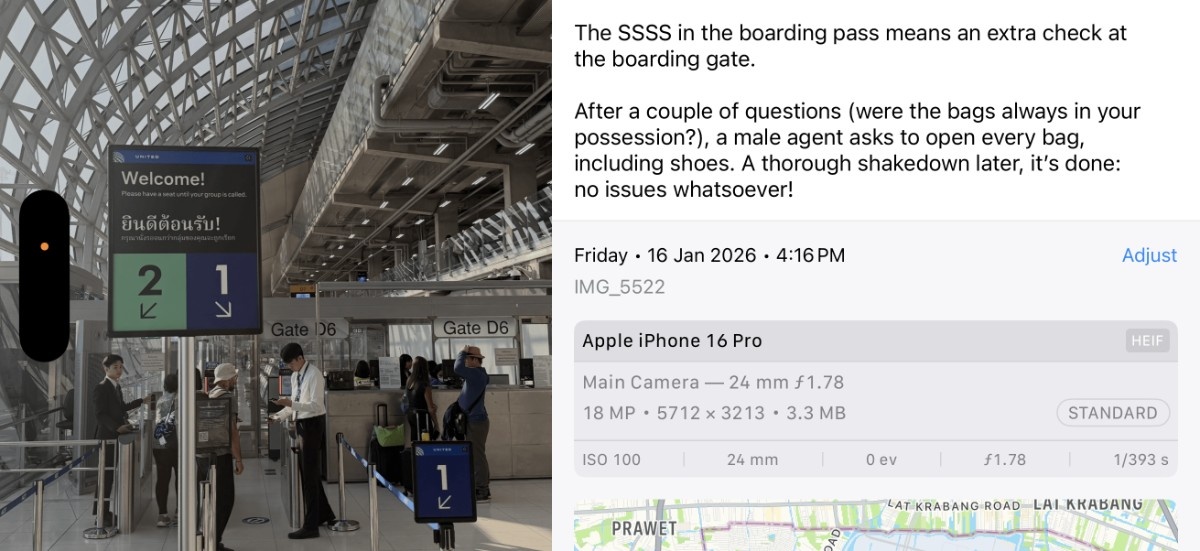
I stood in the United line, showed my Hong Kong Pre-Arrival Registration form — basically a way to visa-free travel for Indian citizens — and, after answering a few quick questions on the purpose of my stay (I didn’t say I was just transiting!), was issued a boarding pass. For the first time ever in my travels, it had the dreaded SSSS on it, which stands for Secondary Security Screening Selection — though it didn’t go much further than an extra pat-down and shoe removal at the boarding gate.
The actual security screening, immediately upstairs, was completed in only 7 minutes, as almost nothing was flagged. To think that I used to fear the outbound security process at BKK! (Also, unlike the inbound immigration — which can take nearly an hour — the outbound immigration at BKK is typically completed in a jiffy.)
And here’s the caption I’d written, once at the boarding gate, as to how the SSSS actually went down…
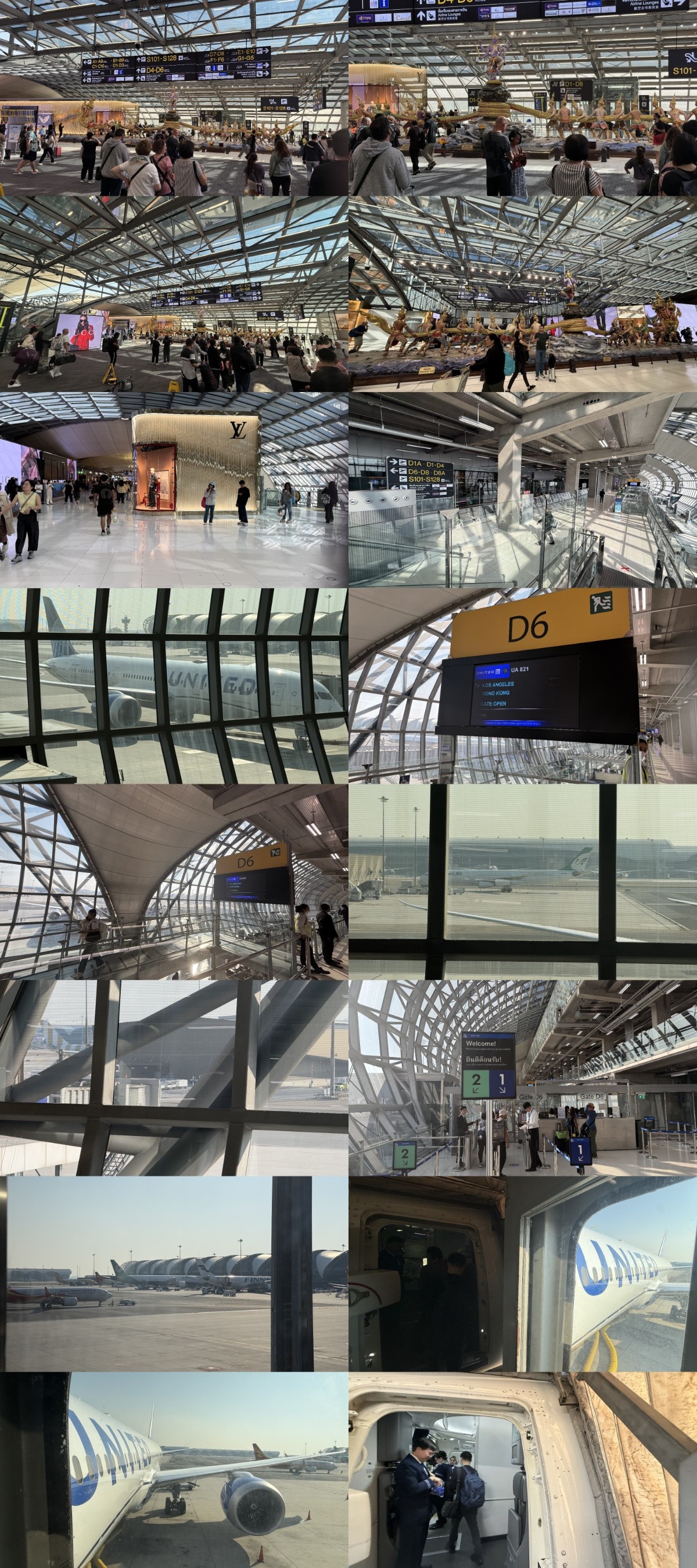
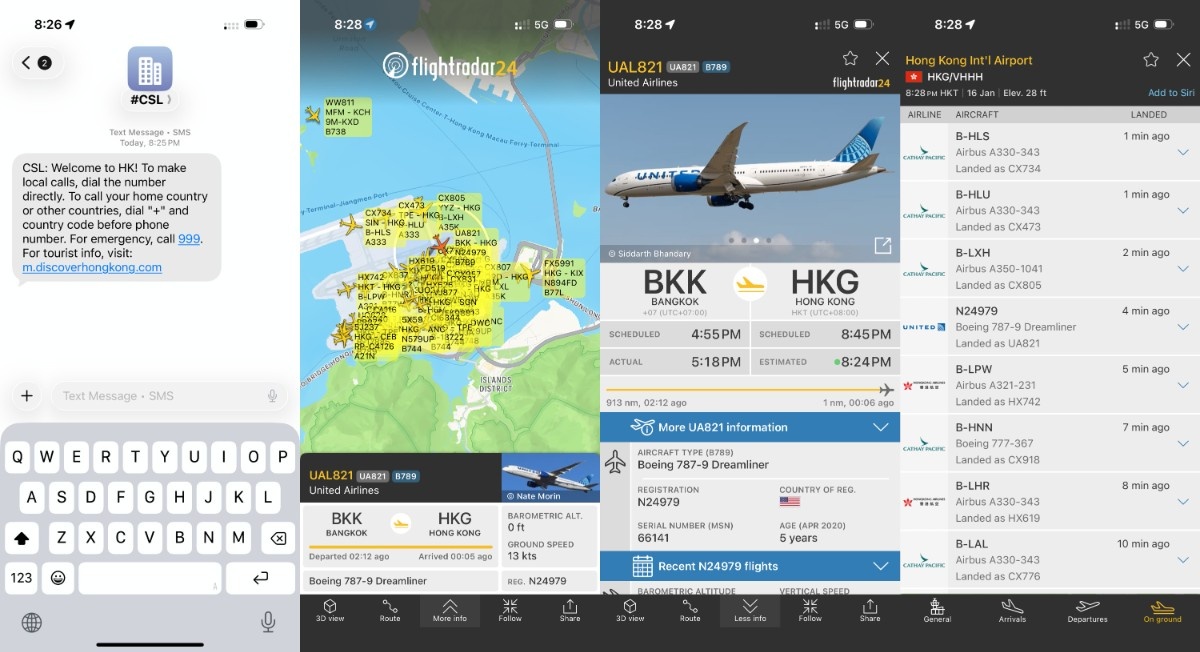
Anyway, I came face-to-face once again with the giant dragon-shaped boat from Hindu mythology. From there it was only a short walk past the Louis Vuitton store to Gate D6, located as it was in the central pier of the terminal, without too much traipsing involved. There stood N24979, my United 787-9 Dreamliner, a registration that I’d known in advance — well before the flight had even departed from Los Angeles, thanks to Flightradar24.
The D gates are all located bang in the central pier of Suvarnabhumi, connecting the two wings on either side plus the much, much nicer SAT-1 satellite terminal. Today, unfortunately, I’d have to suck it up and go to the awfully ugly design of the main terminal’s gates — and at BKK you need to go down a level to board the flight, unlike other airports I’ve seen. The following day, however, I lucked out when my Star Alliance-liveried A350 to TG Jakarta was boarding at the SAT-1 satellite building, which is leaps and bounds ahead of the main part of BKK.
For the record, United does not follow the N123AB registration series that most other US airlines follow (though some of its oldest aircraft do follow a NxxxUA pattern), instead having 5-digit registration patterns. The last three digits of the registration are the fleet number of the aircraft. So, for example, the 787-9 fleet has fleet numbers from 951 to 997, and consequently the last 3 digits of the plane’s registration will be that fleet number — so mine was 979. (The first two digits of the registration, however, are very random: so UA’s six oldest 787-9s are N38950, N19951, N26952, N35953, N13954 and N38955 — crazy, I know!)
However, there are some brand-new 787-9s delivered from February 2026 that have the new Polaris cabins — including the Polaris Studio concept — and a ultra-premium-heavy configuration. These have fleet numbers from 1101 onwards, and so their registrations are N61101, N21102, N61103, etc.
In the distance stood an antique A340 of Mahan Air, Iran’s largest private airline. Again, BKK is nothing short of fascinating when it comes to planespotting — Western airlines like United and Finnair (whose A350 you also see below), East Asian heavyweights like EVA Air (which has a mini-hub at BKK for its European flights) and Hainan Airlines, Russian visitors like Aeroflot and S7 Airlines, lesser-known Middle Eastern ones like El Al Israel Airlines and Royal Jordanian, South Asian ones like Air India Express and Biman Bangladesh… the list is endless!
Now wasn’t the time for any of those: after a fairly long wait, I would finally be stepping on board the US airline that long prided itself on flying the friendly skies through its advertising. As to how friendly they would turn out to be… well, I’d be just about to find out!
The flight: Boarding and departure
Flight: United Airlines UA821/UAL821
Date: Friday, 16 January 2026
Route: Bangkok Suvarnabhumi (VTBS/BKK) to Hong Kong International (VHHH/HKG)
Aircraft: N24979, Boeing 787-9 Dreamliner
Age: 5 years 9 months at the time (built: 17 April 2020; delivered: 26 April 2020)
Seat: 55K (starboard side, middle seat near window)
Boarding: 4:10pm Indochina Time, UTC +7 (5:10pm Hong Kong Time, UTC +8)
Departure: 5:20pm ICT (6:20pm HKT)
Arrival: 8:25pm ICT (7:25pm ICT)
Duration: 2 hours 5 minutes
Notes:
• First flight on a US airline, and only my second Western airline flown after KLM Royal Dutch Airlines — which I would fly for the third time on the very next day, as you’ll see below. To date, I’ve never flown outside Asia! (However, that will change in the fall of 2026, as I go for a semester exchange at Melbourne Business School in Australia. In fact, I might even go to Central Europe before that.)
• Eighth Star Alliance member flown, the others all being from Asia — Air India, SQ, TG, Asiana, ANA, EVA (the last three all flown in May 2025) — with the exception of Ethiopian Airlines, which I’d also be flying for the third time (as I’ve written in the Travelling Bonus) in barely a few hours’ time.
• As far as fifth-freedom flights are concerned, I happen to fly 787s (especially -9s) more often than any other aircraft type, even though the A350-900 is otherwise my most-flown widebody by quite some distance. This flight was no different — and indeed, as I’ve mentioned, this trip alone had no fewer than three FFRs on 787-9s, the others being on KLM and Ethiopian. Aside from these, I’ve also flown Gulf Air’s 787-9 on the BKK–SIN fifth-freedom route (November 2023), which is now discontinued, and Saudia’s new 787-10 FFR flight (November 2025) from Singapore to Denpasar.
Putting the ‘friendly’ in Friendly Skies starts with the cabin crew and co-passengers
As soon as I stepped on board, I knew that I would be in for an especially friendly experience, starting from the cabin crews chatting in the galley but not forgetting to deliver a ‘Welcome on board!’.
Once I moved right past the Polaris® lie-flat Business Class seats — and you’re going to see a lot of that registered-trademark symbol below — and headed towards the back of the cabin, I reached my seat, 55K. On most other widebodies that I’ve flown, that would’ve been a window seat — but not United! That’s because United has seats numbered all the way to L, with my upcoming flight on Ethiopian — as well as my Saudia 787-10 in November — also having the same. Unfortunately, paying for a window seat would’ve been exorbitant, and anyway none were available in the rear section of the plane, so I’d have to make do with the middle closest to the right side.
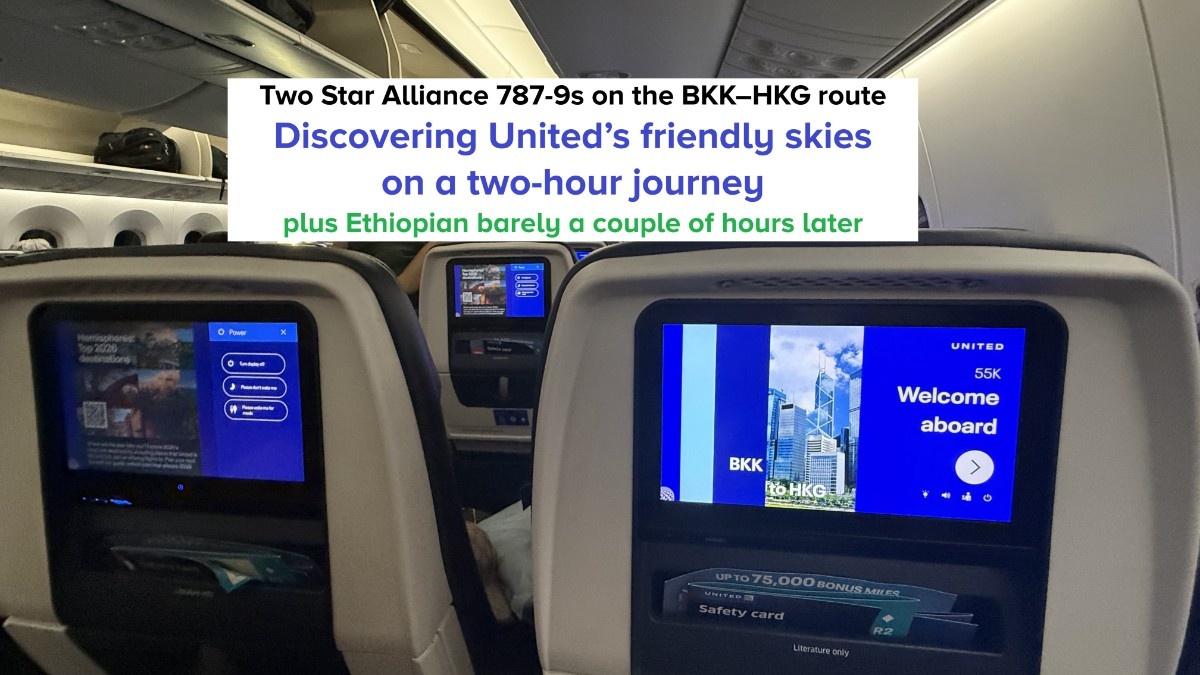
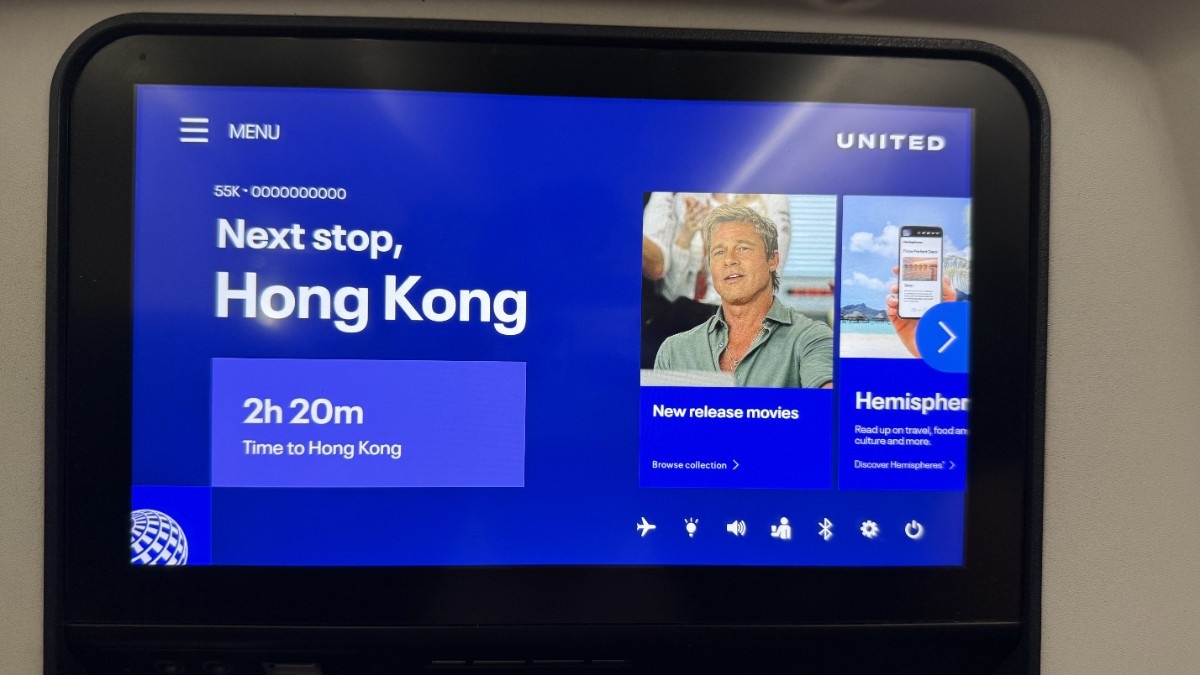
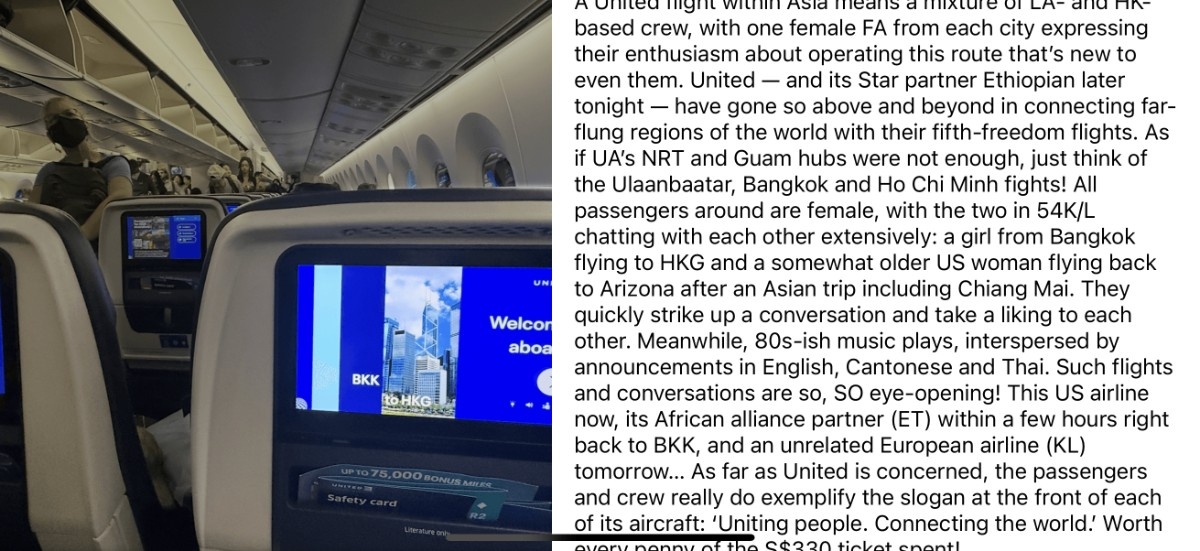
Immediately, I was delighted to experience United’s latest and greatest new IFE system, with a big ‘BKK to HKG’ sign at the bottom and a ‘Welcome aboard’ to the right. I’ll state upfront that the investments United has made to its inflight experience have been simply massive, and this is one of the best examples of a Western airline revamping its IFE from head to tail. Be it on the premium A321neos — including the ‘Coastliners’ that will shuttle between EWR (later also JFK) and LAX/SFO — and upcoming A321XLRs, or the 737 MAXes that fly as far afield as eastern Asia (like Ulaanbaatar!), or these 787-9s that are the backbone of the longhaul fleet, the airline’s new Neue Plak font has been applied everywhere with utmost consistency.
No matter how brilliant the service provided by the likes of Star Alliance partners All Nippon Airways and EVA Air — and a premium traveller will almost always pick them over a potentially slipshod US airline any day! — they will forever be inhibited by their countries’ rigid corporate identity norms, and will never be able to deliver this level of Western professionalism in their entertainment systems, menus and overall brand appearance. Even the otherwise globalised Singapore Airlines doesn’t quite cut the mustard when it comes to IFE branding.
All this is to say: THREE CHEERS for United’s transformation across branding and passenger experience. As one might say nowadays, it’s GOATed! 👏🏽🤩
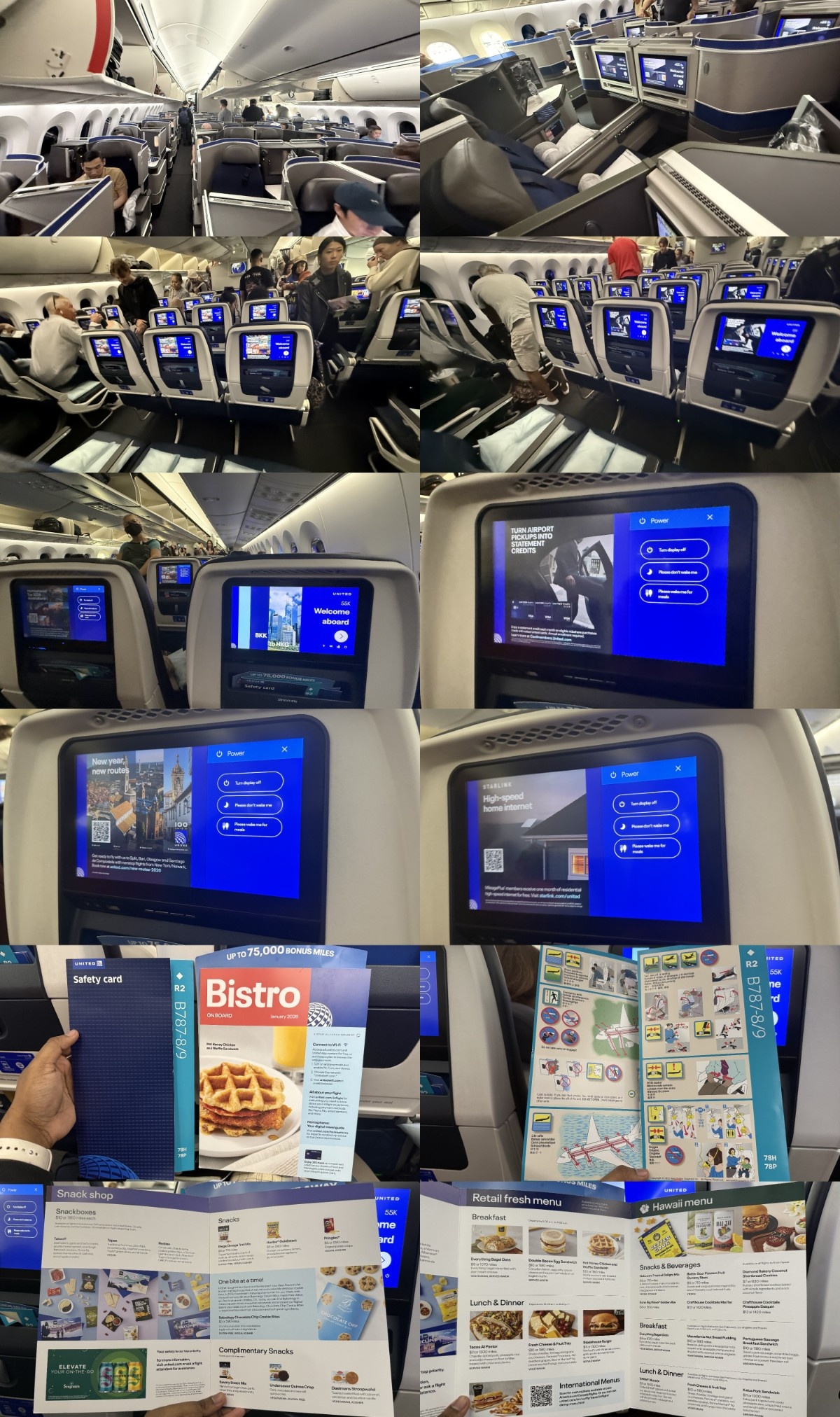
You can see above that, besides the safety card — which still features UA’s old FF Clan font; perfectly nice though not as unique as Neue Plak — there was also a buy-on-board menu for the airline’s domestic routes. Not that any of that would be needed here!
Of course, with the Hemispheres magazine being discontinued from the fall of 2024 and there being no digital equivalent (aside from some SilverKris-esque inspirational journeys online), any printed reading material from a North American airline (other than Hawaiian) is too much to expect at this point in post-COVID travel. This is far from the renaissance that magazines have been having in East Asia, with the revival of Thai Airways’ Sawasdee — as I saw on the previous flight — standing out in particular, as well as Singapore Airlines’ SilverKris in April 2026.
As more passengers boarded, it was soon clear that I was surrounded by an especially lively bunch of ladies around me. There was a girl in 55L, the window seat beside, who was a young traveller like me, though I don’t remember what she looked like. Then there were two in 54K and L in front of me, who ended up striking an unlikely bond. One was a young twentysomething girl from right about here — Bangkok — and the other a kindly, older woman in her forties, wearing glasses that perched on the tip of her nose. She was returning to Arizona after a trip across Southeast Asia, including Chiang Mai, and delighted in speaking to the younger one, who was clearly a Thai avgeek — she knew her 787s from her 777s. I enjoyed eavesdropping on them 😂, though it was only at the end of the flight that I indulged my globetrotting passions by briefly chatting with these girls.
Meanwhile, some 1970s/80s pop songs played over the PA — I couldn’t identify what they were — and that helped to set the Americana vibe even more, aside from those to the left side of me chitchatting in Cantonese instead of English.
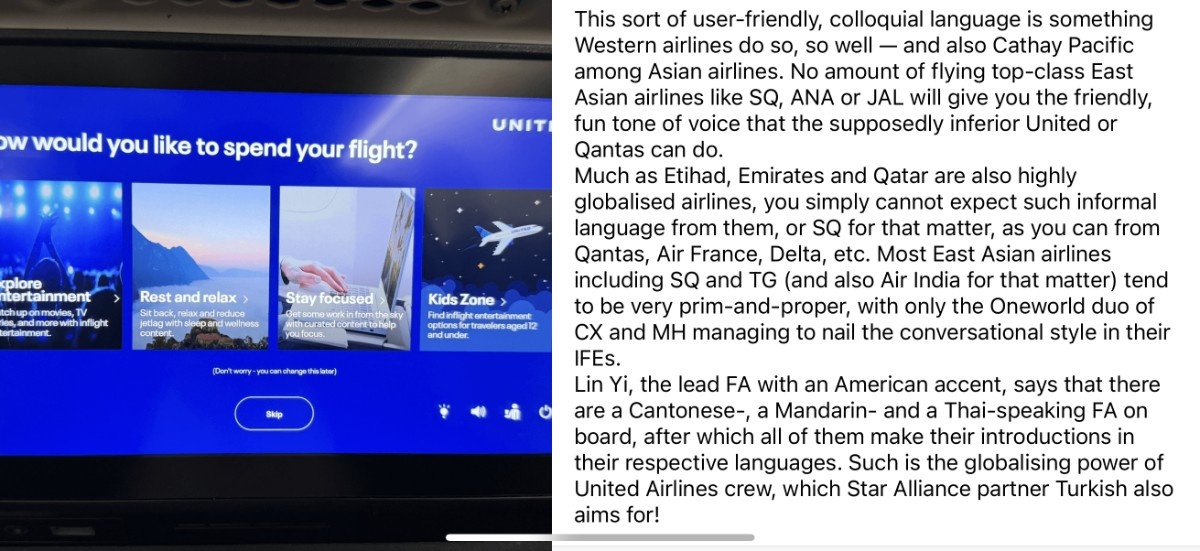
It was in this constant environment of people (women in particular) sharing their travel stories — almost like a lively bar with strangers-turned-friends you’re sharing a beer with — that I decided to explore the IFE system. Immediately, I was asked this question: How would you like to spend your flight? Explore entertainment? Rest and relax? Stay focused? Or are you a kid (or a kid-at-heart)? Such efforts to making a flight an enjoyable journey, instead of only a static selection of movies and TV shows, is something I’ve never seen before — other than perhaps Cathay Pacific A350s, which have a ‘timeline’ of when food will be served and when you can relax, though nothing quite like this!
Few airlines that I’ve flown seem to understand the role of IFE in the broader passenger experience the way United does, and this little feature before the main IFE demonstrated exactly why.
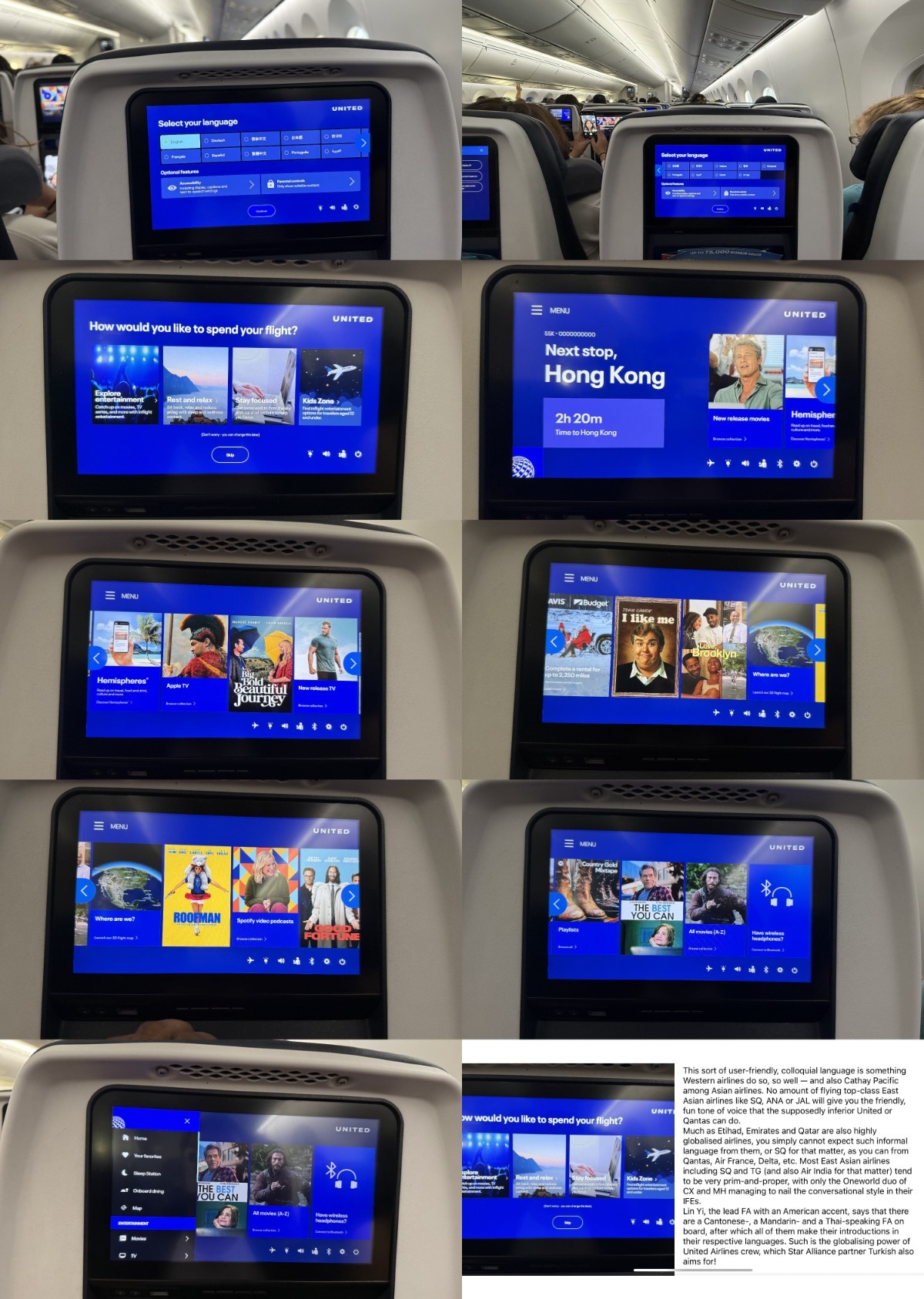
Presently, lead flight attendant Lin Yi — American despite that Chinese name — made a welcome announcement for this 2h9m flight to HKG. She said: ‘Our entire team will make sure you have a great flight. On this flight we have a Cantonese-, a Mandarin- and a Thai-speaking flight attendant, so please let us know if you need any language assistance.’ She was the one who’d cheerily welcomed me on board, and who’d been chatting with another flight attendant at the entry door — as US cabin crew often do — though she didn’t forget to welcome passengers as they boarded, something that’s all too often missing on US carriers.
Then the cabin crew who spoke Cantonese, Mandarin and Thai made their introductions in those languages, which did lengthen the proceedings a little.
After which the captain of the flight made his welcome onboard, and added: ‘It gives me pleasure to announce that we have a 3-million miler on board with us today! 😲 We have a chance to welcome him on board; he has flown with us a lot. … Trying for an on-time arrival, but we’ll see when we get there, maybe a few minutes’ delay. That’s all we have for you. I’ll give you more en route, and thank you very much for coming with us today.’
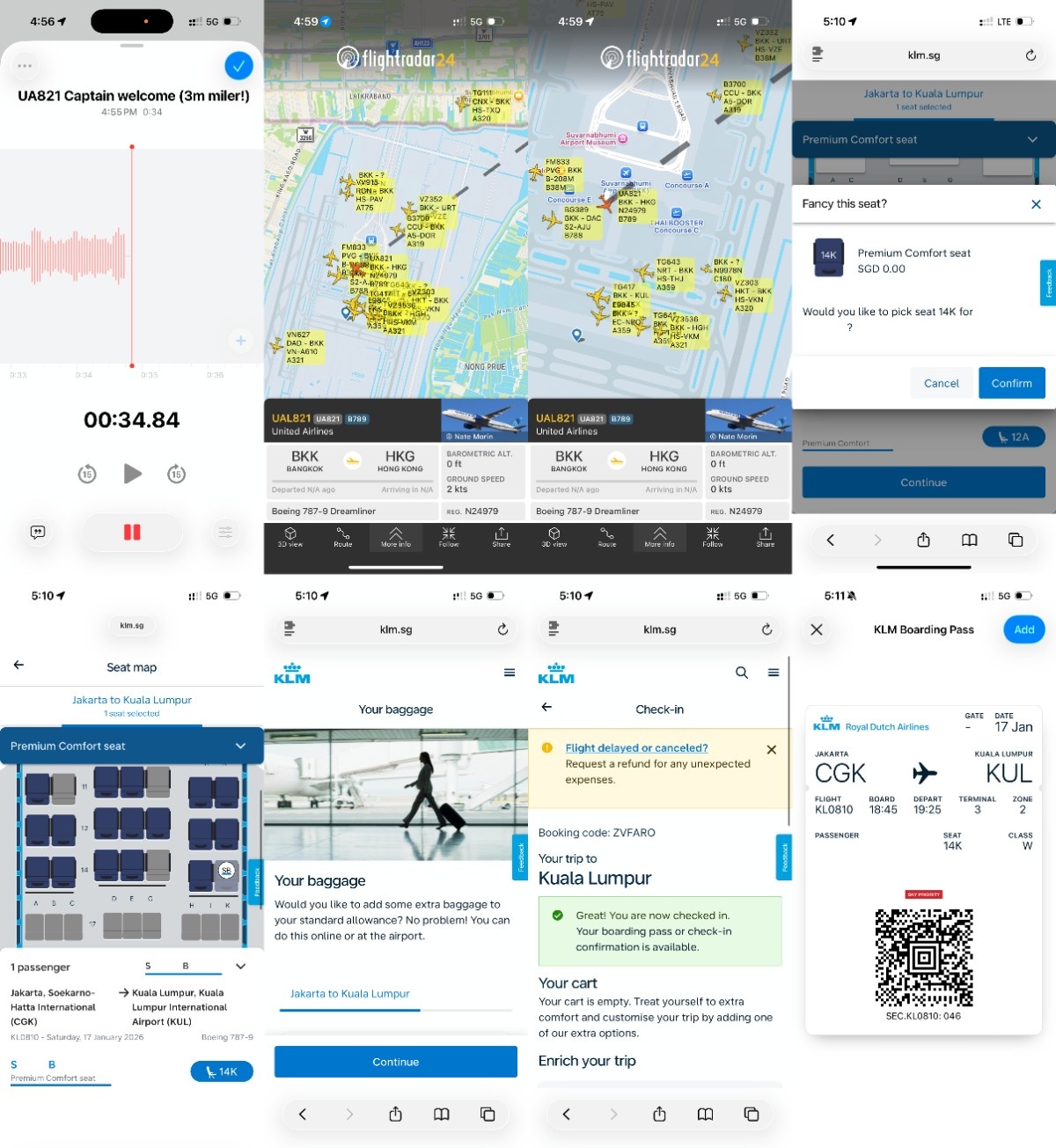
Simultaneously, just as the captain was making his special welcome for the 3-million miler, I looked up N24979, our chariot for the day, on Flightradar24. A few minutes later, after the safety video (see below) was done, I remembered to check in for my KLM Royal Dutch Airlines flight — in Premium Economy (not too bad after Business Class on TG!) — the following evening from Jakarta to Kuala Lumpur. It’s always nice whenever you can get the boarding pass on your iPhone, instead of having to collect it at the airport due to immigration/visa checks being required at the check-in counters!
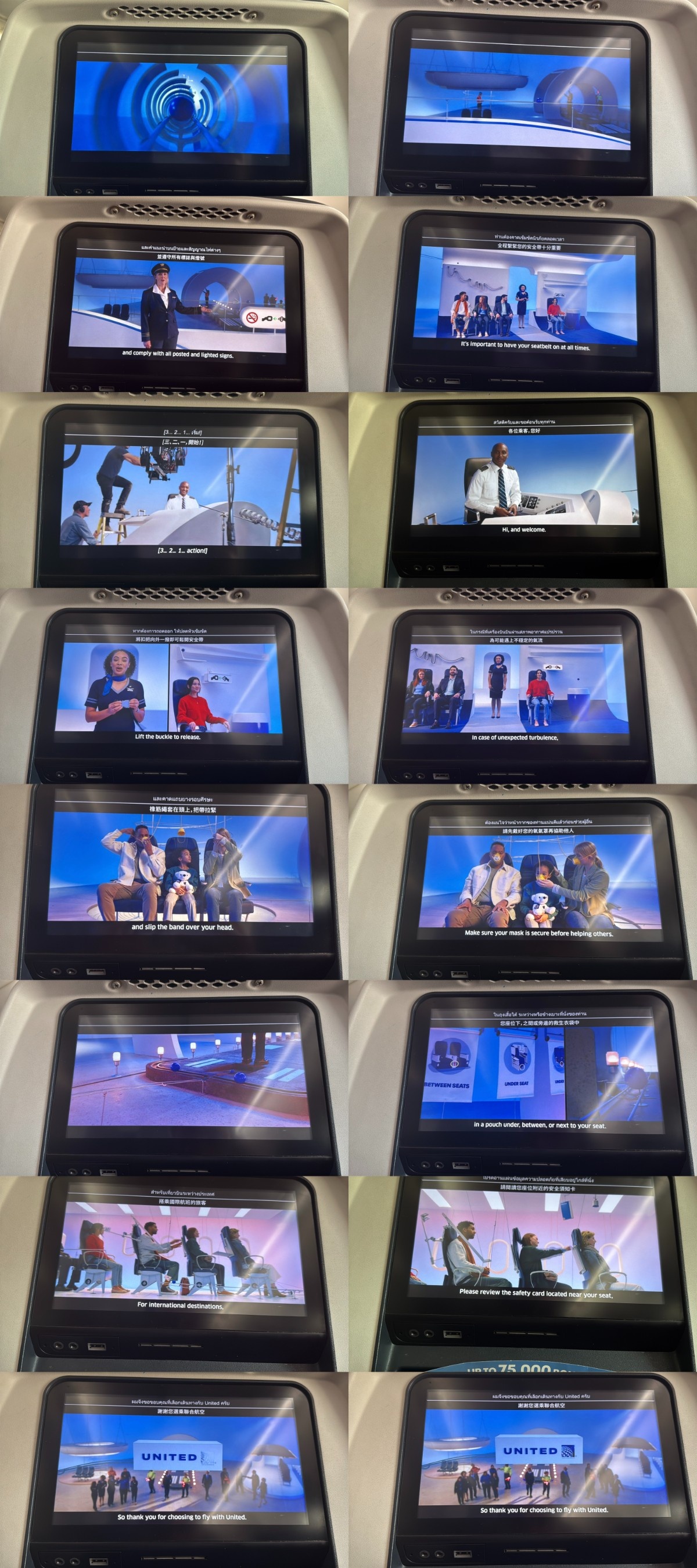
Now United’s creative, quirky new safety video (entitled Safety in Motion) was screened, following the journey of a ball through all the moving parts — literally! — of the safety demonstration process. I had a fun time following the little ball, all while admiring the sheer blueness of the whole production — not unlike my snappy KLM flight the following evening, from Jakarta to Kuala Lumpur, with its Delft-tile-themed video that I’d seen beforehand. (Also in use here was United’s famous Rhapsody in Blue theme music, though I’m none the wiser as to what that sounds like.)
Here I must say that UA went out of its way to come up with something so innovative and fresh that didn’t involve a famous landmark (Etihad Airways’ Louvre Abu Dhabi), a cartoon character (ANA’s Pokémon) or the standard tourist-trap videos (Cathay Pacific, Malaysia Airlines) — and yet didn’t look completely generic (Emirates, Japan Airlines), no matter how well-done. Kudos!
Generously, there were subtitles in three languages for accessibility: English at the bottom, Thai and Traditional Chinese at the top, the latter two separated by a dividing line.
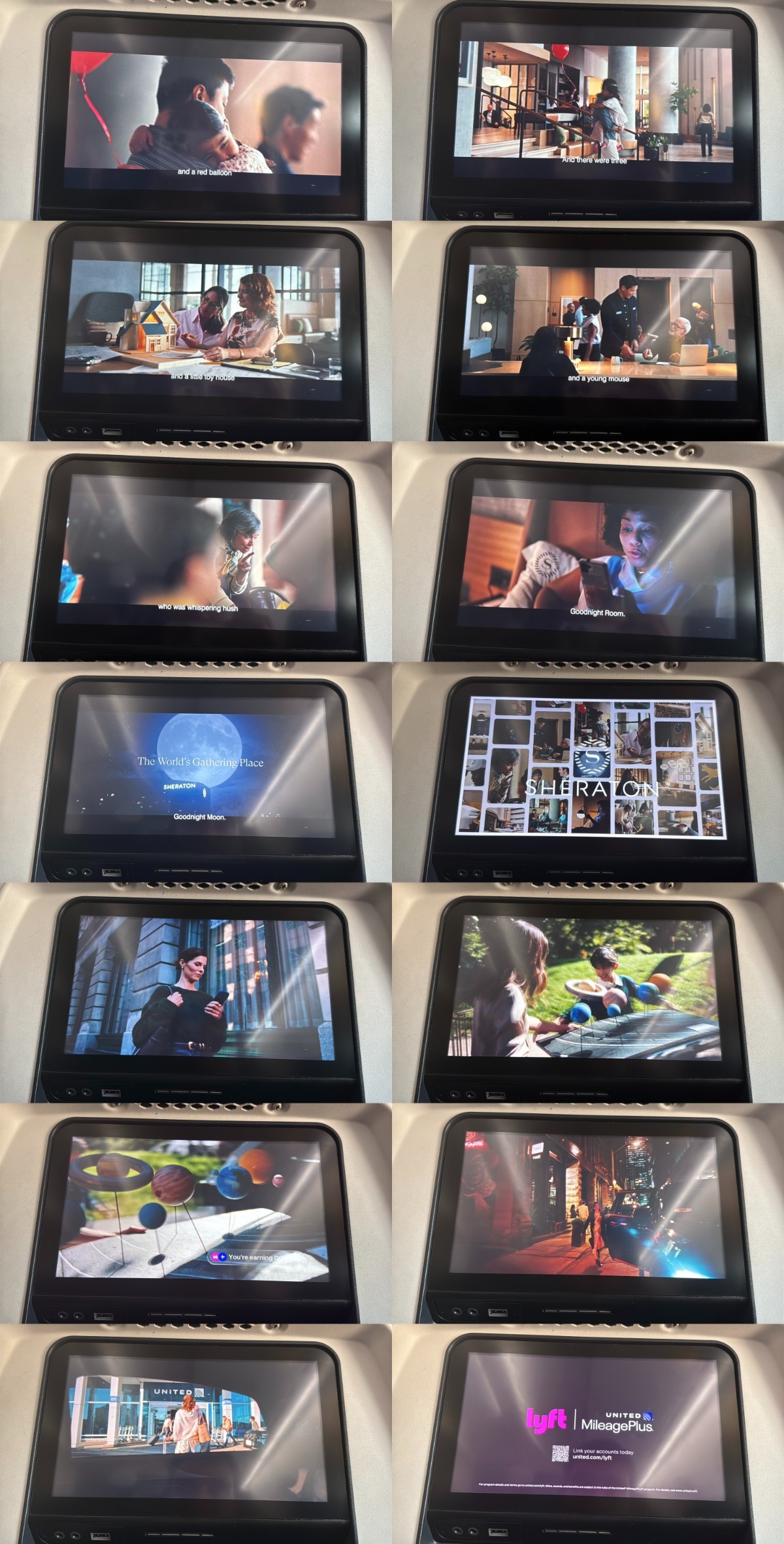
This was followed by a couple of ads: Sheraton Hotels & Resorts’ heart-touching ‘Goodnight Room’ campaign — a tribute to the beloved Goodnight Moon bedtime story — and a partnership between United MileagePlus® and the recently rebranded Lyft. (If you’re interested, you can check out OMAAT‘s exceptional one-night stay at the limited-period Goodnight Moon Suite at the Sheraton Boston in December 2025. Spoiler alert: little Miles was absolutely DELIGHTED by the special concept, as were both his fathers!)
Being accustomed to Asian airline ads — as well as the Swiss luxury watch brands (or what I jokingly call ‘Helvetic horologists’) that are dime-a-dozen on Singapore Airlines — it was a refreshing change to see something American for once. Also, these ads were devoid of the lines and lines of tiny disclaimer text at the bottom that typify a lot of US ads.
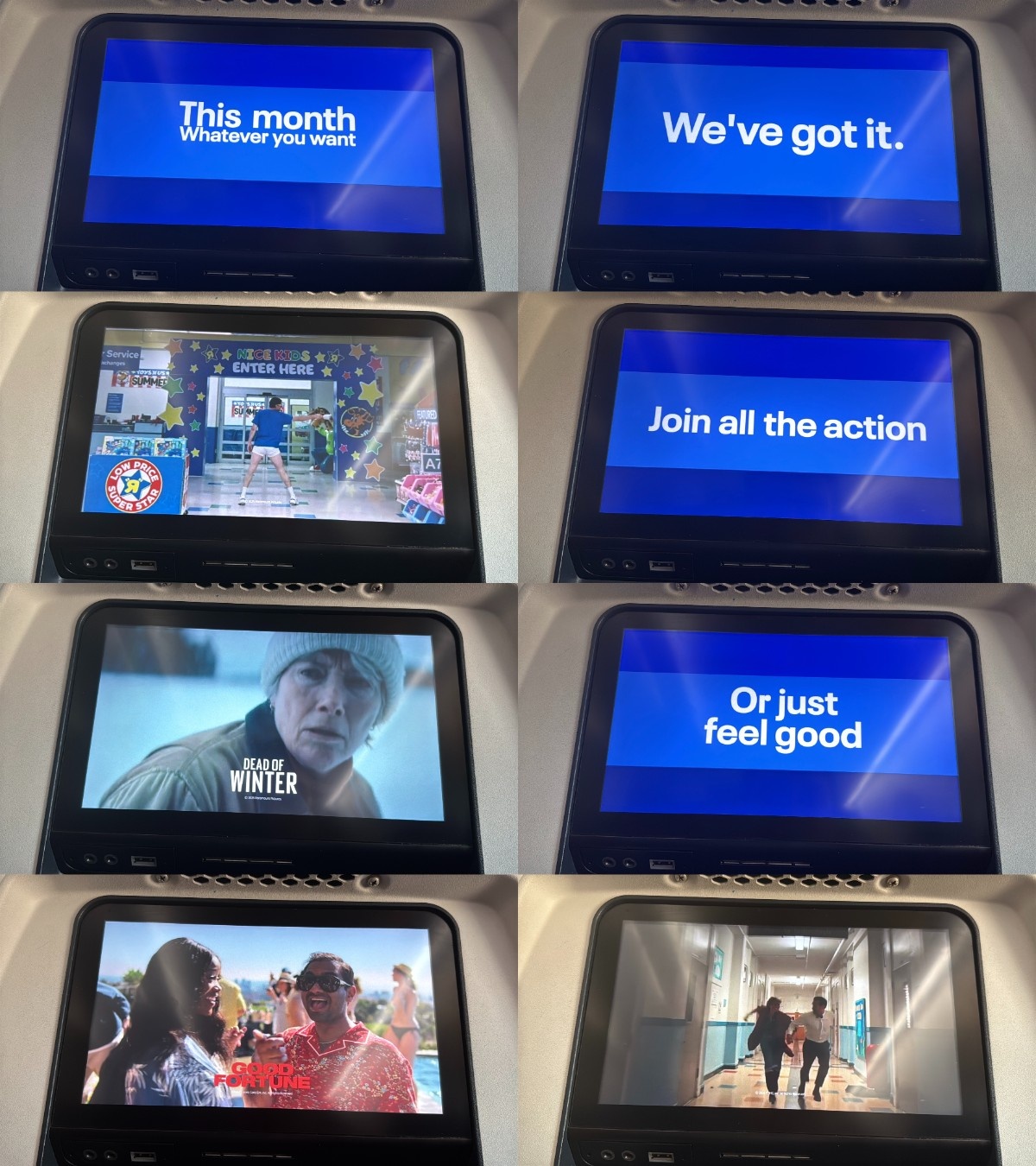
Next came a promo for United’s entertainment offering, with blockbusters lined up one after the other. It sure did remind me of Saudia’s similar promo, which I’d seen two months before (November 2025) on the 787-10 from Singapore to Denpasar — and that one surely gave the impression of an underrated airline trying hard. While United is by no means underrated, it certainly has to put in some effort on this BKK–HKG route that has some more illustrious airlines: not only Thai Airways and Cathay Pacific, but also Emirates’ A380!
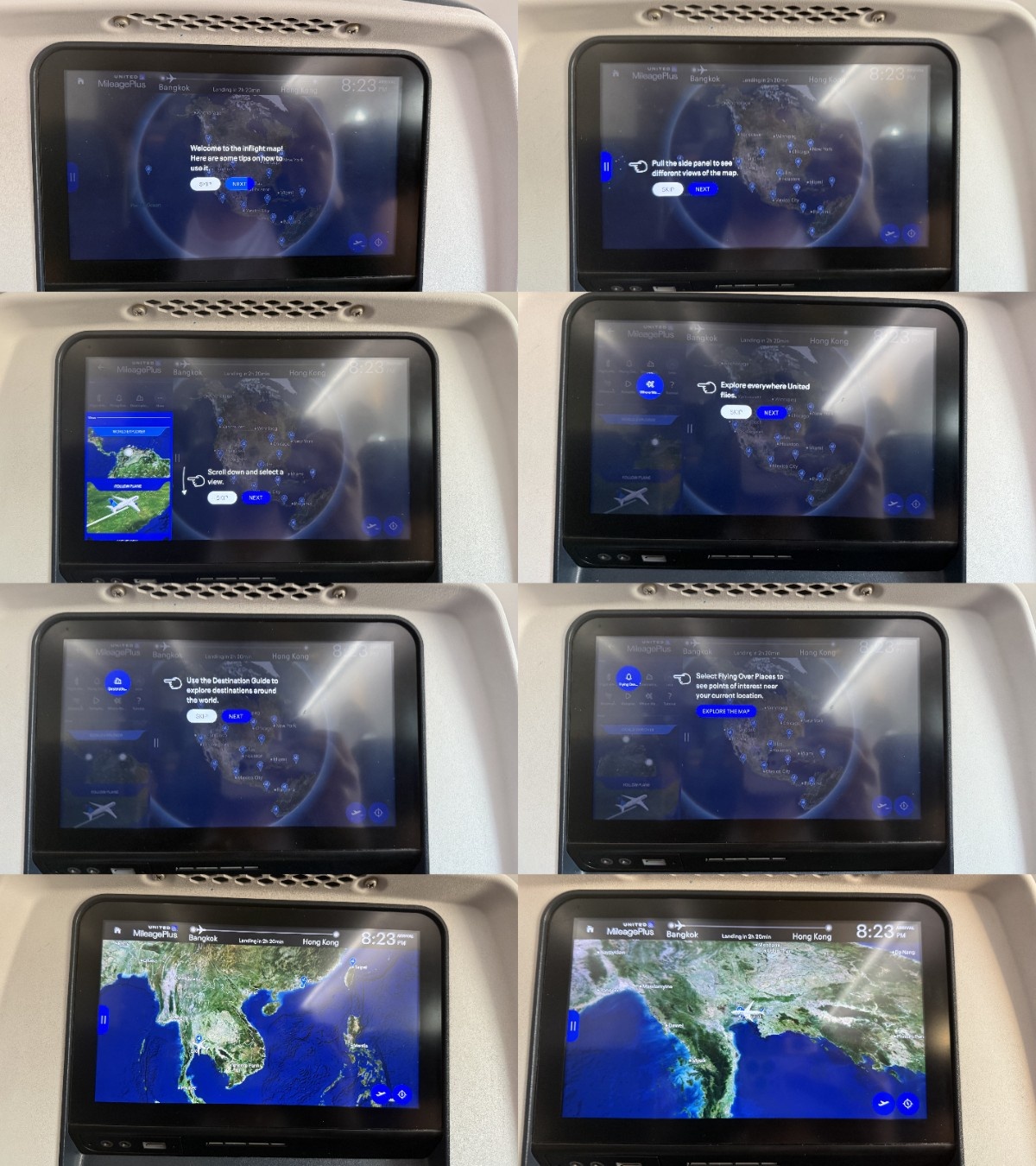
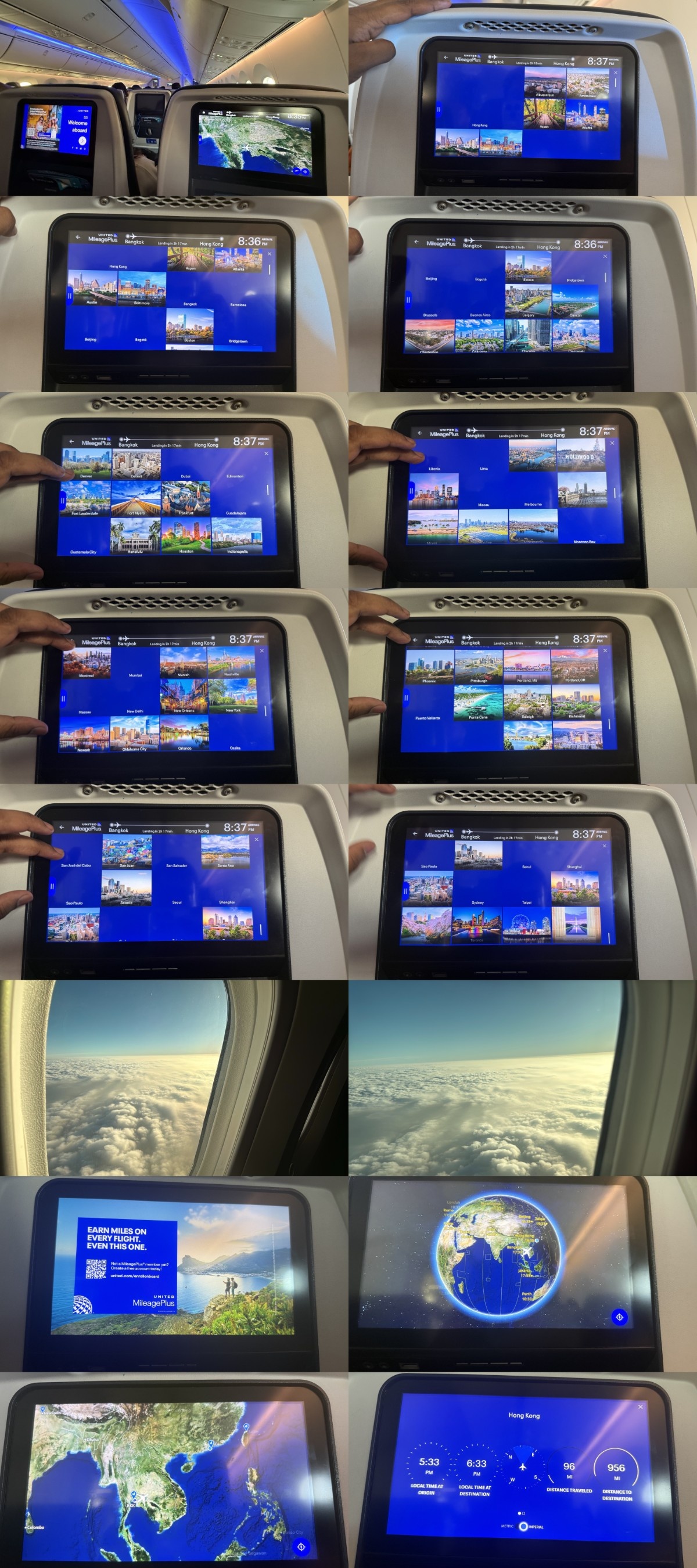
With all this done, I moved to the moving map, which to my delight was powered by FlightPath3D — a system that’s quickly become one of my favourites out there, as I saw two months prior (again, November 2025) on the Malaysia Airlines A330neo. (I still do think the Panasonic Arc system is one of the best out there — as seen on Air India’s A350 and ex-Vistara A321neo, SQ’s 737 MAX and Etihad’s A350-1000 — but FlightPath3D, which I also saw on the luxurious Taiwanese carrier Starlux Airlines’ A330neo in May 2025, is giving Arc a run for its money in terms of the sheer detail of its destination overviews.) After the introductory tutorial, I could only briefly see the position of the plane as it taxied on Suvarnabhumi’s runway.
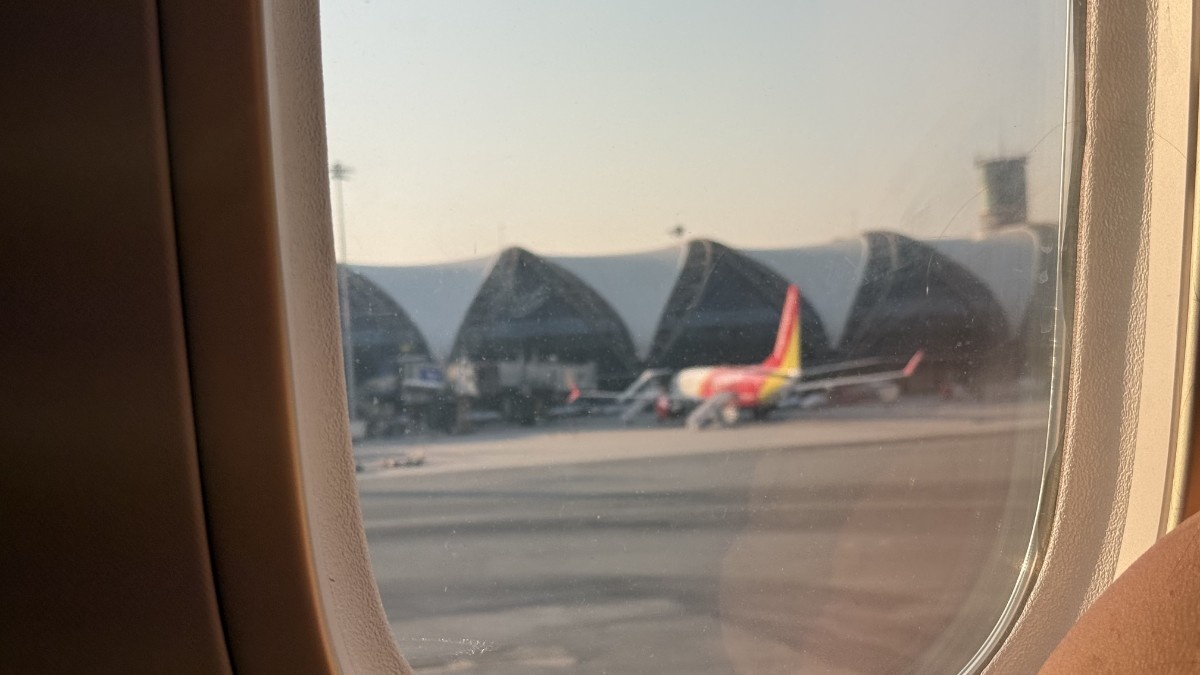
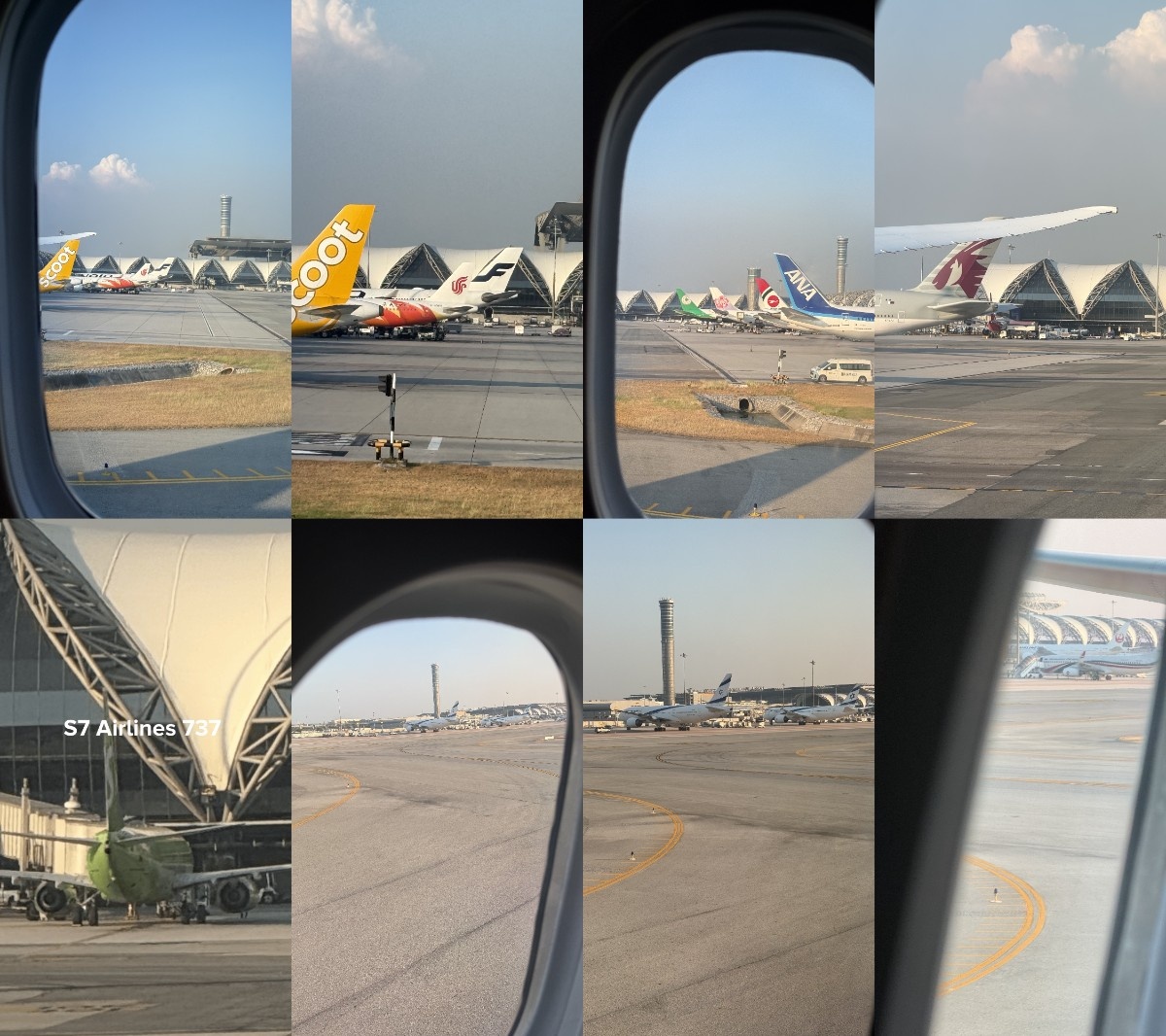
Only briefly, I say, because the traffic out of the window was far more interesting. With Thai VietJetAir having recently started to operate the 737 MAX, breaking with its all-Airbus fleet, I was amused to see one parked at a nearby gate. And, BKK being BKK, there is never a shortage of colourful aircraft parked all over — which is why I firmly think BKK is a much better airport OUTSIDE the main terminal building than inside it:
• an Air China A321 (B-6365) in Beautiful Sichuan colours, replete with a panda,
• standing next door to a Finnair A350 and a shiny Scoot 787,
• with EVA Air and China Airlines jets alongside a Biman Bangladesh 737 (plus ANA and JAL),
• the obligatory Qatar Airways A380 (there are often two of them at a time at BKK),
• along with a lime-green S7 Airlines 737 — a common Russian visitor here,
• and a pair of ancient El Al Israel Airlines 777-200ERs.
Indeed, I was surprised to see not one but two El Al 777s parked at Suvarnabhumi! (Nowadays El Al also flies to Phuket, but for some other Middle Eastern airlines like Kuwait Airways and Royal Jordanian, BKK is their only destination in Southeast Asia.)
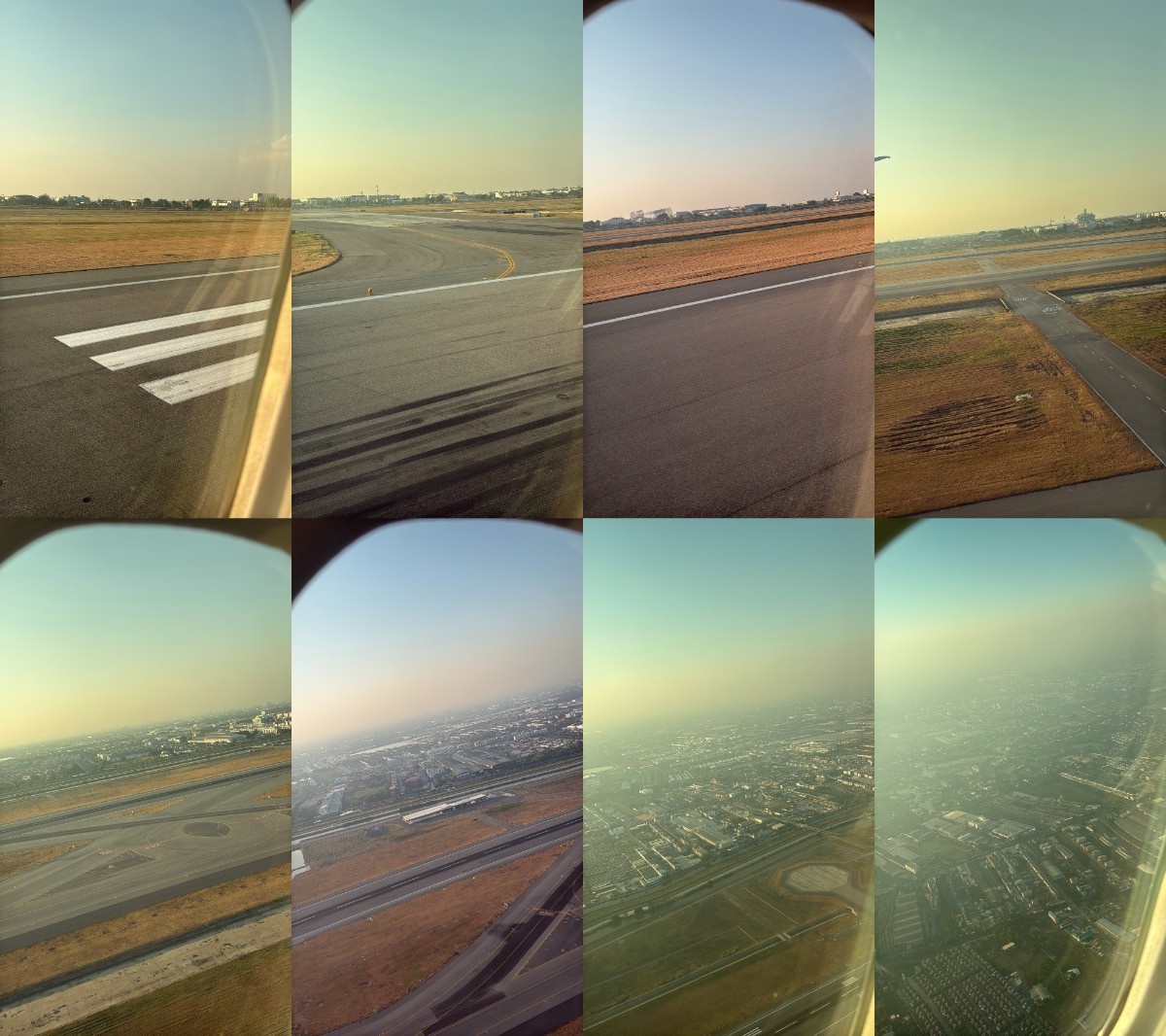
Eventually we hit the runway against the backdrop of the setting sun — much like my Gulf Air 787-9 fifth-freedom flight to Singapore in November 2023 — and, with the windows themselves offering a rather golden effect, it provided a rather poetic setting as we set sail for Asia’s World City. (It may have lost a lot of its lustre — a tongue-twister! — but Hong Kong will always remain one of the world’s most cosmopolitan and global cities, a perfect fit for the bridge-spanning airline that is United: an airline that flies from Kaohsiung to Nuuk to Marrakech to Adelaide and everywhere in between.)
With my camera view out of the window rather constrained, thanks to the young woman in the window seat beside me, I had to take mostly vertical (portrait-mode) videos and photos of the takeoff. More often than not, I’m able to snag the coveted right-hand window seat, but this wasn’t one of those times!
Presenting the Newest, Most Improved™ Entertainment System of a US Airline®
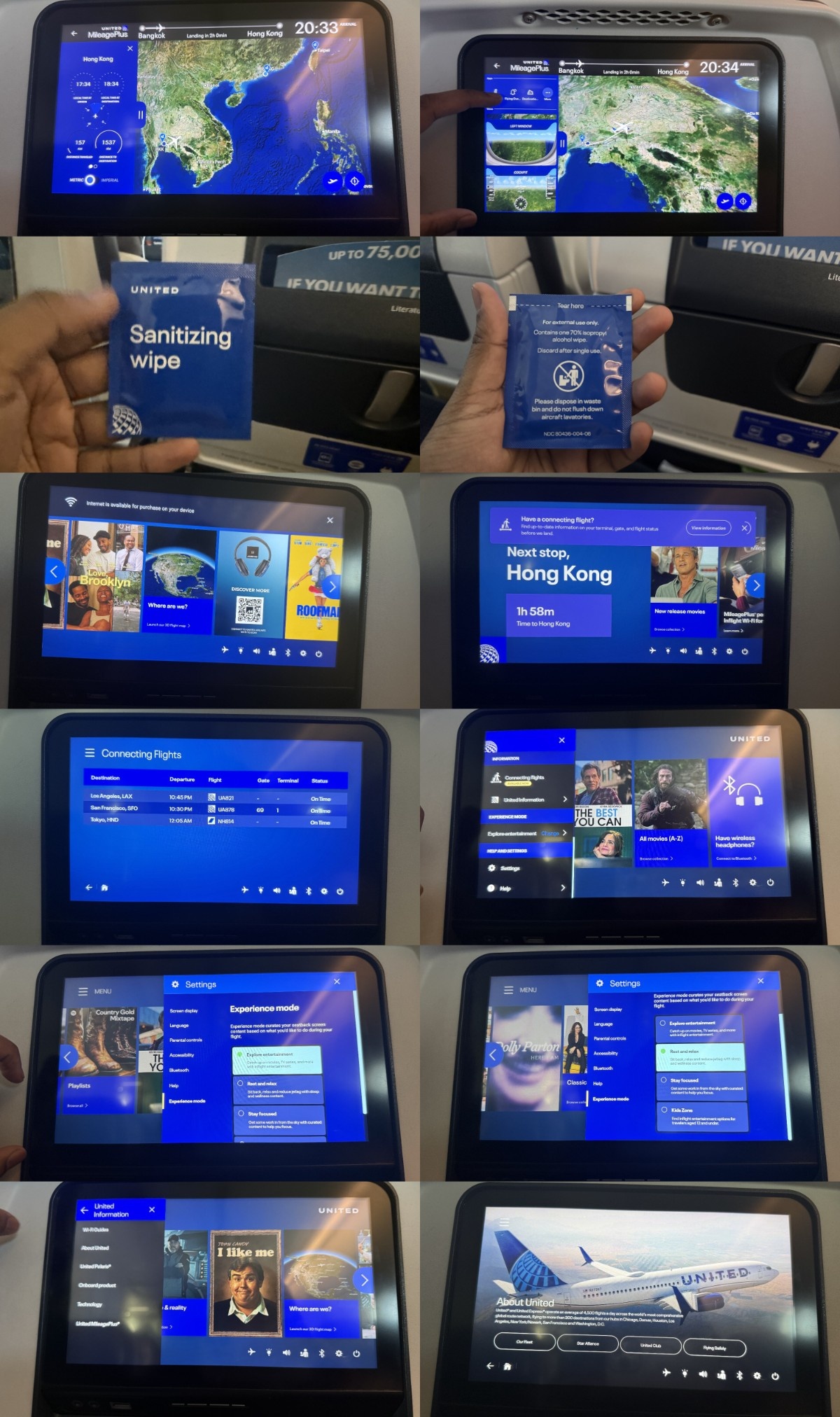
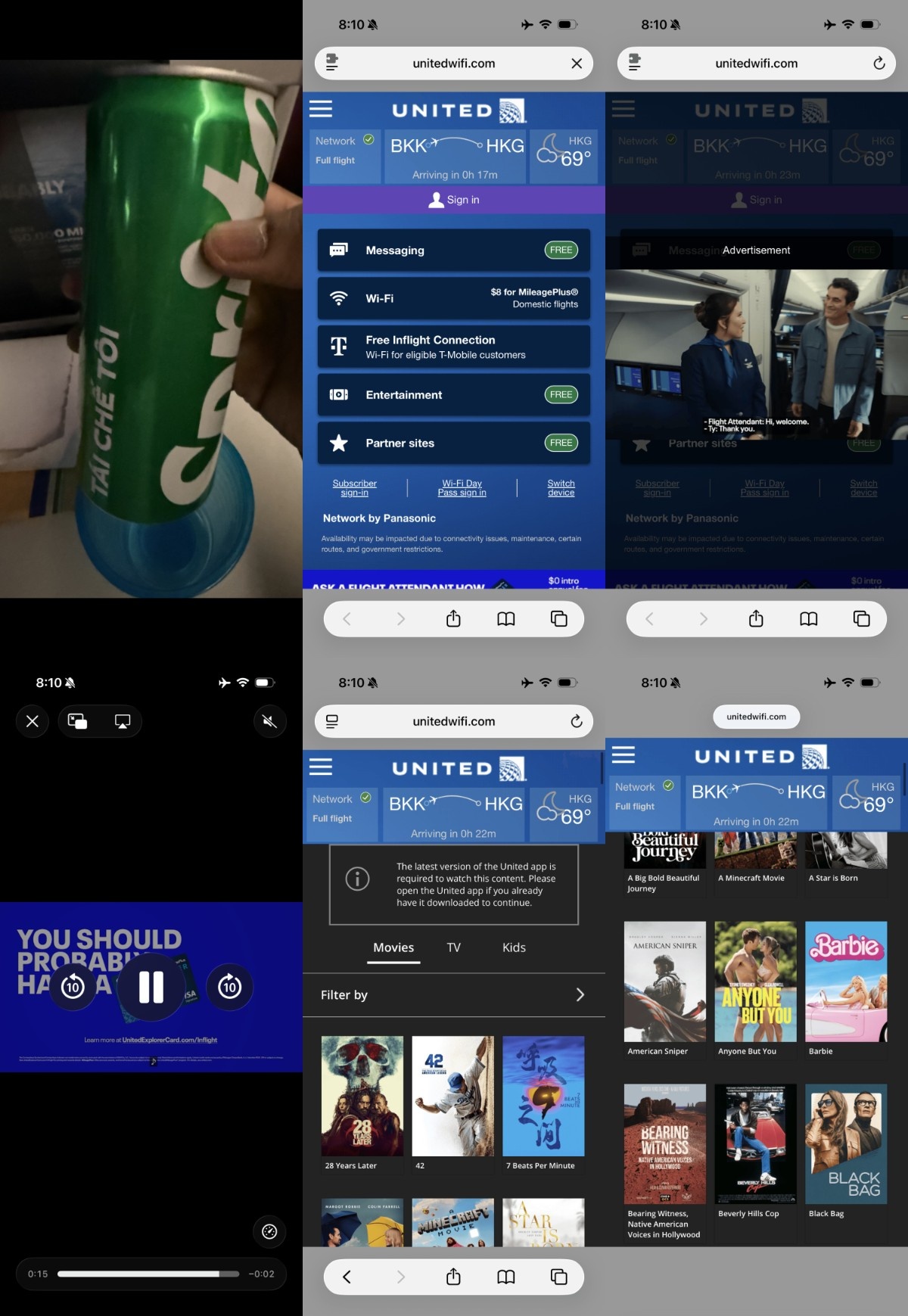
No sooner had the plane taken off than I had a look at the various tiles for destinations across the United network — many of which, inexplicably, lacked a cover image. I didn’t expand on any of them, though. As the cabin crew came around to hand out refreshing wipes, I checked out the part of the IFE that I always love the most: how well does an airline tell its own story?
As one might expect from a US company, the About United page was liberally peppered with ® and ™ symbols! Aside from which I will confidently say that few Western airlines today have enhanced their IFE as much as United in recent times. Starting with setting the Experience mode — through which you choose whether you want to rest/relax, get productive or be entertained during the flight — through to all the user-friendly gestures, there was little doubt in my mind that UA sees IFE as not only a static selection of content, but something that actively shapes travellers’ journeys. This extended to the informational pages: the fleet, the Star Alliance membership, the Premium Plus and Polaris products and certain US-specific pages like TSA Pre✓ and Global Entry — all of them very thoughtfully written.
Flying top-tier East Asian carriers like All Nippon Airways, EVA Air or Japan Airlines may give you impeccable service and hospitality, much more than a Western airline like Delta, Qantas or Lufthansa does, but they can never recreate the flawless tone of voice that those Western airlines — and other highly Westernised airlines elsewhere (like Cathay Pacific, Malaysia Airlines and Etihad Airways) — do so brilliantly.
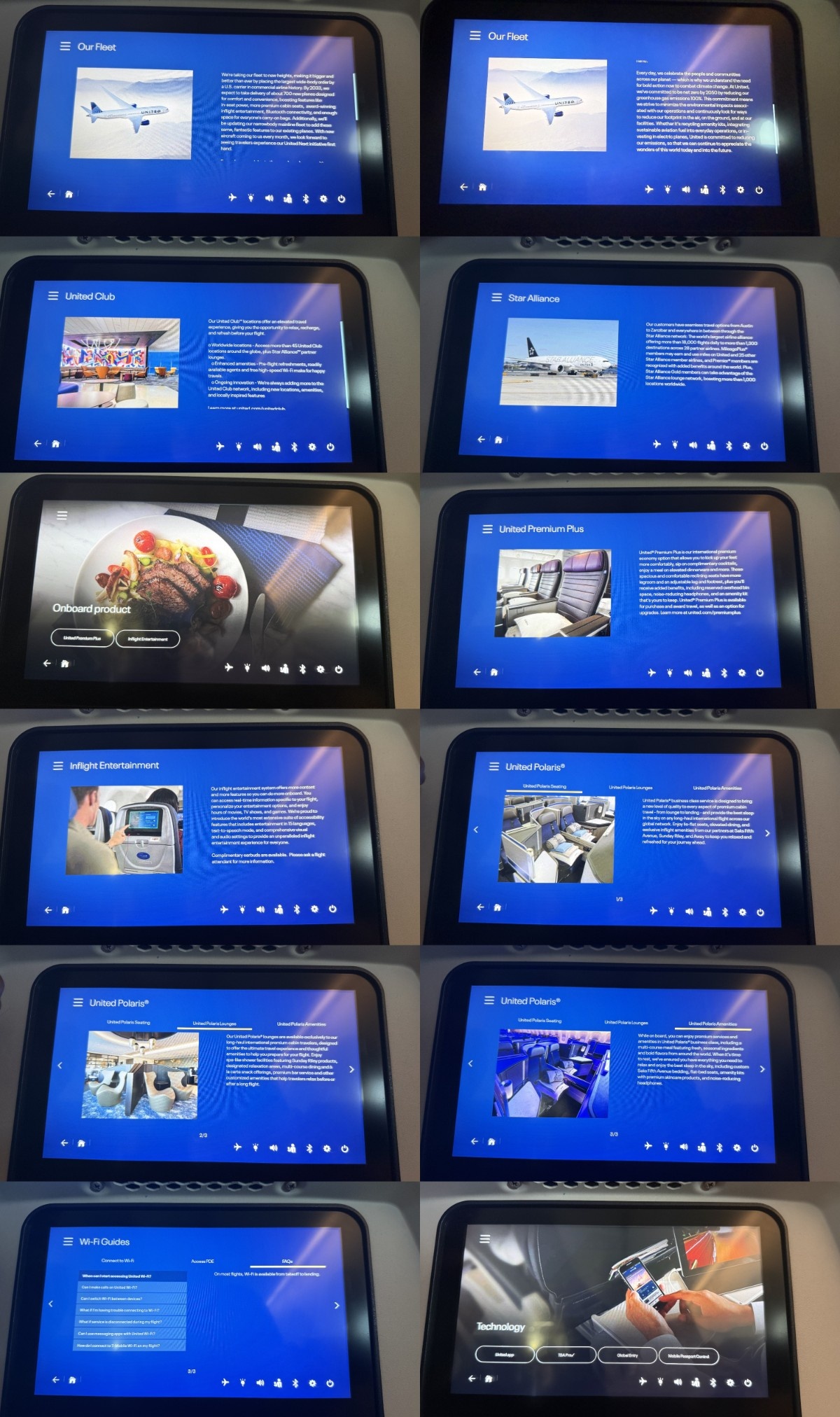
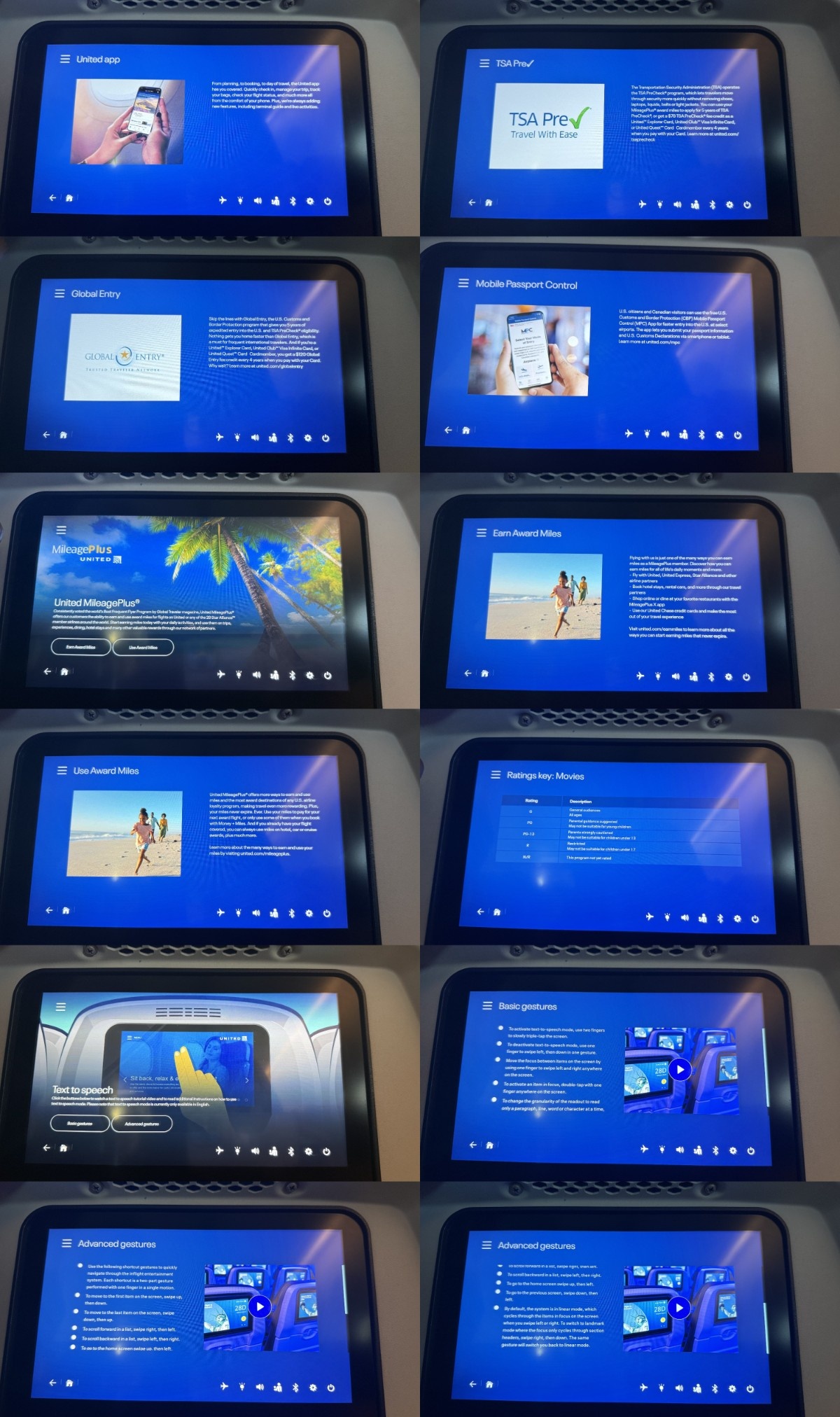
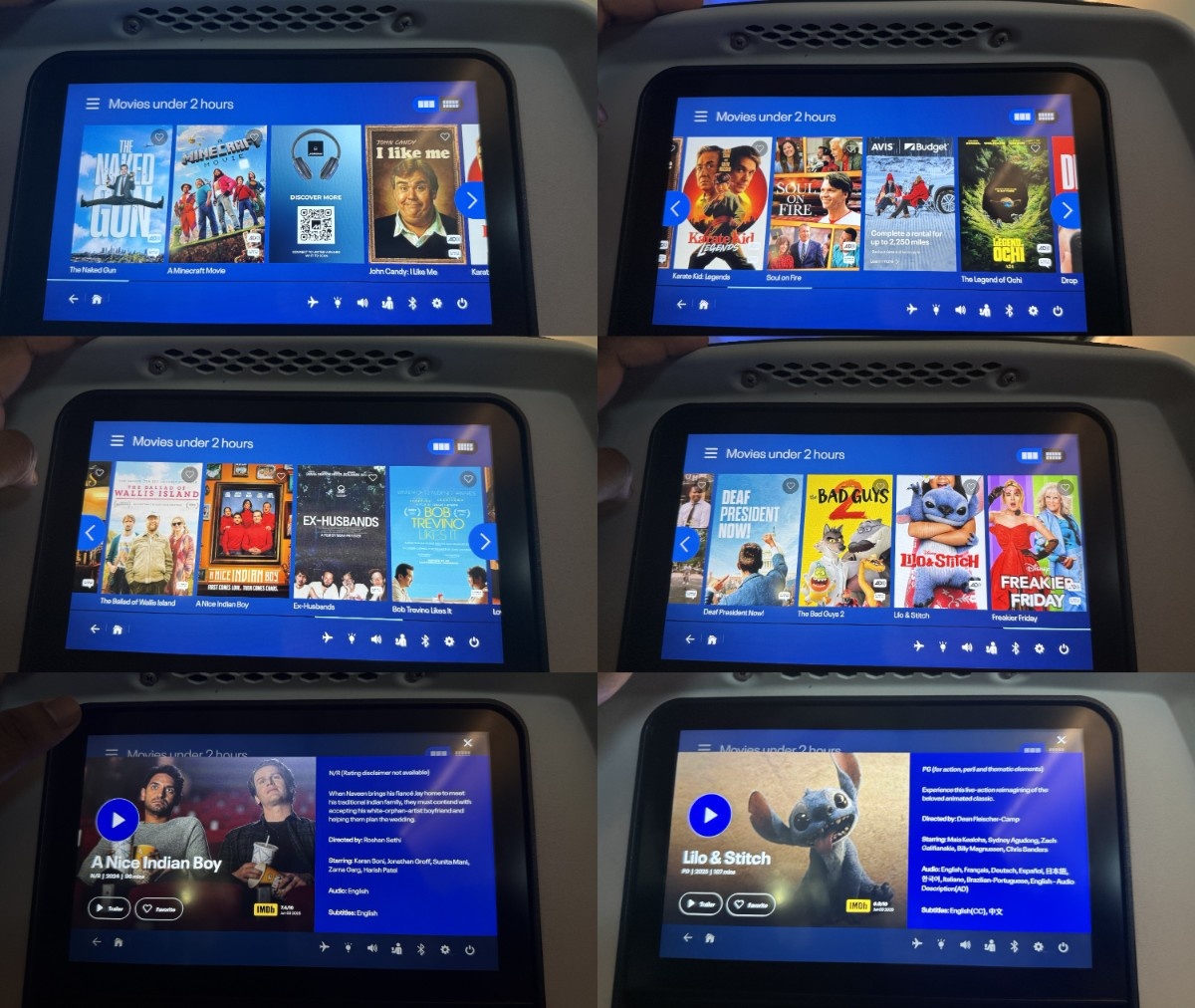
There was even a section called ‘Movies under 2 hours’ — a very useful addition given the short duration of this sector! Admittedly completing even these within 2 hours can prove to be a bit of a challenge, given all the announcements and the meal service, but it can be done.
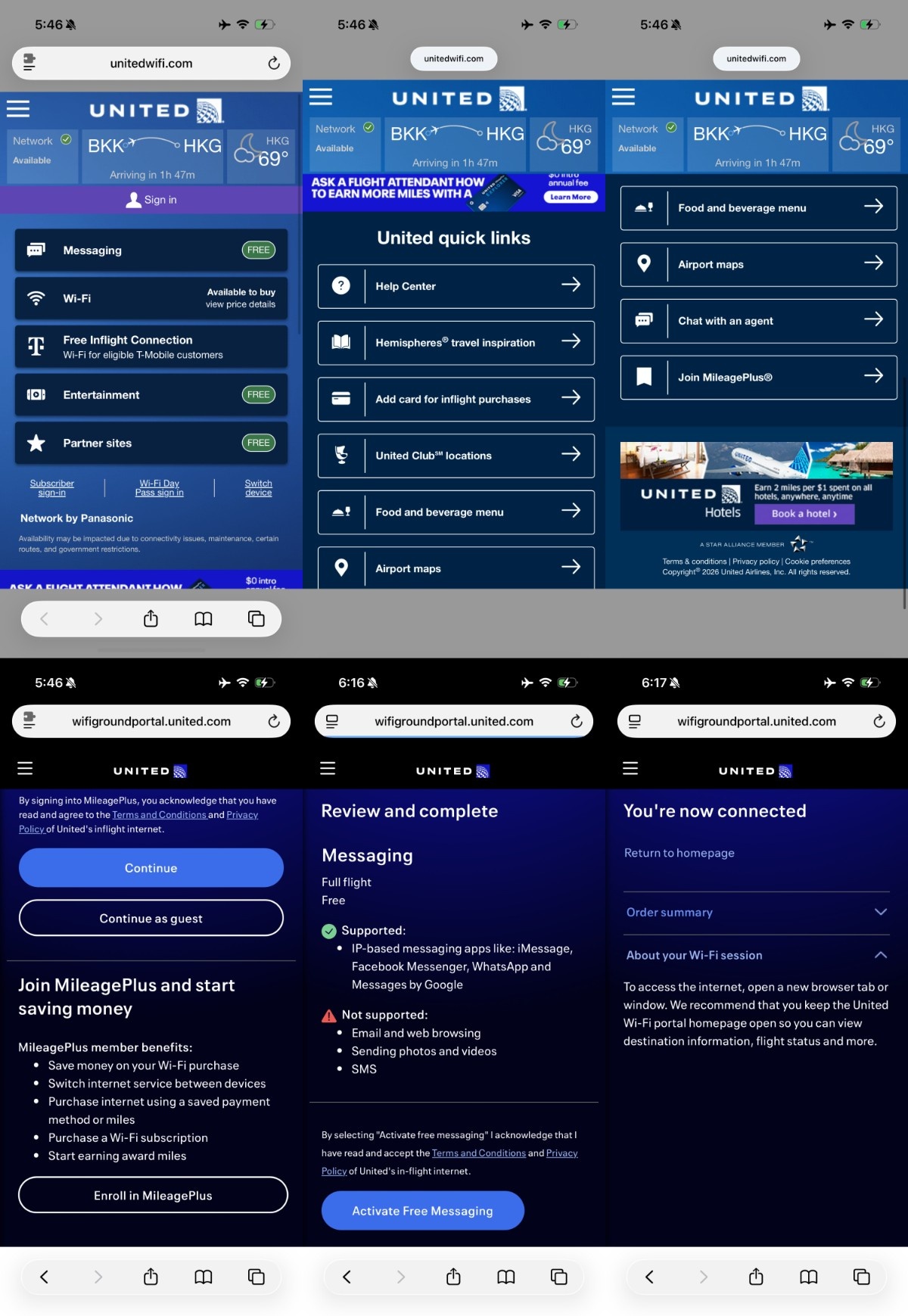
Now I connected to the Wi-Fi, where (as you’d expect) inflight messaging was free. At present Panasonic powers the onboard connectivity for most widebody aircraft, but with United aggressively rolling out the absolutely game-changing Starlink experience across the entire fleet, you can expect that it will overtake Qatar Airways as the airline with the widest Starlink coverage by the end of 2027. Given how drastically transformational technology Starlink is, this will give United a MASSIVE edge in the inflight connectivity game.
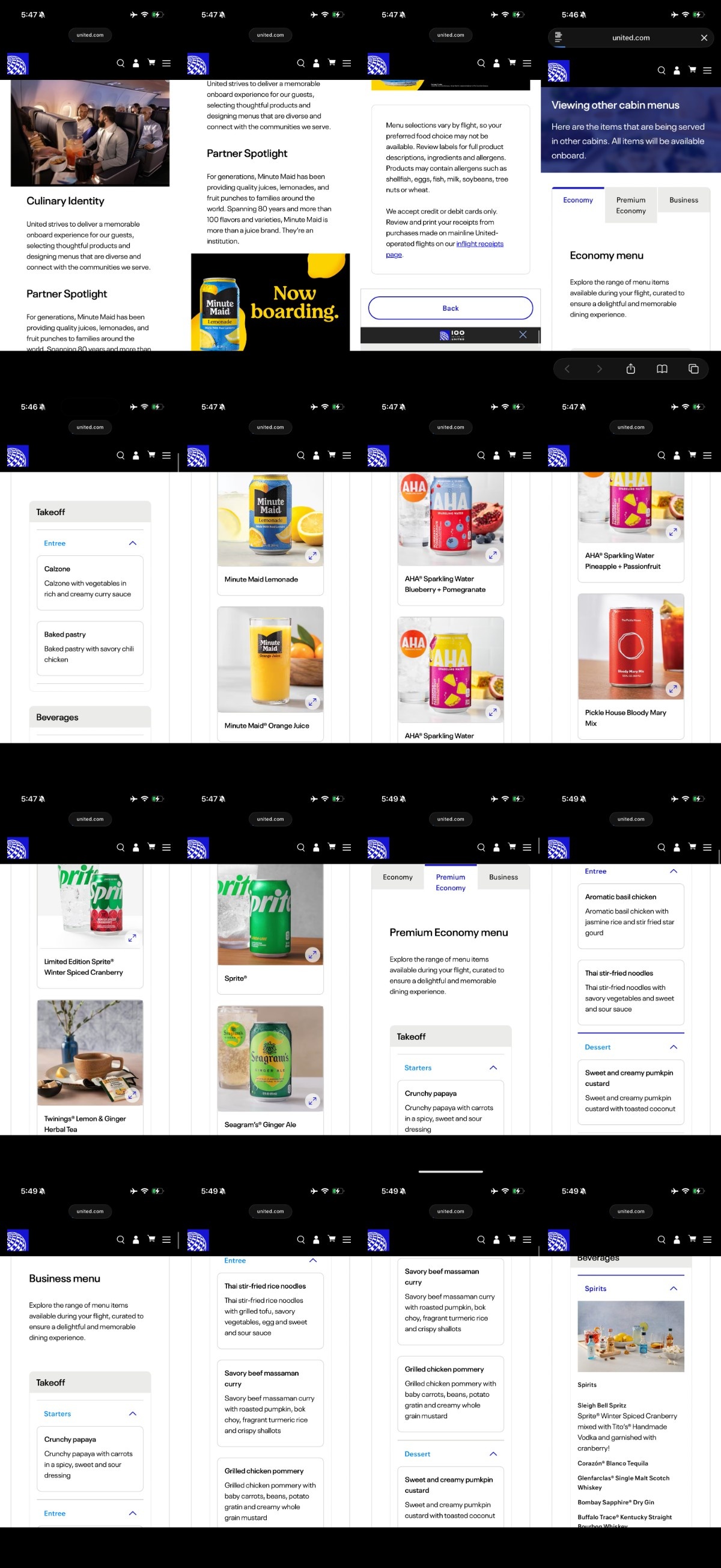
The next thing I checked out in the mobile inflight portal was the menus for the flight — across all three cabins — and here the biggest highlight was United’s beverage partnerships (almost all of them, again, with a ® symbol!). Certainly, the non-alcoholic drink selection made for very strong reading: Minute Maid, AHA sparkling water, Twinings tea, Sprite, Seagram’s ginger ale.
We Economy folk had the option of a vegetarian calzone or a chicken baked pastry, while those in Premium Economy (United Premium Plus®) would be treated to either aromatic basil chicken or Thai stir-fried noodles. The catering was evidently more inspired by Thai than Hong Kong cuisine, which is never a bad thing!
‘Minute Maid is more than just a juice brand. They’re an institution.’ — Partner Spotlight section of United’s inflight portal
A quick one: Catering and crew compliments
Soon enough, a snack box was handed out along with — wait for it! — a crispy waffle for those at the rear of the bus. I believe they were out of the non-vegetarian option, and I’d have chosen the calzone anyway. I’d say it was fine: nothing earth-shattering, but it had the flavour and taste that was needed. Along with this, drinks were also served: I, being a predictable sort, chose Sprite, but another person mught have made the most of United’s illy coffee collaboration and chosen that instead.
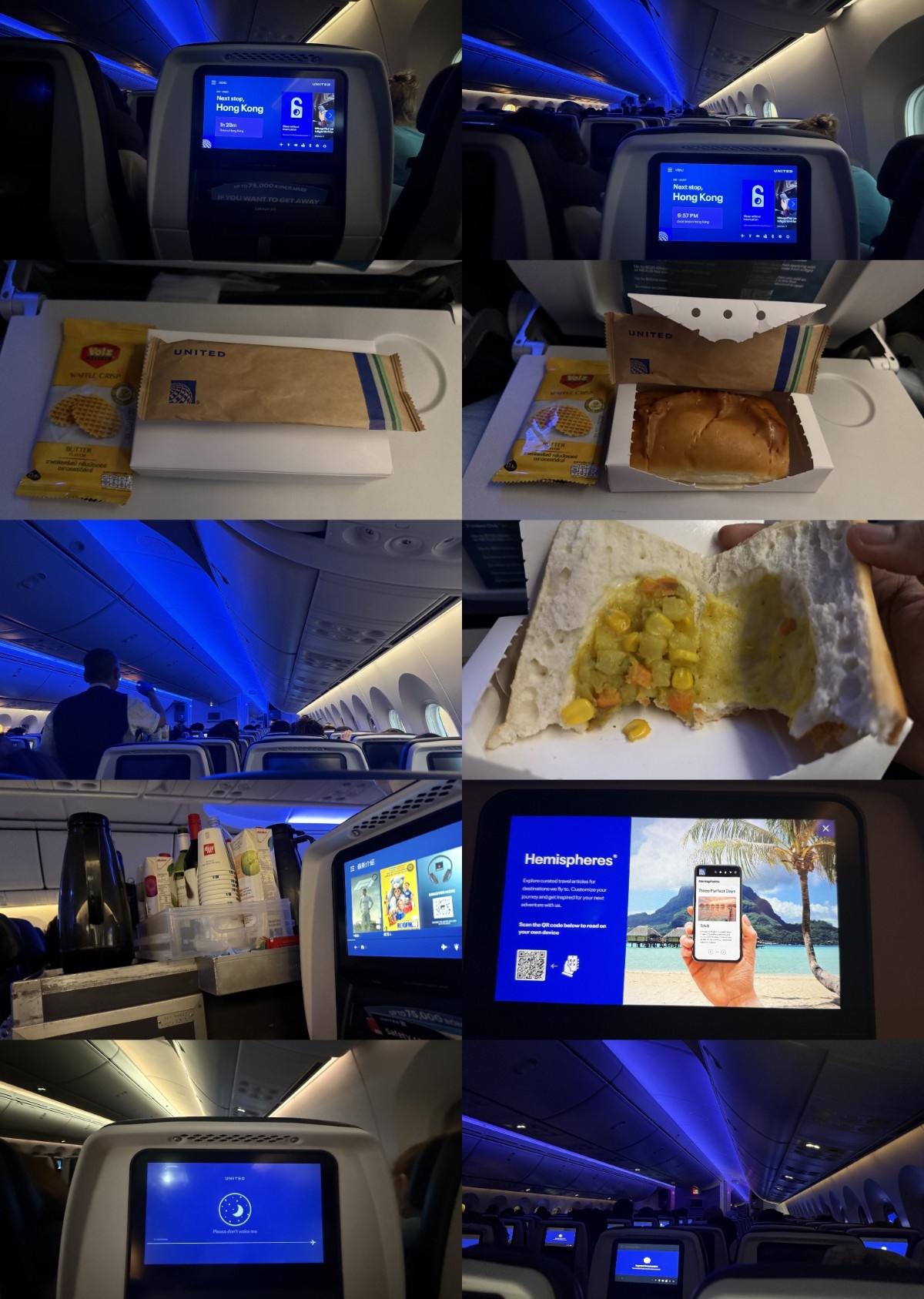
Not much to write about for this picture collage, other than a couple of ads for MileagePlus and co-branded cards — and also the fact that the seatback IFE selection was also available on your phone (but only if you’d installed the United app beforehand)!
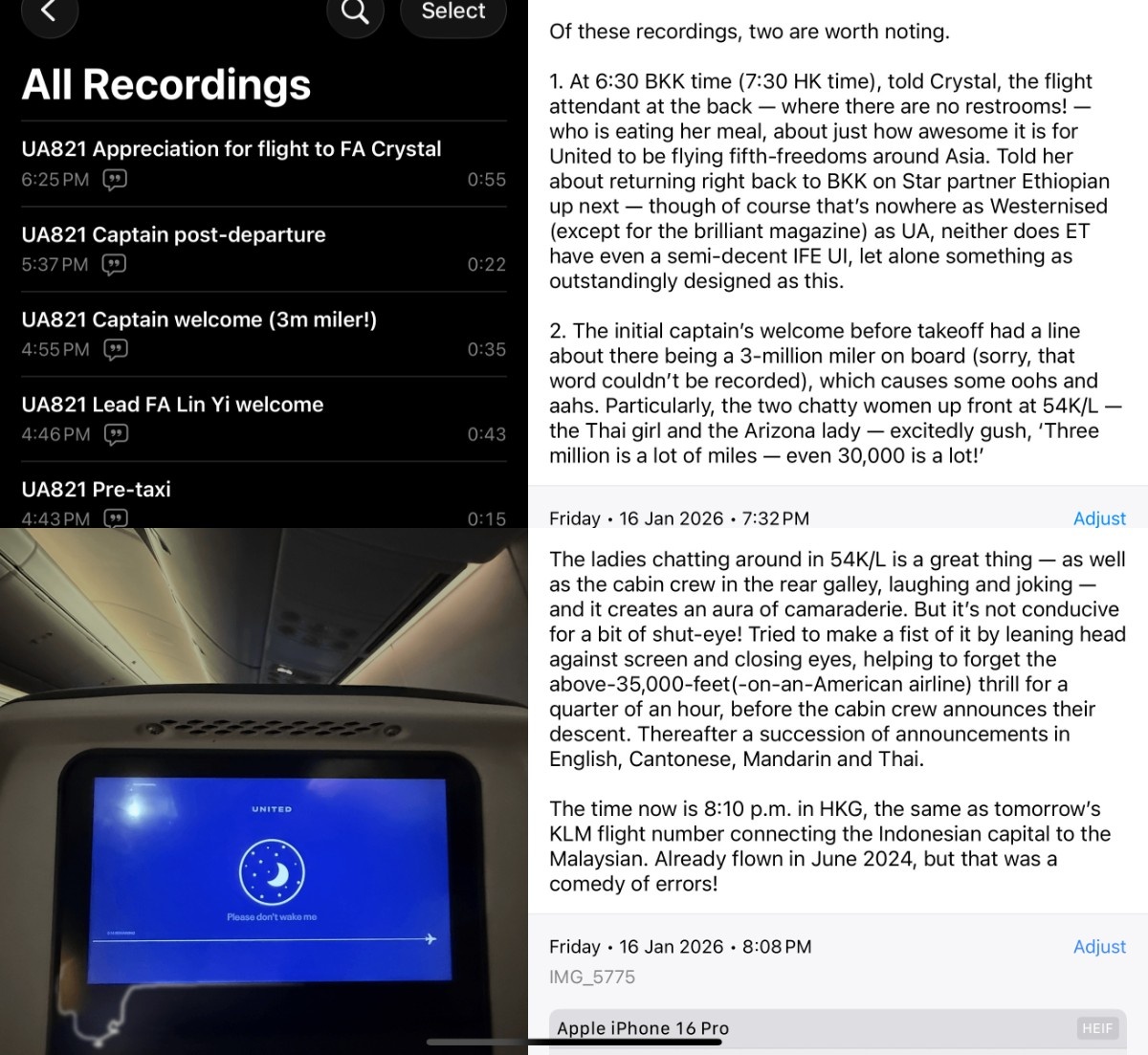
This one is more significant: around halfway into the flight, I went to the rear galley and shared a few compliments to Crystal, the flight attendant seated there. You can read about it below. All I’ll say is this: no one, perhaps, comes close to United for connecting so many different parts of the world with short flights. An Emirates or a Qatar does it all from a single hub, but United has built multiple hubs across not only the United States but also the Pacific — including the one at Tokyo Narita.
Again, the women in 54K/L were so much of a good vibe that it was very hard to not eavesdrop on their conversations — though it made catching forty winks for the remaining forty minutes all the more difficult!
Before you know it: A unique flight comes to a soft end
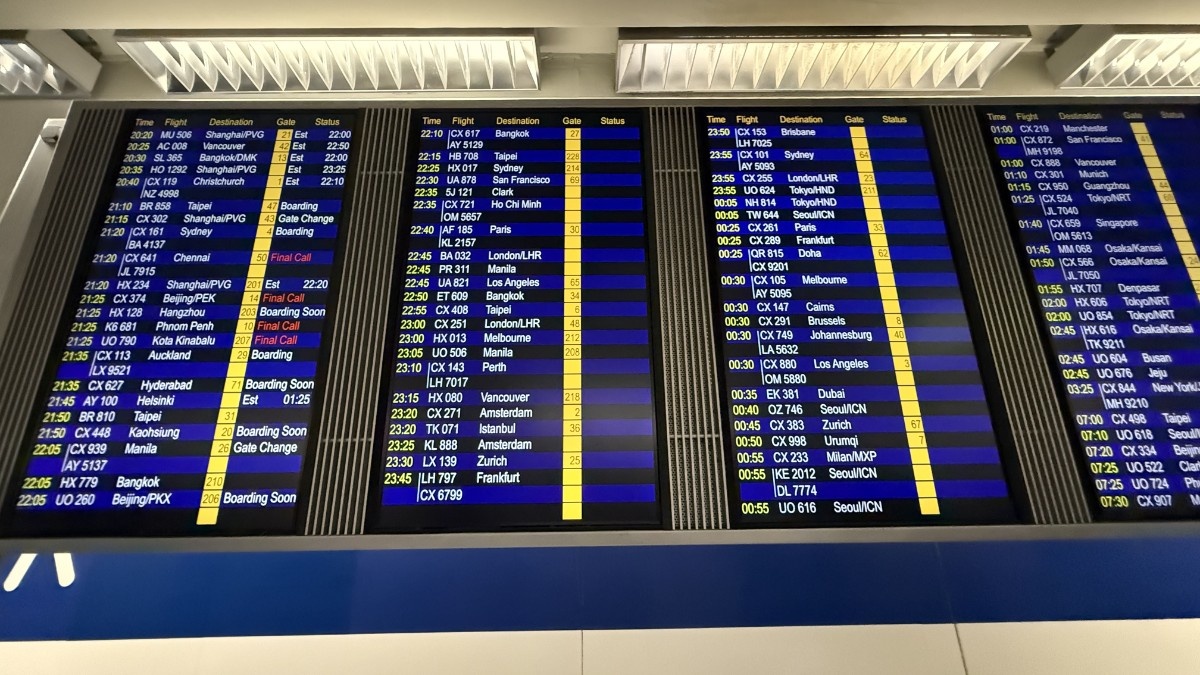
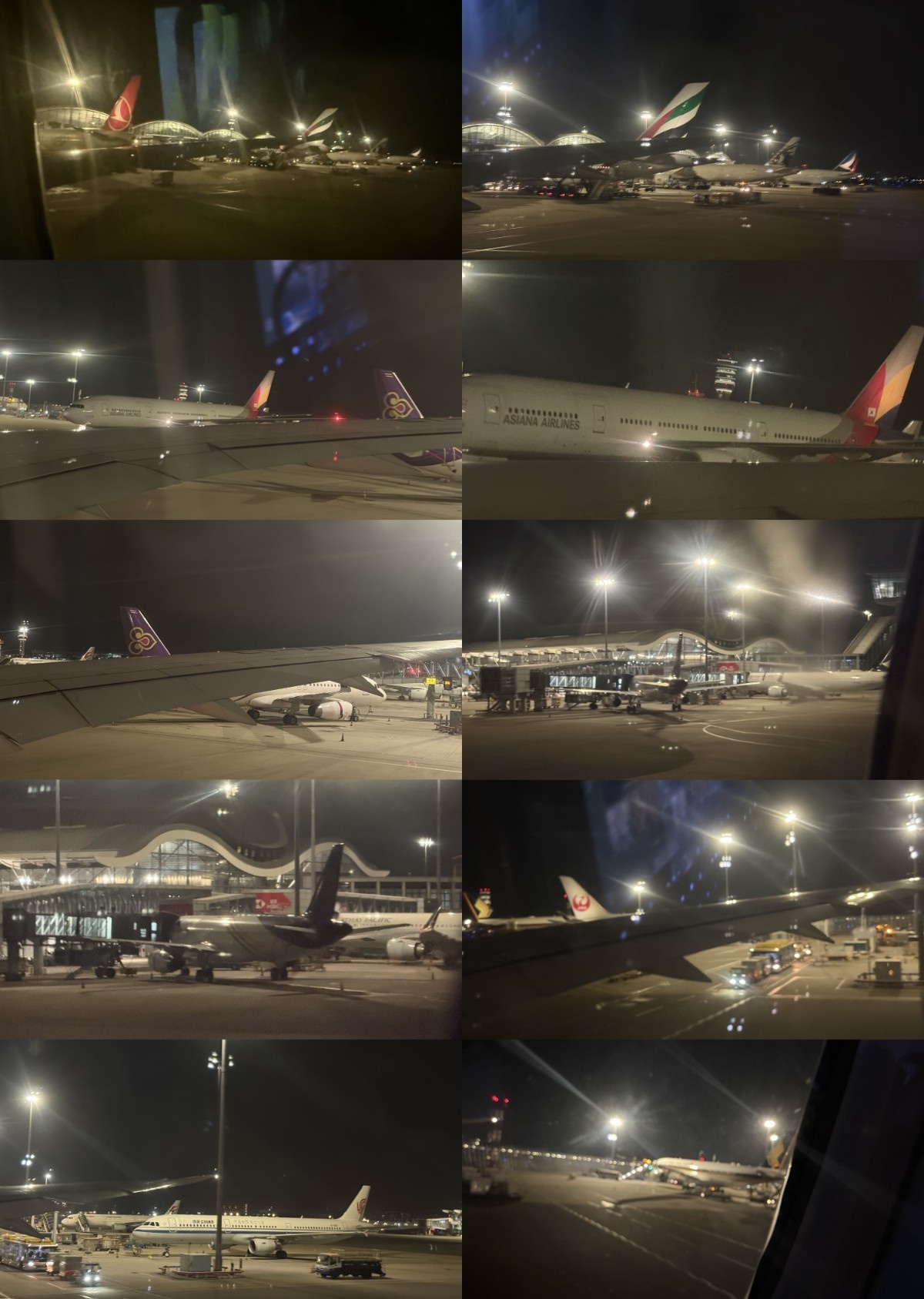
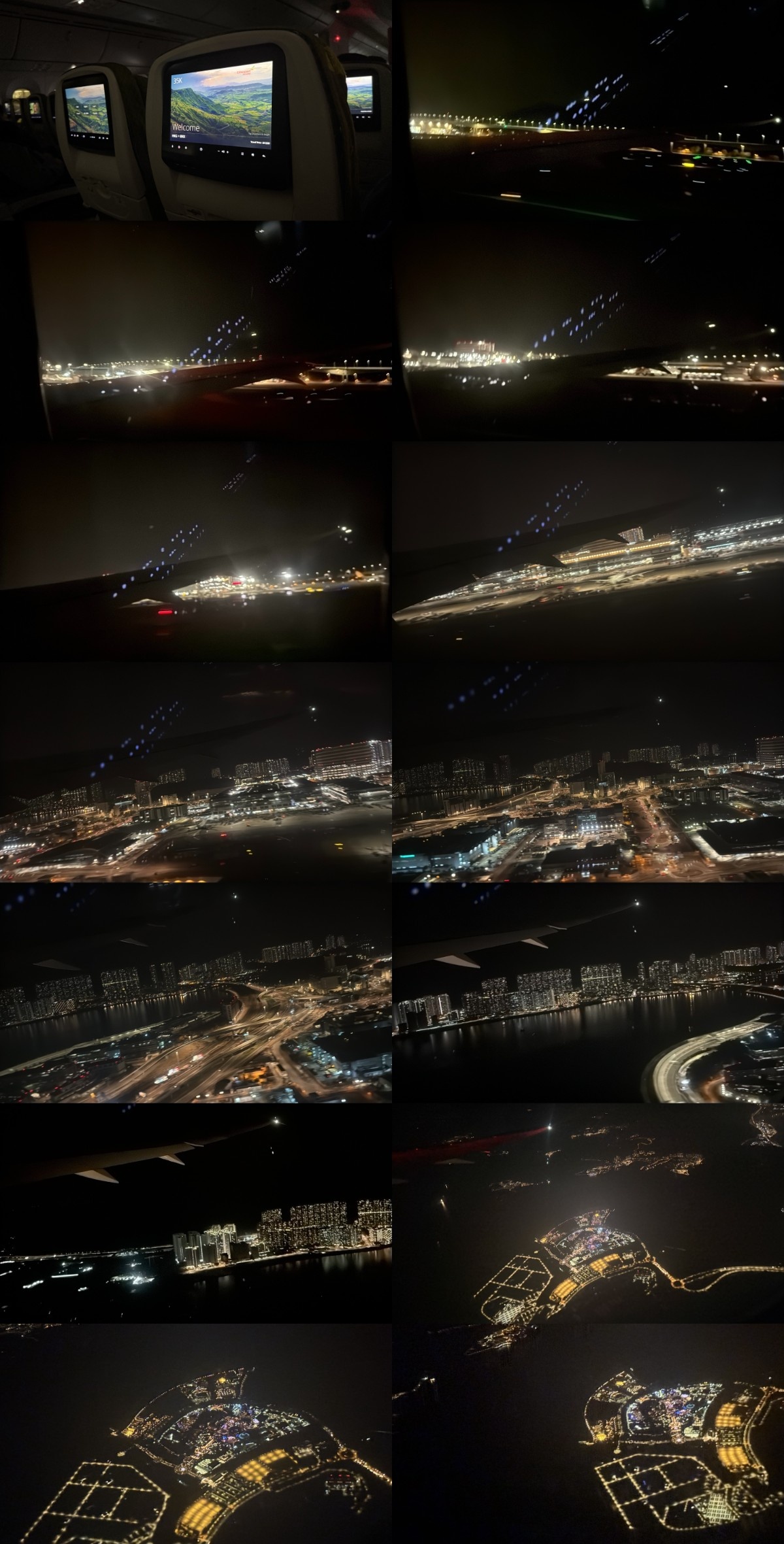
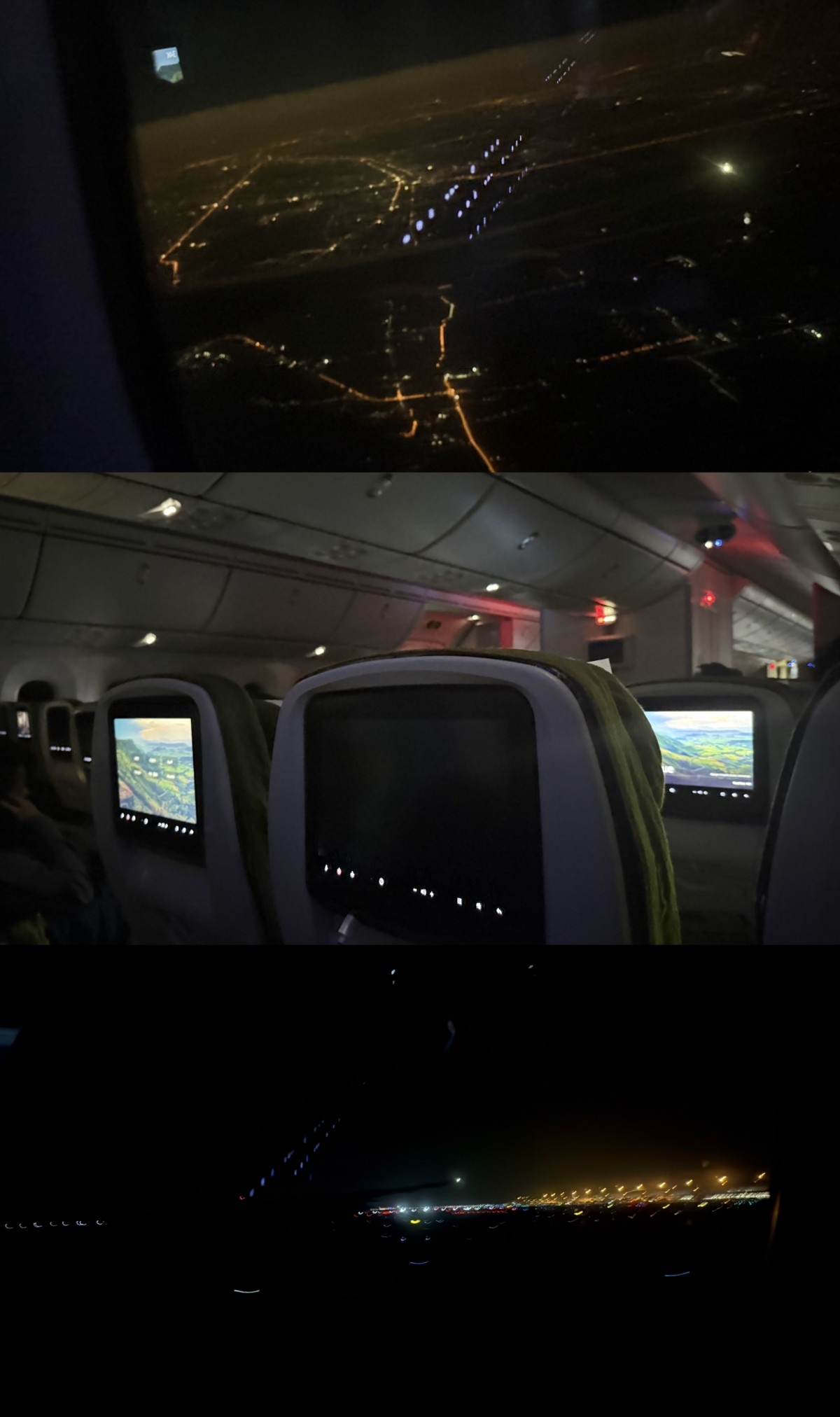
N24979 ever-so-softly touched down at Hong Kong International Airport at five minutes to half-past eight, and with there not being much of a hazy view above the ground (as I’ve seen at HKG before and since), the night skies were as clear as could be. During the taxi, we pulled very close to a fellow United 787-9 bound for San Francisco as UA878.
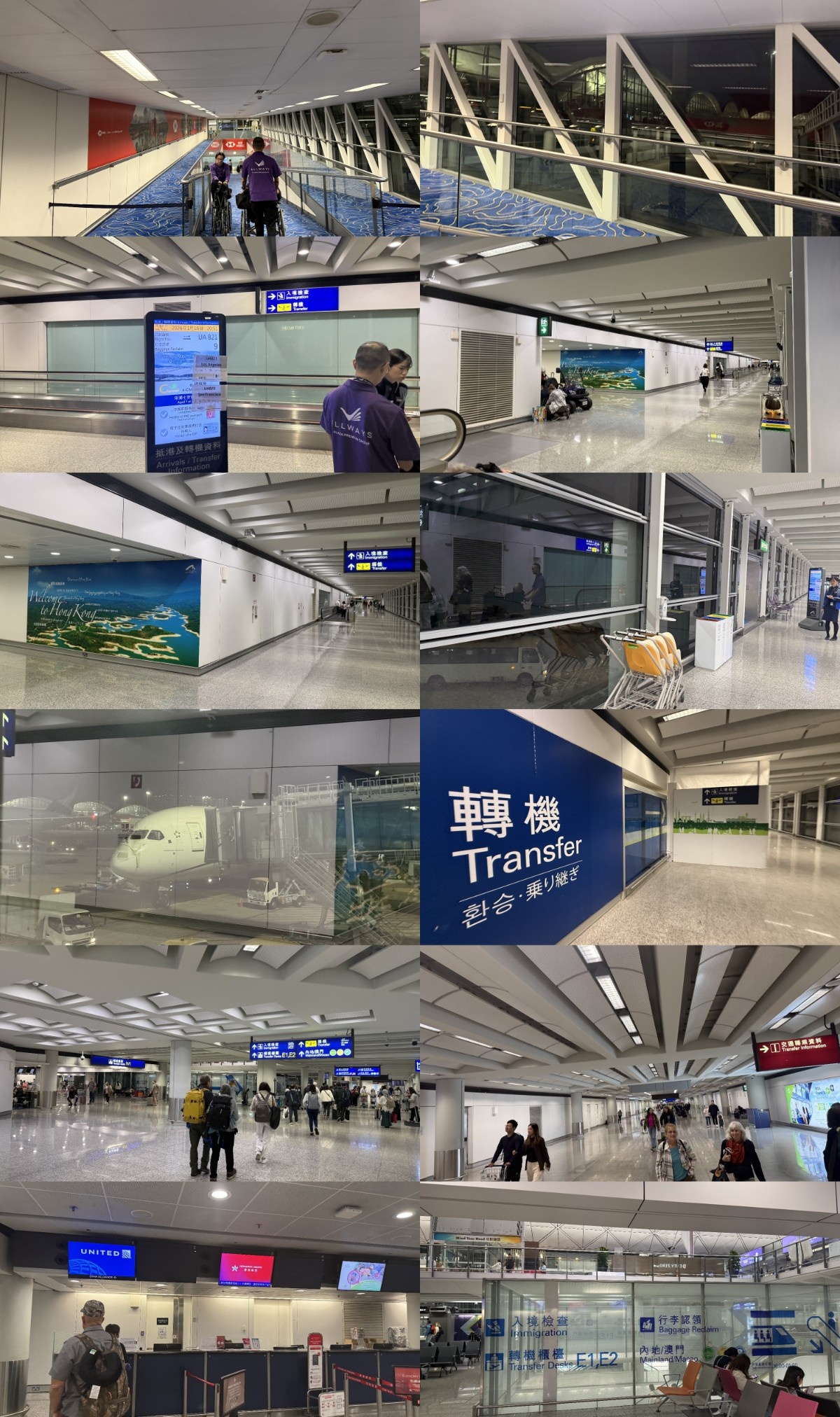
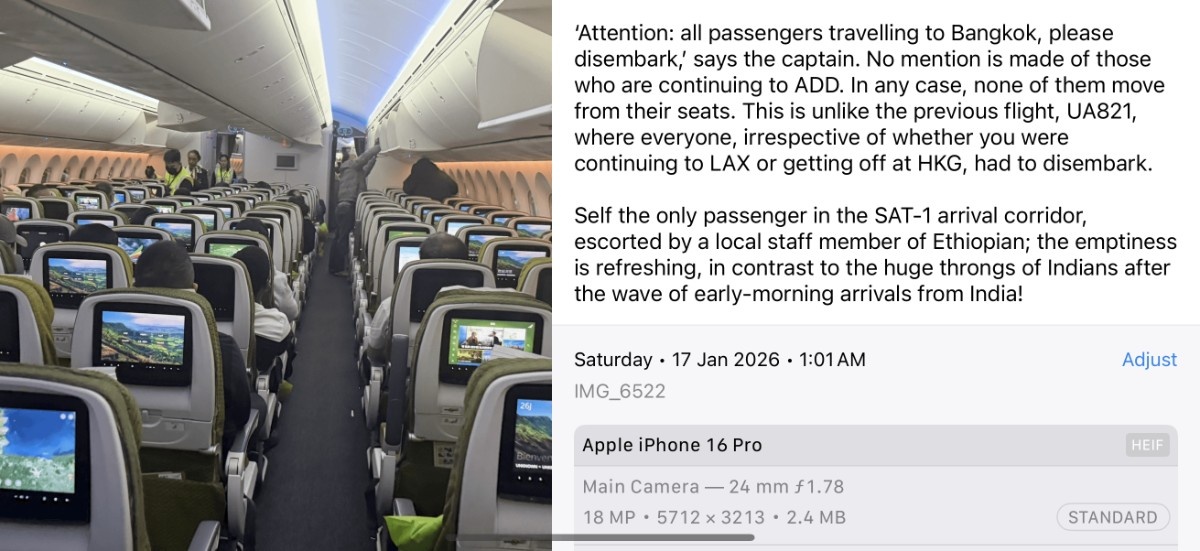
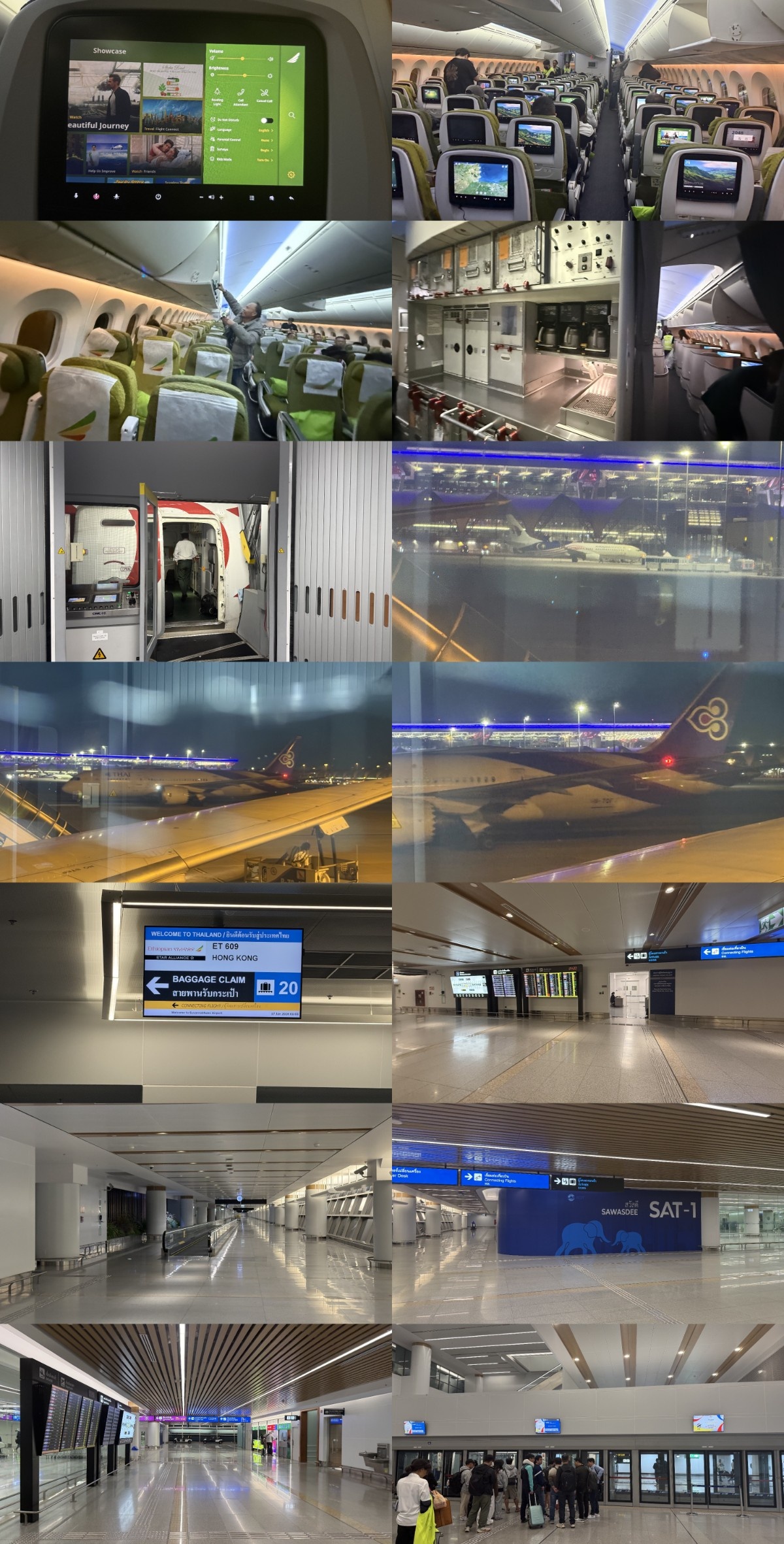
All passengers were asked to get off the plane, whether continuing to Los Angeles or terminating at HKG. This is in contrast with my next flight (Ethiopian HKG–BKK), where only those alighting at BKK were asked to disembark — and those continuing to Addis Ababa received no instructions at all, staying put in their seats.
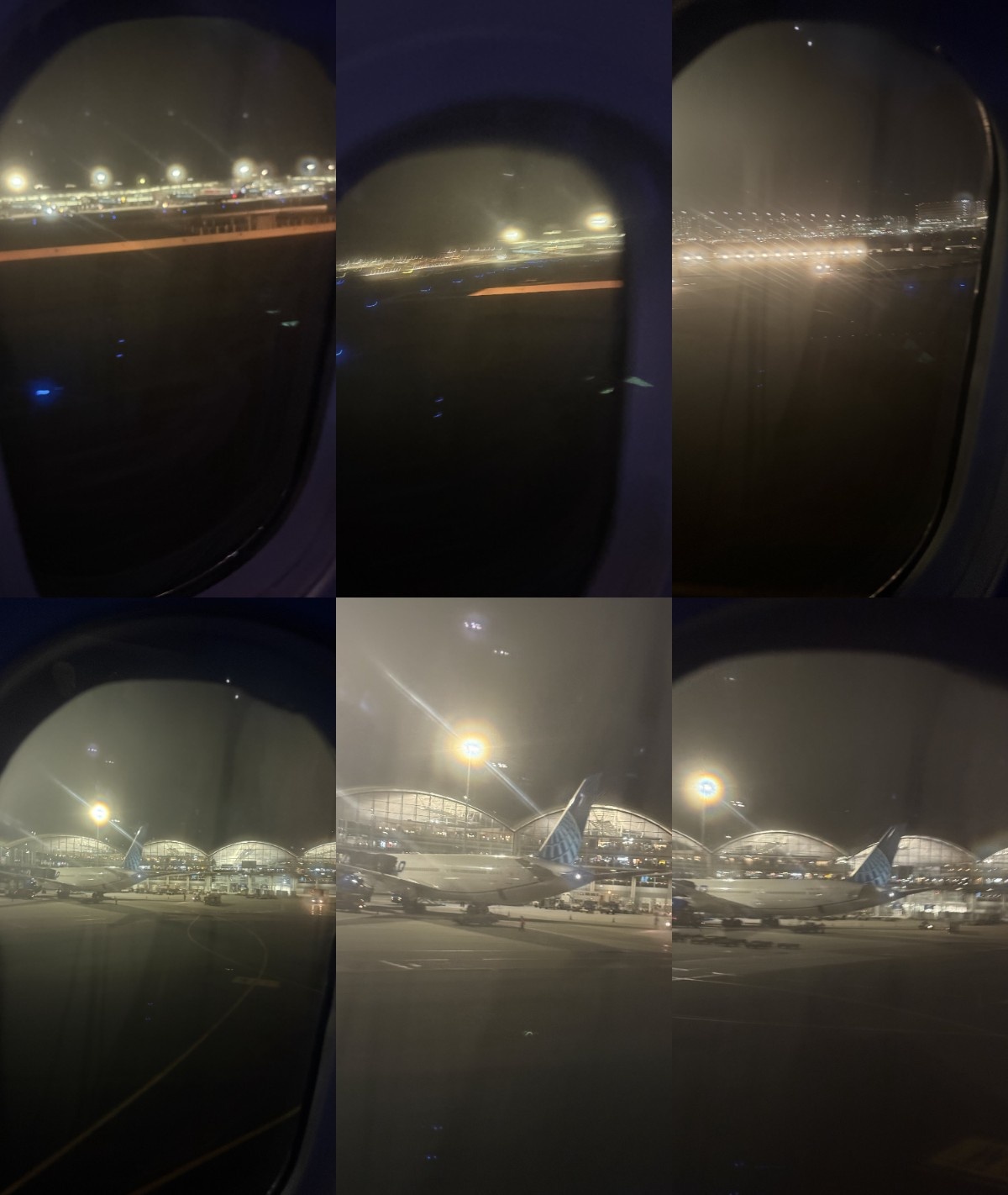
This is where I broke the ice with the wonderful women in 54K/L. Introducing myself to them as an aviation geek was too good to resist, and I commended their ability for reviving the fascination of travel — see new places, discover new things, most importantly rediscover yourself — with their chitchats. They were, again, so much of a good vibe that I couldn’t help but share their camaraderie, and I said that I often flew just for the heck of flying a new airline. This without regard for the destination — the prime example being right now, as I’d turn back after barely an hour or two at HKG!
I also told them how they could ‘hack’ the miles-and-points scene, with the US having the best travel credit cards, by reading websites like One Mile at a Time, The Points Guy and Upgraded Points. The girls were delighted to have met a seasoned traveller like me — despite never having left Asia so far! — and told a bit about their own travels before making for the exit door. I then thanked the flight attendants for their very friendly service — in keeping with United’s longtime Fly the Friendly Skies slogan — before stepping out of the plane.
This flight exemplified why those words written at the front of every United plane — Connecting people. Uniting the world. — mean so much for this airline, more than for a superconnector giant like Emirates, Etihad or Qatar with a much more premium reputation!
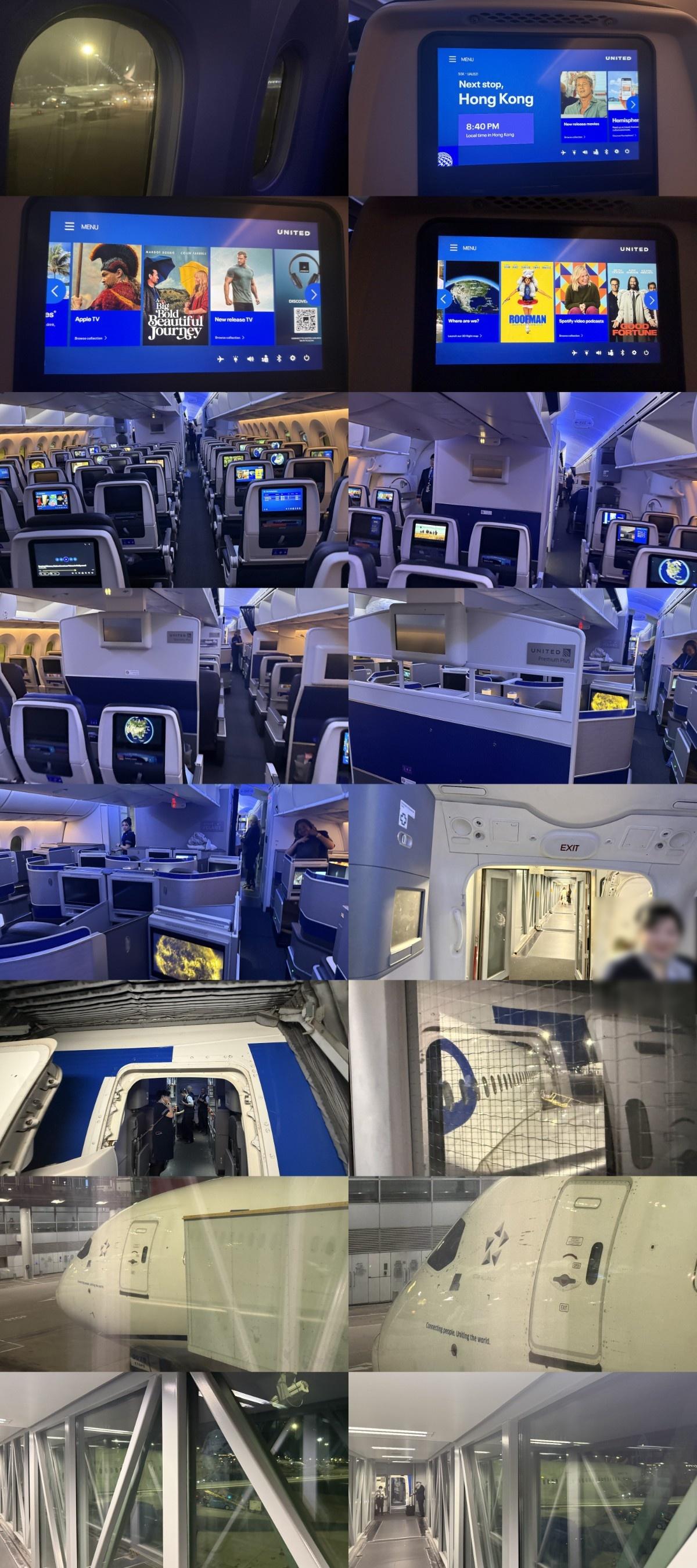
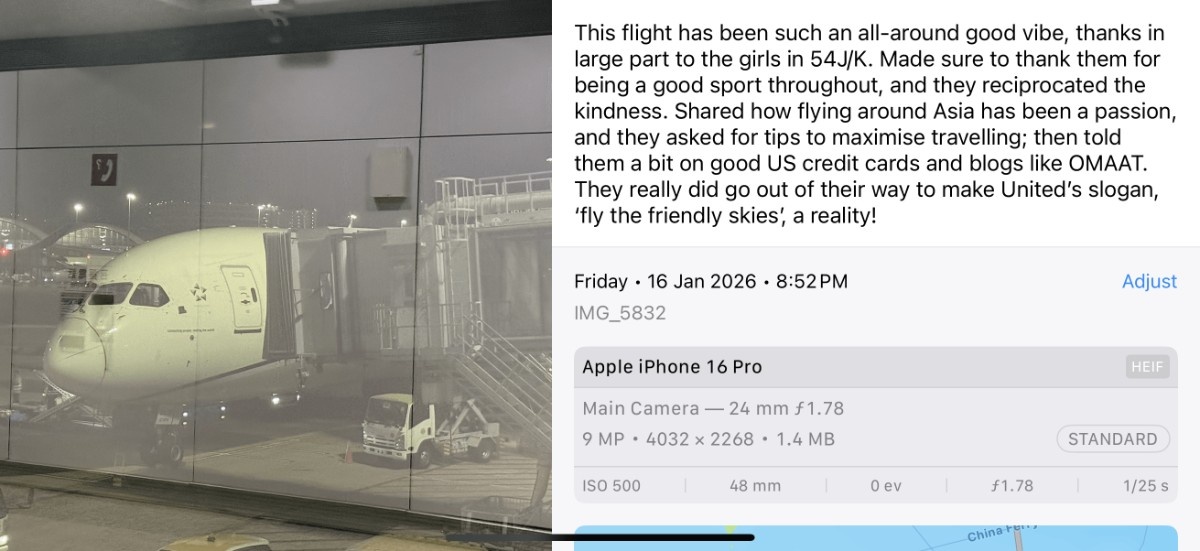
After such an all-around energising, inspiring flight, the return leg was always going to be a bit of a downer in comparison… but my journal entry for the evening was all manner of colour and gaiety. As it very well should!
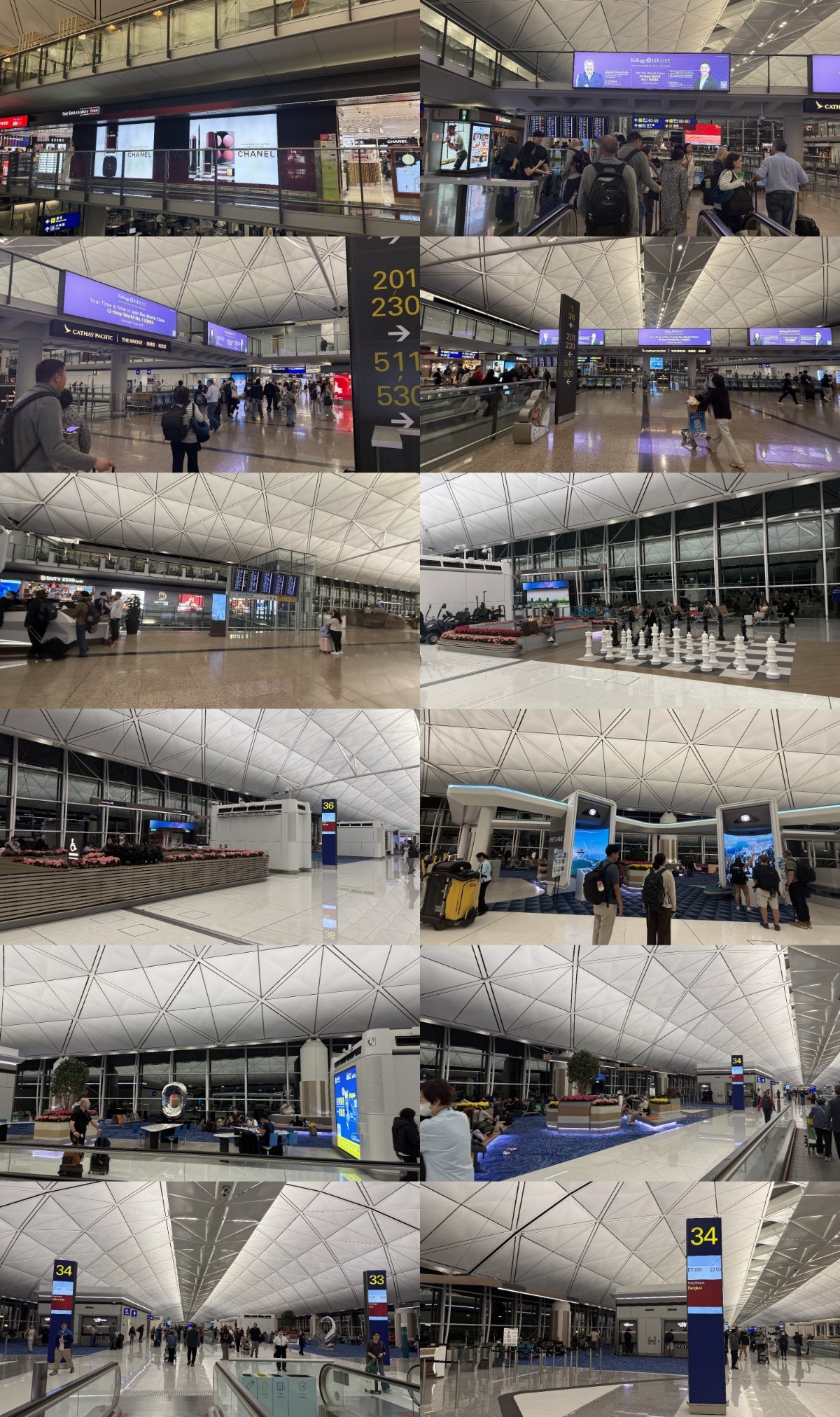
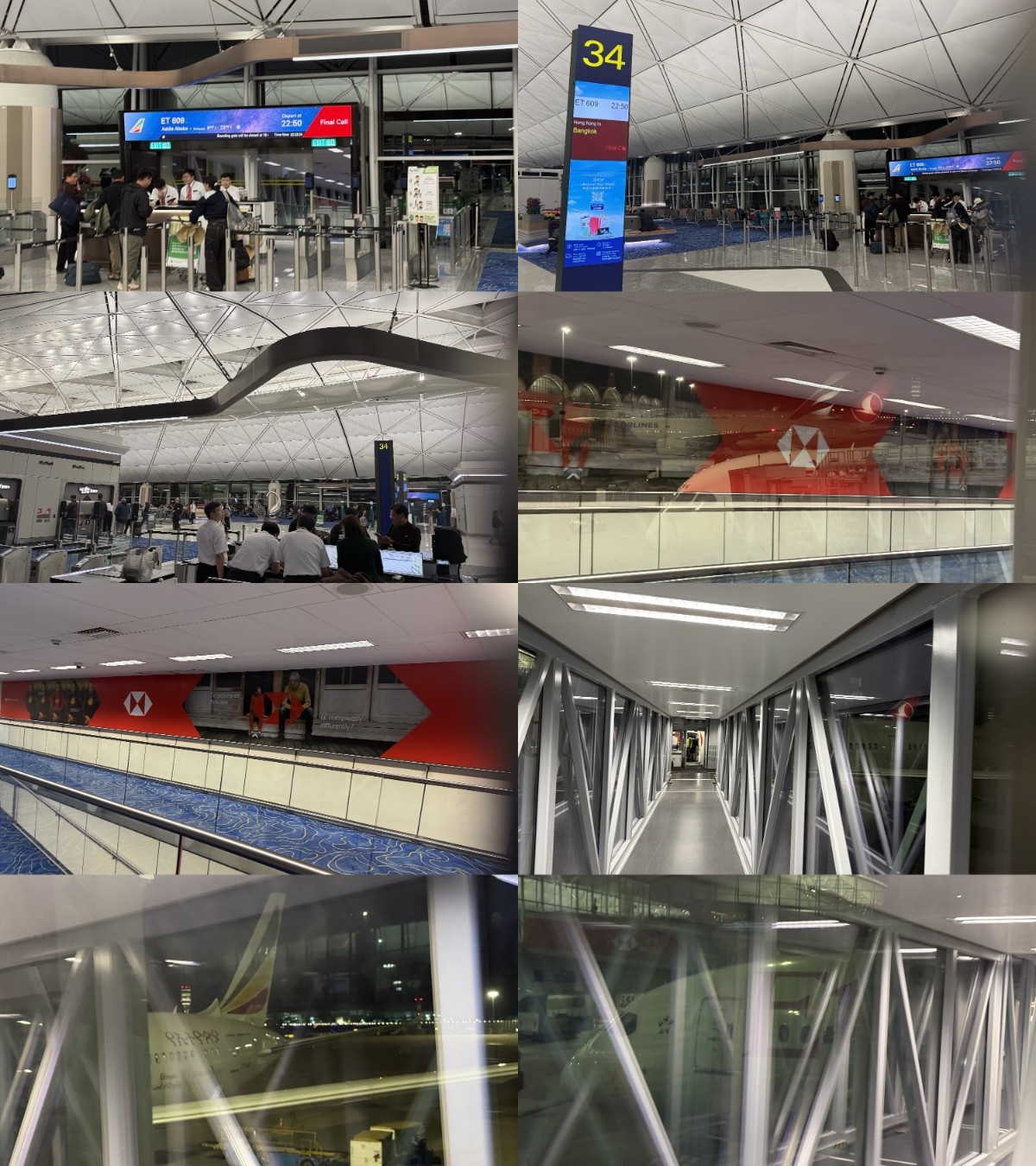
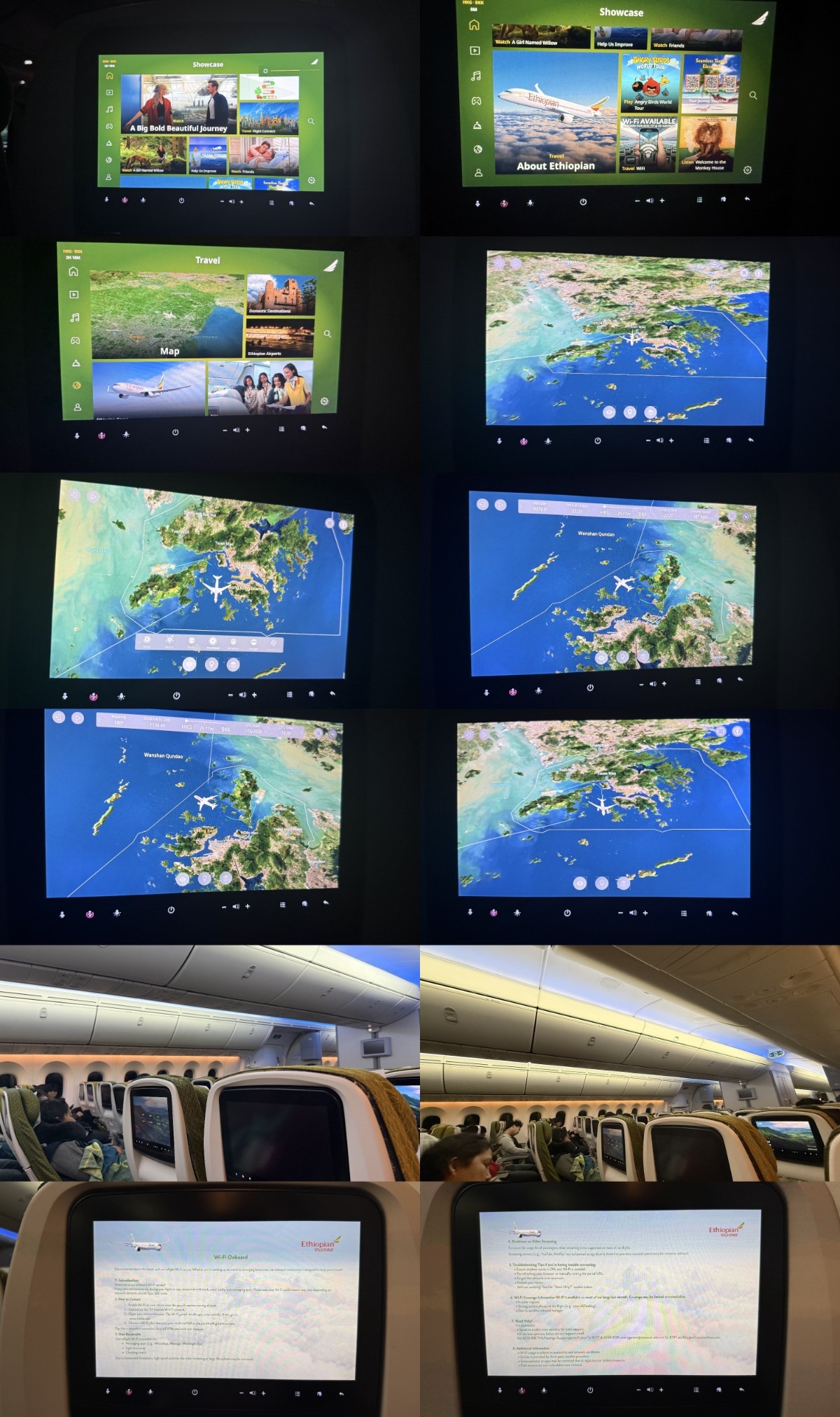
Details of the return leg on Ethiopian are in the Travelling Bonus below.